Free model waiver form + what it is and when your practice needs one
A model waiver form is a signed document that lets a healthcare practice use a p...

5
Last Updated: Sep 29, 2026

Buying a cosmetic clinic transfers goodwill, equipment, the lease and the client base, but not AHPRA registration, TGA advertising compliance or the facility licence.
Recent Australian listings for single-site clinics run from roughly AU$100,000 to more than AU$2 million.
Asking prices track normalized net profit rather than turnover, so ask the seller for every add-back in writing.
A facility licence under laws such as the NSW Private Health Facilities Act 2007 must be applied for by the incoming owner.
The Ownership Transfer Checklist covers registration, advertising compliance, facility licensing, poisons permits, patient record handover and insurance.
A cosmetic clinic for sale transfers its equipment, lease and goodwill, but not its regulatory standing, which the buyer must re-establish personally. That distinction decides whether a clean-looking deal becomes a trading clinic or a stalled one three weeks after settlement. Our roundup of medical spa systems ranks eight platforms to consider if you replace the seller’s practice software.
This guide is written for both sides of the transaction. Buyers get a valuation frame, a due diligence checklist and the compliance steps a broker’s listing leaves out. Sellers get the preparation work that makes a clinic straightforward to buy, and defensible to price.
A cosmetic clinic delivers prescription-medicine treatments such as injectables, supervised by AHPRA-registered practitioners. That supervision is what separates a clinic from a beauty salon. AHPRA, the Australian Health Practitioner Regulation Agency, registers those practitioners individually rather than registering the clinic.
That definition matters before you look at a single financial figure. Botulinum toxin and dermal fillers are Schedule 4 prescription-only medicines in Australia. A clinic that administers them sits inside a regulated system that a facial room or a waxing room does not.
Plenty of listings blur that line. Searching for a beauty business for sale in Melbourne, or a wellness business for sale, returns skin clinics, day spas and salons side by side. Only some of them carry AHPRA and TGA obligations.
Two questions sort a shortlist quickly:
If the answer to both is no, you are buying a beauty or wellness business, and most of the licensing steps below fall away. If either is yes, treat the sale as a regulated handover. Surgical work sits in a stricter tier again, with facility standards a cosmetic surgery clinic has to meet from day one.
Ask early which state rules apply to any laser or intense pulsed light equipment in the sale. Those requirements are set state by state rather than nationally.
Recent Australian listings for a cosmetic clinic for sale range from roughly AU$100,000 to more than AU$2 million. The spread is wide because the price is built from profit, not from the treatment menu.
At the small end sits a single-room clinic run by one cosmetic nurse, with a modest client list and leased equipment. At the top end sits an established multi-room clinic with several practitioners, owned laser platforms and a reception team. Both get called a skin clinic in the listing copy.
Most asking prices are quoted against normalized net profit, sometimes called EBITDA or profit including the owner’s wage. Normalizing is the step that decides whether a price is fair.
A clinic where the owner injects four days a week has a practitioner’s wage buried in its profit figure. A buyer who does not inject has to pay someone else to do that work.
Ask for the add-backs in writing. Any financial line a listing marks as undisclosed is a number you will need before settlement. For the revenue those prices are built on, see what cosmetic clinics earn in Australia.
Compare the total against building from scratch. Fit-out, equipment, registration and a lease bond all land before a single patient books. Our breakdown of starting an aesthetics business sets those costs out line by line.
An asking price usually covers goodwill, fit-out, fixtures and the lease assignment, with equipment and stock often priced separately on top. Listings rarely spell this out, which is where deals stall late.
Patient records are the item most often missing from the contract, and the hardest to reconstruct afterwards. A clinic without its treatment history keeps the beds and loses the reason patients rebook.
AHPRA registration is personal to the practitioner and never transfers with a sale, so the buyer’s cosmetic nurses and doctors need their own registration. The same principle runs through every compliance item in a cosmetic clinic sale.
AHPRA registers practitioners through boards including the Medical Board of Australia and the Nursing and Midwifery Board of Australia. No mechanism exists to move a registration across with a business. Check each practitioner on the public register before settlement, and check that their scope of practice matches the treatments the clinic sells.
Under AHPRA’s guidelines, cosmetic procedures also carry consultation, screening and cooling-off requirements that the practitioner is responsible for meeting. A clinic that loses its only prescriber on settlement day cannot administer injectables at all, whatever the contract says.
Under the TGA’s advertising rules, prescription-only medicines cannot be advertised to consumers. That restriction covers indirect brand references, hashtags, and the discount incentives clinics like to run on Schedule 4 injectables. Testimonials about those treatments are restricted too.
A seller’s back catalogue of social posts does not disappear at settlement. Audit the website, the booking pages and every social account before you take them over. Then price the clean-up into the deal rather than discovering it as the new owner.
Under section 15 of the Private Health Facilities Act 2007 (NSW), a facility licence does not transfer with a sale. The incoming operator applies to NSW Health with the outgoing licensee’s consent, and that application can be refused.
Cosmetic surgery premises and facilities using certain levels of anesthesia or sedation fall into licensable classes. Victoria and Queensland run equivalent private health facility regimes under their own legislation, administered separately by each state health department.
Location decides which regulator you deal with. A clinic in Sydney, a clinic in Melbourne and a clinic in Brisbane each answer to a different state health department. Confirm the rules for the state the clinic trades in rather than assuming one national process.
Approvals to obtain and hold scheduled medicines are issued to an individual or a legal entity. Victoria’s health department guidance is explicit that such an approval is not transferable to a new owner. Expect the same requirement elsewhere, and confirm it with the relevant state health department before settlement.
Those four items, plus records and insurance, make up what we call the Ownership Transfer Checklist. The checklist is the part of a cosmetic clinic sale that no contract can complete for you.
The order matters more than the list, because a licence or permit application can take weeks that a settlement date will not wait for.
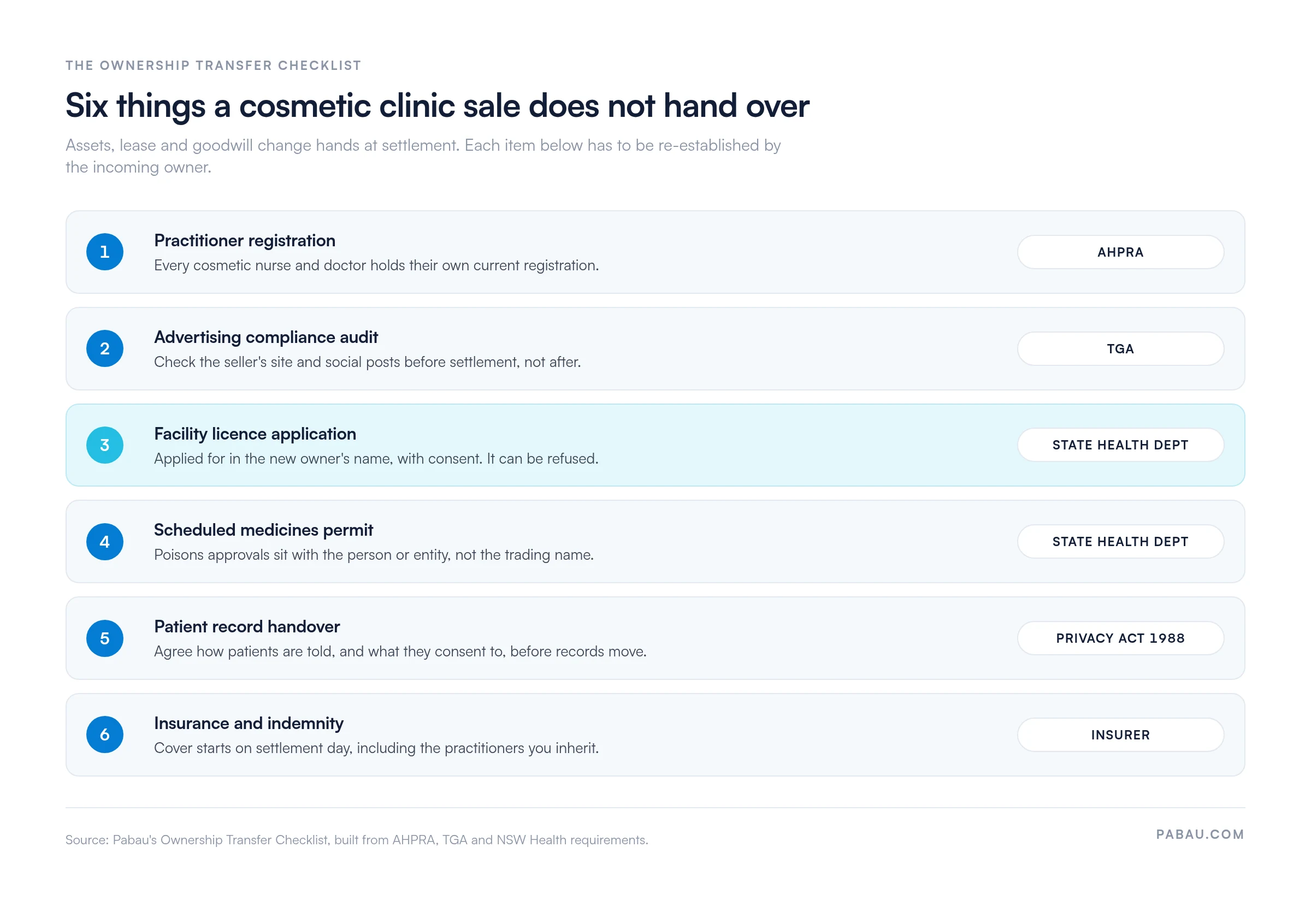
Work the checklist backwards from the settlement date. Any step that needs a regulator’s decision goes first, and the items you control go last.
Run these in order. The financial checks are cheap and fast, and the regulatory ones can stop you trading.
Sellers control more of the price than they expect. The work that lifts a valuation happens six to twelve months before the listing goes live, not during negotiation.
Get an independent valuation first, so the asking price is defensible rather than aspirational. Then prepare normalized financials that separate the owner’s clinical income from the business’s profit. A buyer who can see that split can raise finance against it. A buyer who cannot will discount the price to cover the doubt.
Close out any open matter with AHPRA before you list. An unresolved notification against a practitioner is a discovery a buyer makes during due diligence, and it never improves the offer.
Then plan the two handovers sellers forget. Staff need a clear position on entitlements and continuity. Patients need to be told who will hold their records. Health information carries obligations under the Privacy Act 1988 that a sale does not suspend.
Lenders assessing a cosmetic clinic purchase weigh normalized profit and patient rebooking patterns more heavily than turnover. Goodwill also gets financed more cautiously than equipment, because nobody can repossess a client list.
That changes what you prepare. A rebooking rate and a repeat-treatment mix tell a lender the revenue survives the owner leaving, which is the risk being priced. Turnover on its own tells them very little about a practitioner-led business.
Because goodwill is an intangible asset, expect a larger deposit or extra security against it than against a laser platform. Build the repayments into a cash flow forecast before you sign, including any months where a licence application is still pending.
The regulatory handover has an operational twin, and the operational one is what patients notice. Appointment books, treatment histories, consent forms and before-and-after photos all have to survive the change of ownership intact.
In clinics we onboard partway through a sale, patient records are usually the item left until last. Notes sit in a filing cabinet, photos sit on a departing owner’s phone, and consent forms sit in an old inbox. Rebuilding that history after settlement is slow, and for a returning injectable patient it may not be possible at all.
Practice management software like Pabau keeps the clinical record and the business record in one system. A change of owner then does not mean a change of history. Each patient file holds treatment notes, consent forms, photos and the products used, on one timeline.
One system for clinical and commercial records is the practical case for software for cosmetic clinics. Online booking keeps taking appointments through the transition, so existing patients rebook the way they always have. Staff access gets reassigned rather than rebuilt, and the outgoing owner’s login is closed off cleanly.
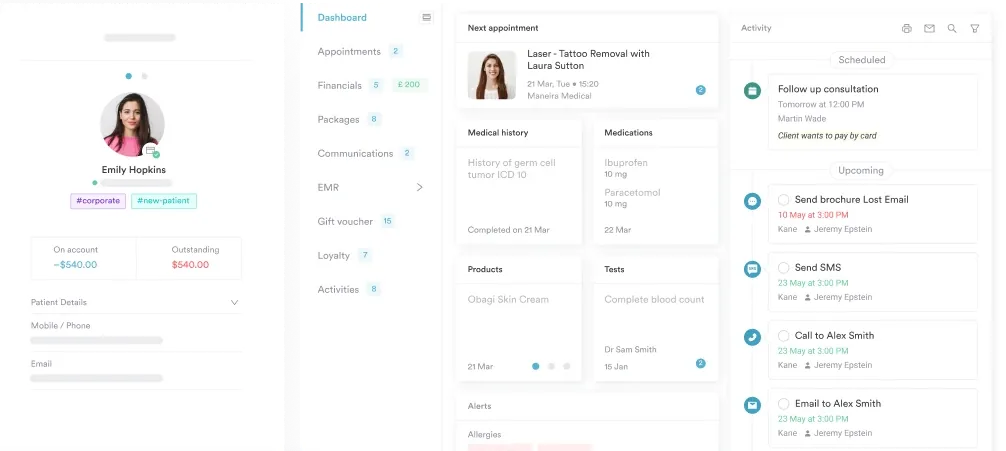

Pabau holds treatment notes, consent forms, photos and payments in one patient record, so a change of owner does not interrupt care or booking. Your incoming team starts with the full history instead of a blank system.

A cosmetic clinic sale is a regulatory handover dressed as a financial one. The contract moves the assets on a single day. Registration, advertising compliance, the facility licence and the poisons permit each move on their own timetable, and only when somebody applies.
So treat the settlement date as an output rather than an input. Start from the longest regulator timeline on the Ownership Transfer Checklist, then count forward to the day you sign.
For sellers, the same checklist is a sales tool. A clinic with clean registrations, compliant advertising and portable patient records is worth more than an identical clinic without them. Book a demo to see how Pabau keeps records, consents and bookings intact while a cosmetic clinic changes hands.

Modeling the repayments? The cash flow forecast template gives you a structure for the first trading year.
Building the case for the purchase? The medical aesthetics business plan shows what a lender expects to see.
Inheriting someone else’s compliance record? Med spa compliance covers the obligations that come with the keys.
Planning the first year under new ownership? How to grow your aesthetic business maps the customer journey steps that lift rebooking.
Setting up a new site means paying for fit-out, equipment, registration and a lease bond before any revenue arrives. Buying an established clinic in the AU$100,000 to AU$2 million range costs more up front. It also arrives with existing revenue, trained staff and a client base. The trade-off is control over the build against immediate cash flow.
Margins tend to be strongest where treatments are clinical, repeat and practitioner-led. A cosmetic clinic with a high rebooking rate on injectables and skin treatments earns predictable revenue that a product-led or one-off-treatment business does not. Profitability still depends on the individual business, so judge any listing on its normalized profit rather than on its category.
No. AHPRA registers individual practitioners rather than businesses, so registration cannot be sold or assigned with a clinic. Every cosmetic nurse and doctor working under the new owner must hold their own current registration before treating patients. Check each of them on the public register before settlement.
Usually yes, where the clinic is a licensable facility. Under laws such as the Private Health Facilities Act 2007 (NSW), the incoming owner applies for the facility licence themselves, with the outgoing licensee’s consent. The licence does not transfer automatically and the application can be refused. Victoria and Queensland run their own equivalent regimes.