Free model waiver form + what it is and when your practice needs one
A model waiver form is a signed document that lets a healthcare practice use a p...

5
Last Updated: Sep 29, 2026

Cosmetic nurse requirements in Australia start with current registration as a registered nurse or enrolled nurse with the NMBA.
The practice-period rule is one year outside cosmetics for a registered nurse, and two years for an enrolled nurse.
No cosmetic course is NMBA-approved, because the NMBA only approves programs that lead to registration or endorsement.
New Ahpra and NMBA guidelines took effect on 2 September 2025, adding a seven-day cooling-off period for patients under 18.
Laser and IPL licensing sits with each state and territory, and only Queensland, Western Australia and Tasmania license cosmetic laser use.
Cosmetic nurse requirements in Australia come down to four things. You need current registration with the Nursing and Midwifery Board of Australia (NMBA). You also need a set period of relevant practice outside cosmetics, and procedure-specific education and training. Every Schedule 4 medicine you administer needs a prescriber behind it.
There is no cosmetic nurse licence to apply for. Your nursing registration is the licence.
Search this question, though, and you meet three different experience figures. One training provider says 12 months of general nursing. Another says a year in hospital under a “new regulation”. Neither cites the regulator, and neither states the rule the way the guideline does.
The month count is roughly right. The wording is not, and the wording is what an employer will check and what a notification will test. This guide works from the NMBA guideline and the Ahpra release, and names a source for every figure.
Cosmetic nursing is the delivery of non-surgical cosmetic procedures, such as anti-wrinkle injections and dermal fillers, by an Ahpra-registered nurse within their scope of practice.
The non-surgical boundary matters. Cosmetic nursing covers cosmetic injectables, skin treatments and energy-based devices. Cosmetic surgery sits outside it, under the Medical Board of Australia and its separate guidelines for medical practitioners.
Job ads still call the role a “cosmetic injector”. The correct professional term in Australia is cosmetic nurse, and that is the term Ahpra and the NMBA use.
Cosmetic injections are the visible part of the job. A registered nurse (RN) in a skin clinic also runs consultations and assesses whether a patient is suitable for treatment. The same nurse manages complications and keeps the clinical record that proves it.
To become a cosmetic nurse in Australia, register with the NMBA, practise outside cosmetics for a set period, then complete procedure-specific training before injecting.
Course pages tend to stop at the training itself. The steps run in order, and the table below shows how far each nursing role can go once they are done. Nurse practitioners are the only nurses who can prescribe for their own patients.
| Role | Base registration | Practice required before cosmetics | Scope of cosmetic practice | Prescribing |
|---|---|---|---|---|
| Registered nurse (RN) | NMBA registration as an RN, usually after a Bachelor of Nursing | One year full-time equivalent in general or specialist practice, excluding non-surgical cosmetic procedures | May assess patient suitability and take the added responsibilities for patients under 18 | Cannot prescribe. Administers Schedule 4 medicines on a prescriber’s order |
| Enrolled nurse (EN) | NMBA registration as an EN, usually after a Diploma of Nursing | One year full-time equivalent after registration, plus one year in a related area such as dermatology or general surgery | Works under RN supervision. Cannot assess patient suitability or treat patients under 18 | Cannot prescribe. Never permitted to inject filler in very high-risk facial areas, with no supervision exception |
| Nurse practitioner (NP) | NMBA registration as an RN, plus NP endorsement | 5,000 hours of advanced clinical practice in the past six years, plus an NMBA-approved master’s degree | Same as an RN, within the clinical speciality the endorsement covers | Prescribes within scope, so no separate prescriber is needed |
Sources: the NMBA and Ahpra guidelines for practitioners who perform non-surgical cosmetic procedures, and the NMBA registration standard for nurse practitioner endorsement.
The filler restriction on enrolled nurses runs across two risk tiers. An enrolled nurse may inject filler in high-risk areas only with a prescriber or registered nurse on site. That tier covers the temples, nasolabial folds, peri-orbital area and medial cheek. Very high-risk areas are off limits entirely, and that tier covers the glabella, nose and forehead.
Laid out as a sequence, the pathway is shorter than the course marketing suggests. Only step three carries the figure everyone argues about.
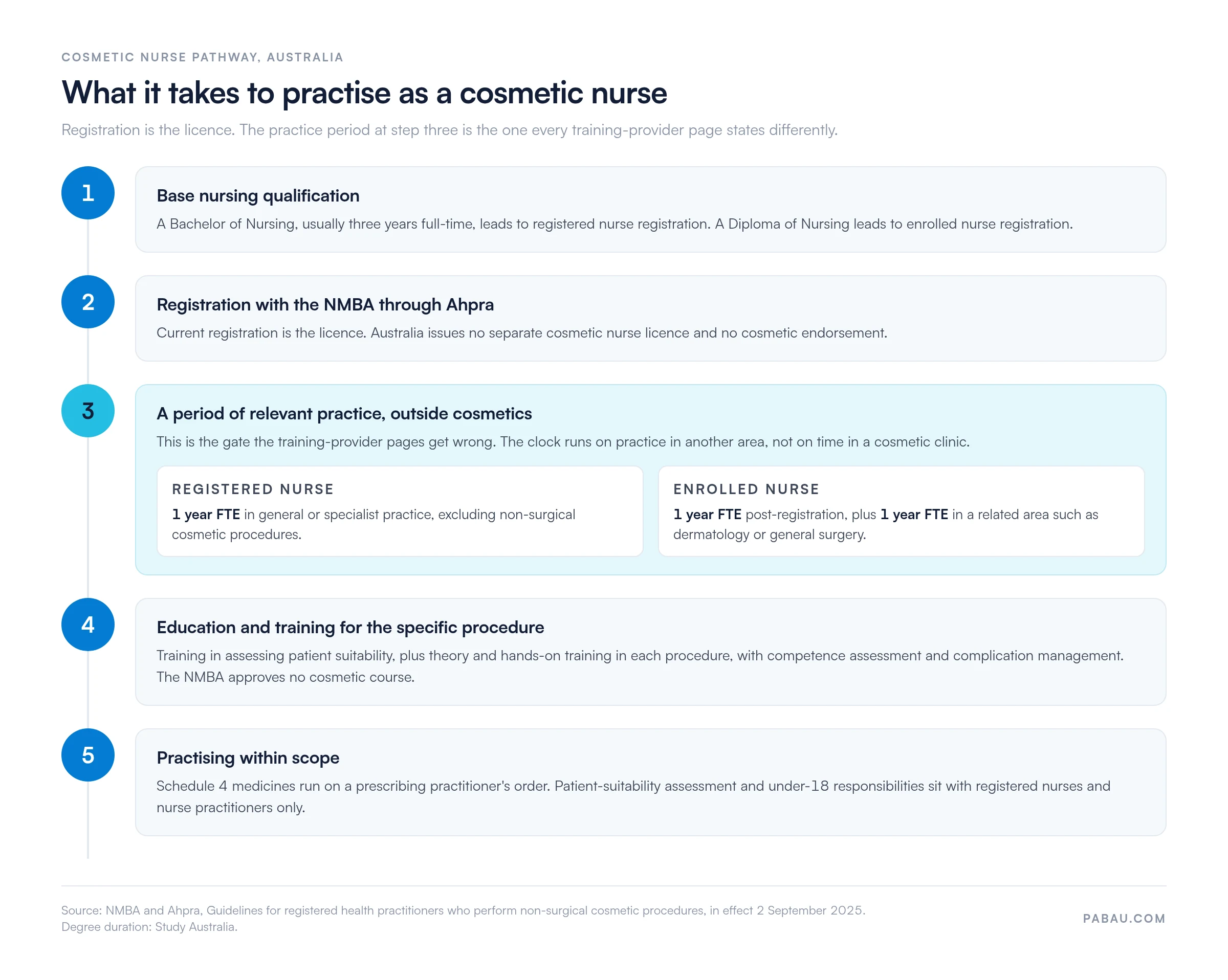
Entry starts with a nursing qualification and registration. A Bachelor of Nursing, usually three years full-time according to Study Australia, leads to registration as a registered nurse. A Diploma of Nursing leads to registration as an enrolled nurse, sometimes called a Division 2 nurse in Victoria.
Two bodies get used interchangeably on training-provider pages, and they are not the same. Ahpra, the Australian Health Practitioner Regulation Agency, is the national administrator. The NMBA is the board that sets the standards for nurses and issues the guideline this article works from.
Registration is what you renew, and there is no cosmetic layer on top of it. Australia issues no cosmetic nurse licence and no cosmetic endorsement, so your Ahpra record will never show the words “cosmetic nurse”.
The NMBA also expects professional indemnity insurance that covers all aspects of your practice. Moving into injectables changes what your cover has to include, so tell your insurer before your first treatment day.
A registered nurse needs one year full-time equivalent of general or specialist practice, excluding non-surgical cosmetic procedures, before practising in cosmetics.
Call this the practice-period rule, because it is where the training-provider pages and the guideline part company. Full-time equivalent, or FTE, means a year of full-time hours, so part-time practice takes proportionally longer.
The training-provider pages get the duration roughly right and the substance wrong in three ways.
That third point is missing from every course-provider page we checked. It is also the one that decides whether an established cosmetic nurse has a problem. If you are already in the chair, the guideline does not send you back to a ward.
The practice period is also not the whole test. If a notification is lodged against you, the NMBA expects you to show you were working within scope. Scope here is defined by your education, relevant practice, training, authorisation, competence, qualifications and experience. A year on a roster proves one of those seven.
In practices we onboard, this is usually the moment a clinic owner realises credentialling is a record-keeping job. Nobody can evidence a nurse’s practice period from memory two years later.
The NMBA sets a minimum training content rather than a minimum course length. Before you perform a procedure independently, you need training in assessing patient suitability for it, plus theoretical and hands-on training in that specific procedure.
Hands-on training has to include an assessment of your competence and training in managing side effects and complications. A course that ends without someone signing off that you can inject, and manage it when a treatment goes wrong, does not meet the requirement.
Botulinum toxin and dermal fillers are Schedule 4 medicines under the Poisons Standard, which the Therapeutic Goods Administration (TGA) maintains. A registered nurse can administer them, but a prescribing practitioner has to prescribe them after a valid consultation. That is why most cosmetic clinics in Australia run under a named cosmetic clinic medical director or a contracted prescriber.
Nurse practitioner endorsement is the route to prescribing yourself. The NMBA requires an approved master’s degree plus 5,000 hours, about three years full-time, of advanced clinical practice within the past six years. Some course marketing describes this as an AQF Level 8 qualification, which understates it, since a master’s degree sits at AQF Level 9.
On 2 September 2025, one shared guideline replaced the NMBA’s cosmetic position statement and now covers every regulated profession performing non-surgical cosmetic procedures except doctors.
Ahpra and the National Boards published two documents. One governs performing non-surgical cosmetic procedures. The other governs advertising the higher-risk ones. Medical practitioners keep standalone guidelines because theirs also cover cosmetic surgery.
Nurse-specific requirements sit in an appendix to the shared guideline, and Appendix A carries the enrolled nurse rules. The guideline builds on the safeguards the Medical Board of Australia introduced in 2023.
Three parts of the change matter most to a nurse moving into the field:
Those under-18 safeguards are absent from every training-provider page in the top results. That is a fair signal of how closely those pages track the regulator. Our guide to the Ahpra advertising guidelines covers the marketing side in detail.
Scope is not only set by the guideline, either. The NMBA points to state and territory drugs and poisons legislation as part of what shapes it, which is where the next section starts. You can read the NMBA’s own summary for nurses and the Ahpra release alongside this.
Ahpra registration works nationally, but only Queensland, Western Australia and Tasmania require a separate licence to use a laser for cosmetic treatments.
That matters the moment a skin clinic adds hair removal, pigment or skin-rejuvenation devices to the treatment menu. The licence is a radiation-safety instrument, granted by a state regulator, and it is entirely separate from your nursing registration.
| State or territory | Radiation regulator | Licensing for cosmetic laser and IPL |
|---|---|---|
| New South Wales | NSW Environment Protection Authority | No cosmetic-specific licence. The EPA has publicly consulted on introducing one. |
| Victoria | Department of Health (Health.vic) | No licence. Health.vic publishes provider guidance tied to the Public Health and Wellbeing Act 2008. |
| Queensland | Queensland Health | Licence required. A possession licence, an approval to acquire and a use licence under the Radiation Safety Act 1999. |
| Western Australia | Radiological Council of Western Australia | Licence and registration required for Class 3B and Class 4 lasers. IPL is not regulated. |
| South Australia | EPA South Australia | No licence. The EPA does not prescribe non-ionising apparatus under its radiation regulations. |
| Tasmania | Tasmanian Department of Health | Licence required for Class 3B and Class 4 lasers and for IPL used cosmetically, under the Radiation Protection Act 2005. |
| Australian Capital Territory | ACT Health | No cosmetic-specific licensing scheme published. Confirm before you buy a device. |
| Northern Territory | NT Health | No cosmetic-specific licensing scheme published. Confirm before you buy a device. |
We could not verify a published cosmetic laser or IPL licensing scheme for the ACT or the Northern Territory. Those two rows say so rather than guess. Check with the regulator named in the table before you commit to a device.
Western Australia adds a clinical condition on top of the licence. For several cosmetic laser treatments, the patient needs an in-person consultation with a medical practitioner or nurse practitioner to check for skin cancers before treatment.
Drugs and poisons legislation varies too, and it governs how Schedule 4 medicines are supplied, stored and administered in your state. The medicine is national. The handling rules around it are not.
No cosmetic nursing course is NMBA-approved, because the NMBA only approves programs of study that lead to registration or endorsement. The NMBA approves no professional development training in cosmetic procedures at all.
Read any “NMBA-approved” or “Ahpra-approved” claim in course marketing as a marketing claim. What the regulator cares about is whether your training covered the required content and whether someone assessed your competence.
Four kinds of training show up in the Australian market:
You will also see a diploma of cosmetic nursing advertised by private providers. Check what the qualification actually is before you enrol, because the word diploma covers both an accredited vocational qualification and an unaccredited in-house certificate.
TAFE is worth answering directly, because it comes up constantly. A TAFE Diploma of Nursing leads to enrolled nurse registration, which is a base qualification. No accredited TAFE-specific cosmetic nursing pathway exists in Australia.
Whichever route you take, hold the course against the NMBA’s minimum content. Ask whether it teaches patient-suitability assessment, whether the practical block ends in a competence assessment, and whether complication management is taught rather than mentioned.
Ask about total cost too, including the practical block, travel and any repeat assessment. Providers publish fees inconsistently, so a headline figure is rarely the number you pay.
Every requirement above ends as a record someone has to produce later. That means the nurse’s registration and practice period, the prescriber’s order, the consent and the product batch number. It also means the before-and-after photos and the consultation date behind an under-18 cooling-off period.
On paper, or spread across a booking tool and a phone camera roll, those records sit in five different places. Practice management software like Pabau keeps them on one patient timeline. The treatment note, the signed consent, the product batch and the photos all sit against the same appointment.
Pabau’s staff records hold each nurse’s registration details and expiry dates. A practice manager can see who is credentialled to do what without opening a filing cabinet. Pabau’s digital consent forms timestamp when a patient signed, which is what evidences a seven-day cooling-off period. Clinics comparing platforms can start with our roundup of the best aesthetic clinic software.
The daily win is smaller than the compliance one and matters more. A nurse opens one screen mid-appointment instead of four, and finishes the day without writing up notes at nine at night. Pabau is software for cosmetic clinics rather than a general booking tool, and every subscription includes every feature.
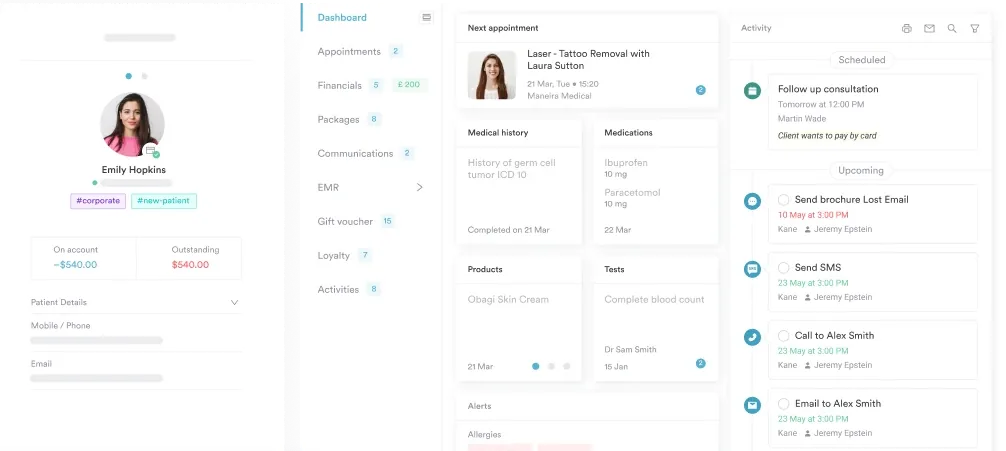

Pabau stores nurse registration details, timestamped consent forms, product batch numbers and before-and-after photos against a single patient timeline. This gives a cosmetic clinic the record trail the Ahpra and NMBA guidelines expect, without a second system.

The pathway into cosmetic nursing is more navigable than the conflicting advice suggests, once you read the guideline instead of the course brochure. Register, spend a year practising somewhere other than a cosmetic clinic, train properly for each procedure, and work under a prescriber.
The trade-off worth remembering is that the regulator judges scope, not tenure. A year on a ward and a two-day course is a floor rather than a qualification. A notification will ask about your competence, not your calendar.
If you are hiring rather than training, the same shift applies. Credentials, consent dates and treatment records all have to be produced on request. That makes them a systems problem long before they become a compliance one. Book a demo to see how Pabau keeps a cosmetic nurse’s credentials, consents and treatment records on one patient timeline.

Need the marketing side of the same rulebook? AHPRA advertising guidelines sets out what a cosmetic clinic may and may not say in an ad.
Wondering who has to sign off on prescriptions? Medical director for a cosmetic clinic in Australia explains the oversight arrangement most Australian skin clinics run on.
Thinking about opening your own place? Cost to open a skin clinic in Australia breaks down the setup costs before the first booking.
Want the earnings picture in full? How much an aesthetic nurse makes compares pay across settings and experience levels.
Checking what nurses can legally inject? Can nurses do Botox walks through the supervision and prescribing rules behind injectables.
Qualify and register as a registered nurse or enrolled nurse with the NMBA. Then complete the required period of practice outside cosmetics, and procedure-specific training with a competence assessment.
No accredited TAFE cosmetic nursing pathway exists. A TAFE Diploma of Nursing leads to enrolled nurse registration, which is only the base qualification. A free cosmetic nurse course at TAFE is not something Australian TAFEs offer.
Roughly four to five years from scratch. A Bachelor of Nursing runs about three years full-time, registration follows, then one year of practice outside cosmetics for a registered nurse. Enrolled nurses need two years of practice.
The barrier is sequence rather than difficulty. Nothing in the pathway is academically hard. The practice period, the training content and the prescriber arrangement simply have to happen in the right order.
SEEK put the average annual salary for cosmetic nurse roles in Australia at $85,000 to $90,000 AUD, refreshed on 1 September 2026. For a full breakdown by setting and experience, see aesthetic nurse salaries.