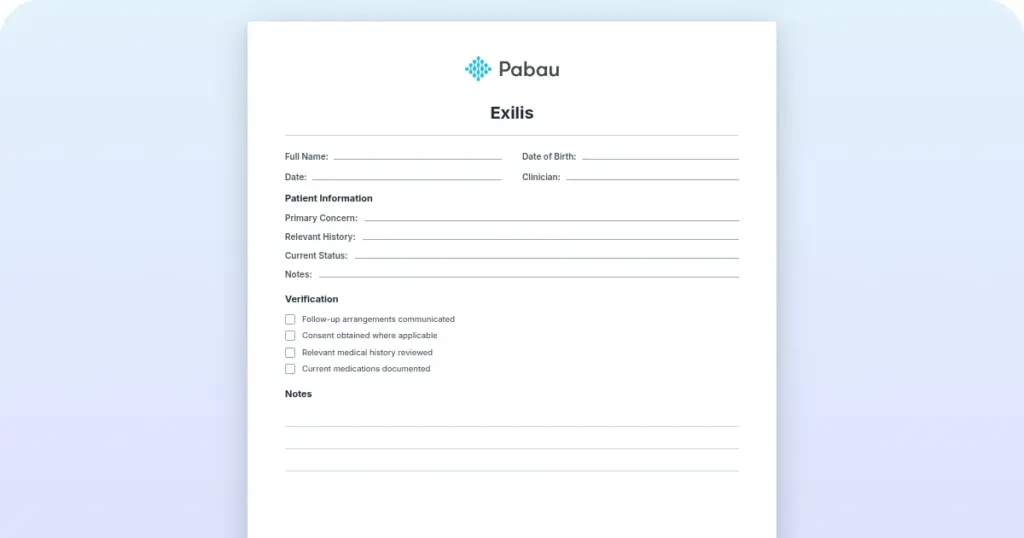
Exilis patient treatment record: Free PDF for RF sessions
An Exilis patient treatment record is the session log for BTL’s radiofrequ...

3
Last Updated: Oct 23, 2026

Three regulators bind an Australian cosmetic practice’s advertising: Ahpra, the Therapeutic Goods Administration, and your state or territory health department.
Testimonials about clinical care are prohibited outright, including reviews you like, reply to, reshare or link to.
The Guidelines for advertising higher risk non-surgical cosmetic procedures commenced on September 2, 2025, with no transition period.
The maximum penalty for an advertising offence is AUD 60,000 for an individual and AUD 120,000 for a body corporate.
The TGA layer, not Ahpra, is what stops you naming Botox or writing anti-wrinkle injections in a public advertisement.
The AHPRA advertising guidelines for cosmetic procedures are three Ahpra instruments that control what a cosmetic practice may say publicly. Two further layers apply on top: the Therapeutic Goods Administration (TGA) and your state or territory health department.
Ahpra is the Australian Health Practitioner Regulation Agency, and it styles its own name Ahpra rather than AHPRA. It supports 15 National Boards under the Health Practitioner Regulation National Law.
Every registered health practitioner is bound. So is every cosmetic practice, skin practice and cosmetic nurse that advertises a regulated health service, along with body corporates and unregistered marketing staff.
This guide works through the Ahpra cosmetic advertising guidelines, the TGA layer and the state layer in turn. By the end you can audit your own advertising footprint, surface by surface.
The AHPRA advertising guidelines prohibit five specific things. All five come from section 133 of the Health Practitioner Regulation National Law, which the guidelines interpret.
The parent instrument is the Ahpra guidelines for advertising a regulated health service, issued on December 14, 2020. All National Boards made it jointly under section 39 of the National Law.
Section 41 matters as well. An approved guideline is admissible in proceedings as evidence of what appropriate professional conduct looks like.
Here are the five prohibitions, each with a cosmetic practice example.
The word advertiser is wider than most practice owners expect. It covers registered health practitioners, individuals who are not registered, and body corporates.
Ahpra advertising rules define advertising broadly. It covers all verbal, printed and electronic communication that promotes a regulated health service or attracts a person to use it.
Content on public and private social media profiles or groups can be advertising. So can a practitioner’s own comments underneath a post.
Whatever you claim, you must be able to substantiate it. Ahpra calls this acceptable evidence, and it means peer-reviewed research from formal studies.
Before-and-after studies with few or no controls do not qualify. Neither does a single case study, and neither does your own outcome gallery.
Every registered health practitioner is bound by the general advertising guidelines. One or both of the cosmetic-specific instruments may then apply on top, depending on the procedure and the registration.
The table maps the three cosmetic advertising guidelines against the work an Australian practice actually performs.
| Procedure you perform | Your registration | Which Ahpra instrument or instruments bind you | In force since | The one extra thing it adds |
|---|---|---|---|---|
| Cosmetic injectables performed by a cosmetic nurse under a prescriber’s order | Registered nurse, Division 1 | Advertising a regulated health service, plus the higher risk non-surgical guidelines | December 14, 2020 and September 2, 2025 | Your registration number must appear wherever you are named as performing the procedure |
| Cosmetic injectables prescribed and performed by a medical practitioner | Medical practitioner | Advertising a regulated health service, plus the higher risk non-surgical guidelines | December 14, 2020 and September 2, 2025 | The same identification duty, read alongside Good medical practice: a code of conduct |
| Dermal filler and thread lifts | Any registered practitioner performing them | Advertising a regulated health service, plus the higher risk non-surgical guidelines | December 14, 2020 and September 2, 2025 | Both are named examples of higher risk non-surgical procedures |
| Energy-based skin treatments such as laser, IPL and radiofrequency | Any registered practitioner performing them | Advertising a regulated health service, and the higher risk guidelines if the four-question test is met | December 14, 2020 | Ahpra publishes a test rather than a list, so you assess each treatment |
| Non-surgical procedures that are not higher risk, such as routine skin treatments | Any registered practitioner | Advertising a regulated health service | December 14, 2020 | Section 133 still applies in full to every claim you publish |
| Cosmetic surgery performed by a medical practitioner | Medical practitioner, with specialist registration where a specialist title is used | Advertising a regulated health service, plus the cosmetic surgery guidelines | December 14, 2020 and July 1, 2023 | Advertised cost must be the total cost, including anaesthesia and aftercare |
| A dentist providing facial injectables | Dentist | Advertising a regulated health service, plus the higher risk non-surgical guidelines | December 14, 2020 and September 2, 2025 | Dental veneers are a named higher risk example, so both sides of the list matter |
When two instruments apply at once, the stricter rule governs. Ahpra puts it plainly: advertisers should comply with the most specific guidance.
Cosmetic surgery advertising sits outside the higher risk non-surgical instrument. The two do not overlap, so a surgical practice reads the surgical guidelines and the general ones.
The Guidelines for advertising higher risk non-surgical cosmetic procedures commenced on September 2, 2025, the day they were issued. There was no transition period afterwards.
Advance copies were published on June 3, 2025. Ahpra CEO Justin Untersteiner said on commencement that practitioners had since May to get their houses in order.
The single biggest change is identification. Where advertising names an individual as performing the procedure, it must carry that practitioner’s registration details, including their registration number.
A higher risk procedure is one undertaken to revise or change the appearance, colour, texture, structure or position of bodily features. The dominant purpose must be a more desirable appearance.
Ahpra will not publish a list of captured treatments. It gives a four-question test instead, covering dominant purpose, whether a registered practitioner is required, what authorisation is needed, and how deeply the procedure goes.
Named examples include dental veneers, botulinum toxin and dermal fillers, injection lipolysis, thread lifts, sclerotherapy, blood-derived injections and hair transplants. Botulinum toxin used for a medical condition is excluded.
Two tiers run through the instrument. Obligations under the National Law bind every advertiser, while professional expectations bind registered practitioners and can affect registration.
Every non surgical cosmetic treatment you promote is affected. Here is each requirement, and what it means you have to change.
Discounts survive. Section 133 permits a discount where the terms and conditions of the offer are stated. Price promotions are a drafting problem, not a prohibition.
Responsibility follows control. Any person who authorises advertising is responsible for it, including the business owner and whoever runs the marketing.
An employed practitioner is not automatically off the hook. They need to show they took all reasonably practicable steps to have the advertising corrected.
The AHPRA cosmetic injectables guidelines let you advertise the service, not the medicine. You can offer a consultation. You cannot name, abbreviate or hint at the prescription-only product.
Two regimes run at once. Ahpra governs how you describe the practitioner, the outcome and the risk. The TGA governs whether you may refer to the substance at all.
Advertising rules for cosmetic injectables Australia-wide therefore come from two regulators, not one. The reason a brand name is off limits sits with the TGA, and is explained further down.
| What practices commonly write | Permitted? | Which rule applies | Write this instead |
|---|---|---|---|
| Botox from 9 dollars per unit | No | TGA | Advertise a consultation fee only, with no product name and no per-unit price |
| Anti-wrinkle injections | No | TGA | Our clinic can provide consultations about reducing wrinkles |
| Dermal fillers from 450 dollars | No | TGA | Book a consultation to discuss facial volume treatment options |
| Product-name hashtags on a results post | No | TGA | Delete them, because acronyms, nicknames, abbreviations and hashtags are treated as references |
| Our world-renowned master injector | No | Higher risk non-surgical guidelines | AB (NMW000123456), registered nurse, Division 1 |
| Painless, quick and completely safe | No | Higher risk non-surgical guidelines | Describe the sensation honestly, state the material risks and give a realistic recovery time |
| Become the best version of yourself | No | Higher risk non-surgical guidelines | Describe what the procedure does, with no psychological or social benefit claim |
| A patient quote thanking the team for their results | No | Ahpra section 133(1)(c) | Remove it, and publish factual service information in its place |
| Win a free treatment, tag three friends | No | Higher risk non-surgical guidelines | Run no competition, because a procedure must never be a prize |
| 50 dollars off, this week only | Yes, with conditions | Ahpra section 133(1)(b) | Publish the terms, conditions and expiry date alongside the offer |
| A before-and-after pair, two weeks after treatment | Yes, if conditioned | Higher risk non-surgical guidelines | Lead with the before or composite image, keep it unedited and add the results warning |
| Results last three to four months | Care needed | Ahpra section 133(1)(a) and (d) | Claim only a duration you can substantiate with acceptable evidence |
The right-hand column is where compliance is won. Deleting a phrase leaves a hole in your marketing, so decide in advance what fills it.
Three tests cover most drafting decisions.
The cosmetic surgery advertising guidelines add three things: a total-cost rule, strict specialist title discipline, and personal responsibility for advertising your employer controls.
The Medical Board of Australia issued them on July 1, 2023. They bind registered medical practitioners who advertise cosmetic surgery.
Cosmetic surgery involves cutting beneath the skin. The Board’s examples are breast augmentation, abdominoplasty, rhinoplasty, blepharoplasty, surgical face lifts, cosmetic genital surgery, liposuction and fat transfer.
A non-surgical procedure does not cut beneath the skin, although it may pierce it. Medically justified surgery, reconstructive surgery and gender affirmation surgery are not cosmetic surgery.
If your advertising mentions cost, it must show the total cost. That means anaesthesia and aftercare as well as the consultation and the surgical procedure.
Section 115A restricts the title surgeon. Only medical practitioners with specialist registration in surgery, obstetrics and gynaecology, or ophthalmology may use it.
A practitioner with general registration cannot be advertised as a cosmetic surgeon. Neither can a specialist in another field, such as general practice or dermatology.
Section 115A(2) binds any person, not only the practitioner. A practice owner, a marketing manager or an agency can commit the offence.
Every reference to surgeon must be removed from websites, social media, letterheads, business cards and practice windows. The restriction applies in any language.
Specialist titles work the same way. Only specialist registration in a recognised specialty permits the title, and only an endorsement holder may claim the endorsement.
Responsibility is personal. A practitioner must use their best endeavours to ensure that anyone advertising their services complies, even where an employer controls the advertising.
Ahpra runs a cosmetic surgery hub and a dedicated hotline on 1300 361 041.
The TGA advertising guidelines, not Ahpra, are what stop you naming Botox. Advertising a prescription-only medicine to the public is prohibited under the Therapeutic Goods Act 1989.
The prohibition sits in section 42DL(10). An advertisement must not refer to a substance in Schedule 3, 4 or 8 of the Poisons Standard, unless it appears in Appendix H.
The trigger is a mere reference. No claim, no promise and no misleading statement is required for the prohibition to bite.
Botulinum toxins for human use sit in Schedule 4. So does hyaluronic acid in preparations for injection or implantation, which captures dermal filler.
Appendix H only ever covers Schedule 3 medicines. It never rescues an injectable.
A health service is not a therapeutic good. The boundary is narrow, but it still applies. You may advertise the consultation, not the substance.
The TGA’s own acceptable example is that our clinic can provide consultations about reducing wrinkles. It should be clear the customer is offered a practitioner-led consultation.
Since March 7, 2024 the TGA no longer permits wrinkle reducing injections either. The test is whether a reasonable consumer would read the content as promoting a prescription medicine.
There is no approved word list to copy. The TGA has expressly declined to publish acceptable or substitute terms, so you have to apply the test yourself.
TGA cosmetic injectables advertising decisions come down to five questions.
The TGA has named specific prohibited references. They include anti-wrinkle injections, dermal fillers, and injectables promoted for reducing submental fat.
Individual rulings exist for Botox, Sculptra and Profhilo, all prohibited. Rejuran and PDO threads, which are devices rather than scheduled medicines, may be advertised subject to the Code.
Energy-based devices such as lasers and radiofrequency may also be advertised. Compounded cosmetic injections may not.
Reception-area material counts as advertising. A printed price list on your waiting room counter is as exposed as your home page.
Advertising directed exclusively to health practitioners sits outside these rules under section 42AA. A public page that a practitioner happens to read does not qualify.
TGA cosmetic advertising enforcement escalates. It runs from infringement notices through to civil proceedings and criminal prosecution, with public warning notices available as well.
Before-and-after photos are permitted but tightly conditioned. Testimonials about clinical care are prohibited outright. Unsolicited third-party reviews sit somewhere between the two.
Section 133(1)(c) prohibits using a testimonial about a regulated health service. A cosmetic-context testimonial is wider than a written quote on your home page.
Linking to outcome images counts. So does a 24-hour story. The prohibition applies in print, on a website, on social media and on material displayed inside the practice.
Reviews are the part practices get wrong. You are not responsible for a review a patient chooses to post about you.
You are responsible the moment you interact with it. Liking, replying, resharing or linking to a review converts it into advertising that you have used.
Ahpra suggests disabling reviews, comments and tagging where you cannot moderate them. Selectively published, edited or fabricated reviews are the highest-risk category of all.
The TGA adds a second layer. Code section 24 bars testimonials from anyone engaged in the supply of the goods, which includes you and your staff.
It also bars testimonials from current or former health practitioners, so no practitioner testimonial is permitted at all. Free treatment in exchange for a post is valuable consideration.
Images survive if you can satisfy every condition below. Treat the list as a pre-publication checklist rather than a set of preferences.
Ahpra sets no retention period for consent records or original images. The duty is to hold them, store them securely, and remove published images when consent is withdrawn.
The same rule bites differently depending on where the advertisement sits. The surfaces that cause trouble are usually hashtags, legacy posts and closed groups, not the home page.
Four points shape any cosmetic advertising audit. The first is that links, tags and hashtags form part of the advertisement, even where the linked material is external.
A compliant post that links to a non-compliant page is therefore not compliant. Your own site is only half the surface you are responsible for.
The second is that all social media posts, historical and new, are required to comply. Read with the continuing-contravention provisions, every day a legacy post stays up matters.
The third is that closed channels are covered. Private groups and dark marketing are caught unless the audience is genuinely health-practitioner-only under section 42AA.
A members-only group that any consumer can join does not qualify. The fourth is that you may be responsible for a paid influencer’s post about your practice.
| Where the ad lives | The rule that most often bites here | What to remove | What to keep on file as evidence |
|---|---|---|---|
| Clinic website service pages | Prescription medicine references | Product names, abbreviations and per-unit pricing | Dated screenshots of each published version |
| Website before-and-after gallery | Image conditions and consent | Edited, filtered or mismatched image pairs | Signed image consent linked to each published asset |
| Price list and pricing page | Price information treated as advertising a medicine | Any price attached to a scheduled substance | The approved price list, with the date it was approved |
| Online booking flow | Booking systems caught as advertising | Service names and prices that reveal the medicine | A screenshot of the customer-facing booking steps |
| Instagram and TikTok posts | Testimonials and idealised outcomes | Patient quotes, lifestyle promises and results reposts | A pre-publication approval record for each post |
| Hashtags on any post | Hashtags treated as references to the substance | Every product-name and nickname hashtag | A written approved-hashtag list, with the date agreed |
| Legacy and archived social posts | Historical posts must comply too | Any post published before the current rules | A remediation log showing what was fixed and when |
| Stories and time-limited content | Testimonials, including a 24-hour story | Reshared patient content and outcome takeovers | Saved copies of any story you published |
| Comments and direct messages | Interaction converts content into your advertising | Replies that endorse a patient’s outcome claim | A moderation policy and a dated moderation log |
| Reviews on your Google Business Profile | Liking, replying or resharing a review | Your interactions, not the reviews themselves | A written policy on how staff handle reviews |
| Paid search and social ads | Targeting rules and prohibited references | Prohibited keywords, and targeting aimed at minors | Ad copy, targeting settings and the approval record |
| Influencer and ambassador content | Your responsibility for a paid post | Content you cannot approve before publication | The signed agreement and pre-publication approval |
| Staff personal accounts | Practitioner self-description and identification | Titles you cannot substantiate, such as master injector | A signed staff social media policy |
| Private groups and dark marketing | Closed channels are still advertising | Offers you would not publish publicly | Evidence of how membership is verified |
| Directories and third-party booking platforms | Third-party listings you control the content of | Outdated titles, claims and product names | A list of every listing, with review dates |
| In-practice signage and reception material | Displayed material counts as advertising | Printed price lists naming a medicine | Photographs of current in-practice material |
| Email and SMS marketing | Discount conditions and prohibited references | Offers without terms, conditions and an expiry date | The sent campaign and its approval record |
Work the table top to bottom once, then set a review cycle. An audit you run annually is worth more than a rewrite you do once.
Ahpra and the TGA apply nationally. Premises, devices and staffing are regulated state by state, and the differences are sharper than most practices expect.
Advertising regulations Australia-wide therefore have a local layer. Three jurisdictions add an advertising offence of their own, and three regulate the devices you treat with.
| State or territory | Premises licence for non-surgical work | Cosmetic laser licence | Cosmetic IPL licence | Extra state advertising rule |
|---|---|---|---|---|
| New South Wales | No | No | No | None found on accessible sources, so treat this as unverified |
| Victoria | No | No | No | Yes |
| Queensland | No | Yes | No | Yes |
| Western Australia | No | Yes | No | None identified |
| South Australia | No | No | No | None identified |
| Tasmania | No | Yes | Yes | Yes |
| Australian Capital Territory | No | No | No | None identified |
| Northern Territory | No | No | No | None identified |
The device columns follow ARPANSA, as at August 21, 2026. Cosmetic lasers are regulated in Tasmania, Queensland and Western Australia. Cosmetic IPL is regulated only in Tasmania.
The licensing bodies differ too. They are Queensland Health’s Radiation Health unit, the Radiological Council of Western Australia, and Tasmania’s Director of Public Health.
Western Australia is the strictest on lasers. It requires registration of the premises and the device, plus a use licence or an exemption for the operator.
An Ahpra-registered Division 1 nurse holding a recognised laser safety course is exempt from the licence. They still need the certificate on file.
Western Australia also requires an in-person consultation with a medical practitioner or nurse practitioner before a cosmetic laser course, other than hair removal.
The Radiological Council states that Intense Pulsed Light is currently not regulated under the Radiation Safety Act. IPL in Western Australia therefore needs no radiation licence.
No jurisdiction requires a premises licence for ordinary non-surgical cosmetic work. Licensing thresholds turn on anaesthesia, sedation or listed surgical procedures instead.
NSW Health states that laser hair removal is not a skin penetration procedure. The NSW EPA states that it does not regulate the possession or use of lasers.
NSW also imposes a prescriber rule that affects how you describe your service. Since September 1, 2021 a NSW prescriber must personally review the patient before authorising treatment.
Local councils add their own requirements on top of all of this. Check with your local council before you fit out or advertise a new treatment room.
Queensland has the strongest of the three. Section 234 of the Medicines and Poisons (Medicines) Regulation 2021 prohibits advertising a Schedule 3, 4 or 8 medicine.
The maximum is 80 penalty units, or AUD 13,816. Exceptions cover professional journals, price lists, and advertising that complies with the Therapeutic Goods Advertising Code.
Victoria has two. Section 27A(3A) of the Drugs, Poisons and Controlled Substances Act 1981 carries 20 penalty units, or AUD 4,182.
Regulation 37 of the Public Health and Wellbeing Regulations 2019 adds another 20 penalty units, again AUD 4,182. It bites where you advertise a business class your registration does not show.
Tasmania restricts advertising a restricted substance to professional publications, under regulation 44 of the Poisons Regulations 2018. The maximum is 10 penalty units.
The practical point is exposure. A Queensland or Victorian practice can be penalised under state law for a post the TGA never acts on.
Every skin penetration scheme in Australia exempts registered health practitioners. The question is not what you do, but who is on your roster.
A practice staffed only by doctors and cosmetic nurses generally sits outside these schemes. One that also employs beauty therapists or dermal clinicians is captured for that side of the business.
The current maximum under the National Law is AUD 60,000 for an individual and AUD 120,000 for a body corporate, per offence.
Those figures come from the Health Practitioner Regulation National Law and Other Legislation Amendment Act 2022 (Qld), assented to on October 21, 2022.
Ahpra confirms that as of July 2024 the increased penalties apply in every jurisdiction, including Western Australia. Advertising law Australia guidance still quoting AUD 5,000 is pre-2022 and out of date.
| What was breached | Maximum penalty, individual (AUD) | Maximum penalty, body corporate (AUD) | Who enforces it |
|---|---|---|---|
| Section 133 advertising offence | 60,000 | 120,000 | Ahpra and the National Boards |
| Section 115A misuse of the title surgeon | 60,000, or three years imprisonment, or both | 120,000 | Ahpra and the Medical Board of Australia |
| Strict liability advertising of a prescription medicine, section 42DL(3) | 36,400, converted from 100 penalty units | 182,000, applying the five-times corporate multiplier | TGA |
| Civil penalty, section 42DLB(1) | 1,820,000, converted from 5,000 penalty units | 18,200,000, converted from 50,000 penalty units | TGA |
| Misleading or deceptive conduct | Set by the Australian Consumer Law, and not quantified in the regulators’ cosmetic guidance | Set by the Australian Consumer Law, and not quantified in the regulators’ cosmetic guidance | The ACCC and state fair trading regulators |
Read the two regimes differently. The National Law states its penalties in dollars, so those figures can be quoted flatly from the statute.
The TGA figures are calculations, not published penalties. They convert penalty units at AUD 364, the value set by the Crimes (Amount of a Penalty Unit) Instrument 2026.
That value applies to offences committed on or after July 1, 2026. The corporate multiplier comes from section 4B(3) of the Crimes Act 1914.
Strict liability is the realistic exposure for an ordinary non-compliant post. No fault element and no harm need be proved.
Each day a contravention continues can also be treated as a separate offence. A legacy post is not one breach frozen in time.
Most matters settle well below the maxima. An infringement notice for a single contravention is capped at AUD 4,368 for an individual and AUD 21,840 for a body corporate.
Published enforcement bears that out. The TGA issued four infringement notices totalling AUD 13,656 to two registered nurses. They were accused of importing unapproved botulinum toxin and advertising prescription-only medicines on social media.
Enforcement starts three ways: a public complaint, a notification, or a proactive Ahpra audit. The advertising compliance and enforcement strategy sorts matters into low, medium and high risk.
Medium-risk and repeat non-compliance attract targeted audits. Those audits can require a signed declaration of compliance, followed by a sample check of what you actually published.
Scrutiny of this sector is heavy. Between September 2022 and March 2025, Ahpra investigated about 360 notifications related to non-surgical cosmetic procedures, with about 300 now closed.
Over 1500 calls have also been made to the cosmetic surgery hotline. Complaints about advertising can be made on 1300 419 495 or through the online form.
Fines are not the only outcome. Ahpra can impose conditions on registration that restrict advertising, refer a practitioner to a panel or tribunal, or prosecute an advertiser.
Most of what this article asks for is an evidence problem. Every published image needs consent on file, and you need to know which consent covers which asset.
Practice management software like Pabau is built for cosmetic and skin practices. It keeps patient records, consent forms, treatment notes and clinical images in one place.That matters most when consent is withdrawn. You can find every asset tied to that patient record and act promptly, rather than searching phones and shared drives.
Digital consent forms are stored against the patient record. They show what was agreed, when it was agreed and by whom.

Before-and-after photos captured against the treatment record keep the image, the procedure date and the consent linked together. That is the pairing an audit asks you to produce.
Consultation notes and patient communications are timestamped. You can evidence what a patient was told about risks and outcomes before they consented.
Pabau Scribe, our AI scribe, drafts clinical notes from the consultation. Documentation gets written while the detail is fresh, instead of at the end of a long day.
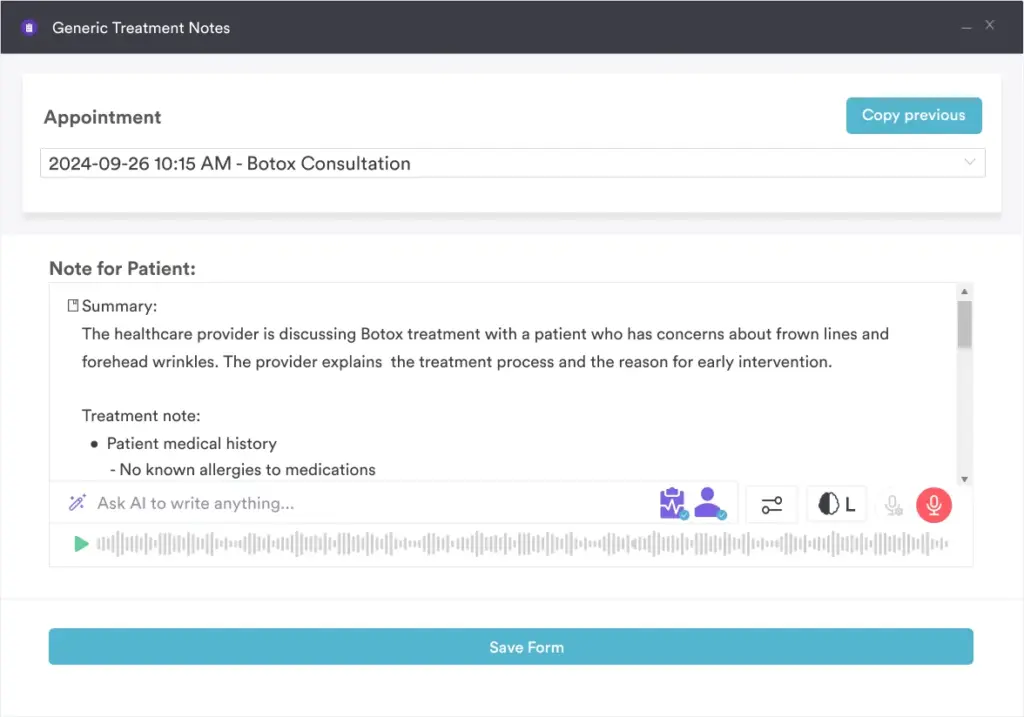
Pabau does not make a practice compliant. It holds the records that let you evidence compliance if Ahpra audits your advertising.
Every subscription includes every feature, so no feature here sits behind a higher tier. Setup runs through structured onboarding rather than a free trial.

See how Pabau links every published image to the consent that covers it, so you can evidence your advertising decisions. Consent forms, treatment photos and clinical notes stay attached to the patient record.

The surfaces that cause trouble are usually the ones you did not build. Legacy social posts, hashtags, directory listings and in-practice price lists carry the same rules as your website.
Work backwards from the evidence instead of forwards from the copy. If you cannot produce the consent for a published image, take it down before someone asks for it.
The rules changed on September 2, 2025, with no transition period. Any post published before that date was written under a different standard and needs rereading against this one.
If your consent records and treatment images live in several places at once, that is the first thing to fix. Book a demo to see how Pabau keeps them together.

Need a system built for an Australian practice? EMR software in Australia covers what to look for in patient records and documentation.
Rebuilding your social calendar after the September 2025 changes? Social media marketing for clinics sets out what to post when testimonials are off the table.
Planning growth without leaning on testimonials? Marketing strategy for an aesthetic clinic works through the channels that stay open to you.
The AHPRA advertising guidelines are Ahpra instruments that interpret section 133 of the National Law. They control what a registered practitioner may say when advertising a regulated health service.
No. The AHPRA cosmetic injectables advertising guidelines permit before-and-after photos, subject to conditions. Images must be genuine, unedited, consented to, and carry a prominent results-vary warning.
No. Section 133(1)(c) prohibits testimonials about a regulated health service. That includes resharing patient posts, linking to outcome images, and liking or replying to a review.
Not the medicine itself. You may advertise a consultation, but the Therapeutic Goods Act prohibits referring to a prescription-only substance in advertising directed at the public.
Up to AUD 60,000 for an individual and AUD 120,000 for a body corporate, per offence. Ahpra can also impose conditions on registration or prosecute an advertiser.
Yes. A dedicated instrument for non surgical cosmetic procedures commenced on September 2, 2025. It covers higher risk work such as injectables, thread lifts and dental veneers.
Partly. You are not responsible for a review a patient posts. You are responsible if you like it, reply to it, reshare it or link to it.