Exilis patient treatment record: Free PDF for RF sessions
An Exilis patient treatment record is the session log for BTL’s radiofrequ...

3
Last Updated: Oct 23, 2026

A two-room skin clinic in Australia costs roughly $160,000 to $460,000 to open, and a four-room clinic roughly $340,000 to $1,000,000.
A cosmetic nurse renting a room can start for about $19,000 to $78,000, because there is no fit-out to fund.
Cosmetic lasers are licensed in only three jurisdictions, Queensland, Western Australia and Tasmania, and IPL is licensed only in Tasmania.
Fit-out is the biggest single line for any clinic with its own premises, at $1,500 to $3,000 per square metre.
Four to six months of rent is usually paid before the first client walks in, so cash runs out before revenue starts.
How much does it cost to open a skin clinic in Australia depends on two decisions far more than on any national average. A cosmetic nurse renting a room inside someone else’s clinic can start for about $19,000 to $78,000. A two-room clinic on its own lease runs about $160,000 to $460,000. Whichever setup you choose, our comparison of med spa management software sets out the total cost of ownership for each platform.
The two decisions are the clinic model and the state you trade in. A four-room clinic with a premium fit-out can reach $1,000,000. Cosmetic laser licensing exists in only three jurisdictions, so the same build costs different money in Brisbane and in Sydney.
Every figure below is in Australian dollars and traced to a published Australian source. Where a number simply is not published anywhere, this guide says so. That applies to injectable wholesale prices, multi-practitioner insurance premiums and time to break even.
One line is easy to underestimate and cheap to fix. Practice management software like Pabau sits under bookings, records and payments for a cosmetic clinic in Australia. It is one of the smallest lines in the whole budget, and merchant fees will cost you more.
A skin clinic in Australia costs between about $19,000 and $1,000,000 to open, depending on which of three models you build. Skin clinic startup costs fall away almost entirely when you rent a room instead of leasing premises. Fit-out is the reason.
| Cost line | Solo cosmetic nurse, room rental | 2-room clinic, about 60 sqm | 4-room clinic, about 120 sqm |
|---|---|---|---|
| Bond and rent before trading | Usually none | $15,000–$38,000 | $24,500–$84,000 |
| Fit-out, with contingency | None, the room is furnished | $99,000–$207,000 | $198,000–$414,000 |
| Equipment | $5,000–$11,000 | $25,000–$125,000 | $80,000–$350,000 |
| Opening stock | $10,000–$50,000 | $10,000–$50,000 | $20,000–$80,000 |
| Licensing, registration and council | About $240 | $3,700–$18,000 | $3,700–$25,700 |
| Insurance, first year | $385–$925 | $1,800–$2,200 | $2,500–$6,000 |
| Software and payment hardware | $100–$400 | $100–$400 | $200–$1,500 |
| Website, brand and launch | $3,000–$15,000 | $5,000–$20,000 | $10,000–$35,000 |
| Total, excluding wages and working capital | About $19,000–$78,000 | About $160,000–$460,000 | About $340,000–$1,000,000 |
There is one useful cross-check on the top band. SILK Laser Clinics publishes an initial investment of $185,000 to $325,000 for a 25% or 50% share of a turnkey clinic. Grossed up, that implies a whole clinic costing roughly $650,000 to $740,000.
That sits inside the four-room range above, toward the upper middle. Wages and working capital sit outside every total here. Both are covered further down, and neither has a reliable published Australian benchmark.
Six variables move the number more than the rest combined. Work through them before you price the build, because each one changes several lines at once.
The treatment menu you plan is what ties these together. Laser, IPL, radiofrequency and skin treatments can be named and marketed freely. Injectables cannot, and that single fact reshapes both your marketing budget and your business model.
Government registration is the cheapest part of opening a skin clinic, and compliance is the expensive part. An ABN is free and a company costs $636 to register. The money goes on the prescriber relationship, the training hours and the marketing you are not allowed to run.
Two guidelines from the Australian Health Practitioner Regulation Agency (Ahpra) took effect on 2 September 2025, and they reshape how a nurse-led clinic operates. One covers performing non-surgical cosmetic procedures. The other covers advertising the higher-risk ones.
The performing guidelines were developed by every National Board except the Medical Board of Australia. Doctors stay under the Medical Board’s own guidelines, in force since 1 July 2023. Plenty of write-ups get this backwards, so check any advice that says otherwise.
These are the rules that change what a clinic costs to run:
One budgeting trap is worth naming. Ahpra does not approve cosmetic injector courses. The Nursing and Midwifery Board accredits programs leading to registration or endorsement, not short courses. Any training provider claiming Ahpra approval is misrepresenting what it sells.
Training is also a recurring cost rather than a one-off. Ahpra expects procedure-specific training, demonstrated competence in managing complications, and continuing professional development covering cosmetic work. Budget for it every year.
You cannot advertise cosmetic injectables to the public in Australia, at all. Most contain Schedule 4 substances, and the Therapeutic Goods Act 1989 bans advertising prescription medicines to consumers. That single rule removes your highest-intent keywords from the plan.
Since March 2024 the Therapeutic Goods Administration (TGA) has also caught generic wording. Brand names, substance names, acronyms, nicknames, hashtags and category terms are all treated the same way. That includes wording still sitting on clinic websites across the country.
What this means in practice:
Penalties reach $1.65 million per breach for an individual and $16.5 million for a corporation. The TGA has named unapproved goods used in cosmetic procedures as an enforcement priority for 2026 and 2027.
Here is the practical warning. A 2025 audit of 100 Australian cosmetic clinic websites found prohibited terms on 98 of them. Copying a competitor’s website copies illegal advertising, so brief your web agency on the rules before they write a word.
Cosmetic lasers are licensed in only three jurisdictions, Queensland, Western Australia and Tasmania. IPL is licensed in only one, Tasmania. ARPANSA, the Commonwealth radiation authority, states the position plainly. Five of eight jurisdictions require no radiation licence for cosmetic laser or IPL at all.
| State or territory | Laser licence? | IPL licence? | Authority | Fee (AUD) |
|---|---|---|---|---|
| Queensland | Yes, possession and use | No | Queensland Health | Possession $938.72 first year, use licence $184.13 |
| Western Australia | Yes, registration and licence | No | Radiological Council of WA | Registration $300 a year for up to two devices, exemption from licence free |
| Tasmania | Yes | Yes | Director of Public Health | Application $250.88, then $403.76 a year, plus $403.76 premises registration |
| New South Wales | No | No | NSW EPA does not regulate lasers | None |
| Victoria | No | No | Department of Health, guidance only | None |
| South Australia | No | No | EPA South Australia does not license lasers | None |
| Australian Capital Territory | No | No | No regulation prescribes lasers | None |
| Northern Territory | No | No | Department of Health | None |
Three points in that table are worth drawing out, because they are routinely reported wrongly.
New South Wales is genuinely deregulated. The NSW EPA says so in one sentence: it does not regulate the possession or use of lasers. So the cost to open a skin clinic in Australia is lower in NSW on this line. The saving against a licensed state is roughly $1,100 in the first year.
Queensland is the most demanding. The business holds a possession licence and every operator holds a use licence. The possession licence must be in place before you buy the machine, which is a sequencing problem rather than a fee problem.
Queensland also requires 25 to 100 supervised practical hours, depending on the procedure. Add a radiation safety and protection plan and an appointed radiation safety officer. Those hours delay revenue. The fee unit rises from $1.096 to $1.133 on 1 October 2026, lifting every figure by about 3.4%.
Western Australia is not medical-practitioner-only, despite what is often written. Nurses and beauty therapists use a fee-free exemption from licence, and the clinic pays the registration. The binding WA constraints are elsewhere.
That skin-check rule forces a funded medical relationship on a WA laser clinic, which is a staffing cost rather than a licence fee. Tasmania is the strictest jurisdiction overall, and its Radiation Protection Regulations were remade on 13 May 2026, so older guidance is stale.
No licence never means no obligation. Work health and safety law still requires anyone operating laser equipment to be trained in its proper use. Insurers still want a laser safety certificate before they write a policy, whatever the state says.
Registering the business itself costs under $800, which makes it the cheapest decision on the list. Council approval is the line that can surprise you.
| Registration | Fee (AUD) | Notes |
|---|---|---|
| Australian Business Number | Free | Registered through the Australian Business Register |
| Business name, 1 year | $47 | ASIC fee, indexed each 1 July |
| Business name, 3 years | $108 | ASIC fee |
| Pty Ltd company registration | $636 | Proprietary company with share capital |
| ASIC annual review | $342 a year | Ongoing, payable every year |
| GST registration | Free | Compulsory once turnover reaches $75,000 |
| Council development approval | $3,000–$15,000 | Change of use, including planner and drawings |
The $75,000 GST threshold has not moved since 2007, so a new clinic usually crosses it in year one. Council approval costs are dominated by consultants rather than the lodgement fee. A planner, architectural drawings and a statement of environmental effects usually add more than the council charges.
One structural question deserves a building surveyor’s opinion before you sign a lease. Most medical clinics sit in building Class 9a, and converting a retail or office tenancy to that standard means fire rating, egress and ventilation upgrades. Guessing wrong on this is a six-figure error.
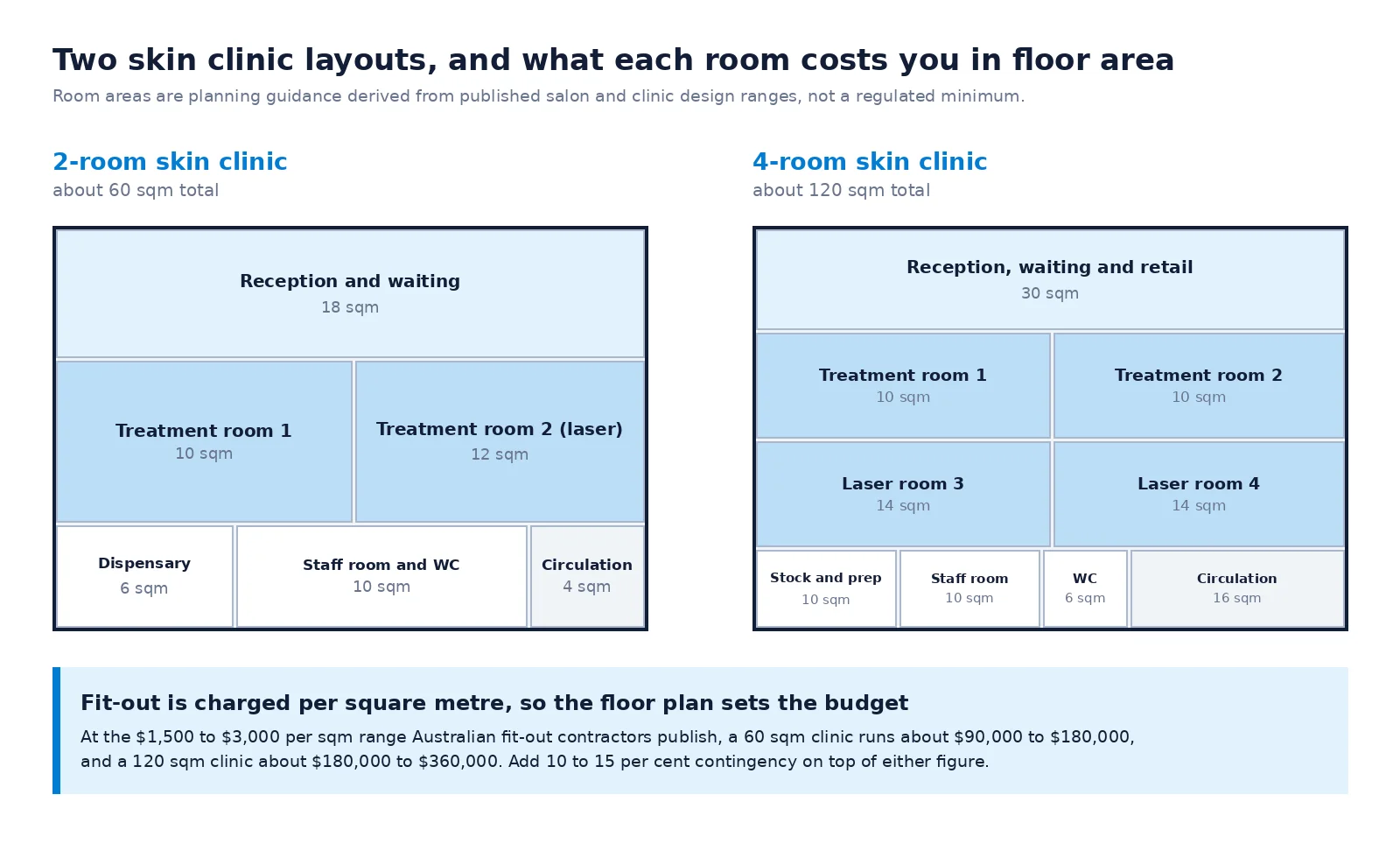
Premises and fit-out cost about $114,000 to $233,000 for a 60 square metre clinic, and about $216,000 to $455,000 for 120 square metres. That covers the bond, rent before trading, the build and a contingency. It is the largest block in the whole budget.
| Item | Small, 1–2 rooms, about 60 sqm | Larger, 3–4 rooms, about 120 sqm |
|---|---|---|
| Annual gross rent at $350–$700 per sqm | $21,000–$42,000 | $42,000–$84,000 |
| Annual gross rent, prime strip at $700–$1,200 | $42,000–$72,000 | $84,000–$144,000 |
| Bond, 3–6 months of gross rent | $5,250–$21,000 | $10,500–$42,000 |
| Rent in advance, 1–3 months | $1,750–$10,500 | $3,500–$21,000 |
| Fit-out at $1,500–$3,000 per sqm | $90,000–$180,000 | $180,000–$360,000 |
| Contingency at 10–15% | $9,000–$27,000 | $18,000–$54,000 |
| Council approval or change of use | $3,000–$15,000 | $3,000–$20,000 |
Rent in Australia is quoted per square metre per year. A suburban strip shop runs about $200 to $300 net, and metro medical suites about $350 to $700 gross. A prime inner strip reaches $700 to $1,200, and a shopping centre passes $1,000.
Use one sanity check on any site. If projected rent and outgoings exceed roughly 15% of projected turnover, the site is too expensive for the business you are planning.
A commercial bond is normally three to six months of gross rent, and one to three months of rent is payable in advance on top. So four to nine months of rent leaves your account before you trade a single day.
Only the ACT and South Australia cap the bond, both at three months. Elsewhere there is no cap, and the landlord holds the money rather than a government custodian. A landlord cannot unreasonably refuse a bank guarantee instead of cash, which is worth negotiating.
Australian fit-out contractors put a medical or cosmetic build at $1,500 to $3,000 per square metre, with $1,800 to $2,500 as the mid-market planning figure. A cosmetic-specific guide published in December 2025 puts it higher, at $2,500 to $4,500.
Both sets of figures come from trade sources marketing their own services, not from quantity surveyors. No independent benchmark exists for this segment. Get three quotes rather than trusting either range, and add 10% to 15% contingency to whichever you plan against.
The single biggest hidden driver is plumbing. Every treatment room needs a hand basin, and that dictates where rooms can physically go. Zoned air conditioning, sealed washable flooring and extra power outlets for device loads follow close behind.
Build timelines run eight to 14 weeks for a standard fit-out, stretching to 16 to 20 weeks with custom joinery or planning approvals. Add design and approvals and the realistic window from lease signing to opening is four to six months.
Equipment is usually the single largest line after fit-out, running about $25,000 to $350,000 depending on how many devices you buy. One laser platform can cost more than every other item on the list combined.
| Equipment | New price (AUD) | Notes |
|---|---|---|
| Laser platform, entry level | $15,000–$25,000 | Portable diode units |
| Laser platform, mid range | $40,000–$70,000 | Nd:YAG, alexandrite and Er:YAG |
| Laser platform, premium | $80,000–$160,000+ | Multi-wavelength platforms |
| IPL | $10,000–$50,000 | Licensed in Tasmania only |
| HIFU | $6,300–$29,995 | Australian suppliers publish these prices openly |
| RF microneedling | $4,000–$45,000 | A used Morpheus8 asks about $66,000 |
| Skin analysis and imaging | $1,400–$9,500 | Salon and clinic grade; medical grade is quote only |
| Treatment bed | $1,600–$3,600 each | Clinical couches run $3,700–$5,500 ex GST |
| Class B autoclave | $2,850–$9,350 | Premium units reach $17,000–$18,000 |
| Injectables fridge | $1,650–$3,000 | A domestic bar fridge is not acceptable |
| Emergency kit | $2,100–$4,200 | Defibrillator, adrenaline and an oxygen resuscitation kit |
New device pricing in Australia is structurally hard to find. Every major manufacturer and distributor quotes privately, so the used market is where public prices live. Used platforms range from about $10,000 for an older unit to $140,000 for a recent premium one.
Depreciation on one clearly disclosed pair of prices runs at roughly 12% a year. Shot count and remaining warranty matter more than model year at the cheap end, so read the service history before you read the price tag.
Equipment finance costs roughly $410 a month per $20,000 borrowed, or about $2,050 per $100,000, on a five-year chattel mortgage at 8.5%. Rates run from about 6.59% to 14.5%, and a startup usually needs a 10% to 30% deposit plus a director guarantee.
The recurring cost to plan for is service. Maintenance contracts run 8% to 10% of device value each year once the warranty ends, or about $2,000 to $8,000 a year per device. Handpiece and tip replacement is larger again, at $3,000 to $20,000 every one to two years.
Total running costs land somewhere between 15% and 50% of purchase price a year, depending on the technology. Budget that from day one, because it does not show up until the warranty lapses.
Opening stock is commonly quoted at $10,000 to $50,000, and that figure is an industry estimate rather than an audited benchmark. The harder truth sits underneath it. A nurse-led clinic cannot simply buy its own injectable stock.
Australian wholesale prices for botulinum toxin and dermal fillers are not published, by anyone. Distributors sell only through verified prescriber accounts, and the TGA requires health-professional pricing to stay out of the public domain. Publishing a Schedule 4 price is itself likely an advertising breach.
So treat any article quoting a per-vial or per-syringe wholesale cost with suspicion. The numbers circulating are usually US figures converted into Australian dollars, or patient-facing retail prices standing in for clinic cost. Neither will help you build a budget.
Dermal fillers are regulated as medical devices and also sit in Schedule 4. Both frameworks apply at once, which is why filler is caught by the advertising rules alongside toxin.
Since 2 September 2025 a real-time consultation is required every time a cosmetic injectable is prescribed. A nurse-led clinic therefore has to fund a standing prescriber relationship, because there is no lawful way around the consultation.
Australian pricing for these services is not published. Providers quote per clinic, typically as a monthly platform or medical directorship fee plus a charge for each consult. The published figures you will find online are US prices, and converting them will mislead you.
Queensland goes further and restricts the business model itself. Registered nurses there cannot buy or hold stock of Schedule 4 cosmetic injectables, and standing orders cannot be used. Only two lawful models exist.
Queensland Health applies a belonging test to the first model, looking at lease documents, independent access and published consulting hours. Intermittent visits do not satisfy it. If you are opening in Queensland, decide the model before you sign a lease.
Non-injectable consumables are cheap and easy to price, because Australian medical suppliers publish them. A straightforward injectable set-up costs a few dollars in consumables, not the $76 to $764 per treatment one widely-copied article claims.
Clinical waste is the recurring line to quote before you open. A 120 litre clinical waste bin runs $35 to $65 per collection, and sharps collection starts from $84. Contract pricing is quote-only, and incumbent suppliers commonly add bin rental and site fees.
Retail skincare is the one stock line with published entry points. Opening orders run from zero up to $5,000 excluding GST at an established cosmeceutical house. One Australian brand publishes a wholesale discount of 35% to 48%, and no clinic-specific margin benchmark exists.
A single-nurse clinic can expect roughly $1,800 to $2,200 a year for professional indemnity, public liability and a business pack, before workers compensation. Professional indemnity is not optional. Section 129 of the National Law bars a registered practitioner from practising without it.
| Cover | Indicative annual premium | Notes |
|---|---|---|
| Indemnity and liability, basic injectables | From $385 | Sole trader, $1m indemnity and $10m liability, published 2023 |
| Adding PDO monos and fat dissolving | From $765 | Same underwriter, same basis |
| Adding laser, IPL and lifting threads | From $925 | 2.4 times the basic rate |
| Business insurance pack | $880–$1,100 | Contents, glass and business interruption |
| Workers compensation | 1.343%–2.012% of payroll | Varies by state and by how the clinic is classified |
| Multi-practitioner clinic | Not published | No insurer publishes a premium for this profile |
That jump from $385 to $925 is the most useful number in the table. Adding laser and threads to a basic injectables scope multiplies the premium by 2.4 with the same underwriter. Treatment mix moves your premium more than turnover or headcount does.
Two exclusions catch new owners out. Cosmetic injectables and laser therapy are excluded from many mainstream beauty and nursing policies, including some union member cover. An employer’s policy also covers a nurse only for work done in that employment.
Landlords and shopping centres routinely demand $10 million public liability and a certificate of currency. Stepping up from $10 million to $20 million adds only about $60 to $70 a year, so it is rarely worth arguing over.
Insurers also want a laser safety certificate before they will cover laser work, including in the five states where no licence is required. Budget the certificate whatever your postcode.
A cosmetic nurse salary in Australia typically runs $85,000 to $90,000, and a dedicated cosmetic injector $95,000 to $130,000. Wages are the largest ongoing cost in any clinic, and they sit outside every startup total in this guide.
| Role | Typical salary range (AUD) | Award likely to apply |
|---|---|---|
| Cosmetic nurse | $85,000–$90,000 | Nurses Award, MA000034 |
| Cosmetic injector | $95,000–$130,000 | Nurses Award, MA000034 |
| Dermal therapist | $73,000–$85,000 | Health Services Award, MA000027 |
| Medical receptionist | $64,000–$70,000 | Health Services Award, MA000027 |
| Clinic manager | $95,000–$115,000 | Depends on duties, take advice |
| Beauty therapist | Not separately published | Hair and Beauty Award, MA000005 |
Award coverage is decided by the work and the business, not by the job title. The Nurses Award is occupational, so a registered nurse doing nursing duties is covered whatever the clinic calls itself. No award mentions dermal therapists by name, so get that classification in writing.
The superannuation guarantee is 12%, not the 9.5% one widely-read guide still quotes. On an $87,500 cosmetic nurse salary that is $10,500 a year in super alone. On a small clinic, that is close to a month of rent.
Payday Super also started on 1 July 2026, and it changes cash flow rather than cost. Super must now be paid on every payday and received by the fund within seven business days. Quarterly super was a working capital buffer, and it is gone.
Cosmetic nursing pay is also increasingly commission-based, and that matters here. Super is now calculated on qualifying earnings, a term that includes commissions and salary sacrifice amounts.
The national minimum wage is $26.44 an hour. Payroll tax is one cost you can stop worrying about: thresholds start at $1,000,000 in annual wages and run to $2,500,000 in the Northern Territory. A startup clinic sits well below every one of them.
Budget $10,000 to $30,000 for marketing and a website combined at launch, then 5% to 10% of revenue once you are trading. The twist is that regulation, not budget, is the binding constraint. You cannot name the products you most want to advertise.
Signage pricing is not published by Australian suppliers in any usable form, so get quotes rather than planning against a figure. Illumination, install height and landlord approval all move it.
There is also no credible Australia-specific cost-per-lead benchmark for this sector. The Australian dollar figures circulating are converted US data, and the conversion hides a bigger problem. The advertising ban removes the highest-intent keywords entirely, so the keyword mix differs, not only the price.
Influencer marketing is largely closed off. Testimonials in advertising a regulated health service are prohibited, and influencer testimonials were specifically banned from 2 September 2025. Free or discounted treatments in exchange for promotion are prohibited too.
Your online booking menu is a live compliance risk as well. A self-select treatment list naming prescription-only products, or showing their prices, is likely to be an advertisement. Advertise consultations and the concerns you treat instead.
A small skin clinic’s fixed monthly costs land in the low thousands before wages, and wages then dominate. The table below builds it up line by line so you can swap in your own numbers.
| Monthly cost | Small clinic, about 60 sqm | Larger clinic, about 120 sqm |
|---|---|---|
| Rent, gross | $1,750–$3,500 | $3,500–$7,000 |
| One cosmetic nurse, including 12% super | $7,933–$8,400 | $7,933–$8,400 per nurse |
| Practice management software | $35–$50 per user | $35–$50 per user |
| Merchant fees at 1.4% to 1.6% | $350–$400 per $25,000 taken | $700–$800 per $50,000 taken |
| Insurance, monthly equivalent | $150–$185 | $210–$500 |
| Clinical waste collection | $75–$140 fortnightly | $150–$280 weekly |
| Equipment service contract | $167–$667 per device | $333–$1,333 |
| Equipment finance | $410 per $20,000 borrowed | $2,050 per $100,000 borrowed |
| Marketing | 5% to 10% of revenue | 5% to 10% of revenue |
The ATO publishes small business benchmarks for beauty services, drawn from tax returns for the 2023-24 income year. They are the closest available government data on what a business like yours spends, and no competing guide cites them.
Read the rent line carefully, because it runs the opposite way to intuition. Rent takes a bigger share of turnover at the smallest end, 13% to 21%, and falls to 9% to 16% once a clinic passes $400,000. Rent is fixed; revenue is what grows.
The expense ratio tells you something blunter. Roughly half to two-thirds of turnover is committed before a client walks in, and it climbs as you grow. Note that these benchmarks cover beauty services and exclude hairdressers, barbers and tanning studios.
Merchant fees of 1.4% to 1.6% typically cost more than your software subscription. On $300,000 of card turnover that is $4,200 to $4,800 a year, against a few hundred dollars for the software.
Card surcharging is also being removed from 1 October 2026 for eftpos, Mastercard and Visa. The Reserve Bank confirmed this in March 2026, alongside lower interchange caps. From that date merchant fees have to be absorbed into your treatment pricing rather than passed on.
An independent build is cheaper at the low end, and the one published franchise figure sits toward the top of the independent range. Only one of the three major Australian franchise brands publishes an investment figure at all.
| Brand | Published initial investment | What you get | What is not published |
|---|---|---|---|
| SILK Laser Clinics | $185,000–$325,000 for a 25% or 50% equity share | Turnkey furnished clinic, training, head office support, group buying | Franchise fee, royalty, marketing levy, term, revenue |
| Laser Clinics Australia | Not published on its franchising page | 50/50 partnership, turnkey clinic, equipment, stock, marketing, recruitment | Investment, franchise fee, royalty, levy, term, revenue |
| Australian Skin Clinics | No dollar figure published anywhere on the page | Turnkey fit-out in three to four weeks, week-long head office training | Every figure, plus the royalty basis |
Figures for Laser Clinics Australia do circulate online, and they come from directories and dated prospectuses. Its own prospectuses said about $350,000 to $400,000 around 2015, and about $290,000 to $320,000 around 2021, plus franchise fees. Both are historic and superseded.
Australian Skin Clinics publishes no dollar amount at all. Its page implies a ten-year term and weekly performance monitoring, and describes franchise fees without naming a percentage.
None of this is evasion, and the reason is worth knowing. Under the Franchising Code of Conduct, earnings information is optional. A franchisor that chooses not to disclose it simply says so at item 20 of the disclosure document.
A new Code took effect on 1 April 2025, and it is where the numbers live. You are entitled to a disclosure document at least 14 days before signing, covering set-up costs, operating costs and future capital expenditure.
The disclosure document must also list contact details for current and former franchisees. Former franchisees are the most useful people you will speak to in the whole process, so call them before you decide.
No Australian dataset publishes a time-to-break-even figure for cosmetic clinics, so anyone quoting one is guessing. The honest answer is to calculate it rather than benchmark it. Divide your annual fixed costs by 52, then divide that by your gross margin.
That gives the weekly revenue you have to clear. It is the method the largest Australian medical oversight provider publishes. It beats borrowing a figure from a US clinic with different regulation and different costs.
The ABS tracks how many new businesses are still trading three years on. Of businesses that started in 2022-23, 49.2% survived to June 2026 across all industries. How your clinic is classified tracks with a materially different result.
That is a 7.8-point spread between the two divisions a skin clinic could fall into. The ABS publishes survival by industry division only, so a finer split for aesthetic clinics in Australia does not exist. Treat the difference as directional rather than predictive.
No Australian government body publishes a cash-reserve rule for small business. The widely-repeated three-to-six-month figure comes from private finance firms, and business.gov.au’s own cash flow guide contains no such rule.
What does exist is Xero’s cash flow research. In 2021, 92% of Australian small businesses had at least one cash-flow-negative month, averaging 4.2 months across the year. That is a better basis for sizing a buffer than a rule nobody published.
Two clinic-specific facts sharpen it further. You will pay four to six months of rent before opening. Payday Super also removed the quarterly super float that older cash flow models leaned on. Size the buffer against both.
Most new clinics open on a patchwork. A booking tool that does not talk to the client record. Consent forms signed on paper and scanned in. Before-and-after photos on a personal phone, and a card terminal that reconciles to no system.
Pabau is an all-in-one practice management system that replaces that patchwork. Appointments, client records, consent, treatment notes, stock and payments sit in one place, so you buy one subscription instead of four. Every subscription includes every feature, and plans scale by number of locations and users.
The compliance side matters more here than the subscription line. The cosmetic procedure guidelines require detailed treatment records, written aftercare naming the prescriber, and photography consent kept separate from procedure consent. Images must not sit on a personal device.
Pabau keeps all of that against one client timeline, so you can produce a full record without hunting through three systems. Batch and product details recorded at the point of treatment also keep your stock count honest, which protects the margin you calculated.
Automated reminders and rebooking prompts protect utilisation in the early months, when the rent is running and the diary is not full yet. Reporting then shows cost per treatment and margin by service, so you can see which room is paying for itself.
There is no free trial. New clinics go through structured onboarding instead, which is the part that gets you live without losing weeks to migration.

Pabau brings bookings, client records, consent, treatment notes, stock and payments into one platform. A new clinic pays for one subscription, and compliance records stay against a single client timeline.

Pick the model before you price the build. Renting a room and leasing a shopfront are different businesses, an order of magnitude apart in capital. No national average will tell you which one suits you.
Then check your state. Laser licensing, workers compensation rates and the poisons rules governing who may hold stock all change at the border. Queensland in particular can decide your business model before you have signed a lease.
The trade-off worth remembering is between the fit-out and the runway. Money spent on a premium build is money you do not have in month five. By then the rent has been running for six months and the diary is still filling.
Keep the software line small and the compliance records tidy from the first appointment. Book a demo to see how Pabau handles bookings, consent and treatment records for a new skin clinic.

Weighing up a laser-led clinic instead? How to start a laser hair removal business walks through the setup steps for a device-led model.
Want to sanity-check the revenue side? How much can a laser hair removal clinic make per month sets out the numbers behind treatment room utilisation.
Comparing clinical record systems for Australia? EMR software Australia reviews the platforms Australian clinics actually run on.
Need to get paid without chasing invoices? Best medical billing software Australia covers the billing tools that suit a small Australian clinic.
Building your consultation process from scratch? How to prepare for a cosmetic client consultation shows what a compliant first appointment looks like.
No Australian source publishes a profitability benchmark for this sector, so treat confident figures with caution. The ATO does publish expense ratios for beauty services businesses: total expenses run 48% to 88% of turnover, and the ratio climbs as turnover grows. Margin depends far more on utilisation and rent than on treatment pricing.
Advertised ranges sit at $85,000 to $90,000 for a registered nurse doing injectables, and $95,000 to $130,000 for a dedicated injector. Employers add 12% superannuation on top of that. Commission of 5% to 15% is common, and a growing share of income in cosmetic nursing now comes from commission rather than base pay.
Only in three jurisdictions. Queensland, Western Australia and Tasmania regulate cosmetic lasers, and Tasmania alone regulates IPL. The other five require no radiation authority at all. Work health and safety law still requires trained operators everywhere, and insurers want a laser safety certificate before they will write a policy.
Yes, subject to state law, but they cannot inject. Botulinum toxin and dermal fillers are Schedule 4 medicines, so only authorised registered practitioners may prescribe or administer them. Chemical peels, microdermabrasion, LED and, in most states, laser and IPL remain open to appropriately trained non-registered practitioners.
SILK Laser Clinics publishes $185,000 to $325,000 for a 25% or 50% equity share in a turnkey clinic. Laser Clinics Australia and Australian Skin Clinics publish no figure at all. Earnings disclosure is optional under the Franchising Code, so the figures arrive in the disclosure document you receive 14 days before signing.
Four to six months from signing a lease is realistic. Design and approvals take four to six weeks, and construction runs eight to 16 weeks, or longer with custom joinery. A council change of use adds more, and Queensland’s supervised laser training hours can delay revenue again.