Free model waiver form + what it is and when your practice needs one
A model waiver form is a signed document that lets a healthcare practice use a p...

5
Last Updated: Sep 29, 2026

No Australian law requires a cosmetic clinic to appoint a medical director, so the job title on its own proves nothing.
The Three-Hat Test splits the role into prescriber, medical director and licence holder, then names who wears each hat.
Since September 2, 2025, Ahpra has required an in-person or video consultation every time a cosmetic injectable is prescribed.
Poisons law is state law, so permits and prescriber duties change at every border, and NSW changes again on November 5, 2026.
The Therapeutic Goods Administration, not Ahpra, is the reason a clinic cannot name a Schedule 4 injectable in public advertising.
Hiring a medical director for a cosmetic clinic in Australia is not a legal requirement. What the law requires is a prescriber. A medical practitioner or nurse practitioner has to write a Schedule 4 prescription for each patient, after a consultation they conducted themselves.
That distinction costs owners money. They buy the job title because it sounds like protection. The duties they assume it covers sit somewhere else, and nobody has been named to carry them.
This guide sets out who may prescribe and inject cosmetic injectables here, and what a medical director does that no regulation compels. It covers how the rules shift between states, and what medical oversight costs. One framework runs throughout, the Three-Hat Test.
No Australian law requires a cosmetic clinic to appoint a medical director. A doctor or nurse practitioner must prescribe every Schedule 4 injectable.
“Medical director” is a job description, not a registration category. Ahpra registers individuals, not roles, and no National Board issues a medical director credential. A register search returns a practitioner’s registration, never a role.
What the AHPRA cosmetic guidelines do impose is a named prescriber for every patient. The prescriber stays responsible for that patient’s care even when a registered nurse performs the injection. Ahpra states that duty explicitly, and it does not transfer with the syringe.
So why do so many nurse-led clinics offering non-surgical cosmetic treatments end up with a medical director anyway? Three commercial pressures, none of them statutory:
None of that makes the appointment mandatory. Commercial pressure makes the appointment sensible, which is a different claim. Keep the two apart when you write the job description.
Three separate duties hide behind the phrase “medical director”, and Australian law attaches to only two of them. Name who wears each hat before you write a job title.
The test itself is one question applied three times. For each hat, name the person wearing it, and name the document that proves it. One person may wear two hats or all three. An unfilled hat is only visible when somebody asks.
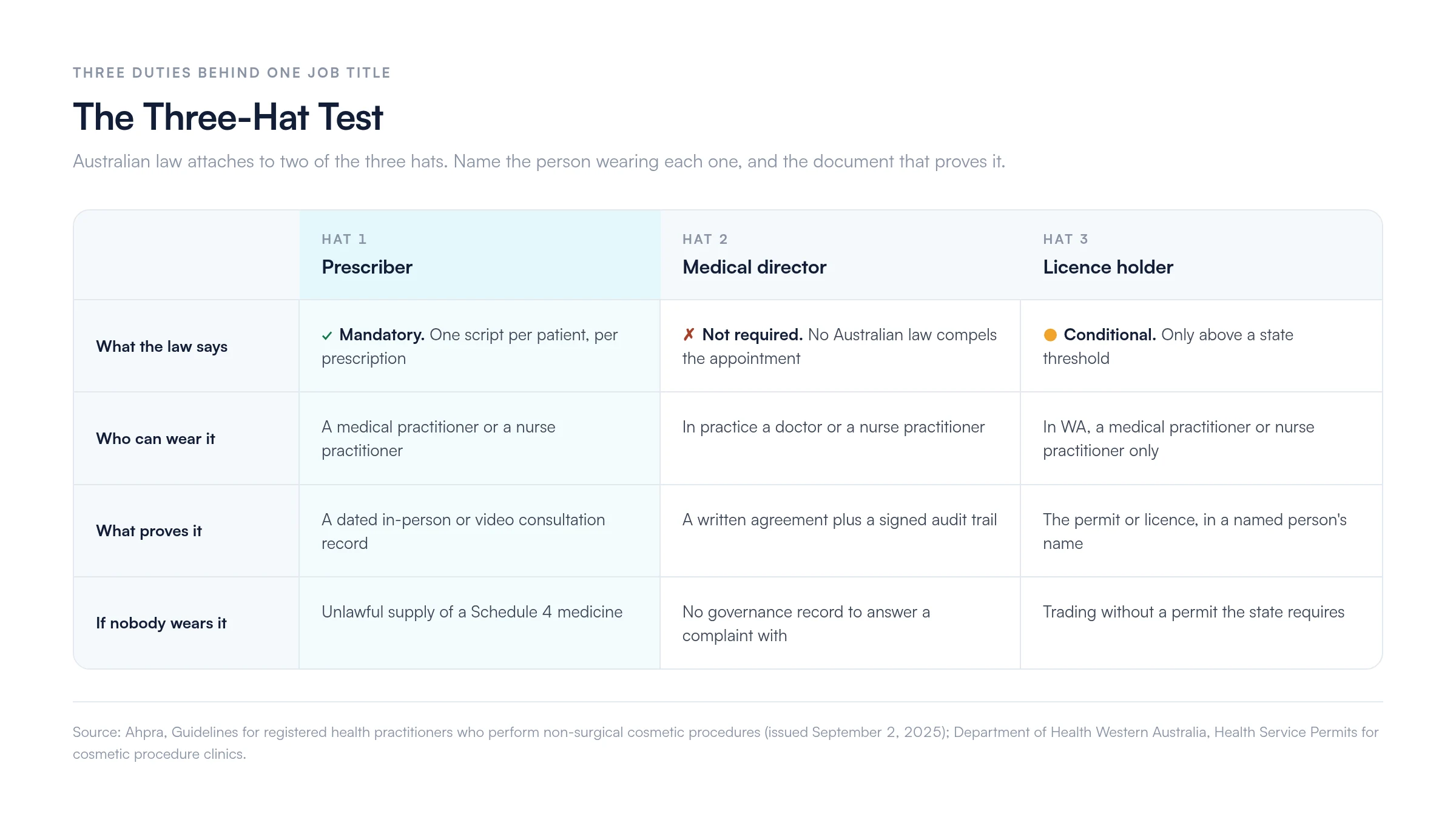
Each empty hat fails differently. An empty Hat 1 is unlawful supply of a prescription-only medicine on the day it happens. An empty Hat 2 carries no cost until a complaint arrives. At that point the clinic has no governance record to answer with.
An empty Hat 3 only matters once you cross a licensing threshold. Western Australia is the clearest example. A Health Service Permit for a cosmetic procedure clinic goes only to a medical practitioner or a nurse practitioner.
The Department of Health WA notes that this person is commonly the medical director. That is Hat 2 and Hat 3 on one head, by design.
Job descriptions for the role tend to stop at outcome language. “Provides oversight” is not a task anybody can be held to. Below is the duty list, with the frequency attached, because a duty without a cadence is a duty nobody performed.
No Australian regulator sets a review cadence for any of that. In practices we onboard, one arrangement holds up under scrutiny more reliably than the rest. That is a quarterly chart audit plus an annual policy review, both minuted and both signed.
Since September 2, 2025, every Schedule 4 cosmetic injectable prescription must follow a real-time consultation, in person or by video, with the prescriber.
That date is the issue date of Ahpra’s Guidelines for registered health practitioners who perform non-surgical cosmetic procedures. The AHPRA cosmetic injectables guidelines apply to every practitioner registered under the National Law except medical practitioners, who follow the Medical Board’s own document instead.
Two prescribing practices the AHPRA cosmetic injectables guidelines now rule out:
Ahpra also sets a seven-day cooling-off period for anyone under 18, between informed consent and the procedure. No money is payable until that period has passed. The National Boards go further, and say botulinum toxin and dermal fillers should not be prescribed cosmetically to under-18s.
Two documents govern this field, not one. Medical practitioners follow the Medical Board of Australia’s Guidelines for registered medical practitioners who perform cosmetic surgery and procedures, issued July 1, 2023. Both documents are reviewed at least every five years, so treat neither as settled.
Registered nurses, nurse practitioners and doctors can administer cosmetic injectables in Australia. Only a doctor or nurse practitioner can prescribe them.
The question of who can inject Botox in Australia has a second half. Administering and prescribing are separate authorities under separate law, and an injector without a prescriber behind them has no lawful supply of product.
The supervision column is where clinics get caught, because a doctor cannot lawfully supervise an enrolled nurse under NMBA requirements. Source: Ahpra.
Anyone researching how to become a cosmetic injector should read that table as a career map. Registration comes first, then the education and hands-on training Ahpra expects in anatomy, patient assessment and complication management.
Poisons law is state law. Who may hold Schedule 4 stock, and whether your premises needs a permit, changes at every border.
Australia has no single set of cosmetic injectables regulations issued from Canberra. Ahpra sets practitioner conduct nationally. Buying, storing and supplying the medicine itself sits in eight separate state and territory Acts.
So the medical director requirements in Australia are mostly premises requirements wearing a person’s name. Two jurisdictions attach the permit to a named practitioner. The other six leave the question to the prescriber’s own authority.
Queensland and Western Australia are the two jurisdictions that license the premises itself, which is why Hat 3 is not optional there. Sources: state legislation registers and health departments.
Two entries in that table are live changes, not history. South Australia’s new Controlled Substances (Poisons) Regulations took effect on September 1, 2026. New South Wales replaces its 1966 poisons Act on November 5, 2026.
The NSW change is the one to read closely, because it puts duties on the business rather than only on the practitioner. From November 5, NSW Health requires each clinic to name a “responsible provider”. That business must also hold risk management policies, keep emergency equipment on site at all times, and retain records for two years.
One NSW rule answers a question owners ask constantly. A verbal direction to administer is lawful only when the prescriber is physically present. A written direction, valid for six months, is what covers remote oversight.
Council skin penetration registration is a common false alarm. NSW Health excludes any procedure carried out by a registered health practitioner from its skin penetration scheme. Victoria excludes cosmetic injecting from both beauty therapy and skin penetration. Queensland is the outlier that licenses it.
Australian clinics buy medical oversight in four shapes, and the honest headline is that nobody publishes what any of them cost. Retainers are privately negotiated between two parties who both prefer the figure stayed private.
Every published figure in this space is either a startup estimate or an insurance premium, never a medical director retainer. Source: Pabau research, September 2026.
Two adjacent facts are published, and both come from the regulator. The Medical Board of Australia’s schedule of fees sets annual general registration at AUD 1,102 from August 1, 2026. Practitioners based in NSW pay a reduced AUD 925.
The second is worth more than any dollar figure. The Medical Board’s registration standard on professional indemnity insurance requires cover for every aspect of a doctor’s practice. A practitioner specifically excluded from cover for an area must not practice in it.
Read that as a hiring test. A candidate whose policy excludes cosmetic work cannot lawfully wear Hat 2 for you, whatever the retainer. Ask for the certificate of currency and read the exclusions before the contract. For the wider budget picture, see our breakdown of the skin clinic startup costs Australian owners face.
You cannot name a Schedule 4 injectable, its brand or its nickname in public advertising, and price lists for it likely breach the Act.
Sections 42DL and 42DLB of the Therapeutic Goods Act 1989 prohibit advertising prescription-only substances to the public. The TGA cosmetic injectables advertising position extends that to acronyms, nicknames, abbreviations and hashtags a consumer would read as a specific product.
General terms lost their safe harbor too. The TGA no longer treats phrases such as “anti-wrinkle injections” or “dermal fillers” as automatically acceptable. The test is whether a reasonable consumer would read the content as promoting a prescription-only medicine.
Before-and-after photography is where the rule gets narrower. Photos are not banned outright. The problem starts when the improvement is evidently the result of a prescription-only injectable. The TGA says such a post is likely to amount to an advertisement for that medicine.
The scale of non-compliance is documented. Operation Redress reviewed 100 Australian cosmetic business websites in March and April 2025. Flagged terms appeared on 98 of the 100, and 67% of sites carried ten or more pages with at least one non-compliant term.
Advertising lands on the medical director’s desk rather than the marketing team’s for one reason. The TGA advertising rules for cosmetic injectables sit inside the Therapeutic Goods Advertising Code. Enforcement attaches to the practitioner and the business, never to the agency that wrote the caption.
A second rulebook runs alongside it. The AHPRA cosmetic advertising guidelines govern testimonials, misleading claims and image consent, and our guide to the AHPRA advertising guidelines covers where the two overlap.
Appointing well is five steps, and the order matters. Skipping step one is why so many agreements describe a title instead of a duty.
The written agreement then has to cover six things:
Owners forget the handover clause most often. That is the clause that hurts when the arrangement ends.
Every duty above is only worth what you can evidence at a complaint or an audit. That makes clinical governance a records problem before it is a hiring problem, and a shared inbox of signed PDFs will not survive the question.
Practice management software like Pabau keeps that evidence attached to the patient rather than scattered across the practice. Consent forms and medical questionnaires land in the client record.
Treatment notes carry the product, the batch and the practitioner who performed the work. A chart audit becomes a report rather than an excavation, which is the point of running software for aesthetic clinics in the first place.
Staff permissions in Pabau can be set to match each injector’s approved scope, which turns credentialing from a spreadsheet into a control. The audit trail records who changed what and when. A medical director reviewing the quarter sees the work rather than somebody’s account of it.
Owners still comparing platforms can start with our roundup of the best aesthetic clinic software. Practices working mainly in skin should compare skin clinic software against the same governance criteria.

Pabau ties consent, treatment notes, batch records and staff permissions to one client record, so a medical director can review a quarter without chasing paperwork. Australian cosmetic clinics use it to answer a complaint with evidence rather than recollection.

The job in front of an Australian cosmetic clinic owner is not filling a title. Run the Three-Hat Test, name the person under each hat, and hold the document that proves it. Do that and the title becomes a description of work somebody is already doing.
The trade-off deserves stating plainly. A governance owner costs money and slows some decisions down, and no regulator will thank you for appointing one. What changes is what happens at the first complaint, when the clinic either produces a record or does not.
Start with the hat that is empty today, and give yourself until November 5 to be ready for the NSW rules if you practice there. Book a demo to see how Pabau keeps consent, treatment notes and sign-off in one auditable record.

Comparing this with the US model? How to hire a medical director for your med spa sets out how the role works where states do mandate it.
Building your governance file from scratch? Med spa compliance for owners walks through the policies and records an inspector expects to find.
Want to see a jurisdiction that does require one? California med spa licensing laws shows what a statutory medical director obligation looks like in practice.
Still costing out the clinic? The cost to open a skin clinic in Australia breaks down fit-out, stock, insurance and working capital.
You must hold registration with Ahpra as a medical practitioner, nurse practitioner, registered nurse or enrolled nurse. Anyone learning how to become a cosmetic injector then needs training in anatomy, patient assessment and complication management.
No Australian regulator publishes a total. The only fixed public figure is registration: the Medical Board of Australia charges AUD 1,102 a year for general registration from August 1, 2026. Fit-out, stock and insurance are quoted per clinic.
Ahpra’s guidelines took effect on September 2, 2025. They require an in-person or video consultation before every prescription and ban batch prescribing. State poisons law is changing too, with NSW replacing its 1966 Act on November 5, 2026.
Yes. Nothing in Australian law restricts clinic ownership to doctors. The constraint is supply, not ownership: a registered nurse cannot prescribe, so the business needs a doctor or nurse practitioner writing every Schedule 4 script.
Not for Hat 2 governance work, which is documentary. Hat 1 is different. In NSW from November 5, 2026, a verbal direction to administer is lawful only when the prescriber is physically present.