

Fear-avoidance beliefs questionnaire

The fear-avoidance beliefs questionnaire (FABQ) is a 16-item, patient-reported tool measuring how strongly fear of pain and movement avoidance drive a patient’s disability. Waddell et al. developed it in 1993, and fear-avoidance beliefs remain among the strongest psychological predictors of poor rehabilitation outcomes in musculoskeletal pain. This guide covers scoring, interpretation, and how to build […]
Rivermead mobility index: Assessment template & scoring guide

The Rivermead Mobility Index is a 15-item hierarchical assessment that measures functional mobility in patients recovering from neurological conditions. It is used after stroke, traumatic brain injury, multiple sclerosis, and spinal cord injury. Collen, Wade, Robb and Bradshaw published it in 1991, and it remains one of the most widely used mobility outcome measures in […]
Diastasis Recti Exercise Plan
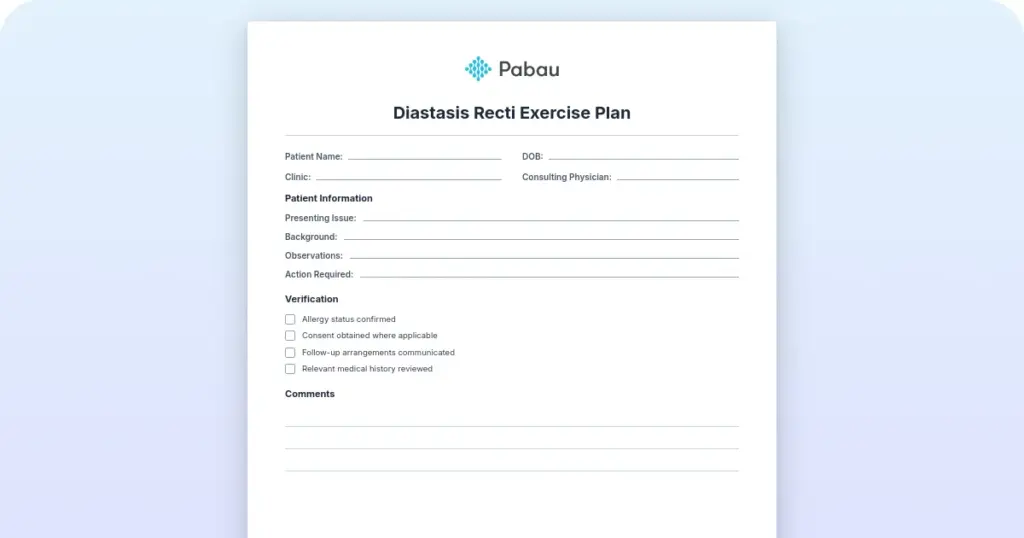
A diastasis recti exercise plan holds up between appointments only when it is written down, measured, and reviewed on a date both of you agreed. That is what this downloadable template does. It is a two-page clinical action plan. The form holds patient and record details, a background section, five goals with measures and target […]
Personal training contract: Free template and 10 clauses

A personal training contract is the written agreement between a trainer and a paying client. It sets out what you deliver, what the client owes, and who carries the risk if someone gets hurt. The free template below covers the core clauses, and the sections that follow walk through all 10 a trainer agreement needs. […]
Gym exercise plan for beginners: 5-day workout template
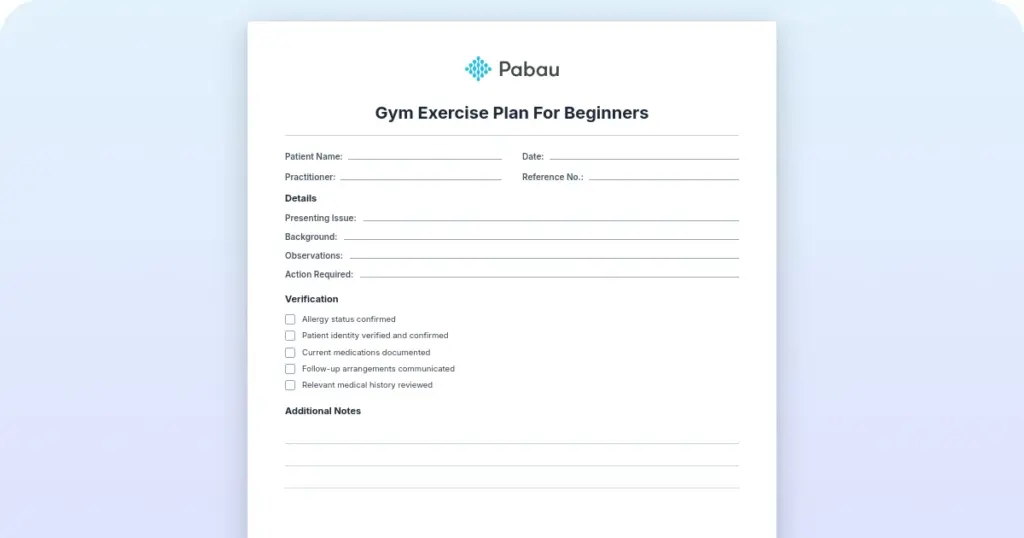
Download your free gym exercise plan for beginners A five-day training week with the exercise list, sets, reps, and rest time for every session. It also carries a movement screen, a baseline strength test, and space to log your weights each week. The return-to-activity criteria are there for a client coming back from injury. Download […]
CPT code 98942: Chiropractic manipulative treatment, 5 regions
CPT code 98942 is the billable code for chiropractic manipulative treatment (CMT) delivered across all five spinal regions. The American Medical Association (AMA) descriptor reads: Chiropractic manipulative treatment (CMT); spinal, 5 regions. It applies when a licensed chiropractor treats the cervical, thoracic, lumbar, sacral, and pelvic regions in a single visit. That makes 98942 the […]
Printable resistance band exercise chart for beginners
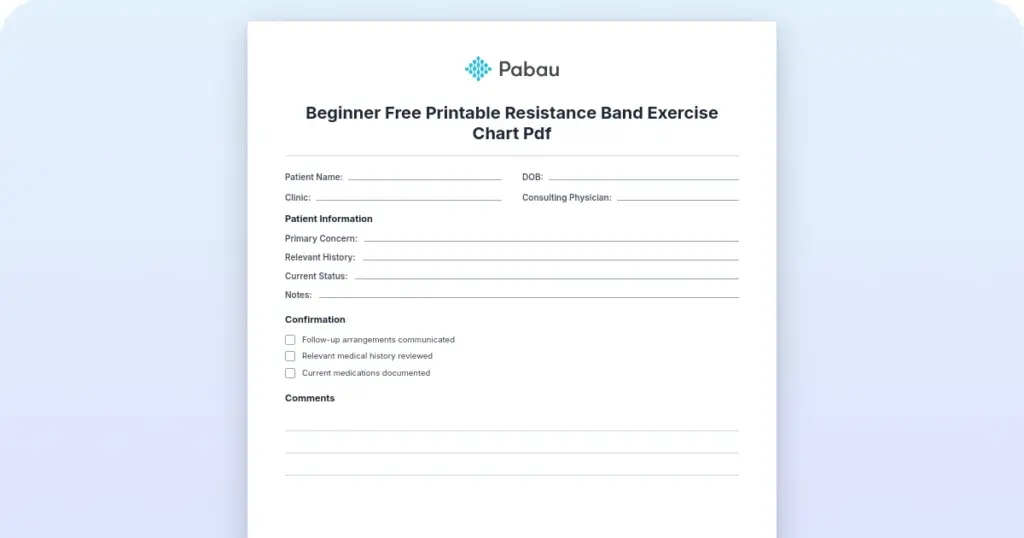
A beginner resistance band exercise chart PDF names each exercise, the muscle it works, and the sets and reps to aim for. That turns band training into a routine you can repeat instead of a guess. The plan below runs three days a week at two sets per exercise, covering upper body, lower body, core, […]
Scarf test: How to perform, interpret and document findings

The scarf test is a passive shoulder maneuver that loads the acromioclavicular (AC) joint to reproduce a patient’s pain. You take the arm across the chest in horizontal adduction, then add gentle overpressure. Pain felt over the AC joint line is a positive result. Pain anywhere else is not. What that positive result is worth […]
Gagey test: how to perform and interpret it

The Gagey test is a seated shoulder examination that measures passive glenohumeral abduction while the scapula is held still. A reading above 105 degrees counts as positive and points to laxity of the inferior glenohumeral ligament (IGHL). Normal shoulders stop at 90 degrees or less. Gagey and Gagey first described the test in 2001. It […]
Sacral thrust test: How to perform, interpret and document

The sacral thrust test is a sacroiliac joint provocation test performed with the patient lying prone. The clinician applies a firm anteroposterior force through the midline sacrum. It counts as positive only when that force reproduces the patient’s familiar posterior pelvic or SIJ pain. On its own the test settles very little. Reported sensitivity sits […]