Health appraisal form
A health appraisal form is a record a licensed provider signs to document someon...

2
Last Updated: Oct 13, 2026

SimplePractice leads on US insurance billing, telehealth, and built-in marketing tools like a therapist directory and website builder.
Carepatron competes on price, offering a free tier and AI-assisted note-taking that SimplePractice matches only at higher plan costs.
Practices outgrowing both tools – especially those running aesthetic, wellness, or multi-discipline services – should evaluate Pabau as a purpose-built alternative.
Carepatron and SimplePractice are two of the most commonly compared platforms for mental health private practice, but they solve different problems. This guide evaluates both across six criteria that matter most when choosing practice management software: scheduling, clinical documentation, billing and insurance, telehealth, pricing, and user experience. Each section covers what each platform does well, where it falls short, and which practice type benefits most.
The comparison is written for solo therapists, small group practices, and multi-discipline clinics evaluating a switch or first-time purchase. If you already know one platform well and want to understand the other, jump to the feature comparison table.
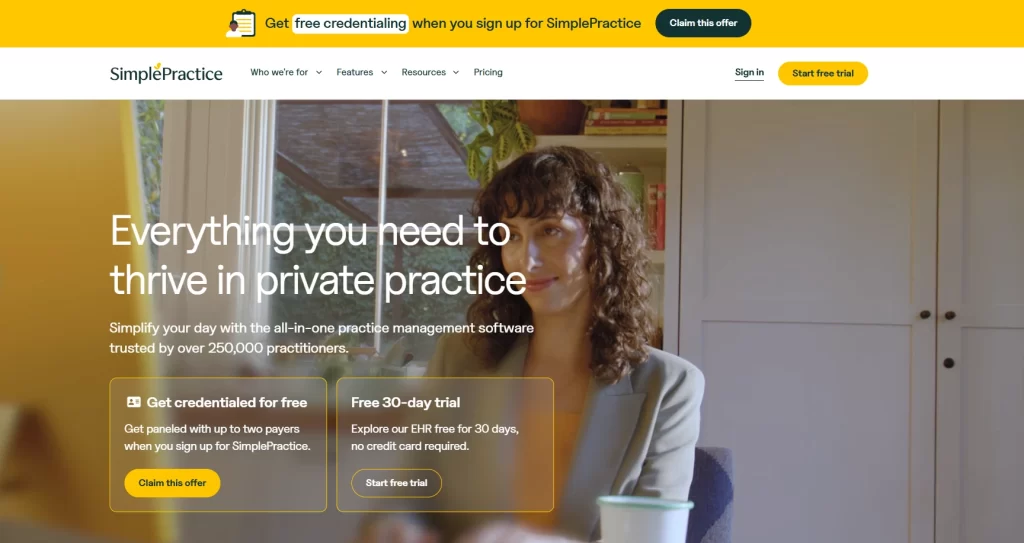
Before comparing features, the decision starts with a fundamental question: what kind of practice are you running? SimplePractice was built specifically for mental health and wellness professionals in the United States. Its feature set reflects that focus tightly – insurance billing, therapist directories, HIPAA-compliant telehealth, and treatment plan documentation are all core, not add-ons. According to SimplePractice’s official website, the platform serves over 250,000 health and wellness professionals.
Carepatron takes a broader approach. The platform targets small and mid-sized healthcare providers globally, offering a modern interface, customisable note templates, and a free tier that makes it accessible for solo practitioners just starting out. Third-party sources suggest it serves approximately 225,000 practitioners. Where SimplePractice wins in depth, Carepatron competes on accessibility and price. Both are outpatient tools — our guide to ambulatory vs inpatient EHRs explains why that distinction matters.
Pricing last verified: April 10, 2026. SimplePractice pricing updated to reflect March 2025 plan changes. Rates may change.
Scheduling is where most practitioners first feel the difference between the two platforms. SimplePractice provides a streamlined appointment booking system with a client-facing portal, automated reminders, and online intake forms. Clients can request appointments, complete paperwork before their session, and pay invoices – all without staff involvement. For a solo therapist managing a full caseload alone, that level of automation is genuinely valuable.
Carepatron integrates with personal calendars to help prevent double bookings and supports real-time updates across devices. Its interface is praised consistently for being modern and intuitive, which matters when a practitioner is toggling between clinical notes and appointment management throughout the day. For practices that want scheduling to feel light rather than administrative, Carepatron delivers that.
The gap becomes clear for any practice with more than one or two clinicians. Neither platform is built for multi-room resource allocation, practitioner-level capacity management, or the kind of complex scheduling logic a busy clinic requires. Group practices that need to manage multiple calendars, treatment rooms, and equipment simultaneously will feel that limitation quickly.
Both platforms invest heavily in documentation, but with meaningfully different philosophies. SimplePractice provides structured, therapy-specific documentation tools: progress notes, treatment plans, measurement-based care, and digital intake forms tailored to mental health workflows. For practitioners working within established therapy protocols, this structure reduces errors and keeps clinical records consistent across a caseload.
Carepatron offers customisable note templates with AI assistance, which gives practitioners more flexibility in how they structure clinical records. The AI-assisted note-taking feature has drawn positive attention from users who want to reduce documentation time without being locked into a rigid template format. According to Capterra reviewers, Carepatron’s notes customisability and integrated AI capabilities make it a strong documentation platform for practitioners who value flexibility over structure.
Where does that leave practices working outside pure mental health? Neither platform handles the clinical documentation needs of aesthetic or cosmetic practices: injection plotting, before-and-after photo management, treatment history timelines, or prescription management. Practices expanding into these areas will need to evaluate whether either tool can grow with them.
Billing is where the differences between these two platforms matter most for US-based practices. SimplePractice has built one of the stronger insurance billing workflows available in therapy-focused practice management software. It handles electronic claim filing, ERA (electronic remittance advice) processing, and client billing with a level of integration that reduces the back-and-forth between practice and insurer. The platform offers three confirmed subscription plans, with insurance billing features included at higher tiers.
Telehealth is a non-negotiable feature for most therapy practices today. SimplePractice includes HIPAA-compliant video sessions as a core part of its platform, not a bolt-on integration. Clients launch sessions directly from their portal without downloading additional software. For therapists who shifted to a hybrid or fully remote model, this reduces friction significantly – both for the practitioner and for the client experience.
Carepatron offers telehealth functionality, but it is widely noted by reviewers and third-party comparison sources as less capable than SimplePractice in this area. If telehealth is central to how your practice operates, this gap matters. A platform’s telehealth quality shows up most clearly in session stability, client access simplicity, and how documentation connects to the video appointment – areas where SimplePractice’s native integration outperforms Carepatron’s current offering.
If telehealth is your primary service delivery model, test the client-facing session launch experience before committing to any platform. Ask the vendor specifically how video appointments connect to documentation – whether the note opens automatically post-session or requires manual navigation. This single workflow detail separates polished telehealth from a basic video link.
According to Capterra reviewers, SimplePractice rates 4.6 out of 5 and earns consistent praise for its billing depth, telehealth integration, and how thoroughly it supports solo practitioners who need to run an entire practice without administrative staff. One reviewer noted that after evaluating several options, SimplePractice’s mobile usability was the deciding factor: “I chose SimplePractice because I can use it on my mobile device, so I’m not locked to a desk.”
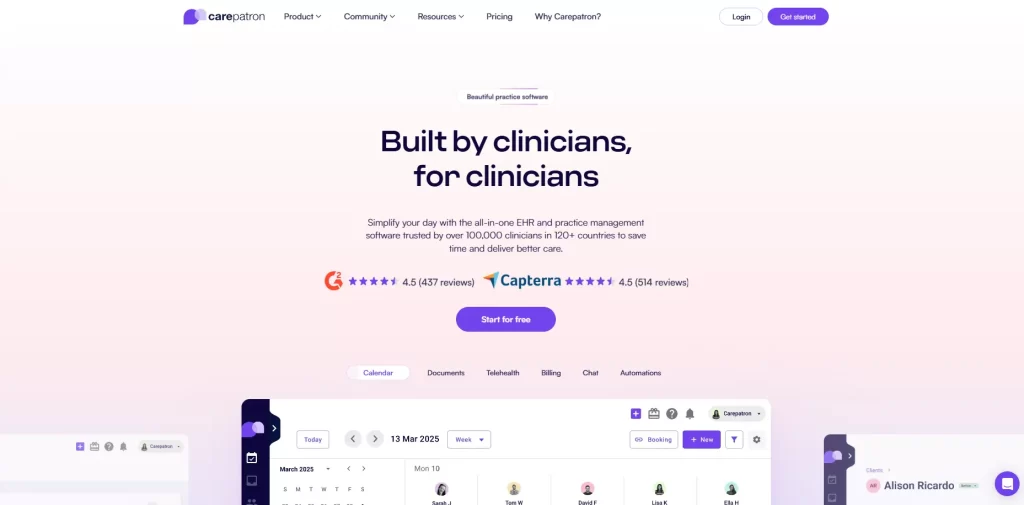
G2 reviewers give Carepatron a 4.5 out of 5 rating, with praise centred on its modern interface, affordability, and flexibility. One Capterra reviewer noted: “The notes features, customizability and now having integrated insurance and AI make Carepatron a top of the line platform.” That sentiment reflects what draws practitioners to Carepatron: the combination of a free entry point and genuinely useful AI features is difficult for SimplePractice to match at equivalent price points.
The table below reflects features as understood from published product information and verified review data at time of writing. Feature availability may change – always confirm against current vendor documentation.

Pabau is built for multi-specialty, aesthetic, and wellness practices that need more than mental health EHR features. See how one platform handles scheduling, clinical documentation, billing, and patient engagement across every service you offer.

Pricing is one of the most searched aspects of this comparison, and the two platforms take fundamentally different approaches. SimplePractice operates on a subscription model with three confirmed plan tiers. The Starter plan begins at approximately $49 per month but limits features significantly – full insurance billing and group practice tools require higher tiers. Costs increase with additional clinicians, which means a three-person group practice pays considerably more than a solo practitioner.
Carepatron’s free tier is a genuine differentiator. For a newly qualified therapist building a caseload, starting without a software subscription cost is meaningful. The trade-off is that advanced RCM features and team functionality require moving to paid plans, which brings the total cost closer to SimplePractice territory. Both platforms add costs for telehealth, additional clinicians, or premium billing features, so the total cost of ownership deserves careful evaluation beyond headline plan prices.
Run a total cost of ownership calculation before committing. For Carepatron vs SimplePractice, add telehealth costs, any per-clinician fees, and billing add-ons to the base subscription. A Carepatron free plan that requires three paid integrations to match SimplePractice’s native feature set can quickly cost more in practice than the SimplePractice Essential plan.
Review data reveals consistent patterns across both platforms. SimplePractice’s strengths cluster around billing depth and telehealth stability, while Carepatron wins on interface design and affordability. According to G2 reviewers, SimplePractice earns a 4.1 out of 5 rating, with users highlighting its robust clinical documentation and digital intake forms as core strengths. Community discussions note that practitioners who manage insurance billing heavily tend to stay with SimplePractice despite its cost, because the alternative of managing claims through a third-party tool is more disruptive than the subscription fee.
Carepatron’s reception on platforms like Capterra reflects its growing momentum: a 4.4 out of 5 rating with positive themes around its modern interface and AI note features. Multiple Capterra reviewers note switching from other platforms and finding Carepatron’s combination of interface quality and flexibility worth the migration effort. The criticism most often cited is that Carepatron’s telehealth and insurance billing tools haven’t caught up to SimplePractice’s depth in those specific areas.
The right answer depends on what your practice actually needs today and where it’s likely to go in the next two to three years. If neither feels right, comparing the wider field of SimplePractice competitors — or a closer matchup like Practice Better vs SimplePractice — can sharpen the decision.
Both Carepatron and SimplePractice were built for solo and small-group mental health practices. If your practice stays within that scope, either tool can work well. But practices that are growing into group settings, adding aesthetic or wellness services, or running multiple locations will hit the ceiling of both platforms. That is where Pabau is designed to operate.
If you are weighing Carepatron specifically, our Pabau vs Carepatron comparison breaks down where each platform fits as your practice grows.
Pabau is a clinic management platform built for multi-specialty healthcare environments. It handles multi-practitioner scheduling with room and equipment allocation, automated workflow triggers for reminders and follow-ups, and integrated telehealth for virtual consultations across specialties. Clinical documentation includes Pabau Scribe-assisted notes, customizable templates, injection plotting, and before-and-after photo tracking for aesthetic workflows.
On the billing side, Pabau offers integrated invoicing, package management, deposit collection, multi-currency billing, and claims management. For practices managing both private pay and insurance clients across multiple service types, this is a meaningful step up from what either Carepatron or SimplePractice provides.
Pabau holds a 4.7 out of 5 rating on Capterra based on over 600 verified reviews, with positive themes around comprehensive clinic management, onboarding support, and suitability for multi-practitioner environments. For practices that have outgrown both platforms or plan to, Pabau’s multi-location management and client portal are designed specifically for that environment.
The choice between Carepatron and SimplePractice comes down to one trade-off: depth versus accessibility. SimplePractice wins for US-based therapists who need robust insurance billing and polished telehealth built into a single platform. Carepatron wins on price, interface quality, and flexibility for practitioners who don’t need the full US insurance workflow stack.
Both platforms serve solo and small-group mental health practices well within those boundaries. Practices that are scaling, adding services, or running multiple locations should also evaluate platforms built for broader clinic operations, and head-to-head comparisons like Jane App vs SimplePractice, ModMed vs DrChrono for specialty practices, or Tebra vs DrChrono are useful benchmarks. Whatever you choose, run a total cost of ownership calculation that includes add-ons, per-clinician fees, and integration costs before committing.
Book a demo with Pabau to see how multi-specialty clinics get scheduling, EMR, billing, and patient engagement out of a single platform.

Need a platform built for therapy and multi-specialty clinics together? Pabau Mental Health EMR covers clinical documentation, scheduling, and billing for practices that operate across mental health and other care disciplines.
Evaluating other Carepatron alternatives beyond SimplePractice? Carepatron Alternatives compares the broader field of platforms available to small and growing practices.
Deciding between Timely and Cliniko? Timely vs Cliniko comparison explains why the choice goes beyond scheduling, since each platform assumes a different clinic type.
Weighing control against marketplace visibility? Vagaro vs Booksy comparison compares Vagaro’s scheduling control against Booksy’s marketplace reach, and introduces Pabau as an alternative.
SimplePractice is the stronger choice for US-based insurance billing. It handles electronic claims filing, ERA processing, and superbill generation natively. Carepatron offers automated invoicing and basic claims management, but its revenue cycle management depth is more limited, particularly for practices with complex payer relationships.
Carepatron offers a functional free plan that includes basic scheduling, note-taking, and invoicing. Paid plans unlock AI note-taking, advanced templates, and team features. The free tier is suited for solo practitioners just starting out, but growing practices typically need a paid plan to access the full feature set.
Carepatron does offer telehealth, but it is consistently rated by reviewers as less capable than SimplePractice’s built-in HIPAA-compliant video sessions. If telehealth is central to your practice model, SimplePractice’s native integration is generally the more reliable choice.
SimplePractice starts at approximately $49 per month for its Starter plan, with higher tiers required for full insurance billing and group features. Carepatron has a free entry tier with paid plans starting around $49 per month according to third-party sources. When telehealth and billing features are factored in, the total cost difference narrows considerably.
SimplePractice leads on US insurance billing depth, telehealth integration quality, and built-in practice marketing tools like a therapist directory. Carepatron leads on price (with a free plan), interface modernity, AI-assisted documentation flexibility, and international accessibility. Your practice’s billing model and growth trajectory determine which trade-off serves you better.
Neither Carepatron nor SimplePractice is designed for aesthetic, wellness, or multi-specialty clinical workflows. Practices adding services like IV therapy, aesthetic treatments, or functional medicine should evaluate platforms built for those environments rather than adapting therapy-focused software beyond its intended scope.