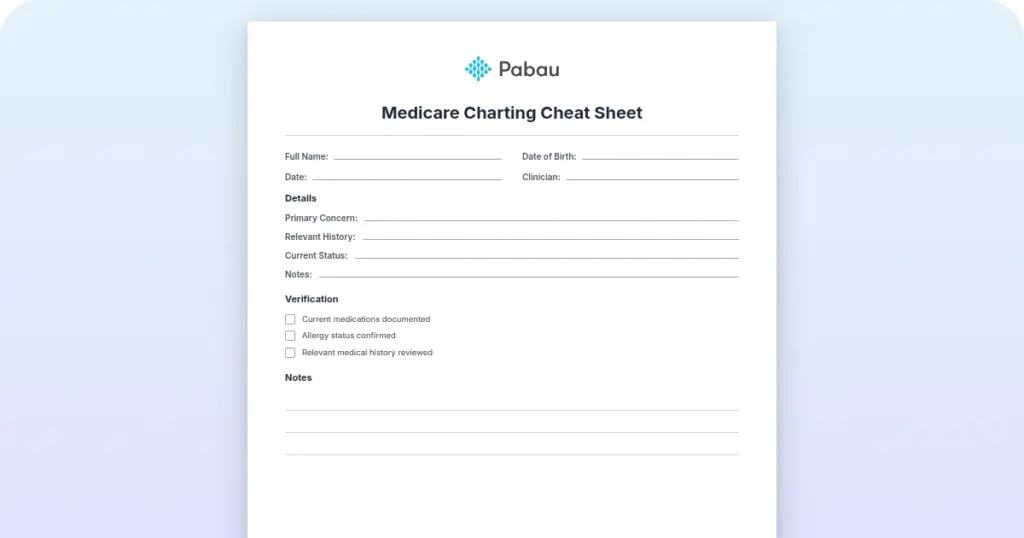
Medicare charting cheat sheet
A Medicare charting cheat sheet is a one-page reference that lists what Medicare...

2
Last Updated: Oct 21, 2026
The best obgyn EHR for an OB-heavy group is ModMed, with athenaOne close behind. For a gynecology-led or women’s wellness practice, Pabau, the practice software we build, is the stronger fit.
Generic EHR roundups score OB-GYN software like any other specialty. This purchase turns on three narrower capabilities: a prenatal flowsheet, global OB billing, and abnormal results tracked until they close. Miss one, and the cost shows up as denied claims or a Pap result nobody followed up.
We ranked six systems on those capabilities, using each vendor’s own website. Below are the reviews, a feature matrix, and the Global-package test, which runs one pregnancy through each demo before you sign.

1. ModMed — strongest fit for OB-heavy groups that want an ACOG-style prenatal flowsheet and global OB tracking.
2. athenaOne — best for multi-provider groups that need OB episodes, global maternity billing and shared records.
3. AdvancedMD — best for billing-led independent practices that want global OB billing plus a portal and kiosk.
4. Pabau — best for gynecology-led and women’s wellness practices that run on booking, intake, follow-up and payments.
5. Greenway Health — good for practices that want trimester-based OB flowsheets alongside scheduling and reminders.
6. PrognoCIS — suits small practices that want one prenatal workflow, a portal and patient self check-in.
The table lists the six systems in ranked order on the three capabilities that decide an OB-GYN purchase, plus published pricing. Every cell comes from the vendor’s own website, checked in October 2026.
| Provider | Best for | Prenatal flowsheet | Global OB billing | Booking + reminders | Pricing |
|---|---|---|---|---|---|
1ModMed | OB-heavy specialty groups | ACOG-style with gestational age and due date | Tracks the global period | Self-scheduling in the Premium+ package | No published pricing |
2athenaOne | Multi-provider groups sharing records | OB Episode with the ACOG antepartum record | Global maternity billing | Automated well-visit reminders | No published pricing |
3AdvancedMD | Billing-led independent practices | ACOG-similar flowsheets | Global OB package | Online self-scheduling and reminders | Quote per provider per month |
4Pabau | Gynecology-led and women’s wellness practices | Not listed | Not listed | 24/7 online booking and SMS or email reminders | From $62/month for one user |
5Greenway Health | Practices wanting trimester templates | OB-specific flowsheets | Not listed | Reminders listed but self-booking not listed | No published pricing |
6PrognoCIS | Small practices wanting self check-in | Prenatal workflow | Not listed | Email and text reminders | No published pricing |
ModMed (Modernizing Medicine) builds specialty EHRs, and its OB-GYN content is coded by board-certified OB-GYNs. ModMed’s EHR, called EMA, documents pregnancies, annual visits and procedures on a touch-based interface.

“Overall, ModMed is easy to use and makes for a seamless check-in process despite occasional glitches.” Maya A., Capterra reviewer
“Customer support could use some work. … It is extremely difficult to get someone to speak with you directly on the phone rather than by email.” Sarah Kate H., Capterra reviewer
ModMed is best for OB-heavy groups that deliver babies and want prenatal charting and global OB billing in a single specialty system.
ModMed doesn’t publish prices on its website, so ask for a quote that names the package tier.
athenaOne is athenahealth’s cloud EHR, and athenaOne for Women’s Health packages it for OB-GYN, menopause care and other subspecialties. athenaOne automatically exchanges patient data with care sites across the healthcare ecosystem.

“What I enjoy most about Athena is the ability to have my billing, schedule, and chart open so I can multitask.” Kimberly S., Capterra reviewer
“Some workflows feel overly complex and require too many clicks to complete simple tasks. The system can be slow at times.” Tabatha W., Capterra reviewer
athenaOne is best for multi-provider OB-GYN groups that share records with hospitals and want billing support bundled with the EHR.
athenahealth doesn’t publish prices on its website, so request a written quote for your provider count and specialty.
AdvancedMD is a cloud EHR and practice management suite with an OB-GYN configuration. AdvancedMD’s flowsheets follow the ACOG data structure, and the OB Summary keeps key pregnancy data on the patient’s demographics screen.

“The EHR and PM (billing module) are well designed, efficient, and they work. The portal is very functional.” Scott H., Capterra reviewer
“Everything needs to be paid for and support isn’t the best.” Julian A., Capterra reviewer
AdvancedMD is best for independent OB-GYN practices that want global OB billing and patient self-service from one vendor.
AdvancedMD prices per provider per month and quotes through its bundle builder, so ask for the OB-GYN bundle in writing.
Pabau is an all-in-one practice management system that puts scheduling, patient records, forms, labs, payments and marketing on one patient record. For OB-GYN practices, its strength is the patient journey around each visit.
Pabau is the strongest pick here for gynecology, well-woman and women’s wellness care. It ranks fourth overall because Pabau’s OB-GYN page doesn’t list a prenatal flowsheet or global OB billing. A delivering practice should look at ModMed or athenaOne first.
Pabau Scribe, our AI scribe. Pabau Scribe turns the consultation conversation into structured clinical notes.
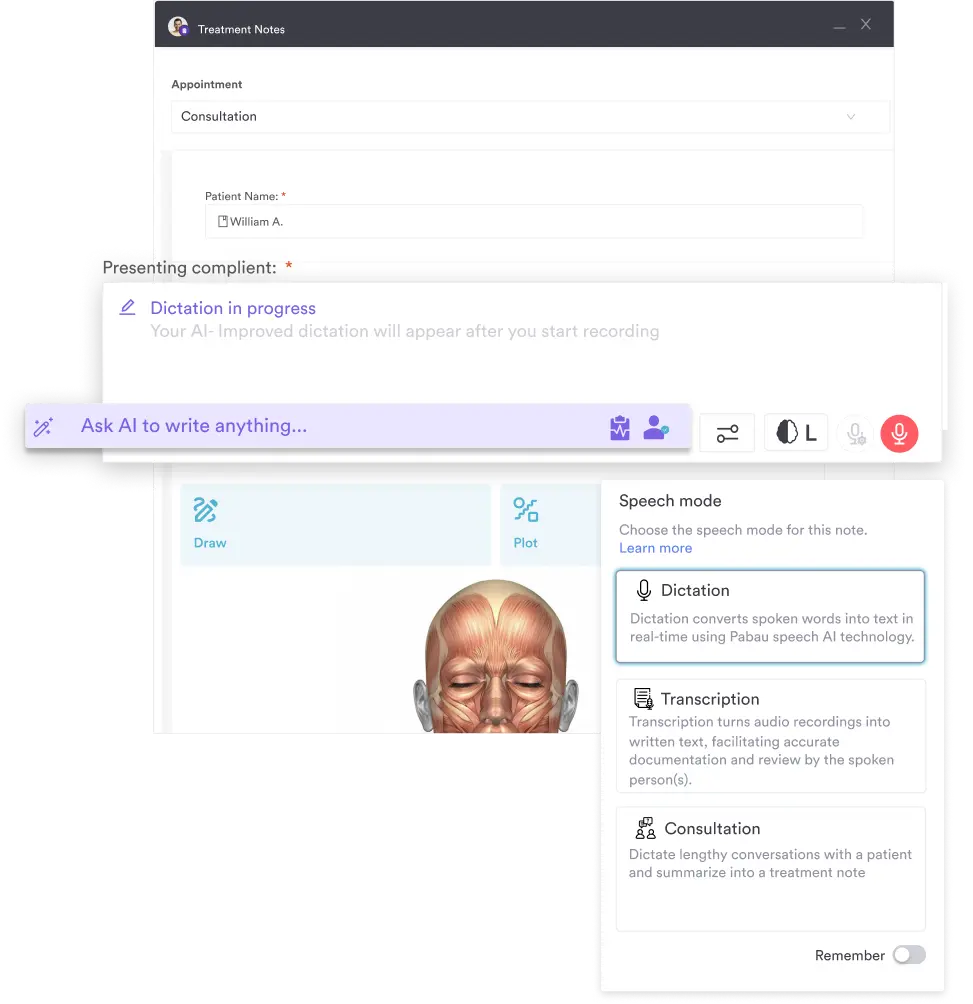
“I’m able to document my notes by talking into the AI tool, and that has saved me so much time…I really love it!”

Lab orders and results. Pabau connects to 123+ lab partners across the UK, US and beyond. Results land in a Lab Inbox, and out-of-range values are highlighted against the reference range.

E-prescribing. Prescriptions go out from the patient record with automated allergy alerts. In the UK, Pabau integrates with pharmacy partners such as CloudRx, SignatureRx and Pharmacierge.

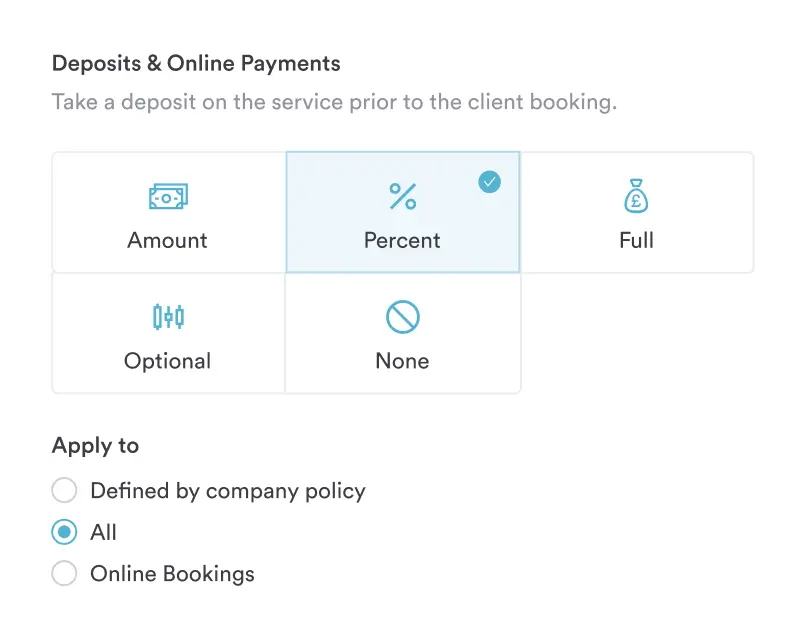
Booking, intake and payments. Patients book online around the clock, complete intake and consent forms before they arrive, and get SMS and email reminders. Deposits, packages and invoices sit on the same record.
“Pabau meets all my EMR needs and has many integrated options like online patient portals, patient self-scheduling…” Nonika M., G2 reviewer
“Because Pabau is feature-rich, new users sometimes find it complex or overwhelming at first, particularly when transitioning from simpler systems. It can take time and training to feel fully comfortable.” G2 reviewer
Pabau is best for gynecology-led, well-woman and women’s wellness practices whose revenue depends on rebooking, recalls and smooth intake.
Book a demo to see Pabau’s booking, intake and recall flow set up for a gynecology practice.
| Plan / Tier | Price | Details |
|---|---|---|
| Starter | From $65/month | Per practitioner; billed monthly |
| Team / Group | Scales by location and user count | Volume-based pricing |
| Enterprise | Custom pricing | Contact sales for a quote |
Pabau starts at $62/month for one user and scales with users and locations, with every feature in every plan. Pabau’s pricing page lists the full plan breakdown.
Greenway Health sells Intergy, a cloud-based EHR for ambulatory practices, with an OB-GYN configuration. Greenway’s OB-GYN page covers OB history, ultrasound documentation and postpartum care plans.

“Intergy is easy to navigate. I find the information needed for patient care with ease. I like the availability of medication costs per pharmacy in the prescribing section.” G2 reviewer, 2022
Greenway Health is best for ambulatory OB-GYN practices that want structured trimester templates and built-in patient education.
Greenway Health doesn’t publish prices on its website, so ask for a quote that separates each module.
PrognoCIS, from Bizmatics, is a cloud EHR and practice management system with OB-GYN templates. PrognoCIS describes itself as ONC certified and HIPAA compliant, and it serves smaller teams as well as growing groups.

“Incredible customer service! … I was always impressed with how quickly reps would contact me regarding my need.” Jason C., Capterra reviewer
“One challenge we occasionally experience with PrognoCIS is that the ePA (electronic prior authorization) feature is not always consistently available.” Rebecca D., G2 reviewer
PrognoCIS is best for small OB-GYN practices that want a single prenatal workflow and patient self check-in without enterprise complexity.
PrognoCIS doesn’t publish prices on its website, so ask whether your quote is per provider or per encounter.
The best EHR for ob gyn practices covers six capabilities natively: prenatal charting, global OB billing, imaging and labs, Pap follow-up, intake, and HIPAA safeguards.
Gynecology EHR demos usually open with templates, which are the easiest part to make look good. Judge each system on the workflows below instead, starting with the flowsheet your clinicians will open at every prenatal visit.
The matrix shows where each vendor’s own website confirms each capability. “Not listed” means the vendor’s site doesn’t claim it, which makes it a demo question rather than a no.
| Provider | Prenatal flowsheet | Global OB billing | Ultrasound or images | Pap or abnormal result follow-up | Portal, intake or check-in | Booking + reminders |
|---|---|---|---|---|---|---|
1ModMed | Yes | Yes | Image management and PACS | Colposcopy mapping | Portal and kiosk | In Premium+ |
2athenaOne | Yes | Yes | Ultrasounds in prenatal workflow | Cancer screening reminders | Portal access and messaging | Partial |
3AdvancedMD | Yes | Yes | Not listed | Out-of-range lab alerts | Portal, kiosk and online intake | Yes |
4Pabau | Not listed | Not listed | Clinical photos only | Abnormal lab values flagged | Client Portal and pre-visit forms | Yes |
5Greenway Health | Yes | Not listed | Ultrasound documentation | Not listed | Mobile intake | Partial |
6PrognoCIS | Yes | Not listed | Images stored as PDF | Not listed | Portal and self check-in | Partial |
A prenatal flowsheet should calculate gestational age and due date, then trend the values recorded at every antepartum visit. Several of those values come from routine prenatal tests timed to specific weeks of pregnancy. Check that the flowsheet captures these without free text:
An obgyn EHR should hold the global claim until delivery while still billing services outside the package. The Global-package test below shows exactly which services those are.
Results should land in the chart with abnormal values flagged, and an abnormal Pap needs a tracked next step until it closes. Structured notes, such as a pelvic exam documentation template, make that follow-up easier to audit.
A good obgyn check-in system sends intake forms before the visit, so patients arrive with history, consents and insurance details already in the chart.
Pabau sends digital intake forms automatically before each appointment. Patients can also complete them through the patient portal, where they rebook or cancel themselves.
For waiting-room check-in, ModMed and AdvancedMD list a patient kiosk, and PrognoCIS lists patient self check-in.

Reproductive health records are some of the most sensitive data a practice holds. Confirm the platform offers:
Pabau meets HIPAA standards with role-based access controls, encryption and full audit trails. Book a demo to see how Pabau handles access and audit trails for your practice.
Ask each vendor for an implementation plan with dates for data migration, template build and staff training.
Small OB-GYN practices should compare total cost, not headline price, because most vendors here quote per provider and price modules separately.
Pabau is the only system on this list with a published starting price. AdvancedMD says bundles save up to 40% against buying each product separately, so ask every vendor for bundled and unbundled quotes.
The Global-package test runs one pregnancy through the demo, from confirmation visit to postpartum, to check the EHR tracks the global package and abnormal results.
Here is the pregnancy to run. A patient confirms her pregnancy, and the antepartum record opens at the next visit. That confirmation visit is billed on its own, per UnitedHealthcare’s obstetrical policy, which follows CPT and ACOG.
About 13 routine antepartum visits then roll into one global code, such as 59400 for a vaginal delivery or 59510 for a cesarean. Weight, blood pressure, fetal heart tones and routine urinalysis are included.
Labs, OB ultrasounds, non-stress tests and amniocentesis sit outside the package, according to the SMFM Coding Committee. Extra visits for complications carry modifier 25 and are reported after delivery.
Delivery starts a six-week postpartum window, and an unrelated problem inside it takes modifier 24. CMS defines modifier 58 for a staged or related procedure and 78 for an unplanned return to the operating room.
The timeline below maps that pregnancy stage by stage, with the alert an EHR should raise at each one.
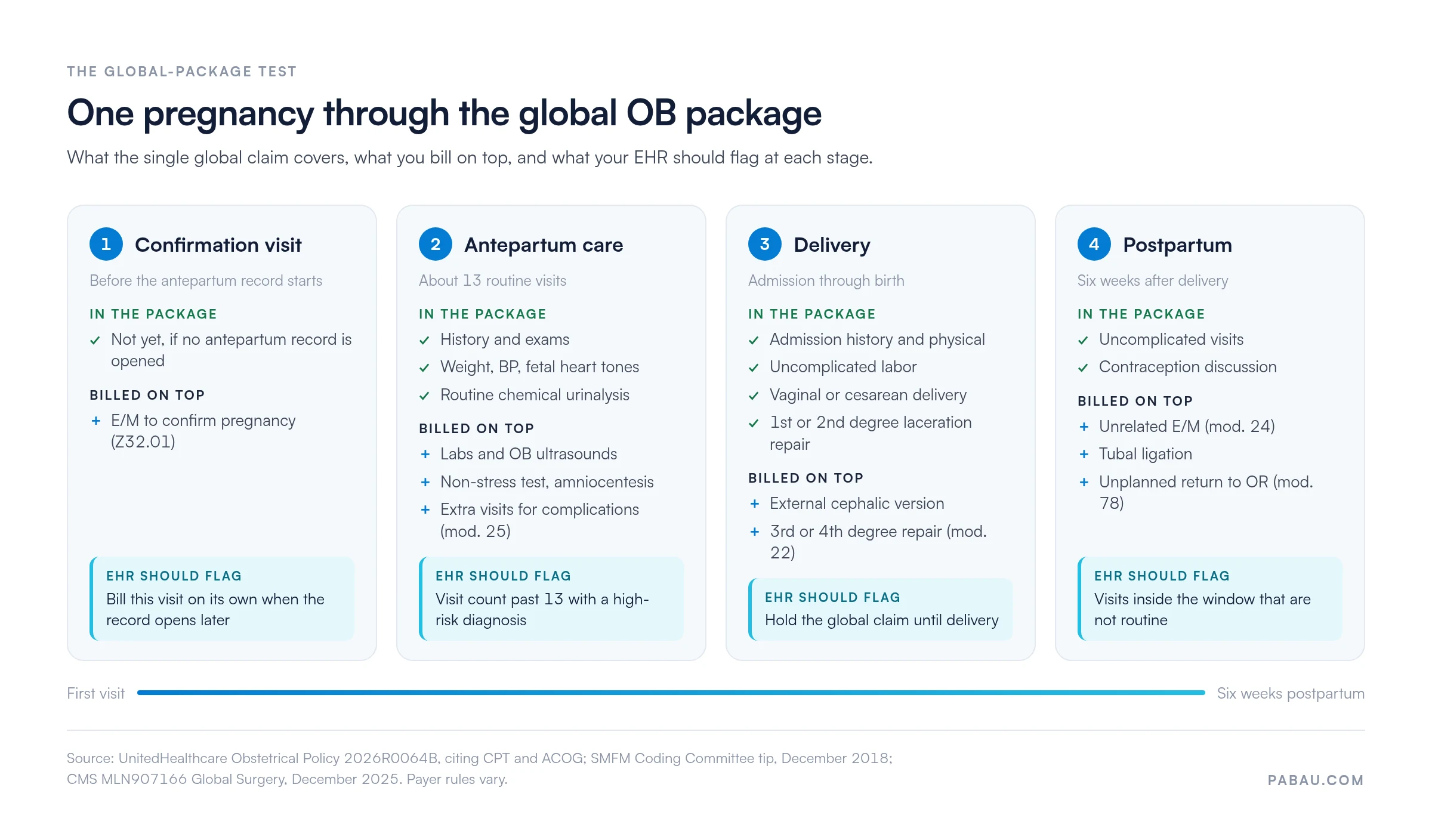
Once you know the stages, ask the vendor to run these seven requests live, on a test patient, without switching to slides:
A vendor that needs a workaround for two or more of these will cost you in denials or missed follow-ups. Score each answer yes, workaround or no, and compare finalists side by side.
Before you sign, check the quote and contract for these four mistakes:
Match the EHR to your revenue driver: delivering practices need global OB billing, gynecology-led practices need patient engagement, and midwifery hybrids need shared prenatal records.
| Practice type | The one capability that decides it | Pick |
|---|---|---|
Solo gynecology practice | Fast intake, online booking and recalls | Pabau or PrognoCIS if you also need a prenatal workflow |
OB-heavy group that delivers | Global OB billing tied to a prenatal flowsheet | ModMed or athenaOne |
Hybrid midwifery and OB practice | One prenatal record every clinician shares | athenaOne or AdvancedMD |
Women’s wellness or aesthetic-adjacent practice | Booking, payments, memberships and marketing | Pabau |
Billing-led independent practice | Claims and global OB from one vendor | AdvancedMD |
The best platform for obgyn practices that also offer fertility or IVF care needs cycle tracking too. Our guide to software built for fertility practices covers that setup.
Yes, telehealth works for gynecology consults, results discussions, contraception follow-ups and postpartum check-ins, while pelvic exams, Pap tests and ultrasounds need an in-person visit.
All six systems here list telehealth on their own websites. Pabau runs video consultations on the same patient record as booking, notes and payment, with telehealth billed through credits.
Plenty of OB-GYN practices run engagement on a patchwork: the EHR for charting, a separate texting tool and a spreadsheet of overdue recalls. Pabau works as CRM software for obstetrics & gynecology practices and replaces that patchwork with one patient record.
Here’s how one patient moves through it. She books her annual exam online and gets the intake form for that visit type. SMS and email reminders follow, and her reviewed results reach the Client Portal.
When we onboard women’s health practices, our team maps booking rules, forms and reminders to each appointment type before go-live. A delivering practice can run Pabau for engagement next to its obstetric EHR, connected through the Pabau API or Zapier.
Book a demo to see recalls and reminders built around your appointment types.

Pabau puts online booking, intake forms, reminders, lab results and recalls on one patient record, so your front desk stops chasing patients between visits.

Choose by practice type first. If you deliver babies, shortlist ModMed and athenaOne, then AdvancedMD if billing control matters most. If gynecology and wellness visits fill your calendar, Pabau gives you stronger patient engagement.
Then run the Global-package test on every finalist. Any finalist that can’t hold the global claim, flag a 14th high-risk visit and close an abnormal Pap will cost you in denials.
The trade-off is depth against reach. Obstetric EHRs chart pregnancy best, and engagement platforms keep patients coming back. Book a demo to see how Pabau keeps gynecology patients booked, informed and followed up.

Running fertility services too? Best IVF clinic management software compares platforms built for cycle tracking and IVF workflows.
Planning the six-week postpartum visit? Postpartum care plan template structures recovery goals, screening and follow-up for each patient.
Counseling patients on ovarian reserve results? AMH levels interpretation guide covers normal AMH ranges by age and what results mean for IVF protocols.
Evaluating a patient for CAH or PCOS? 17-hydroxyprogesterone test reference covers reference ranges, specimen collection, and the CPT code for this test.
Ordering fetal monitoring outside the global package? Nonstress test guide explains the procedure, what it checks and how to read the results.
Not among these six. OpenEMR is free, open-source EHR software, so the license costs nothing. You still pay for hosting, setup, OB templates and support, so price those before you compare it with a subscription.
A start-up gynecology practice needs fast setup and predictable cost. Pabau publishes a starting price of $62 per month for one user, and PrognoCIS targets small teams. If you plan to deliver babies, start on ModMed or athenaOne, since moving open pregnancies later is harder.
The best app for gynecologists is the mobile app of the EHR you already use, so charts stay in one record. ModMed offers touch-based charting, AdvancedMD has iOS and Android apps, and Pabau offers Pabau GO, our iOS app for practitioners.
An electronic health record (EHR) is a digital patient chart built to share data with labs, hospitals and other providers. An electronic medical record (EMR) usually stays inside one practice. Most vendors use the terms interchangeably.
Most obgyn EHR software is quote-based. Of the six systems here, only Pabau publishes a starting price, $62 per month for one user. AdvancedMD quotes per provider per month, and the other four publish no prices.
Most medical offices use a certified EHR, often paired with practice management software for scheduling and billing. The ONC reports that 78% of office-based physicians had adopted a certified EHR by 2021.