A postpartum care plan is a structured clinical document that guides holistic care for new mothers during the critical postnatal period. It covers physical recovery, mental health screening, infant feeding support, and safe discharge planning.
ACOG and AWHONN recommend comprehensive postpartum assessment including uterine involution, lochia monitoring, perineal evaluation, and Edinburgh Postnatal Depression Scale (EPDS) screening to identify complications early.
The postpartum period runs beyond the traditional 6-week timeline. Updated guidelines support evaluation at 3 weeks, 6 weeks, and 12 weeks after birth.
Practice management software like Pabau embeds the care plan directly in the patient record. That gives you digital documentation, automated patient education, and discharge checklists inside one workflow.
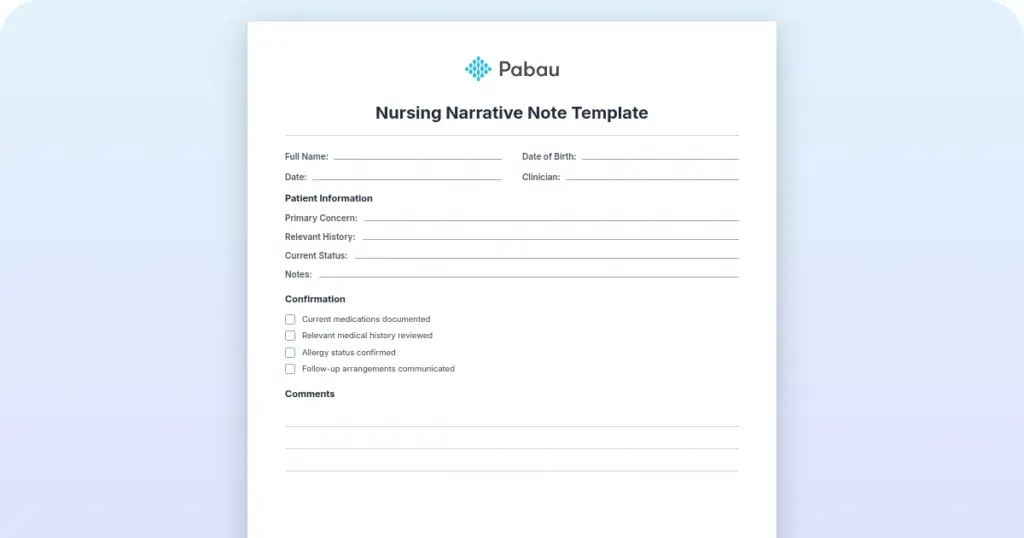
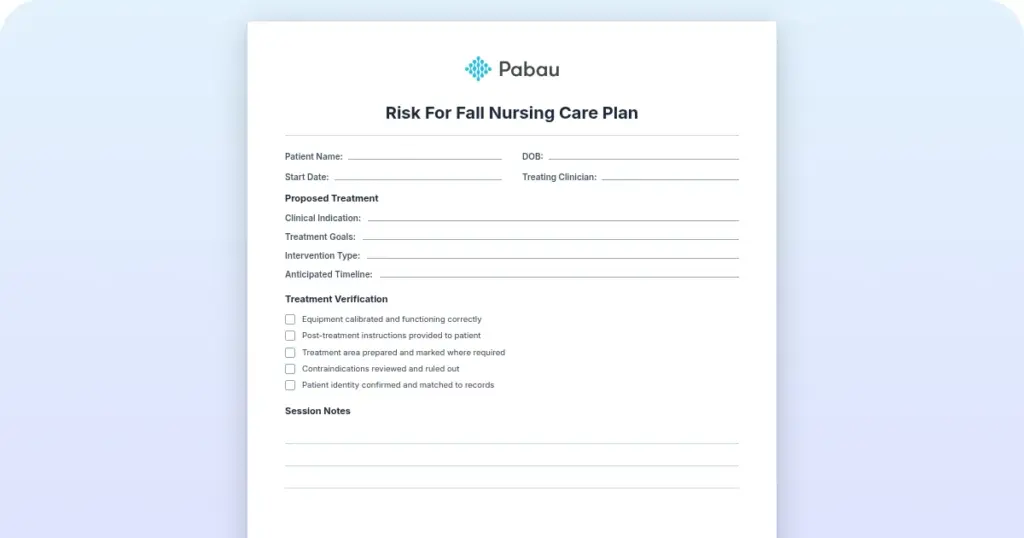
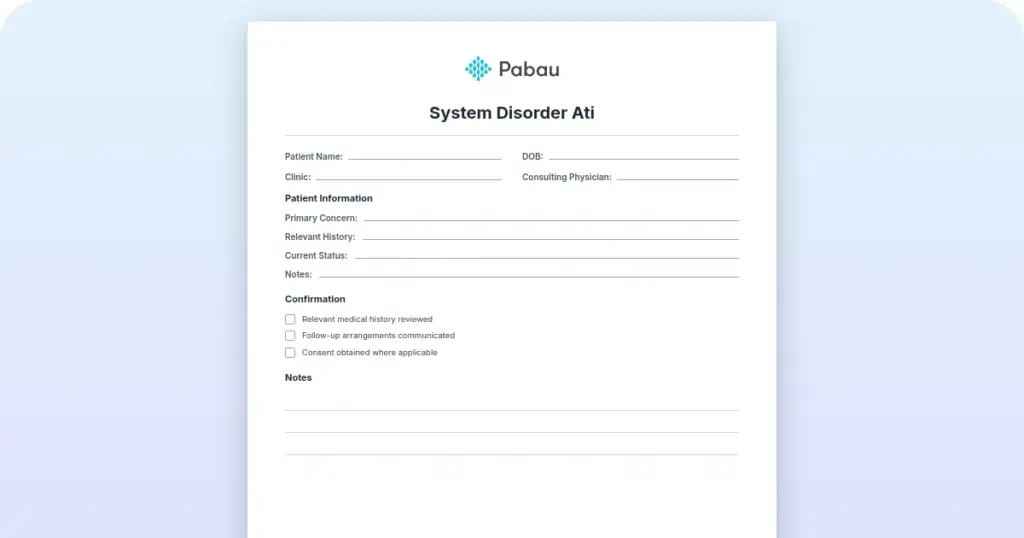
Download your free postpartum care plan template
A ready-to-use template covering maternal assessment, nursing diagnoses, mental health screening, and breastfeeding support. It also carries warning sign monitoring and a discharge planning checklist for clinical teams.
A postpartum care plan is a structured clinical framework that guides comprehensive care for new mothers during the puerperium. That is the period following delivery, usually the first 6 to 12 weeks after birth. This template addresses the physical, emotional, and psychological dimensions of postpartum recovery. It aligns with evidence-based guidance from ACOG, the American College of Obstetricians and Gynecologists. It also follows AWHONN standards, set by the Association of Women’s Health, Obstetric and Neonatal Nurses.
A comprehensive plan covers maternal assessment, including uterine involution, lochia, and perineal healing. It also covers infant feeding support, mental health screening with validated tools, warning signs, patient education, and safe discharge planning. It serves as a clinical roadmap for nurses, midwives, nurse practitioners, and physicians managing the postpartum patient. Those touchpoints include in-hospital recovery, early postpartum visits, telehealth follow-ups, and community transitions.
Postpartum care plans also rest on a clear regulatory foundation. That includes The Joint Commission maternal safety bundles, CDC maternal health standards, and state nursing practice acts. Clinicians use NANDA International nursing diagnoses to standardize the clinical reasoning process. That keeps care quality and documentation compliance consistent across shifts and settings.
Found our content helpful?
How to create a postpartum care plan: 5 operational steps
Building a postpartum care plan within your clinical workflow requires systematic assessment, evidence-based diagnosis, targeted interventions, and measurable outcomes. Below are five operational steps grounded in standard postpartum nursing practice and validated assessment frameworks:
Complete initial postpartum assessment: Run a full BUBBLE-HE assessment within 2-4 hours of delivery or admission to the postpartum unit. The first letters cover bladder output and urinary retention, bowel function and constipation risk, and breast tissue for engorgement and latch readiness. Next come uterine tone and involution, plus lochia flow by amount, color, odor, and clots. Wound healing follows, whether from an episiotomy, a laceration, or a cesarean incision. The last two letters cover Homans sign for DVT risk and emotional status, including risk factors for postpartum depression. Document findings in a structured digital assessment form that feeds straight into the clinical record. That keeps documentation continuous across care transitions.
Identify postpartum nursing diagnoses: Use the NANDA-I taxonomy to select diagnoses that fit your assessment data. Common examples are acute pain related to perineal trauma, impaired breastfeeding related to a knowledge deficit, and risk for postpartum hemorrhage. Map each diagnosis to defining characteristics and related factors documented during assessment. This step ensures clinical reasoning is transparent and helps the team prioritize interventions by acuity.
Establish measurable goals and interventions: Define a patient-centered outcome for each nursing diagnosis. One might read: Mother will verbalize an effective pain management strategy by discharge. Another might read: Infant will latch with audible swallows by 24 hours. Link evidence-based interventions to each goal, covering pain management, wound care, breastfeeding support, mental health referral, family education, and medication administration. Rationales anchor each intervention to clinical evidence.
Conduct perinatal mood and anxiety disorder (PMAD) screening: Administer the Edinburgh Postnatal Depression Scale at hospital discharge, 2 weeks, and 6 weeks postpartum. The EPDS has 10 items and scores from 0 to 30. A score of 10 or higher indicates possible depression and calls for further assessment. A score of 13 or higher indicates probable depression. Differentiate baby blues, which brings mood lability and fatigue peaking on days 3-5, from postpartum depression, which persists and impairs function. Document screening results and referral actions in the clinical record for accountability.
Plan discharge and follow-up coordination: Work through a multidisciplinary checklist before the mother leaves. Confirm her physical recovery status, and verify that the feeding plan and its education are complete. Book the postpartum visit before discharge, since ACOG now recommends contact within 3 weeks rather than a single 6-week visit. Hand over written warning sign instructions covering heavy bleeding, fever, chest pain, and suicidal ideation. Arrange a mental health referral if PMAD risk is identified, then document what the patient and family were taught. Digital patient portals deliver those instructions and appointment reminders securely, which lifts admin work off postpartum teams.
Maternal assessment framework
Systematic assessment is the foundation of a postpartum care plan. The BUBBLE-HE framework and additional assessment domains ensure clinicians detect complications early and respond with evidence-based interventions:
Assessment component
Normal findings
Abnormal or concerning findings
Uterine involution
Fundus descends 1 cm per day, firm and midline, reaching the pubic symphysis by day 10
Boggy, deviated, or higher than expected, which points to delayed involution or hemorrhage
Lochia
Rubra (dark red, days 1-3), serosa (pinkish, days 4-7), alba (yellowish-white, by week 2), scant by week 3-4
Saturation of more than one pad per hour, clots larger than a golf ball, foul odor, or rubra persisting after day 3
Perineal wound
Intact and pink with no ecchymosis, or a healing episiotomy or laceration with good approximation and minimal edema
Separation, purulent drainage, severe edema, fever, warmth, or increasing pain on day 3 and beyond
Breastfeeding (if applicable)
Infant latches with a flanged lip and audible swallows, mother reports relief after the feed, no nipple pain
Poor latch, cracked or bleeding nipples, pain during nursing, infant weight loss above 10%, or feeding refusal
Vital signs and hemodynamics
Blood pressure back to baseline, or below 140/90 if it was elevated in pregnancy. Heart rate 60-100, temperature 36.5-37.5°C, oxygen saturation above 95%
Fever ≥38°C (100.4°F), hypotension, heart rate above 110, severe headache, or visual changes suggesting preeclampsia
Emotional and mental status
Mood appropriate to context, bonding behaviors observed, coping skills intact, sleep and appetite at baseline, no suicidal ideation
Flat affect, crying episodes, reported hopelessness, difficulty with infant care, sleep disturbance, EPDS score of 10 or higher
Common postpartum nursing diagnoses
NANDA-I nursing diagnoses provide a standardized language for postpartum clinical reasoning. The following are the most prevalent diagnoses in postpartum populations, each with defining characteristics and evidence-based interventions:
Acute pain: Related to uterine cramping, perineal trauma, cesarean incision, or breast engorgement. Defining characteristics are a self-reported score of 4 or higher on a numeric pain rating scale, grimacing, guarding behavior, and requests for analgesia.
Risk for postpartum hemorrhage: Risk factors include uterine atony, retained placental fragments, or coagulation disorders. Preventive interventions are uterotonic medications such as oxytocin or methylergonovine per protocol, uterine massage, IV fluid resuscitation, and frequent fundal assessments.
Impaired breastfeeding: Related to knowledge deficit, infant latch dysfunction, or maternal pain. Interventions are lactation consultant referral, positioning education, structured assessment tools that track latch progression, and nipple care education.
Risk for infection: Related to an open wound from an episiotomy, laceration, or cesarean incision, and to lochia. Preventive measures include perineal hygiene education, clean technique during wound inspection, monitoring for fever and purulent drainage, and antibiotic prophylaxis per ACOG guidelines.
Ineffective coping: Related to postpartum hormonal shifts, sleep deprivation, adjustment to motherhood, or unresolved trauma. Defining characteristics are crying, irritability, difficulty making decisions, and avoidance of infant care. Interventions include mental health screening with a psychiatric evaluation template, peer support groups, referral to psychology or psychiatry, and safety assessment.
Mental health screening and postpartum depression prevention
Mental health screening is a non-negotiable component of postpartum care. Screening with validated instruments, paired with risk factor assessment and early intervention, reduces maternal morbidity and improves infant outcomes:
Edinburgh Postnatal Depression Scale (EPDS) is the gold standard screening tool recommended by ACOG, AWHONN, and Postpartum Support International. This 10-item questionnaire takes 2-3 minutes. It queries mood, anxiety, guilt, suicidal ideation, and functional impairment over the prior week. A score of 10 or higher indicates possible depression and calls for further assessment. A score of 13 or higher indicates probable depression. Administer the scale at hospital discharge, 2 weeks, and 6 weeks postpartum to capture the trajectory of postpartum mood.
Baby blues vs postpartum depression: Baby blues brings transient mood lability, fatigue, and crying episodes. It peaks on days 3-5 and resolves by day 14 in 50-80% of new mothers. Reassurance and family education are usually enough. Postpartum depression, coded as F53.0, develops over weeks, persists beyond 14 days, and impairs functioning. Its features include hopelessness, guilt, sleep disturbance beyond what infant care explains, and loss of interest in activities the mother once enjoyed. Untreated postpartum depression raises the risk of maternal suicide, the leading cause of postpartum death in high-income countries. It also raises the risk of infant neglect or maltreatment, so prompt referral to a mental health clinician is essential.
Perinatal mood and anxiety disorders (PMADs) encompass postpartum depression, postpartum anxiety disorder, postpartum obsessive-compulsive disorder, and postpartum psychosis. PMADs affect 1 in 5 new mothers. Risk factors include a prior mood disorder, intimate partner violence, inadequate support, and difficult labor or delivery. Screening should be routine rather than risk-stratified, so cases in low-risk-appearing women are not missed. Refer any positive screen, meaning an EPDS score of 10 or higher, to psychiatry, psychology, or maternal-fetal medicine.
Warning signs and postpartum complications checklist
Patient safety during postpartum discharge depends on clear communication of red flags and empowered self-advocacy. Give every postpartum patient a written and digital warning sign checklist. Then document that the education was delivered and understood:
Severe bleeding: Soaking more than one pad per hour, passing clots larger than a golf ball, dizziness, rapid heartbeat, or chest pain. Seek emergency care immediately.
Infection: Fever ≥38°C (100.4°F), chills, foul-smelling lochia, warmth or redness at the incision site, or urinary frequency and burning without another cause. Call the OB provider or go to the ED.
Thromboembolism: Unilateral calf or leg swelling, warmth, redness, and calf tenderness point to deep-vein thrombosis. Sudden chest pain, shortness of breath, and rapid heartbeat point to pulmonary embolism. Seek emergency care.
Severe headache or vision changes: Postpartum preeclampsia can develop days after discharge. Severe headache, visual disturbances, upper abdominal pain, or blood pressure ≥160/110 warrant immediate evaluation.
Mental health crisis: Suicidal or homicidal thoughts, inability to care for self or infant, disorientation, or hallucinations. Call 988, the Suicide and Crisis Lifeline, or go to the nearest psychiatric ED.
Breastfeeding complications: Extreme engorgement that a warm compress and gentle expression do not relieve. Mastitis brings localized redness, warmth, pain, and fever. Recurrent nipple bleeding that lanolin or hydrogel pads do not settle also needs review. Contact the lactation consultant or OB provider.
Pro Tip
Audit your postpartum discharge documentation every month. Confirm EPDS screening is complete for at least 90% of patients, and check that follow-up appointments were booked before discharge. Track readmission rates by complication type. This simple audit meets accreditation standards and improves safety culture across your team.
Discharge planning checklist
Discharge planning begins on admission and culminates in a multidisciplinary checklist before the mother leaves the hospital or birthing center. A structured discharge planning process reduces readmission rates and improves patient confidence:
Maternal physical readiness: Vital signs stable for 8-12 hours, ambulating without orthostatic symptoms, and pain controlled on oral medication. Perineal or incision healing shows no sign of infection, lochia matches the postpartum day, and hemoglobin is stable or transfused.
Feeding plan established: For a breastfeeding mother, confirm the infant latches with audible swallows, the mother feels confident, and lactation consultant contact details are provided. For a formula-feeding mother, cover preparation and storage, sterilization, and hunger and satiety cues.
Postpartum visits scheduled: ACOG now recommends telehealth or in-person contact by day 3-5. A comprehensive in-person evaluation follows by 3 weeks, with ongoing care through 12 weeks. Confirm appointments in the patient chart, and provide a written reminder with the practice contact number.
Mental health screening completed: EPDS administered and documented, with a referral given if the score is 10 or higher. Provide Postpartum Support International resources at 1-800-944-4773 or postpartum.net.
Patient education documented: Sign-off that mother and support person received and understood the warning sign checklist, perineal or incision care, and activity restrictions. Cover contraception options, sleep hygiene, postpartum nutrition, and support resources too. Record which patient education materials you handed over, written or digital.
Prescriptions and medications: Pain management with acetaminophen or ibuprofen, or something stronger after a cesarean or complicated birth. Add an iron supplement if she is anemic and a stool softener if constipation is likely. Review every postpartum medication for breastfeeding safety, and tell her how to request a repeat prescription from home.
Follow-up referrals: OB provider, pediatrician, and lactation consultant if she is struggling. Add a mental health provider for PMAD risk or a positive screen, plus WIC or nutrition services where indicated.
Who the template is for
A structured postpartum care plan template serves multiple healthcare settings and practitioners:
Hospital labor and delivery units: Nurses use standardized care plans throughout the inpatient stay. That stay usually runs 24-48 hours after a vaginal delivery and 3-4 days after a cesarean. The plan keeps assessment, intervention, and discharge preparation consistent across shifts.
Birth centers and midwifery practices: Certified nurse-midwives and community health workers use care plans to guide out-of-hospital birth follow-up. The plan also bridges the handover to OB provider care and supports physiologic recovery.
Outpatient OB and women’s health practices: Nurses and nurse practitioners in OB-GYN practices reference the plan at the 3-week, 6-week, and 12-week visits. Physician assistants do the same, adjusting interventions to the recovery trajectory and the latest screening result.
Pelvic health and postpartum fitness practices: Physical therapists in pelvic health practices read the plan to spot contraindications. A recent cesarean or diastasis recti are the common ones. Specialized instructors do the same, then coordinate with the OB provider and design a safe exercise progression.
Mental health and maternal-fetal medicine practices: Psychiatrists, psychologists, and maternal-fetal specialists read care plan summaries to inform PMAD treatment decisions. They also use them to coordinate medication safety during breastfeeding and to refer back to the primary OB.
Community health worker and peer support programs: Health coaches and doulas read care plans to learn what recovery should look like. They reinforce the education a clinician has already given and flag when a case needs escalating.
Benefits of standardizing postpartum documentation
A comprehensive postpartum care plan delivers measurable clinical and operational benefits:
Improved maternal safety: Systematic assessment and standardized warning sign checklists reduce missed hemorrhage, infection, preeclampsia, and depression. Clinical audit data show postpartum readmission rates decrease when care plans are used consistently.
Earlier detection of mental health disorders: Routine EPDS screening catches perinatal mood and anxiety disorders while symptoms are still early. Prompt referral follows, which lowers the risk of maternal suicide, infanticide, and child maltreatment.
Continuity of care across settings: Embed the plan in the health record, or share it through a patient portal. Sharing needs the mother’s signed authorization to disclose. Every clinician then reads the same documentation, so the OB, primary care, mental health, lactation, and pediatric teams stop repeating assessments.
Patient confidence and empowerment: Mothers who get written discharge education backed by a care plan score higher on a patient satisfaction survey. They feel more confident in self-care and return to normal function sooner. Clear expectations and warning signs also reduce postpartum anxiety.
Compliance with regulatory standards: The Joint Commission, CMS, and other accrediting bodies now expect postpartum care plan documentation. Practices that run a standardized template can show compliance during an audit and reduce liability exposure.
Workflow efficiency: Pre-populated templates, automated reminders, and portal-delivered instructions cut charting time and manual scheduling errors. Staff then spend their attention on high-acuity patients instead of paperwork.
How Pabau builds postpartum care plans into the patient record
Postpartum care plans still live as static PDFs or paper forms in most practices. Clinicians complete them by hand, file them away from the chart, and then hunt for them at the next appointment.
Practice management software like Pabau keeps the plan inside the patient record instead. You build a customizable postpartum care plan template once, then populate assessment findings as you work. Diagnoses, linked interventions, and progress notes stay attached to the same chart across every postpartum visit, so the next clinician sees the full picture. An OB-GYN practice handling both fertility treatment and postpartum follow-up keeps every stage of the pregnancy journey in one record.
Automated workflows chase the intervals for you. They flag an EPDS screening that is overdue at 6 weeks. They carry lochia and involution findings forward from the last visit. An alert reaches the team when a warning sign such as fever or heavy bleeding is charted. That means less repetitive typing and fewer missed follow-ups.
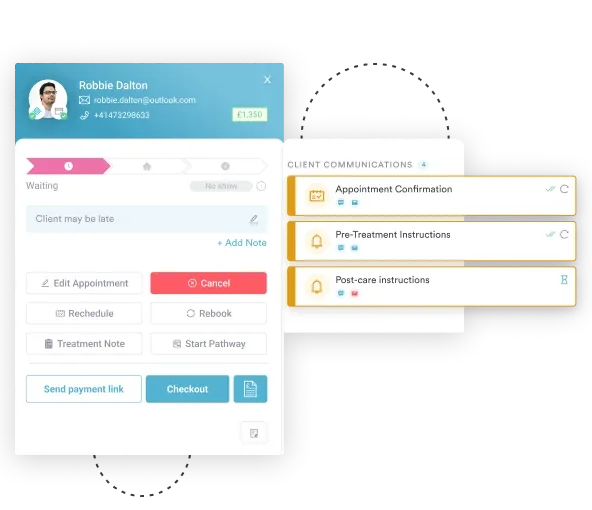
Discharge instructions and patient education go out through our online booking and patient portal, so a new mother can reread them at home. Appointment reminders travel the same way, which keeps the 3-week and 12-week visits from quietly slipping.
Pabau’s automated messaging sends discharge instructions and visit reminders, so a new mother keeps her 3-week and 12-week appointments.
Streamline postpartum care coordination with Pabau
Build customizable postpartum care plan templates, automate patient education, and track recovery progress across appointments, all inside one practice management system.
Postpartum care does not end at hospital discharge. A structured care plan bridges in-hospital recovery and outpatient follow-up, so no mother drops out of view between visits. Systematic assessment, EPDS screening, and a documented discharge checklist catch hemorrhage, infection, and mood disorders while they are still treatable. They also leave your team a defensible record when accreditation review comes around.
Download the postpartum care plan template above and adapt the fields to your own workflow. Practice management software like Pabau lets you embed that template in the patient record. From there you can automate screening reminders and track follow-up compliance. Book a demo to see how it fits your documentation.
Continue your research
Supporting a patient’s next fertility journey?Infertility consultation notes template structures reproductive history, test results and treatment plans within time-limited consultations.
Want to support recovery nutrition?Postpartum diet plan sets out the foods and supplements that help healing and milk supply.
Monitoring a current pregnancy alongside this one?Normal fetal heart rate template standardizes monitoring within the normal 110-160 bpm range for early complication checks.
Planning for a next pregnancy already?AMH levels interpretation guide covers normal AMH ranges by age and what the results mean for fertility.
Choosing an EHR for your OB-GYN practice?Best gynecology EHR systems compares features, pricing and pros across six OB-GYN EHR platforms.
Frequently asked questions
What should be included in a postpartum care plan?
A comprehensive postpartum care plan starts with maternal assessment: uterine involution, lochia, wound healing, and vital signs. It adds breastfeeding or formula-feeding support, mental health screening with the EPDS, and a list of warning signs. It also covers patient education on self-care and infant care, discharge criteria, and follow-up scheduling. Referrals to lactation, mental health, or pediatrics are added as needed.
How long does the postpartum period last?
The traditional definition of the puerperium is 6 weeks post-delivery. However, ACOG now recognizes the postpartum period extends to 12 weeks (3 months) for comprehensive care and mental health monitoring. Many clinicians support ongoing postpartum-specific care through 1 year, particularly for mental health surveillance.
When should a new mother follow up with her provider after birth?
ACOG updated its recommendations in 2018. Contact by telehealth or phone should happen by days 3-5, with the first comprehensive in-person visit by 3 weeks. Postpartum visits or phone encounters then continue through 12 weeks. This replaces the traditional single 6-week postpartum visit and enables earlier detection of complications and mental health concerns.
What is the difference between baby blues and postpartum depression?
Baby blues means transient mood lability, crying, and fatigue. It peaks on days 3-5 and resolves by day 14 in most mothers, which calls for reassurance and family support. Postpartum depression develops over weeks, persists beyond day 14, includes hopelessness and guilt, impairs functioning, and requires professional mental health treatment. EPDS screening helps distinguish the two, with a score of 10 or higher prompting further assessment.
Can I download a free postpartum care plan template?
Yes. The template above is available as a free downloadable PDF. Customize it inside your practice management software, Pabau included. You can add your practice logo, your own workflows, local referral resources, and emergency contact details for your postpartum population.