Nitrates medication list
A nitrates medication list is a point-of-care reference that sets out the main c...

2
Last Updated: Oct 6, 2026

A nonstress test (NST) monitors fetal heart rate responses to movement, using an external monitor placed on the abdomen for 20-40 minutes.
A reactive result needs two accelerations of 15 bpm above baseline, each lasting 15 seconds, within 20 minutes. Before 32 weeks, the 10×10 rule applies instead.
A nonreactive result does not confirm fetal distress. It usually leads to extended monitoring, vibroacoustic stimulation, or a biophysical profile (BPP).
Practice management software like Pabau helps OB/GYN and midwifery practices schedule recurring NST visits and document monitoring results in one place.
High-risk pregnancies need close fetal surveillance, and the nonstress test is one of the most commonly ordered checks in obstetric care. Despite the reassuring name, it makes plenty of expectant parents anxious.
The test answers one question. Does the baby’s heart rate speed up when the baby moves? Two qualifying accelerations within 20 minutes make the result reactive, which is the normal, reassuring finding.
Getting that answer takes 20-40 minutes and a monitor belt. The work around it is heavier. Repeat visits get booked, strips get filed, and abnormal results get chased. OB/GYN EMR software built for recurring prenatal monitoring keeps that side manageable.
A nonstress test is a prenatal assessment that measures fetal heart rate changes in response to fetal movement. The name comes from the fact that the test places no artificial stress on the baby. No contractions are induced, no medications are given, and nothing invasive enters the womb.
The principle is simple. A healthy fetal nervous system makes the heart rate accelerate when the baby moves, much as a healthy adult’s heart rate rises during exercise. When those accelerations appear and meet the defined criteria, the test is reactive.
The test uses an electronic fetal monitor. A Doppler ultrasound transducer on the abdomen picks up the fetal heart rate, and a tocodynamometer (toco belt) records any uterine activity. Both signals print on a continuous paper strip called a cardiotocograph (CTG), also known as a monitoring strip.
According to MedlinePlus, the nonstress test is simple, painless, and poses no known risks to mother or baby. It is used widely in high-risk obstetric care. It is often the first surveillance test ordered when a provider needs to check on the baby between anatomy scans and birth.
Providers order a nonstress test when fetal well-being needs watching beyond routine prenatal care. When testing starts, and how often it repeats, depends on the condition and the local protocol. ACOG Practice Bulletin 229 puts the usual start for high-risk pregnancies at 28-32 weeks, earlier or later depending on clinical context.
Common clinical indications include:
Testing frequency varies. Some patients come weekly, others twice a week when more than one risk factor is present. Practices carrying a high-risk obstetric caseload benefit from scheduling recurring appointments inside a structured workflow. The next visit gets booked before the patient leaves the room.
Those repeat third-trimester visits are also a sensible place for mood screening, which ACOG asks for at least once in pregnancy. The EPDS, a 10-item postpartum depression scale, is validated prenatally and takes about five minutes to complete.
Preparation is minimal, which is part of what makes the nonstress test practical for repeated surveillance. No fasting is required. Patients are usually told to eat a light meal or snack 1-2 hours beforehand. A full stomach tends to increase fetal movement and shorten the test.
Comfortable two-piece clothing makes it easier to apply the monitor belts without undressing fully. Patients should use the bathroom first, because lying still for 20-40 minutes is easier with an empty bladder. Consistent patient compliance with pre-appointment instructions affects both test quality and test duration. Practices that automate those instructions see fewer unprepared arrivals without adding staff workload.
The procedure is short, but knowing what to expect helps patients stay calm and still throughout.
Most nonstress tests finish within 20-40 minutes. An active baby that meets the reactive criteria early can end the test in under 20 minutes. The extension to 40 minutes exists to cover fetal sleep cycles, which normally run 20-40 minutes. Vibroacoustic stimulation often shortens that extension by waking the baby.
Results fall into two categories, and the clinical response to each is very different.
The criteria for a reactive result change with gestational age, reflecting how mature the fetal autonomic nervous system is. The table below summarizes the standard thresholds from ACOG and the Society for Maternal-Fetal Medicine (SMFM).
The CTG paper strip runs at a standard speed of 3 cm per minute. Two channels record at once. The upper channel shows fetal heart rate (FHR) in beats per minute, and the lower channel shows uterine activity from the tocodynamometer.
Clinicians look for these features when reviewing the strip:
A nonreactive result does not mean the baby is in danger. False-positive nonreactive results are common, because fetal sleep cycles last roughly 20-40 minutes and a sleeping fetus produces no accelerations. The Cleveland Clinic notes that the false-positive rate is considerable, which is why escalation runs in stages rather than straight to intervention.
The typical clinical escalation sequence:
Solid patient care management in an obstetric practice means a documented pathway for every step of that escalation. Keep results and follow-up actions in the same system that holds the schedule. Then nothing gets lost between an abnormal strip and the next clinical decision.
These three tests are the backbone of antepartum fetal surveillance. They serve different clinical purposes, and they differ in how invasive and how involved they are.
The NST leads because it is non-invasive, quick, and needs no induced contractions. The BPP widens the view by pairing the NST result with ultrasound findings. The CST asks a narrower question about how the placenta copes under the stress of contractions. Each answers something the others do not, so practices often run them in sequence.
If your practice sees many high-risk pregnancies, build a separate appointment type for each surveillance test in your scheduling system. Different durations and room requirements cause bottlenecks when NST, BPP, and CST share one slot template.
The nonstress test carries no known risks to mother or baby. It is non-invasive, needs no medication, and the external sensors never break the skin or enter the uterus. Doppler ultrasound has decades of obstetric use behind it.
The limitations matter most to the clinician explaining a result to a worried patient:
Practices that keep prenatal patient flow tight spend less of each monitoring visit on admin. That leaves more room for the conversation about what the strip showed.
OB/GYN practices and midwifery teams running regular nonstress test programs share one operational problem. They juggle high-frequency recurring visits for many high-risk patients at once. Every result has to be documented reliably, with a clean handoff whenever one escalates.
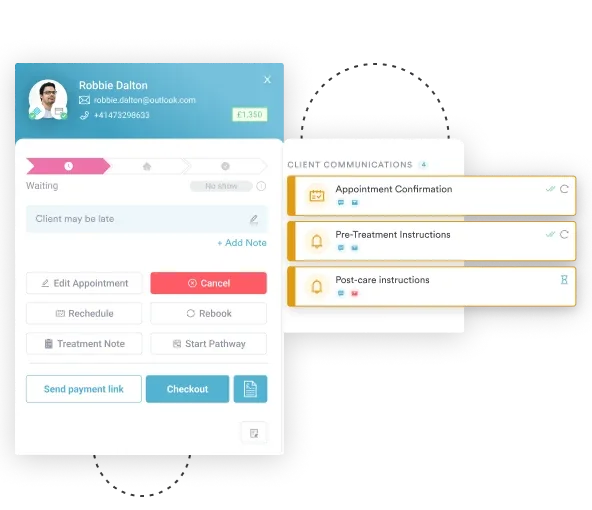
Pabau’s appointment scheduling supports recurring booking patterns, so a weekly or twice-weekly NST slot is set up once instead of rebuilt each visit. The pattern looks a lot like the IVF cycle booking that fertility clinic software handles, with many short, tightly spaced visits per patient.
Digital forms let staff record monitoring results and clinical notes at the point of care. No paper strip sits in a tray waiting to be scanned or retyped later.
Automated workflows send the pre-visit reminders about eating beforehand and wearing two-piece clothing, so nobody has to make those calls. For teams watching patient engagement across a high-risk caseload, one system holding schedules, result history, and follow-up actions cuts the coordination load on admin staff.
Practices that keep prenatal documentation in digital medical forms also cut transcription errors between the paper CTG strip and the patient record. The clinical picture stays accurate and auditable across the whole pregnancy.

Pabau helps OB/GYN and midwifery practices book recurring NST visits, record results, and coordinate high-risk care from one platform. See how it works.

Treat a nonreactive strip as a reason to keep looking, not as a verdict. A sleeping fetus and a compromised one can produce the same flat 20 minutes, which is exactly why the staged pathway exists.
The part worth remembering is about tempo. Surveillance only pays off if the repeat visit happens on schedule. It also needs the previous strip in front of whoever reads the next one. That is an operational problem far more often than a clinical one.
Want recurring prenatal appointments, documentation, and patient reminders in one place? Book a demo to see how Pabau fits an obstetric monitoring workflow.

Confirming a pregnancy for an employer or school? The pregnancy verification letter gives you a ready-made format your front desk can issue the same day.
Monitoring a patient for preeclampsia? The blood pressure pregnancy chart tracks readings across trimesters so rising numbers are easy to spot.
Scoring a newborn at birth? Apgar score template covers all five Apgar signs with checkboxes for the 1 and 5 minute scores.
Tracking ovulation with temperature readings? BBT ovulation chart tracks basal body temperature across the cycle to help pinpoint ovulation.
Documenting prenatal Down syndrome screening? Down syndrome test form covers consent, risk assessment, and results recording for tests like NIPT and the quad screen.
A nonstress test is a prenatal assessment that monitors fetal heart rate changes in response to fetal movement. It uses an external electronic fetal monitor, and it is non-invasive, painless, and typically 20-40 minutes long. The test checks whether the baby’s heart rate accelerates when the baby moves, which points to a healthy nervous system. It is used most often in high-risk pregnancies to confirm fetal well-being between routine prenatal scans.
A nonstress test typically takes 20-40 minutes. If the baby is active and the reactive criteria are met quickly, the test may finish closer to 20 minutes. If the fetus is asleep and produces no qualifying accelerations in the first 20 minutes, monitoring runs on to 40 minutes. Vibroacoustic stimulation can shorten that extension by waking the baby.
No, a nonstress test is painless for both the patient and the baby. The test uses an external electronic fetal monitor held against the abdomen with elastic belts. No needles, internal probes, or medications are involved. Some patients find the ultrasound gel cold and the belt slightly uncomfortable during a long session, but neither causes pain.
A nonstress test is typically ordered from 28 weeks gestation onward in high-risk pregnancies. The exact start point depends on the indication and the provider’s protocol. Common reasons to begin earlier include intrauterine growth restriction, preeclampsia, and gestational diabetes. For late-term and post-term pregnancies (41 weeks and beyond), an NST is routinely ordered to monitor fetal well-being as the due date passes.