Nutrition tracker pregnancy
A pregnancy nutrition tracker is a daily log in which pregnant patients record f...

1
Last Updated: Oct 7, 2026

The Edinburgh postpartum depression scale (EPDS) is a 10-item questionnaire that takes about five minutes to complete. It flags risk of postpartum depression rather than diagnosing it.
Totals run from 0 to 30. A score of 10 to 12 calls for a clinician conversation, and 13 or more for urgent referral.
Add the 10 item scores as they appear on the form. No item is reversed when the response options already run from least to most severe.
Any answer above 0 on item 10, the self-harm question, needs a safety assessment on its own, whatever the total says.
ACOG, the AAP and the USPSTF all recommend universal perinatal screening. The AAP route runs through the baby’s well-child visits, which reach mothers who skip their own follow-up.
Practice management software like Pabau scores the form on submission and alerts the clinician. A positive screen then never sits unread in a paper file.
A ready-to-use 10-item questionnaire covering low mood, loss of pleasure, guilt, anxiety, panic and self-harm ideation. It carries the scoring thresholds, the interpretation bands, and the safety steps a positive item 10 sets off.
Download templateThe postpartum depression scale is a 10-item questionnaire that scores 0 to 30. A total of 10 to 12 means a follow-up conversation, and 13 or more means an urgent referral.
Any answer above 0 on item 10, the self-harm question, calls for a safety assessment on its own.
Published in 1987 by Cox, Holden and Sagovsky, the scale is usually called the Edinburgh postpartum depression scale, or the EPDS. It takes about five minutes to fill in. ACOG, the AAP and the USPSTF all point to it for the perinatal period.
This page walks through the 10 items, how to add them up, and what each score band asks you to do. It also maps how the three guideline bodies split the screening year between the mother’s appointments and her baby’s. The questionnaire itself is in the download above.
It is a validated self-report screen that identifies women likely to be experiencing postnatal depression. The EPDS does not make a diagnosis. In the five minutes a postpartum visit can spare, it sorts a caseload into two groups. One needs a longer conversation, the other does not.
The instrument covers five dimensions of depressive symptoms: low mood, anhedonia (loss of pleasure), guilt and self-blame, anxiety and panic, and self-harm ideation. Each one reflects the emotional terrain of the postpartum period. Hormonal shifts, broken sleep, a new role and constant infant care converge there to create a specific kind of vulnerability.
That specificity is why obstetric and perinatal teams reach for the EPDS ahead of a general depression screen. Two of its 10 items ask about anxiety and panic, and one asks about crying, symptoms a general questionnaire either weights differently or leaves out.
Each of the 10 items is scored 0 to 3, so the highest possible total is 30. Patients normally complete the form themselves, in a waiting area or during a postpartum check-up, and the clinician reviews it with them afterwards. Here is every item with its four response options.
Item 10 is a safety flag, not a scoring line. Any answer above 0 there calls for an immediate safety assessment. Treat it as a prompt to talk to the patient directly and stratify her risk. An urgent referral to mental health services or crisis support may follow.
Scoring is a straight addition. Take the value printed beside the option the patient picked, then add all 10 together.
There is one trap with printed forms. Printed copies of the original form list the options for items 3 and 5 through 10 in the opposite order. Reverse those answers before you add them, or check which way round your own form runs first.
Most digital intake forms handle the addition for you, which removes the transcription errors that creep into hand-scored paper. Pabau’s form templates let you embed the EPDS as a scored questionnaire with threshold alerts. A positive screen then reaches a clinician the moment it is submitted.
Three bands decide what happens next: 0 to 9, 10 to 12, and 13 to 30. The exact cut-off shifts a little between ACOG, the AAP and Postpartum Support International, but the framework below reflects the consensus across perinatal settings.
The item 10 override: a score of 2 or 3 on the self-harm question warrants an immediate safety assessment and referral, whatever the total. Clinical judgment decides here, not the arithmetic.
Timing, setting and the words you use when you hand the form over all change the answers you get back. A structured protocol protects the validity of the score and makes the patient more comfortable answering honestly.
The EPDS wins in a perinatal population, because it was built for one. Both tools are validated for perinatal use, so the honest answer depends on your setting, your caseload and what your practice already screens with.
The PHQ-9 works acceptably after birth. It is simply less sensitive to postpartum anxiety and to the role change that shapes the first year. If your practice already screens on it, our PHQ-9 and GAD-7 template covers that route.
All three bodies recommend universal perinatal screening with a validated tool. They differ on where the screen happens and how often.
Put the three sets of advice side by side and the perinatal year splits into two screening tracks, running through two different sets of appointments.
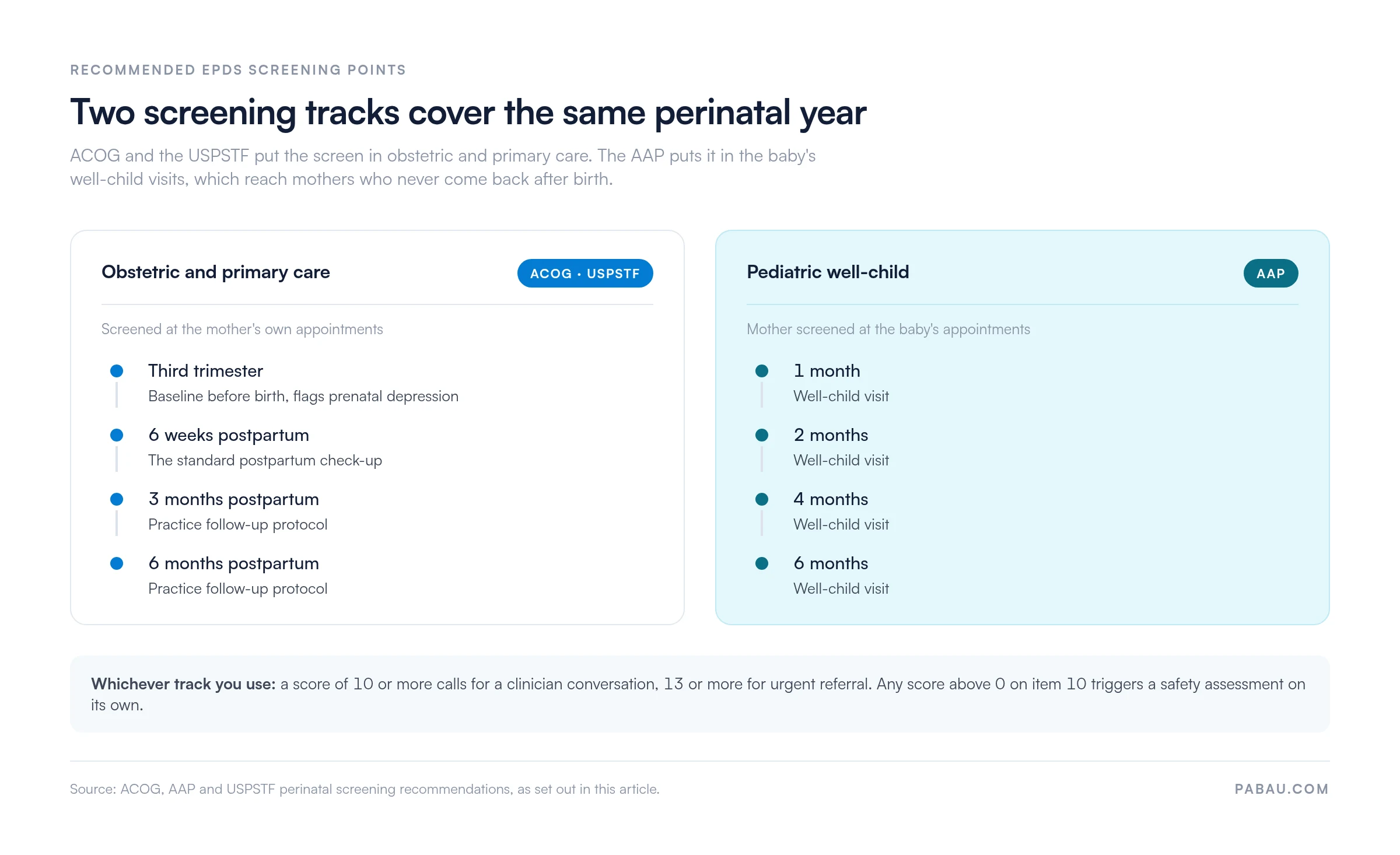
Meeting either track by hand means someone tracking which patient is due which screen, across a year of appointments. Automated screening reminders in a practice management system do that counting instead, and flag the positive results back to a named clinician.
A total of 10 or more, or a positive item 10, starts a clinical evaluation. The score is a signal, not a diagnosis, and the workflow below turns it into a decision. Our psychiatric evaluation template covers the structured assessment that follows a referral.
The EPDS is validated after birth, but perinatal depression starts earlier. Prenatal depression affects 10 to 15% of pregnant women, and it carries similar risks: poor obstetric outcomes, delayed bonding, and continuation into the postpartum year. Running the EPDS in the third trimester identifies those women before delivery.
Depression is also not the only perinatal mood disorder. Postpartum anxiety, OCD and PTSD can arrive alongside it or entirely on their own. A protocol built around depression alone will miss some of them. Practices that screen across the full window need mental health practice software that keeps every score in one client record.
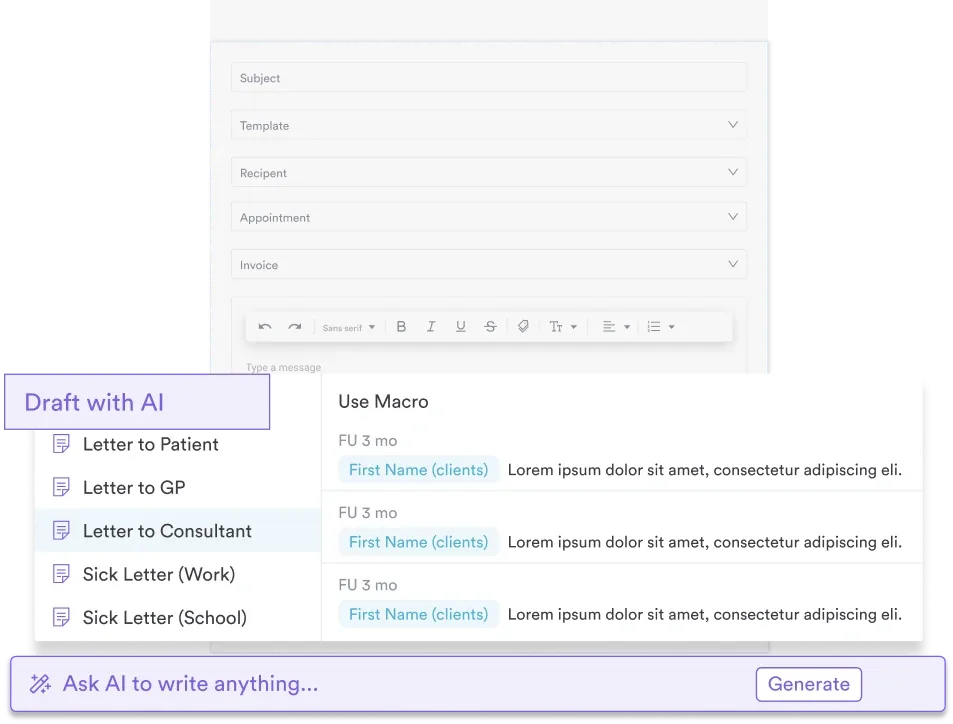
Documentation is the other half of that. A structured perinatal assessment covers mood, anxiety and obstetric trauma, and writing it up properly takes time a busy postpartum practice does not have. AI-assisted drafting takes the first pass at the note and the referral letter.
The scale has well-established validity, and it still has boundaries worth knowing before you build a protocol around it.
In most practices the EPDS is a photocopy. Someone prints it, hands it over, adds up the numbers by hand, writes a total in the notes, and hopes the follow-up gets booked. The score is only as safe as the person who remembers to look at it. Nobody can tell you how many patients were screened last quarter.
Practice management software like Pabau turns the questionnaire into a scored digital form attached to the appointment. Patients complete it in the client portal before they arrive. The total calculates on submission. A threshold alert fires for any total over 10, or a positive item 10, and both land in the client record.
Pabau is used on both sides of that handoff. Obstetric and pediatric practices run the screen, and software for therapy practices takes the referral. Pabau Scribe, our AI scribe, drafts the letter that travels with it.
Every score stays on the record, so you can see a patient’s trend across the perinatal year and report on screening coverage without counting paper.

Pabau scores the EPDS the moment a patient submits it, alerts a named clinician above the threshold, and keeps every result on the client record. Screening coverage becomes a number you can report on.

The scoring is the easy part. Adding 10 numbers takes 30 seconds, and the thresholds have been stable for decades. What decides whether screening helps anyone is what happens in the hour after a total of 13 lands on a desk.
So pick the track your practice can actually sustain. An obstetric team screening once at 6 weeks catches less than a pediatric practice screening four times in six months. The second route costs no extra appointments. Either way, write down who reads the score and who books the follow-up, because a protocol without those two names is a filing exercise.
Download the questionnaire above and start with the visits you already have on the calendar. Book a demo to see how Pabau scores the EPDS on submission and routes a positive screen to a clinician the same day.

Need a plan for a positive item 10? The suicide safety plan gives you a form to complete with the patient in the same visit.
Want a shorter first-pass screen? The PHQ-2 template covers the two-question version that decides whether a longer questionnaire is worth the visit time.
Screening for anxiety and stress as well? The DASS-21 measures all three across 21 items, each with its own severity bands.
Need a severity measure rather than a screen? The Beck Depression Inventory grades how severe a confirmed depressive episode is.
Writing up the assessment that follows? The mental status exam template structures the observations a referral letter needs.
The EPDS is a 10-item validated screening questionnaire, published in 1987, that identifies women at risk of postpartum depression. Each item scores 0 to 3, for a total of 0 to 30, and a higher total means greater risk. ACOG, the AAP and the USPSTF all endorse it for perinatal screening.
Yes. The EPDS is in the public domain and available as a free downloadable PDF. The version above adds the scoring guidance and the interpretation thresholds you need in clinical practice.
A total of 10 to 12 suggests possible depression and warrants a clinician follow-up, and possibly a referral. A total of 13 or more indicates probable depression and an urgent referral to mental health services. Any answer above 0 on item 10 needs an immediate safety assessment, whatever the total.
Not when the response options are printed from least to most severe, as they are in the table above. Then you simply add the 10 values. Copies of the original form list the options for items 3 and 5 through 10 the other way round. Check the order before you total the form.
Yes. The EPDS was designed for use after birth but has been validated for prenatal screening too. Many practices administer it in the third trimester to identify prenatal depression and set a baseline for the postpartum year.
DSM-5 has no separate postpartum depression diagnosis. Major depressive disorder is diagnosed with a peripartum onset specifier when symptoms start during pregnancy or within four weeks of birth. The criteria are the same as for any other depressive episode.