CRM for chiropractors: how to manage patients, bookings and marketing
A CRM for chiropractors is a patient relationship management system built around...

Last Updated: Oct 13, 2026

Antenatal tests are offered (not mandatory) at every stage of pregnancy to check maternal and fetal health across all three trimesters.
Screening tests estimate risk probability; diagnostic tests like amniocentesis or CVS confirm or rule out a condition with certainty.
NIPT analyzes cell-free fetal DNA in maternal blood and has high sensitivity for trisomy 21, but a positive result still requires confirmatory diagnostic testing.
Pabau’s patient record software and digital forms help antenatal care providers document test results, track appointments, and communicate findings to patients without paperwork delays.
Most pregnant women face the same problem at their first booking appointment. They get a list of tests they’ve never heard of, offered in rapid succession, with limited time to ask questions.
Understanding which tests are routine, which are optional, and what each one screens for changes how confidently a patient approaches the months ahead. Their care team benefits from that clarity too.
This guide covers the key antenatal tests offered across all three trimesters and explains the distinction between screening and diagnostic procedures. It also includes a week-by-week reference table. It’s written for both expectant parents and the OB-GYN practice management teams who coordinate their care.
Antenatal tests are health checks offered to pregnant women throughout pregnancy to monitor both maternal wellbeing and fetal development. They fall into two broad categories: screening tests and diagnostic tests. Understanding the difference is the starting point for any informed conversation about prenatal care.
According to the American College of Obstetricians and Gynecologists (ACOG), all antenatal tests are offered to patients who may choose to accept or decline them. A positive screening result does not mean a fetus has a condition. It means the risk is elevated and further investigation may be warranted.
The first trimester is the busiest period for antenatal tests. Most are offered at or shortly after the first booking appointment, typically between weeks 8 and 12.
The booking blood panel is the foundation of antenatal care. It covers a broad range of conditions that affect both maternal health and the pregnancy itself.
The nuchal translucency (NT) scan, performed between 11 weeks and 13 weeks + 6 days, measures the fluid at the back of the baby’s neck. A thicker measurement is associated with a higher risk of chromosomal conditions. These include Down syndrome (trisomy 21), Edwards syndrome (trisomy 18), and Patau syndrome (trisomy 13).
When combined with a blood test measuring PAPP-A and free beta-hCG, it forms the combined first-trimester screen. The result is expressed as a risk ratio, for example 1 in 150, not a diagnosis. Patients with a higher-risk result are offered further testing.
The second trimester focuses on structural assessment of the fetus and screening for conditions like gestational diabetes that can develop as the pregnancy progresses.
The anomaly scan, typically offered between 18 and 20 weeks, checks the fetus for structural abnormalities. It examines the brain, spine, heart, kidneys, abdominal wall, limbs, and face.
The scan is not a diagnostic procedure. It flags features that may warrant further investigation, but detection rates vary widely by condition. The NHS Fetal Anomaly Screening Programme reports detection rates of around 98% for gastroschisis, 90% for open spina bifida, and 50% for serious cardiac abnormalities. A normal result doesn’t rule out every structural condition.
The oral glucose tolerance test (GTT) is usually offered between 24 and 28 weeks. The patient fasts overnight, has a fasting blood glucose measurement taken, drinks a glucose solution, and has a second blood test two hours later.
Who is offered the GTT varies by country and guideline (NICE, WHO, and ADA use different diagnostic thresholds). In many countries it is risk-based rather than universal. It’s offered to patients with a BMI above 30, previous gestational diabetes, a family history of type 2 diabetes, or certain ethnic backgrounds.
The third trimester shifts focus toward fetal wellbeing monitoring, maternal health checks, and preparation for birth.
The non-stress test (NST) measures the fetal heart rate in response to the baby’s own movements using cardiotocography (CTG). A reactive result, meaning the heart rate rises appropriately with movement, is reassuring. A non-reactive result may prompt further evaluation but does not automatically indicate a problem.
The NST is not a routine antenatal test for all pregnancies. It is used for monitoring in high-risk situations, including post-dates pregnancies, reduced fetal movement, or conditions such as pre-eclampsia or growth restriction.
When a screening test returns a higher-risk result, a patient may be offered a diagnostic procedure. The same applies to specific risk factors, such as advanced maternal age or a previous pregnancy with a chromosomal condition. These tests provide a definitive chromosomal analysis.
Both procedures carry a small risk of miscarriage. ACOG Practice Bulletin 162 puts that risk at approximately 0.1-0.3%, or about 1 in 769 for amniocentesis and 1 in 455 for CVS. NHS patient materials use a more conservative estimate of around 0.5%, or about 1 in 200.
Individual risk depends on procedural experience and patient-specific factors. Any patient offered these tests should have a thorough discussion with their clinician before proceeding.
NIPT analyzes cell-free fetal DNA circulating in the maternal bloodstream. It is a screening test, not a diagnostic one, but it is significantly more accurate than standard combined screening for certain chromosomal conditions.
It screens primarily for trisomy 21 (Down syndrome), trisomy 18 (Edwards syndrome), and trisomy 13 (Patau syndrome). Some versions also screen for sex chromosome conditions and certain microdeletions. Published sensitivity for trisomy 21 detection exceeds 99% in high-risk populations, with a low false-positive rate, per NICHD research guidance.
However, false positives and false negatives do occur. A positive NIPT result should always be confirmed by amniocentesis or CVS before any clinical decision is made.
Availability and cost: In the UK, NIPT is available on the NHS for higher-risk pregnancies following a combined screen result, or privately for £400-£900. In the US, coverage depends on the insurer and risk classification. Out-of-pocket costs vary considerably.
Certain pregnancies carry additional risk factors that trigger enhanced monitoring beyond the standard antenatal tests schedule. These include advanced maternal age (typically 35 and over), multiple pregnancies, and pre-existing conditions such as diabetes or hypertension. Others are a history of recurrent pregnancy loss or a previous baby with a chromosomal or structural condition.
For those pregnancies, care teams often coordinate additional monitoring through fertility clinic software and specialist OB-GYN services. Additional antenatal tests commonly offered include:
Consultants and midwives managing high-risk cases benefit from a shared record that captures test results alongside appointment notes. This prevents critical findings from sitting in a separate lab report that the wider care team hasn’t seen.
The following table summarizes the standard antenatal tests schedule. Specific timing may vary depending on local guidelines (NHS, ACOG, RANZCOG) and individual clinical need.
Use this table as a reference, not a prescription. Coordinating appointment management across this schedule is one of the more logistically demanding aspects of running an antenatal care service.
No. All antenatal tests are offered, not required. Both the NHS and ACOG are explicit that pregnant patients have the right to decline any test at any stage. Choosing not to have a particular test does not mean refusing care. It means exercising informed choice.
This matters clinically as well as ethically. A patient who declines GBS screening, for example, should have that decision documented and, where applicable, an alternative management plan agreed.
Patient compliance in antenatal care is less about following a protocol and more about supporting informed decisions. Practitioners should explain what each test screens for, what an abnormal result means, and what the patient’s options are at each step.
A patient who declines a test because they haven’t understood its purpose is a documentation and communication problem as much as a clinical one. Keeping a clear record of what was offered, explained, and decided protects both the patient and the provider.
A test result is only useful once it reaches the right person at the right time. For antenatal care teams, that means the result gets documented accurately, communicated to the patient, and followed up at the next appointment.
Practice management software like Pabau, our EMR and patient record platform, pulls test results into the patient’s file. That replaces a separate lab portal that only one clinician checks. Pabau’s patient record software and digital intake forms link each result to its appointment. Automated clinical workflows flag any result that needs a follow-up action.
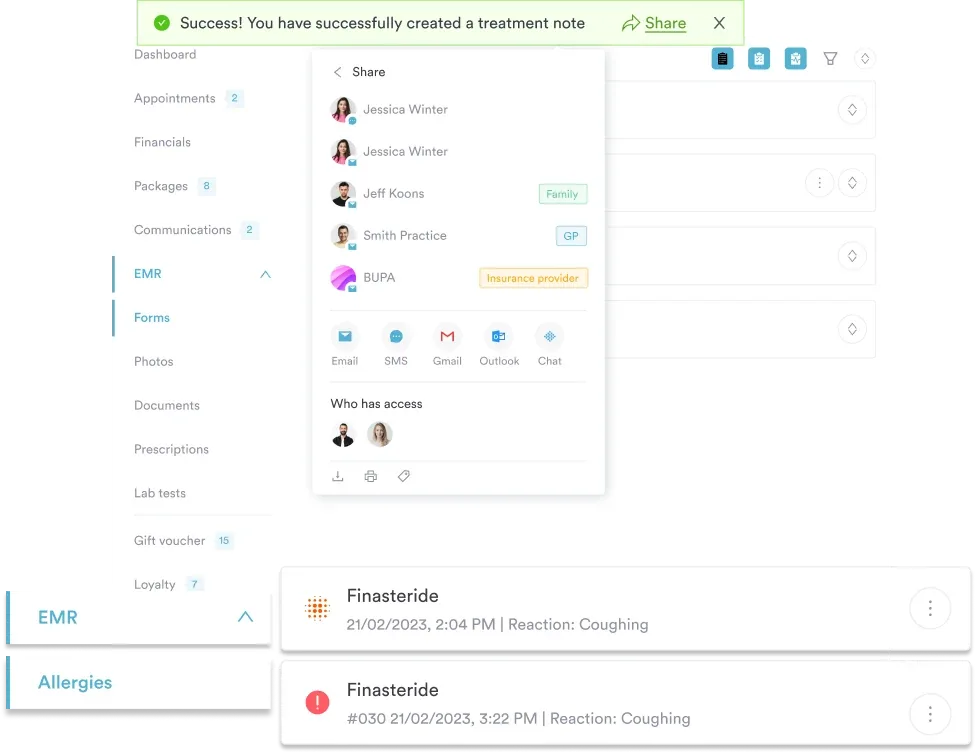
Keeping patient records up to date across a full antenatal episode is harder than it sounds. Results come from multiple sources: labs, scanning units, specialist clinicians, and the patient’s own monitoring at home. Good documentation also captures what was communicated to the patient and when, using digital medical forms that create a timestamped record of each consultation.
This matters most for results with significant implications, including high-risk screening results, positive infectious disease screens, or referrals for diagnostic testing. Better patient engagement follows naturally once the care team is working from the same up-to-date record.

Pabau helps OB-GYN and antenatal care practices track patient records, document test results, and automate appointment workflows across all trimesters.

A positive screening result changes the odds, not the certainty. Only a diagnostic test like amniocentesis or CVS changes the certainty. Treating the two the same way is the most common source of confusion once a result comes back.
For a practice, the harder task starts after the sample is taken. That means getting the result into the right file, explaining it to the patient in plain language, and booking whatever comes next.
Pabau’s patient records and automated workflows keep that chain intact across all three trimesters. Book a demo to see how Pabau keeps antenatal test results and follow-ups in one place.

Managing a multi-clinician OB-GYN or antenatal care practice? OB-GYN EMR software covers how Pabau supports obstetric and gynecology practice workflows from booking through clinical documentation.
Want to reduce paperwork at the first booking appointment? Digital intake forms can be sent to patients before their first visit. Their medical history, consent, and preferences are already in the system when they arrive.
Coordinating care across a fertility or specialist antenatal service? Fertility clinic software outlines how Pabau handles complex multi-appointment patient pathways with linked records and automated follow-ups.
Antenatal tests are health checks offered to pregnant women throughout pregnancy to monitor maternal wellbeing and fetal development. They include blood tests, urine tests, ultrasound scans, swabs, and (in some cases) diagnostic procedures such as amniocentesis. Some tests are offered routinely to all pregnant women; others are offered based on individual risk factors.
The first antenatal visit typically includes a booking blood panel covering blood group, Rh factor, and full blood count. It also covers HIV, hepatitis B, syphilis, rubella immunity, and sickle cell or thalassemia screening. A urine sample is also taken. Blood pressure is measured, and general medical history is recorded.
A screening test estimates the probability that a condition is present. A positive result means elevated risk, not a confirmed diagnosis. A diagnostic test confirms or rules out a condition with a high degree of certainty. Amniocentesis and CVS are diagnostic; the NT scan, combined screen, and NIPT are screening tests.
All antenatal tests are offered rather than mandatory. Both the NHS and ACOG affirm that patients have the right to decline any test. The decision should be documented, and the care team should explain the purpose of each test and what declining it means for ongoing monitoring.
NIPT analyzes cell-free fetal DNA in the mother’s blood. It screens for chromosomal conditions including Down syndrome (trisomy 21), Edwards syndrome (trisomy 18), and Patau syndrome (trisomy 13). In the UK, NIPT is available on the NHS for pregnancies identified as higher risk following a combined screen result. It is also available privately, typically costing £400-£900.
Yes. High-risk pregnancies are typically offered more frequent growth scans, Doppler blood flow studies, and earlier gestational diabetes testing. They’re also offered serial blood pressure monitoring and more frequent non-stress testing in the third trimester. Risk factors include advanced maternal age, multiple pregnancy, pre-existing conditions, and a history of pregnancy complications.