Getting along with siblings worksheet
A getting along with siblings worksheet is a printable that helps children and t...

1
Last Updated: Oct 23, 2026

Skin peel treatment notes record what you assessed, which peel you chose, how you applied it, and how the skin responded.
The core fields are the presenting concern, Fitzpatrick skin type, peel and add-on selection, application times, frosting, and client tolerance.
Writing down the reason for your peel choice is what turns a checkbox form into a defensible clinical record.
Application time and frosting are the two fields that let you escalate strength safely at the next session.
Practice management software like Pabau keeps peel notes, consent, and photos on one client record, so a course reads as one history.
A ready-to-use peel session form covering the presenting skin concern, clinical purpose, Fitzpatrick skin type, and peel selection. It also records add-ons, application times, frosting, client tolerance, and the consent discussion you had.
Download templateA skin peel treatment note is the per-session record of one peel. It captures the skin you assessed, the peel you chose, how long it stayed on, and how the client reacted. Done well, the next practitioner can pick up a course of peels without guessing at strength or contact time.
This guide walks through every field on the template above and shows a completed note for a common acne case. It also covers the record-keeping rules that apply to aesthetic practices. The template is free to download, and it is built around the peel systems most med spas stock.
Skin peel treatment notes are the clinical record a practitioner writes for each chemical or cosmetic peel session. US practices usually call this charting. UK practices call it treatment notes. Either way it is the same document, and it sits in the client record alongside consent and photos.
Three documents get confused with each other here. The consent form and the aftercare sheet are both handed to the client. The treatment note is what you write for yourself, your colleagues, and anyone who reviews the file later.
Peels are the one aesthetic treatment where the note directly controls the next appointment’s safety. Strength, contact time, and layer count all escalate over a course. Without last session’s numbers written down, you are escalating blind.
Safe escalation. A client who tolerated six minutes of salicylic acid with no frosting can usually go further next time. A client who reported extreme discomfort at three minutes cannot. That decision lives in the note, not in your memory of a Tuesday afternoon six weeks ago.
Complaint defense. Peel outcomes are subjective, and post-inflammatory hyperpigmentation is a genuine risk in higher Fitzpatrick types. A note showing you assessed skin type, discussed the risk, and recorded the client’s agreement is your strongest evidence if the result is disputed.
Course continuity. Most peel plans run four to six sessions, and in a multi-practitioner practice they rarely stay with one person. A structured note means anyone on the team can take session four without re-interviewing the client from scratch.
Every peel note should answer six questions. What was the client concerned about? What is the clinical purpose of treating it? What is their skin type? Which peel did you choose, and why? How did you apply it and how did the skin respond? What happens next?
The template groups those answers into four blocks, in the order you work through them.
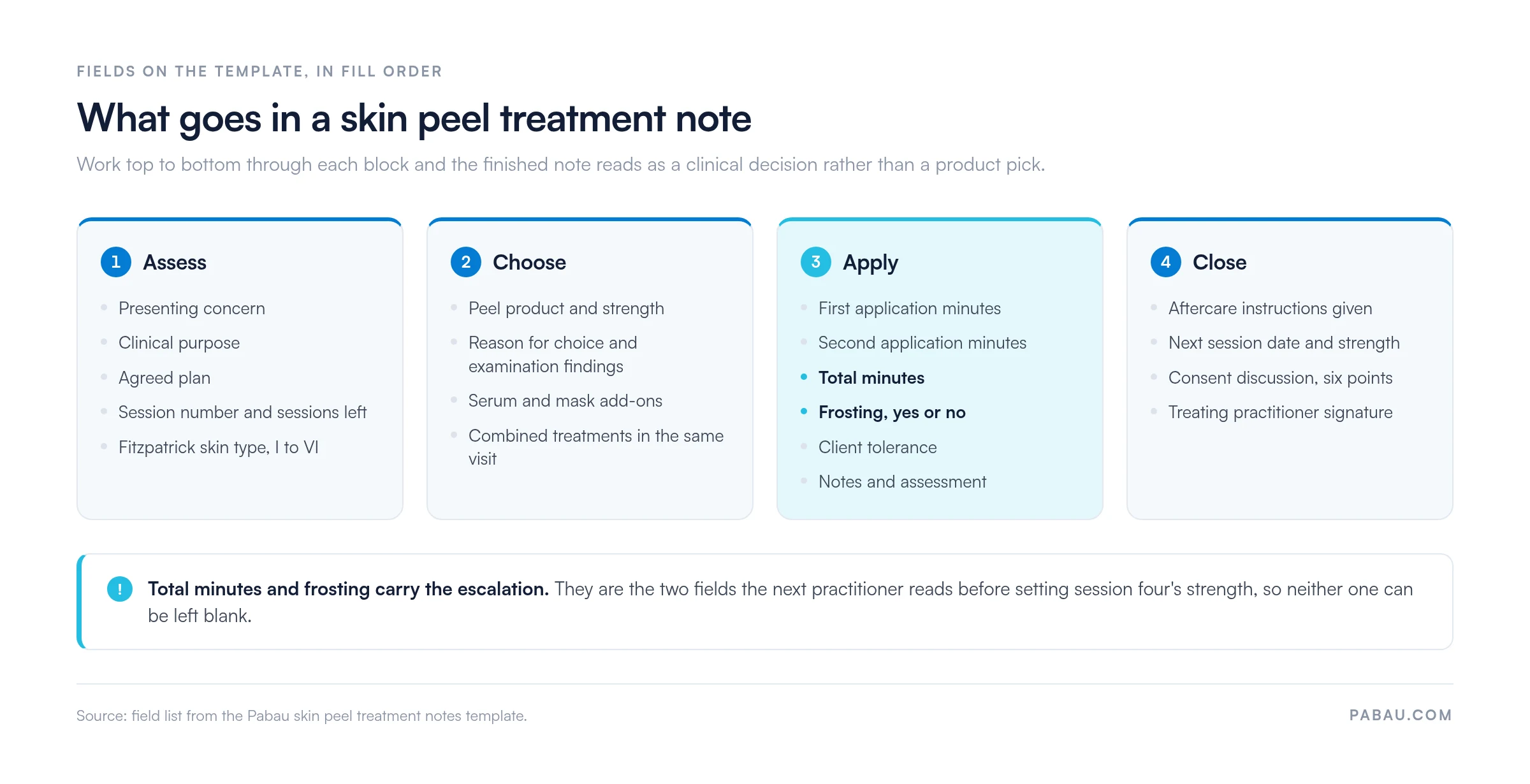
Start with what the client came in for. The template lists the concerns that bring people in for peels: rosacea, active acne, acne scarring, hyperpigmentation, skin rejuvenation, anti-aging, and skin texture.
Then write the clinical purpose in your own words. That one sentence is what turns a beauty treatment into a medical record. For active acne that might be reducing sebaceous gland activity to lower sebum and improve skin quality. For hyperpigmentation it is reducing melanocyte activity to even out tone.
Record the session number and how many sessions remain, in the form “third treatment, three left”. It takes four words and saves the next practitioner a phone call.
Log the Fitzpatrick skin type, I through VI, at the first session and confirm it at each one after. It drives which peels are appropriate, how aggressively you can escalate, and how much you emphasize sun protection in aftercare.
Types IV to VI carry a higher risk of post-inflammatory hyperpigmentation after a peel. Your note should show that you knew the type before you chose the peel, not after.
Record the exact product and strength, not the category. “Peel” is not a record. “Enerpeel SA” is. The template splits this across two ranges, so the practitioner ticks the specific product rather than writing a vague description.
Next to it sits a free-text box for the reason for choice and examination findings. That box is the single most valuable part of the note. Write what you saw on the skin and why it pointed to this peel at this strength.
Peels are rarely delivered alone. The template captures serum and mask add-ons such as retinol, hyaluronic acid, antioxidant, stem cell, kojic acid, vitamin C, a hyaluronic acid mask, and exosomes.
It also records combined treatments delivered in the same visit: LED light therapy, dermaplaning, and microneedling. This matters when a reaction has to be traced back. If the skin flared, the note has to show whether the client had dermaplaning first.
These are the numbers you will need at the next session. The template asks for first application minutes, second application minutes, and total minutes. Fill in all three, even when there was only one pass.
Frosting is a simple yes or no, and it carries clinical weight. On a trichloroacetic acid peel it is your endpoint marker. On a salicylic acid peel the white precipitate is not the same thing, so say which you observed. A blank frosting field on a TCA note is an incomplete record.
The template offers three tolerance options: the client felt minor pain, the client was comfortable, or the client was in extreme discomfort. Tick one, then add what you actually observed underneath.
Describe the skin, not the outcome. “Uniform erythema across both cheeks, settled within 20 minutes” is an observation. “Skin looked great” is not. Use the notes and assessment box for any unexpected reaction, including any neutralizing you had to do early.
Write down which aftercare instructions you gave, not just that you gave some. Sun protection, the retinoid pause, the exfoliant pause, and the makeup window are the four that get disputed most often. Our chemical peel aftercare guide sets out what those instructions should say.
Close the note with the plan. When is the next session, at what strength, and what would make you hold rather than escalate? A one-line plan is the difference between a course and a series of unrelated appointments.
The template closes with the six points you confirm you discussed with the client:
Then sign it. The treating practitioner’s name and signature are what make the note admissible, and an unsigned note is worth very little in a complaint. Keep the signed chemical peel consent form filed against the same client record.
The template lists two professional ranges, iS Clinical and Enerpeel, because those are the systems most aesthetic practices stock. Each one asks for a slightly different set of numbers in the note. Here is what to capture against each.
Concentrations vary by supplier and by protocol, so record the strength you actually used rather than assuming the range default. If your practice stocks a system that is not on the form, add a line for it and keep the same fields.
Here is the template filled in for a common case: a client on a six-session acne course, back for session three. Every line below maps to a field on the downloadable form.
Read the plan line again. It tells the next practitioner exactly what to do and exactly what would make them stop. That is the whole point of a peel note.
Peel notes get written up at the end of the day, when the times and tolerance scores have already blurred together. A few habits fix that.
Log the times while the peel is on. You are already watching a clock. Write the first and second application minutes straight onto the form as they happen, rather than reconstructing them three clients later.
Photograph before you cleanse. Same spot, same light, same angle, every session. Store the images on the client record, so the photos and the written note stay together instead of living on someone’s phone.
Tick, then annotate. The checkbox fields exist so you can move fast. Spend the saved time on the two free-text boxes that matter: reason for choice, and notes and assessment.
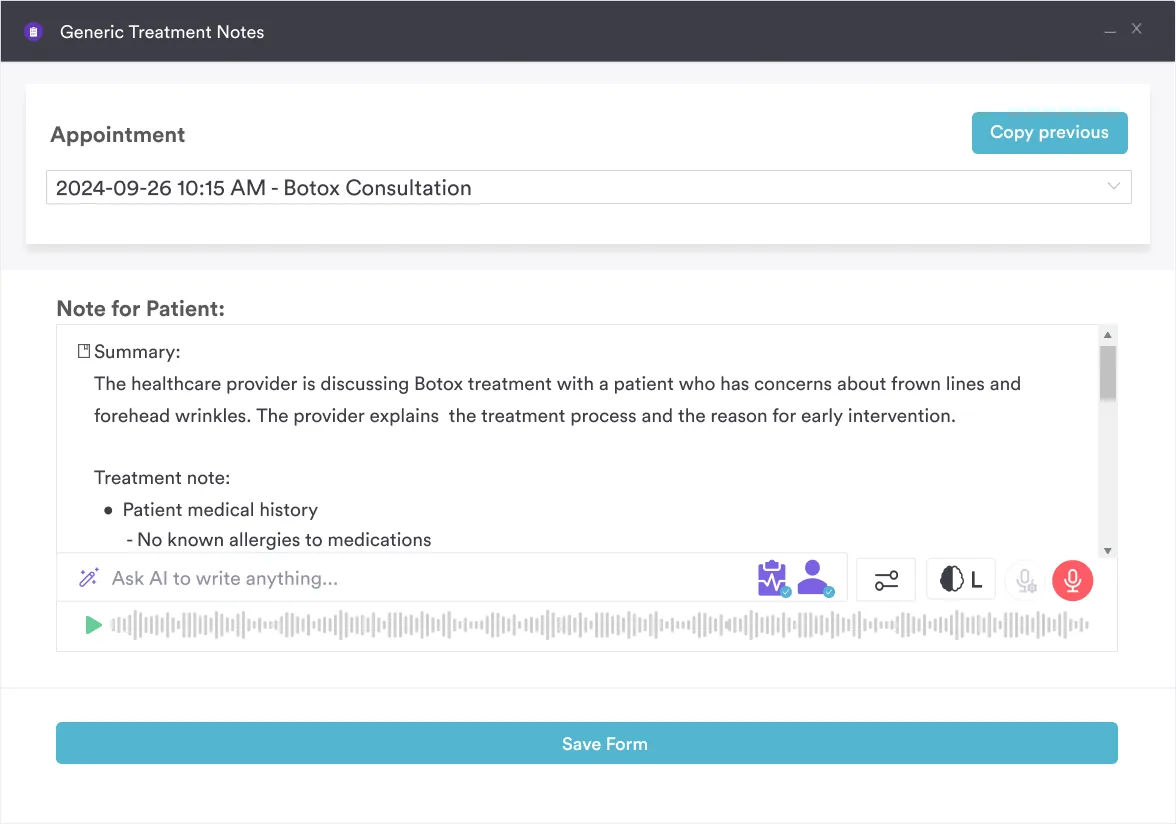
Dictate the assessment. Pabau Scribe, our AI medical scribe, turns a spoken summary into a structured treatment note. Describing the erythema out loud while you neutralize takes 30 seconds. Typing the same thing at 7pm takes five minutes and loses detail.
Never copy last session forward untouched. Duplicating a note is a fast way to record a peel that did not happen the way you wrote it. If you start from the previous note, change the times, the tolerance, and the plan before you save.
Peel notes are clinical records, so a handful of rules apply regardless of whether a physician, nurse, or esthetician delivered the treatment.
Write at or near the time of service. A note created weeks after the appointment carries far less weight, and backdating one is a straightforward compliance problem. Electronic records should show when the entry was made.
Correct by addendum, never by overwriting. If you got a number wrong, add a dated and signed addendum explaining the correction. Your system should keep a version history so the change is traceable.
Refresh consent through a course. A single signature at session one does not cover a peel you escalated at session four. Record the consent discussion each time the protocol changes, and note that the client agreed.
Protect the data. US practices handling protected health information, known as PHI, need access controls and an audit trail on peel notes and photos. UK practices have the same obligation under data protection law. A shared folder of photos on a practice iPad meets neither.
Check your own retention rule. In the US, how long you keep aesthetic treatment records is set by your state medical or cosmetology board. In the UK it follows your practice governance policy and your insurer. Confirm the period that applies before you set any deletion schedule.
Write the reason for your peel choice before you tick the peel. “Oily T-zone, four active lesions on the chin, tolerated session two at six minutes” explains a clinical decision. “Enerpeel SA” on its own only records a product.
These are the errors that turn up most often when a peel record gets reviewed after a complaint.
Most aesthetic practices still run peel notes on paper. The form goes in a folder, the photos sit on a phone, and the consent form is in a different drawer. When a client comes back for session four with a different practitioner, someone spends the first 10 minutes of the appointment reassembling the history.
Practice management software like Pabau puts the same fields on screen instead. Purpose-built medical spa software starts from the aesthetic workflow, so a peel note never has to be bent out of a generic clinical form.
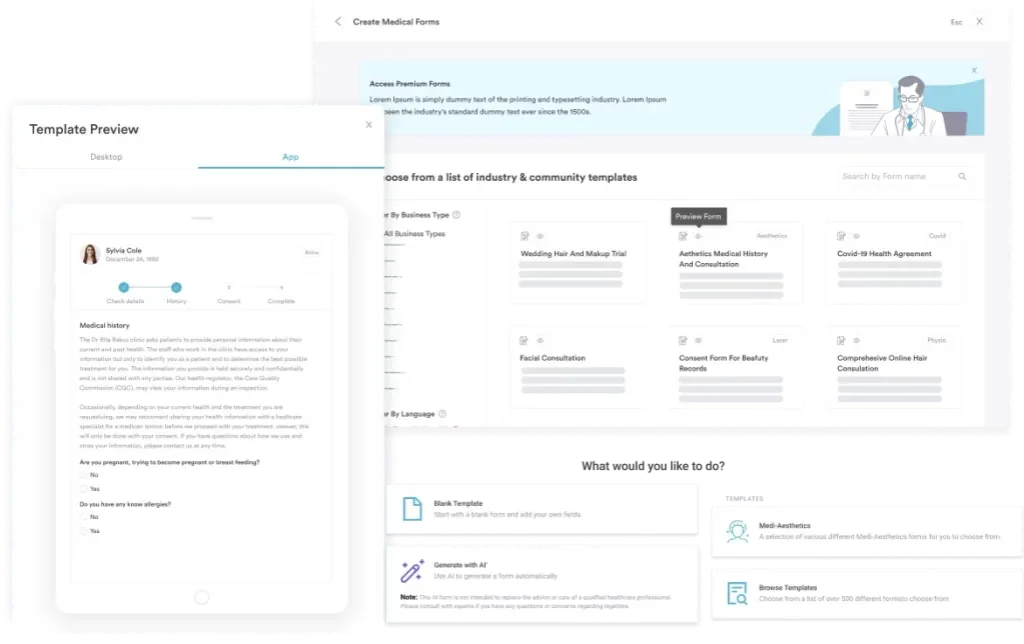
You can rebuild this peel note as a digital form with your own peel list, tolerance options, and frosting field. The note on screen then matches the one your team already knows.
Consent, before-and-after photos, and every session’s note then sit on one client record. Pabau Scribe can draft the assessment from what you dictated in the room. The next practitioner opens the file and sees session three’s contact time and tolerance before they choose session four’s strength.
The outcome is a peel course that reads as one continuous history, and evenings you get back because the notes were finished in the room.

Build a peel note template that mirrors your own form. Capture consent and photos in the same visit, and keep a whole course on one client record.

A skin peel note earns its place by making the next session safer. Skin type, peel and strength, application minutes, frosting, and tolerance are the five fields that decide whether you can escalate. The reason-for-choice box is what shows a reviewer you made a clinical decision rather than a product pick.
Download the template above and use it for your next peel. See how much of it you can complete before the client leaves the room. Would you rather it filled itself in from a form on screen? Book a demo and we will show you how Pabau handles a peel course.

Want the broader documentation picture? Chemical peel treatment record covers pre-treatment screening, peel types, and recovery timelines.
Refreshing consent through a course? Chemical peel consent form is the signature page to file against each session note.
Checking your record-keeping holds up? Med spa compliance walks through the rules covering client records, photos, and consent.
Start with the presenting skin concern, the clinical purpose, and the Fitzpatrick skin type. Then record the peel and strength you chose, your reason for choosing it, and any add-ons. Finish with application times, total minutes, frosting, client tolerance, aftercare given, the next-session plan, and your signature.
Yes, on any trichloroacetic acid peel. Frosting is the clinical endpoint marker, so a blank field leaves no evidence of where you stopped. On a salicylic acid peel, note the white precipitate separately, because it is not the same thing.
No. The consent form is the client’s signed agreement to the procedure and its risks. The treatment note is your clinical record of what you assessed, applied, and observed. You need both, filed against the same client record.
Write a separate note for every session, and record the session number and how many are left. Carry forward only the agreed plan. Each note needs its own application times, tolerance, and next-session strength so the escalation is traceable.
It depends on where you practice. In the US, retention is set by your state medical or cosmetology board. In the UK, it follows your practice governance policy and your insurer’s requirements. Confirm the period that applies to you before deleting any peel record.
Yes, and a tick-box template is faster and more complete than free text. It prompts you through skin type, peel choice, application times, and frosting, so nothing gets left blank. Most practice management software lets you build the same form on screen.