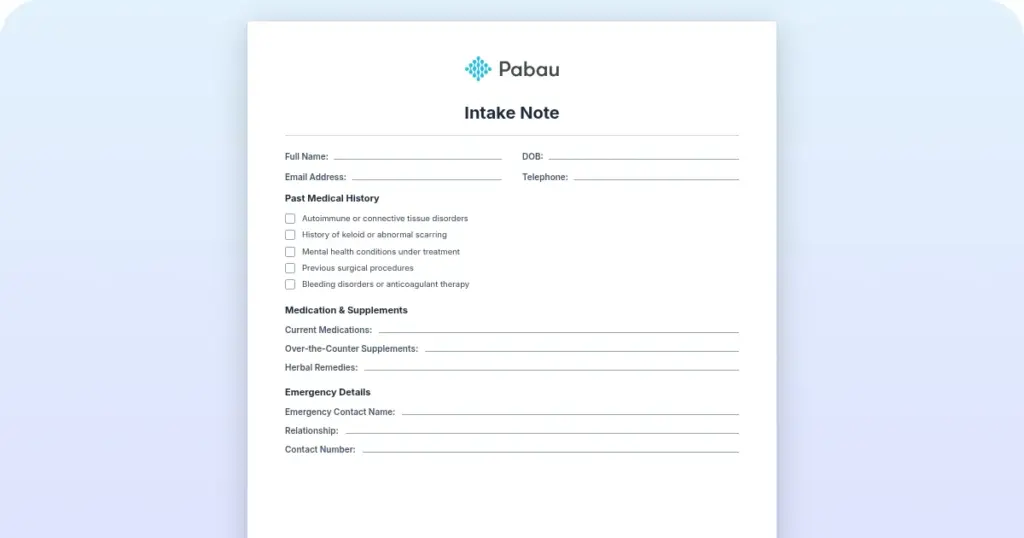
Intake note template
An intake note is the clinical record a therapist or counselor writes at the sta...

1
Last Updated: Oct 22, 2026

The sensation emotion wheel maps body sensations to emotions, running from core feelings at the center out to complex states at the edges.
The somatic layer is what sets it apart. It links chest tightness, jaw tension, or a knotted stomach to a named emotion.
Therapists use it in individual and group sessions for emotion identification, trauma-informed care, and mindfulness work with adults and children.
Practice management software like Pabau stores each assessment in the client record, so emotional patterns sit alongside notes and treatment plans.
A printable assessment wheel that pairs each emotion with the body sensations it produces. Joy, anger, fear, and sadness sit at the center, with more nuanced states on the outer rings.
Download templateA sensation emotion wheel gives clients two routes into the same feeling. There is the word for it, and there is the place in the body where they notice it. That second route is what makes the wheel useful with a client who goes blank on “How are you feeling?”
The tool comes from Lindsay Braman, a clinical therapist, and it has been picked up across somatic therapy, trauma-informed care, and mindfulness-based practice. This guide covers how the somatic layer works, how to run it in session, and how to adapt it for adults and children.
The wheel is also a documentation tool. When a client names the sensation and the emotion, you have language precise enough to track week over week.
A sensation emotion wheel is a circular chart that runs from core feelings at the center to more specific emotions on the outer rings. A further layer names the body sensations that go with each emotional state.
It builds on the standard emotion wheel by adding a somatic dimension. A plain wheel shows gradations of feeling, moving from angry to frustrated to annoyed, and our emotion wheel worksheet follows that pattern. The sensation version goes one step further. It labels the body signals that arrive with each emotion, from the heat of anger to the flutter of anxiety and the heaviness of sadness.
That pairing matters most in trauma-informed care, where clients often cannot name or locate an emotion until they notice a physical signal first. So instead of asking “What are you feeling?”, you can ask where they notice it in the body, and what it feels like there.
Lindsay Braman, a clinical therapist, built the version most practices now use. Her wheel adapts the feelings wheel format and adds the body sensation layer. That layer gives a route in to clients with alexithymia, meaning difficulty identifying emotions.
The somatic layer is the part clinicians reach for most. It maps physical sensations onto emotional states, which matters because many clients cannot identify an emotion mentally until they recognize it physically.
Somatic therapy and trauma-informed care both work from the premise that trauma is held in the body. A client may know intellectually that they are anxious. What they feel is a racing heart, shallow breathing, and trembling hands. Without a way to connect the two, those signals get filed as stress.
With the wheel, the client traces the sensation back to the emotion. From there they can apply a coping skill, or look at what set it off.
The list above stops at the core emotion. The grid below carries each sensation out through both rings. You can see the word a client is likely to reach for once the feeling has language.
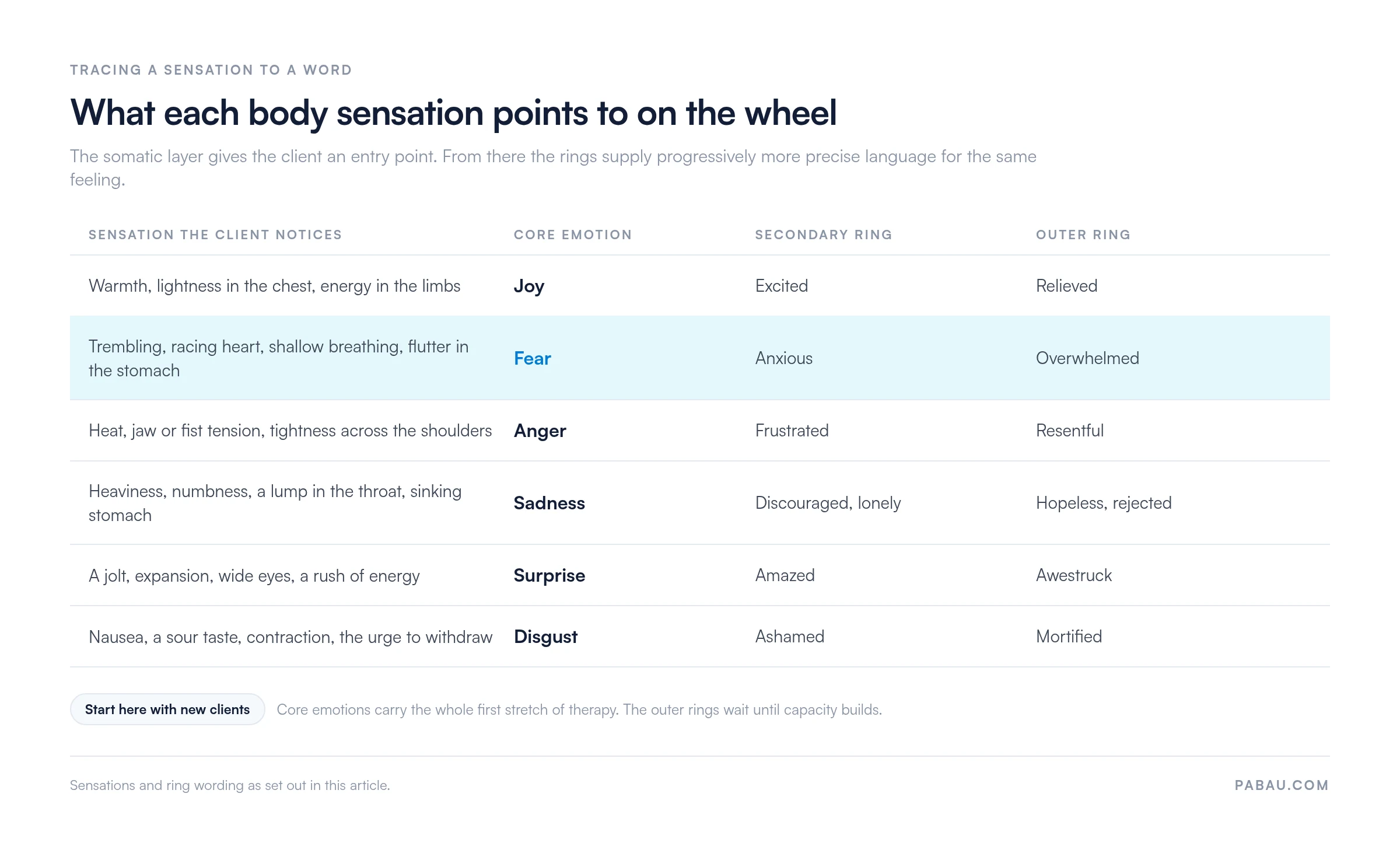
That specificity turns emotional identification from an abstract task into something a client can point at. A teenager who says “tightness in my throat and heat in my chest” can find those sensations on the wheel and land on anger.
Naming it is the first step toward choosing a response instead of reacting.
The wheel is built in rings, and the rings run from simple to specific. Knowing which ring a client is ready for is most of the skill in using it.
The rings track emotional development as much as complexity. Young children work at the center, learning to say mad or sad. Adolescents and adults get more from the middle and outer rings. A client who moves from “I’m angry” to “I’m resentful” has named two states that call for different work.
Using the wheel well means picking the moments. These five steps cover the points in a course of therapy where it earns its place.
Adults arrive with years of practice at suppression. Many were told to stop crying, toughen up, or stop being so sensitive. The sensation layer sidesteps that, because noticing a tight jaw is an observation rather than a confession.
In adult sessions, use the wheel to connect emotion to context. “You say you are frustrated with your partner. When that frustration shows up, what does your body do?” Emotions then read as information about a situation, which is easier to work with than a verdict on character.
You can also put the question into your patient intake software, so it arrives before the session. Ask which emotions have been most present this week, and where the client noticed them.
Children and adolescents have a smaller emotional vocabulary than adults, which makes the sensation layer a good fit. School counselors report that children of five or six can point at the wheel and say their tummy feels like butterflies.
For ages five to eight, stay with the core emotions and plain sensation words. Ask where in the body happy, sad, or angry lives. Children of nine to 12 can handle the secondary ring, and adolescents can work the outer one.
A shared vocabulary also travels. When a whole class shares the words for anger and shame, a conflict conversation can start from what each student felt.
The wheel earns session time in five or six concrete ways, and most of them show up in the first month of using it.
On paper, this work stays on the sheet. The completed wheel goes into a folder, and the pattern it shows never reaches the progress note. Pabau is therapy practice management software, so the assessment sits in the client record next to the notes and treatment plan.
Pabau Scribe, our AI medical scribe, drafts the session note while you work. The sensations a client reported stay in their own words, and the note lands in the record without an export step.
Because each entry is stored, you can open a client’s history and see which sensations keep coming back. Automated reminders and post-session check-ins go out on their own, so clients keep practicing the noticing work between appointments.

Pabau stores each sensation emotion wheel assessment alongside intake forms, progress notes, and treatment plans. Your team can see how a client’s emotional patterns shift from one session to the next.

Start with the core ring and the few sensations a client already notices. That is enough for the first month. The outer rings can wait until the client can find a feeling in their body without prompting.
The trade-off worth remembering is precision against pace. Push a client to the outer rings early and you get vocabulary they cannot feel yet. Stay too long at the center and the work stalls at “I’m mad”.
Download the template above and bring it into your next session. Book a demo to see how Pabau keeps each assessment in the client record, so emotional patterns stay visible session to session.

Need a next step once the client can name the feeling? Coping wheel gives them a set of regulation options to choose from in the moment.
Working with a client who has no words yet? Feelings face chart starts from facial expressions instead of vocabulary, which suits younger children.
Ready to turn awareness into a plan? Change plan worksheet structures the goal, the barriers, and the support a client will need.
Comparing software for your therapy practice? Top 7 mental health software in the US weighs the platforms on documentation, scheduling, and billing.
It is a circular chart that runs from core feelings at the center to more complex emotions on the outer rings. A further layer names the body sensations tied to each emotion. A client can start from a racing heart or a tight chest and trace inward to the word.
The Emotion Sensation Feeling Wheel was created by Lindsay Braman, a clinical therapist. She describes it as an adaptation of the feelings wheel, a format usually traced to Gloria Wilcox’s 1982 Feeling Wheel. Her addition is the explicit body sensation layer. That is what makes it useful in somatic and trauma-informed work.
Yes. Children of five or six can use it, starting with the core emotions and plain sensation words like ‘my tummy feels like butterflies’. School counselors use it to build emotional vocabulary and to give a class shared language for conflict.
A standard feelings wheel shows gradations of feeling, from angry to frustrated to annoyed. The sensation version adds the body signals for each one. Anger reads as heat and jaw tension, anxiety as a racing heart and trembling, sadness as heaviness and numbness.
The wheel itself has not been through randomized controlled trials. The principles behind it have research support, including body awareness, somatic processing, and emotional vocabulary development. Treat it as a clinical tool with a sound basis rather than a validated instrument.