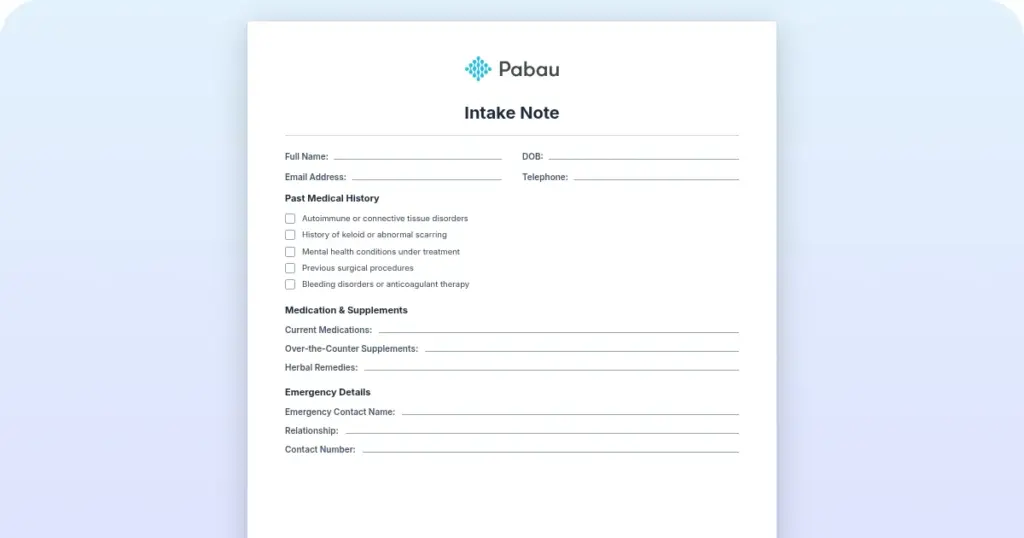
Intake note template
An intake note is the clinical record a therapist or counselor writes at the sta...

2
Last Updated: Oct 22, 2026

A therapy invoice is a formal request for payment from a client or insurer, covering session details, fees, and payment terms.
Every invoice needs your name and credentials, the client’s details, the date of service, the session fee, and payment instructions.
Insurance billing adds three fields: your NPI number, a CPT code for the session, and an ICD-10 diagnosis code.
An invoice requests payment. A superbill is a coded receipt the client files with an out-of-network insurer.
Practice management software like Pabau builds the invoice from the completed appointment, so nobody retypes fees or codes.
A print-ready invoice form covering your practice details, the invoice number, and the client’s contact information. The service table takes the date, description, hours, rate, tax, and total, with payment instructions and terms underneath.
Download templateMost therapists start out copying an invoice off the internet or writing one by hand. Both cost time, invite errors, and leave no record to fall back on when a client disputes a charge. A structured invoice reads as professional to clients and payers alike. It also makes sure you collect what you are owed.
This guide covers what belongs on a therapy invoice, how it differs from a superbill, and how to fill one out. It also walks through modality-specific billing for physical therapy and massage, plus what changes between insurance and self-pay clients.
A therapy invoice is a formal billing document you send to a client, or to their insurer, requesting payment for sessions delivered. It records the dates, the session type and length, the fee per session, and the total due.
A receipt confirms a payment already made, while an invoice asks for one. A superbill goes further, carrying the diagnosis and procedure codes an insurer needs. A plain invoice stays simpler, focused on the amount owed and how to pay it.
An effective invoice carries mandatory fields plus a few optional ones. The mandatory fields keep it professional and defensible. The optional fields exist for insurance billing and more complicated payment arrangements.
Therapists most often go wrong by treating an invoice and a superbill as one document. The two have different purposes and different readers.
In practice, a therapist sends a self-pay client an invoice for $75. An out-of-network client gets a superbill carrying CPT code 90834 and ICD-10 code F41.1, then files it with their insurer for partial reimbursement.
Use the download above as your reference. Five steps complete a therapy invoice accurately.
The core structure holds across modalities. The billing conventions underneath it do not, and the difference shows up as soon as you bill a payer.
Physical therapy is often billed in 15-minute treatment units rather than a flat session rate. Use the CPT codes for the treatments delivered, such as 97110 for therapeutic procedures. Modifiers such as 59 for a distinct procedural service may apply when several treatments are billed in one session.
A massage invoice shows the massage type, the duration, and the session fee. For insurance, use the appropriate CPT code, such as 97124 for massage therapy. Some practices add a line for gratuity. Others note add-ons such as aromatherapy or hot stones.
Which fields you need depends on who pays. Sound revenue cycle management starts with that distinction, so it is worth settling before the first invoice goes out. The matrix below shows what each of the three routes asks for.
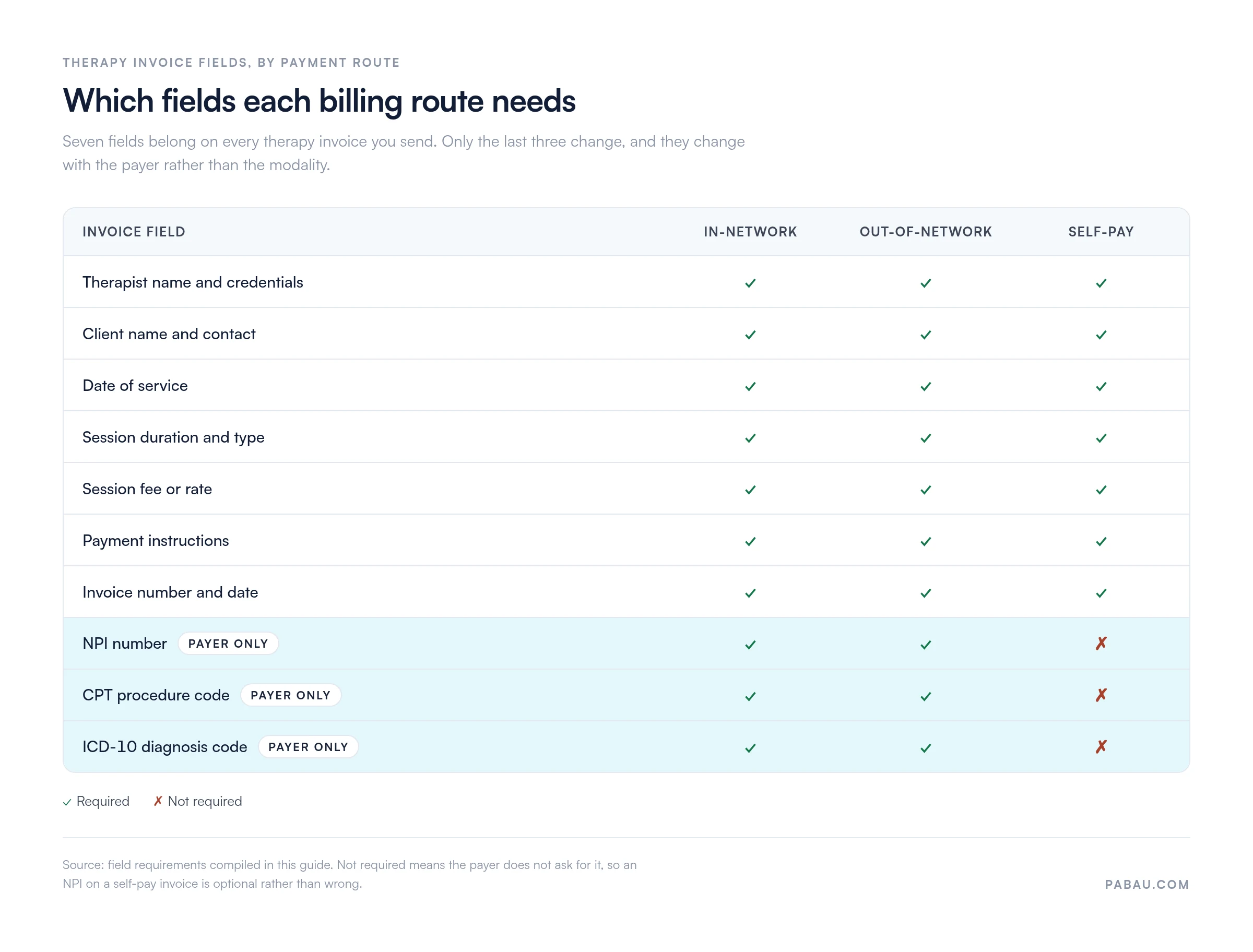
Insurance eligibility verification before each session prevents billing surprises. Confirm the client’s coverage and copay before the invoice goes out.
Create a master invoice with your practice details already filled in, then save a copy per client with their information entered. That cuts invoicing time and stops the same retyping errors coming back. In a multi-therapist practice, keep the master in one shared location so everyone bills on the same format.
Billing errors cluster around rushed invoices and missing fields. Medical billing compliance habits catch them before they delay payment or trigger a denial.
Therapy invoices carry protected health information, known as PHI: client names, dates of birth, diagnosis codes, and insurance details. HIPAA requires that PHI sit behind limited access, encryption, and regular backups.
Practice software built for HIPAA encrypts PHI at rest and in transit. It restricts records by role, so reception staff cannot open clinical notes. It also logs who opened which record, and when. A Word or PDF invoice saved on your laptop has none of those safeguards.
Invoices held in a system with access controls, encryption, and an audit log meet HIPAA’s technical safeguards. Invoices sitting in an unencrypted folder or an email thread leave you exposed to breach liability.
A static template works while you have a handful of clients. As the practice grows, manual invoicing turns into a bottleneck. Entry errors climb, payments slip, and admin time goes with them.
Pabau builds the invoice from the completed appointment instead. Mark a session complete in the calendar, and the client name, date, duration, therapist, and fee arrive pre-filled. You check it and send.
For insurance work, Pabau keeps your NPI, your CPT codes, and each client’s plan details in the client record. That record feeds claims software for therapists, which pre-populates the invoice with the correct codes. Superbills come off the same data, so nobody transcribes diagnosis codes by hand.
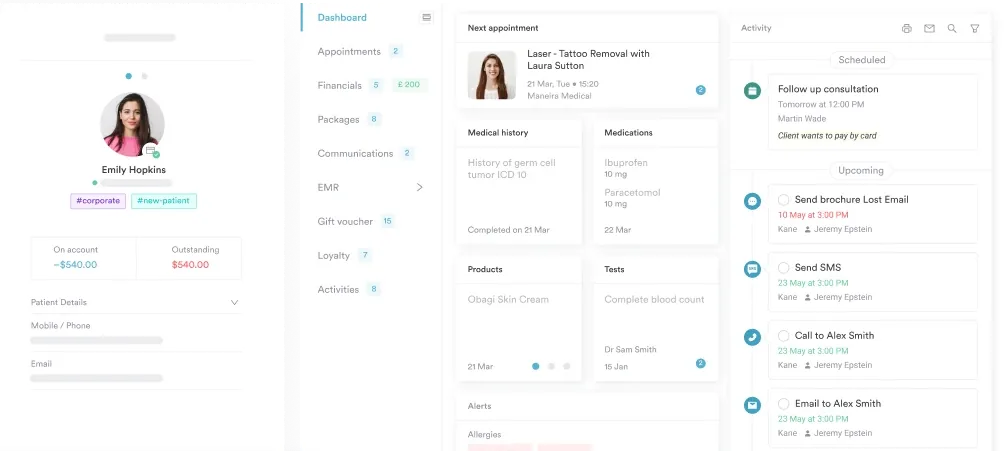

Reduce billing errors and accelerate payment with automated invoice generation from your therapy appointment calendar.

The invoice is where a session turns into money, so the fields on it decide how fast you get paid. Get the payer-specific ones right and most claims clear on the first pass.
Download the template and set up one master copy with your practice details and NPI already in place. That will carry a solo caseload comfortably. Once two or three therapists are billing, retyping the same details is the part that starts costing you.
That is the point to move invoicing into the system that already holds the appointment. Book a demo to see how Pabau turns completed therapy sessions into invoices your clients can pay.

Need a coded receipt for an out-of-network client? The complete superbill guide for healthcare providers walks through the codes and documentation an insurer expects.
Billing a client’s plan directly? The assignment of benefits form template lets you collect from the insurer instead of chasing the client.
Billing a 45-minute session? CPT code 90834 sets out what payers expect to see documented for individual psychotherapy.
Download a therapy invoice template, fill in your practice details, then add the client name and session information. Enter your fee and your payment instructions. For insurance billing, include your NPI number, the CPT code, and the ICD-10 diagnosis code. Send it within two or three days of the session.
An invoice is a payment request you send the client. A superbill is a detailed receipt carrying diagnosis and procedure codes, which an out-of-network client files with their insurer. Invoices are short and client-facing. Superbills are longer and written for the payer.
Yes, if you bill insurance directly. A self-pay invoice does not need an NPI, though including it adds legitimacy and helps if the client later files a claim.
Code by session length: 90832 for 30 minutes, 90834 for 45 minutes, and 90837 for 60 minutes. Physical therapy uses codes such as 97110, and massage uses 97124. Confirm the code with the payer before you bill.
Send the client an invoice for your full fee, along with a superbill carrying the CPT and ICD-10 codes. The client pays you in full, then files the superbill with their insurer for out-of-network reimbursement.
Therapy invoice templates circulate as PDF, Word, and Excel files. PDF suits digital signing and emailing, Word lets you add your practice logo, and Excel helps when you bill several clients at once. The template above downloads as a print-ready PDF.
You can, but a healthcare-specific form is better. It has fields for the NPI, CPT, and ICD-10 codes that generic business invoices leave out. If you bill insurance regularly, that saves time and prevents errors.