HIPAA compliant texting: What you can send patients & how to communicate securely
HIPAA compliant texting is possible when a text holds no protected health inform...

Last Updated: Oct 16, 2026

Practice policies are the written rules covering scheduling, billing, confidentiality and emergencies, and they are what protect you when a dispute starts.
Every private practice needs seven core policies: cancellation, payment, confidentiality, informed consent, telehealth, crisis and emergency, and acknowledgment.
A policy only becomes enforceable once the client has signed for it, so the acknowledgment record matters as much as the wording.
Digital intake forms and e-signatures collect that acknowledgment at booking and store it against the client record.
Review every policy once a year, and sooner when regulations change or an incident exposes something the wording never covered.
A ready-to-use document covering appointment scheduling, cancellation and no-show terms, payment, confidentiality and client communication. Every figure is left blank, so you can set your own notice window and fees before you send it out.
Download templatePractice policies are the written rules that govern how your practice runs. They cover when a client can cancel, when payment is due, who may see a record, and what happens in an emergency. Most practices need seven of them.
Writing them is the easy half. What decides whether a policy holds up is proof that the client read it and agreed to it. This guide covers both halves, and the template above gives you the wording to start from.
Practice policies are written guidelines that define how your practice operates, across scheduling, billing, confidentiality and emergency procedures. They are not the same as procedures. A policy states the what and the why. A procedure explains the how.
The reason to write them down is exposure. HIPAA requires written privacy policies. Professional licensing boards expect documented protocols. Once a disagreement turns into a complaint or a claim, an unwritten rule is one person’s word against another’s.
Clients benefit too. Clear policies remove surprises about cancellation fees, payment terms and the limits of confidentiality before treatment starts.
Each one protects the practice and the client at the same time. Here is the full set:
The seventh gets its own section further down, because it is what turns the other six into something you can enforce.
No-shows and late cancellations waste appointment slots and cut revenue. Reminders reduce patient no-shows, since 37.6% of people who miss an appointment simply forgot it. A written policy handles the rest, by putting a price on the empty slot.
Your policy needs to answer three questions:
Say it at booking and repeat it in writing. A standalone appointment cancellation policy gives you wording you can drop straight into your client agreement.
Set out the terms before the first invoice goes out. A payment policy states:
If you take a deposit for certain services, name those services and the amount. A deposit rule that only exists in the front desk’s head is the one that gets argued about.
This one is not optional. Document your compliance with HIPAA, or UK GDPR if you also operate there. Explain how client records are stored and protected, and say where confidentiality stops, such as mandatory reporting of abuse.
Also state how a client can access their own record and how long you keep it. Publish the policy where clients can find it, and hand a written copy to every new client.
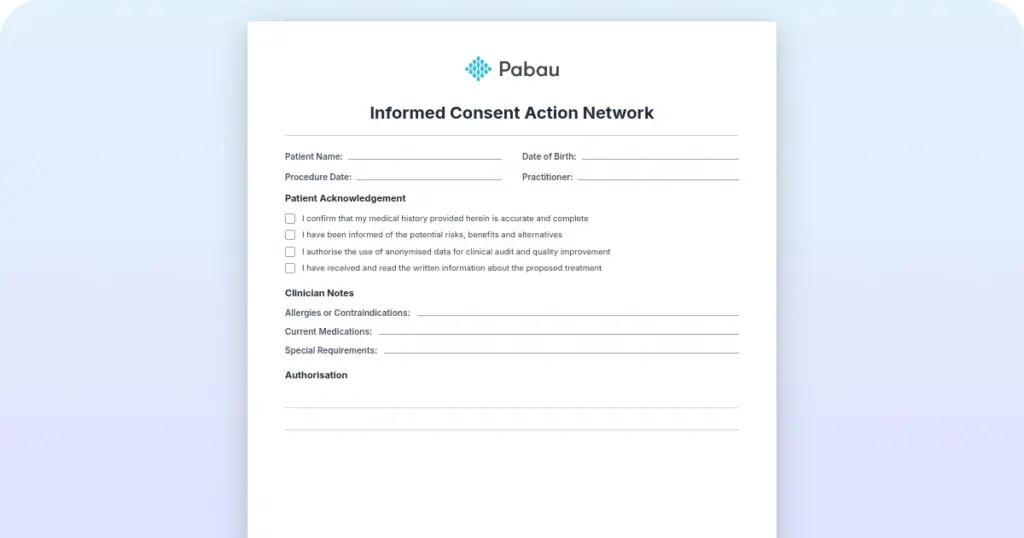
Informed consent means the client understands the risks, the benefits and the alternatives before agreeing to treatment. Your policy should require written consent on a form. That form records what was discussed, and carries the client’s signature and the date.
Keep signed forms with the clinical record for as long as your state requires you to retain records.
If you offer virtual visits, write down which platform you use and the technical standard it has to meet, such as an encrypted connection. Add what happens when the connection fails mid-session, and who the client should call instead.
Then say when telehealth is appropriate at all. Naming the visit types you will not do remotely saves an awkward conversation later.
Clients need to know what happens outside opening hours. State who they contact in a crisis, how quickly someone responds, and when you would call emergency services on their behalf.
This policy also carries your mandatory reporting obligations, so staff know the point at which confidentiality gives way. Those thresholds vary by state, so check yours rather than copying another practice’s wording.
Writing a policy does not take a lawyer, but it does take being specific. Five steps:
A policy only starts protecting you once you can show the client saw it and agreed to it. That is the difference between a document and a defense. The stages below show where that moment sits in the life of a policy.
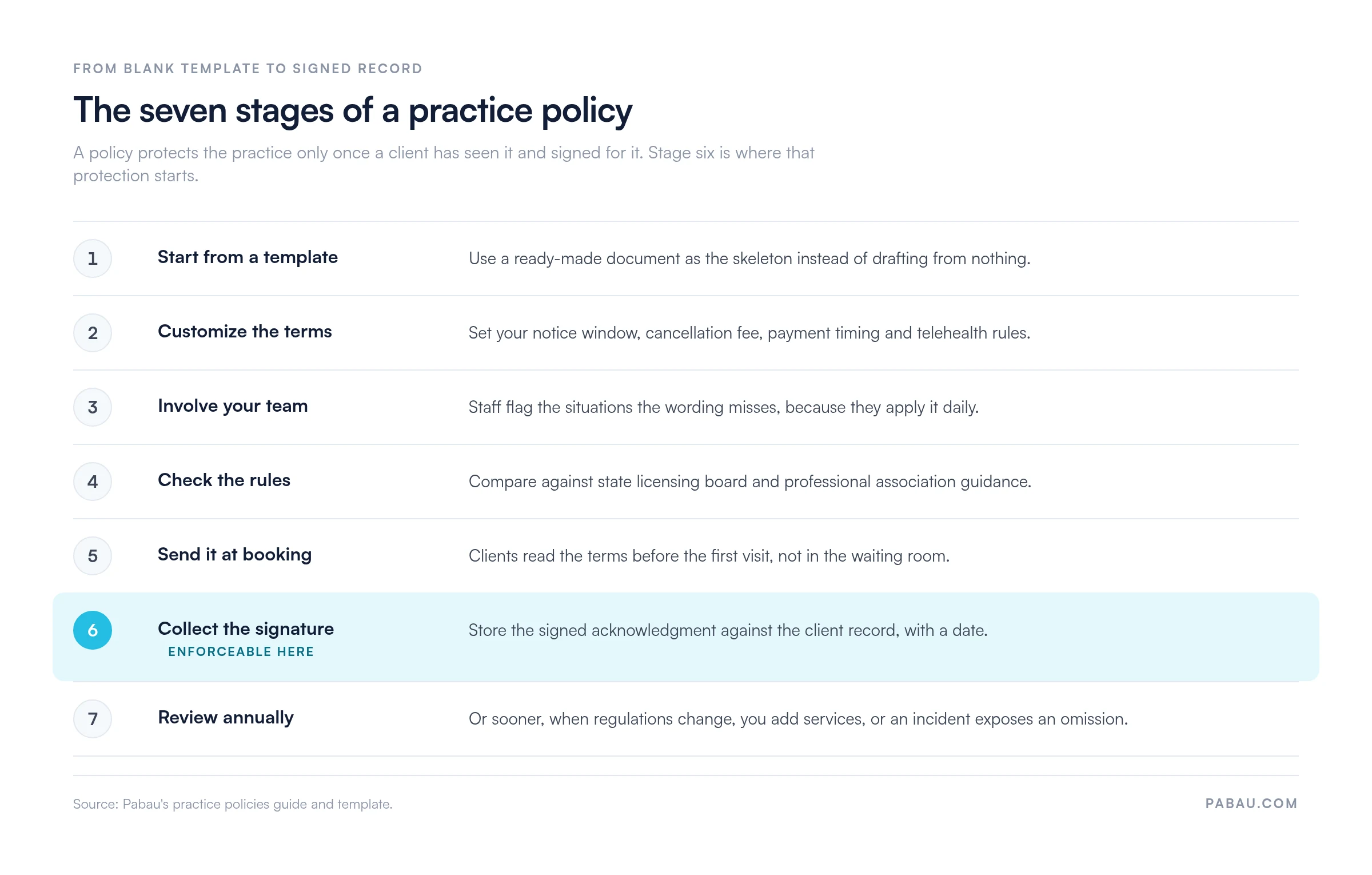
Emailing PDFs and filing the replies by hand loses that proof quickly. Digital intake forms send the policies through the client portal when the appointment is booked. The client signs on screen, and the signed copy lands on their profile.
Compliance management tools keep the audit trail behind it, showing who signed which version and when. If a client later disputes a cancellation fee, that record is what settles it.
The same applies internally. Staff sign for the policies they have to enforce, and new hires sign during onboarding rather than three months in.
Once a year, at minimum. Review sooner when something changes around the policy rather than inside it. Run through a short checklist each time:
Redistribute anything you change, and collect a fresh acknowledgment. An updated policy that nobody has signed is still the old policy.
Most practices manage policies in three places at once. The wording lives in a document, the sending happens over email, and the signed copies sit in a filing cabinet or a shared drive. Finding one signature takes ten minutes.
Practice management software like Pabau collapses that into a single workflow. Your policies attach to the booking, so the client reads them before the visit and signs on their phone. The signed copy files itself against the client record, next to the appointment it applies to.
Pabau GO, our iOS app, shows the same client record on your phone. You can check what someone signed without walking back to reception for the file.
The audit trail is the part that earns its keep when something goes wrong. You can show which version of a policy the client agreed to, and the date they agreed to it.


Pabau sends your policies with the booking, collects the e-signature, and files it against the client record. You stop chasing paperwork and always know who agreed to what.

The seven policies above are not hard to write. Practices come unstuck at the last step, where the signed acknowledgment either exists or it does not.
So work backwards from that step. Decide how you will collect and store a signature before you settle the wording. The storage is what you will need two years from now. If that means a spreadsheet and an inbox, expect to lose an afternoon to every dispute.
Download the template, set your own numbers into it, and put a date in the calendar to read it again next year. Book a demo to see how Pabau sends your policies at booking and files every signature against the client record.

Taking deposits or holding a card on file? The credit card authorization template covers the permission your payment policy has to obtain in writing.
Struggling to get invoices paid? Patient collections explains how to chase balances without damaging the client relationship.
Writing the telehealth section? HIPAA-compliant telehealth platforms compares the tools that meet the technical standard your policy will name.
New to running the business side? Practice management software walks through the systems that sit behind your policies day to day.
A policy is the written rule that states what you do and why, such as requiring 24 hours’ notice to cancel. A procedure is the step-by-step how, such as canceling by phone or through the online portal. Policies set the rule; procedures describe how it gets carried out.
At minimum once a year. Review sooner whenever regulations change, you add services, hire staff, relocate, or an incident exposes something the wording never covered. Record the review date and what changed, so you can show a version history later.
They are enforceable once the client signs an acknowledgment confirming they read and understood them. Keep the signed copy in the client record as proof of agreement. The policy also has to be reasonable, clearly written, and consistent with state and federal law.
Document the refusal in the client record. Where the policy covers something critical, such as informed consent for treatment, you may decline to provide services. For less critical policies, let the refusal stand and keep a record of the offer and the response.
You can customize a template to fit how your practice works. For added assurance, ask your state licensing board or professional association to review the critical sections, such as confidentiality and informed consent. Legal review is worth the cost for telehealth, insurance billing and mandatory reporting.