Anja Dodevska
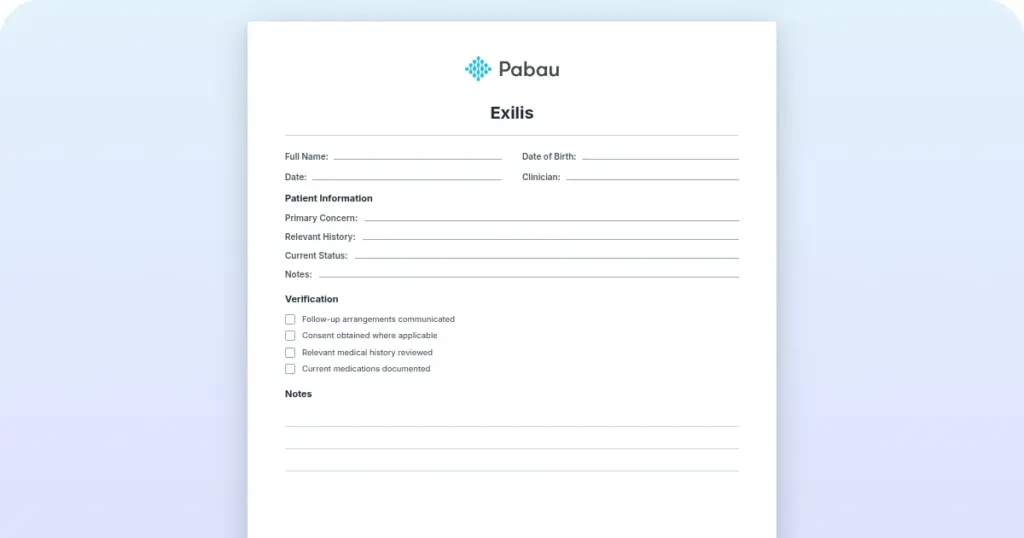
Exilis patient treatment record: Free PDF for RF sessions
An Exilis patient treatment record is the session log for BTL’s radiofrequ...

3
Last Updated: Oct 23, 2026
Free PDF 1 page, print-ready Clinician-reviewed
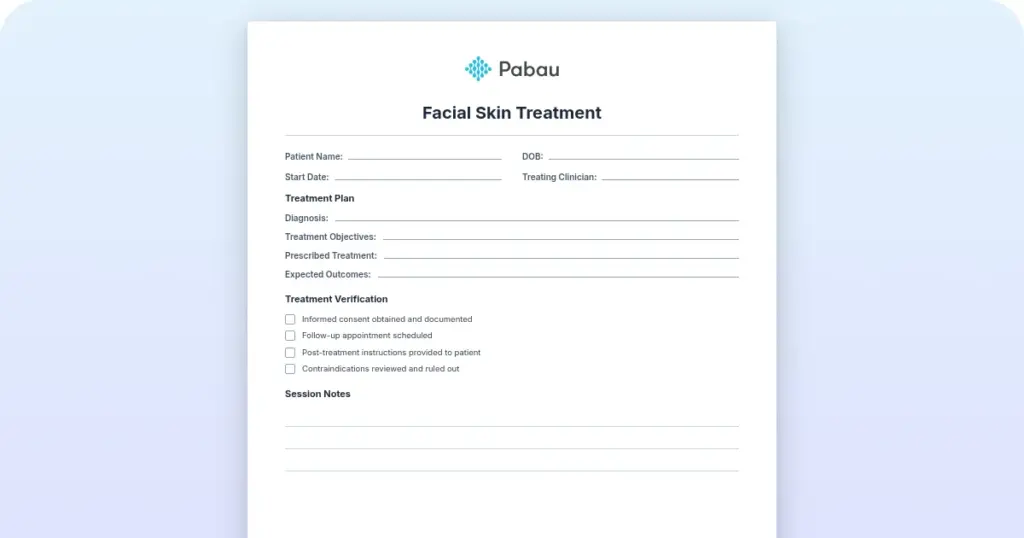
Download your free anti-wrinkle treatment note template A ready-to-use clinical documentation form covering patient details, contraindication screening, consent confirmation, pre-treatment assessment, injection site mapping with units administered, and post-treatment aftercare instructions for botulinum toxin treatments. Download template What is an anti-wrinkle treatment note template? An anti-wrinkle treatment note template is a clinical documentation form. Aesthetic […]
A ready-to-use clinical documentation form covering patient details, contraindication screening, consent confirmation, pre-treatment assessment, injection site mapping with units administered, and post-treatment aftercare instructions for botulinum toxin treatments.
Upload this PDF, or any form you already use, and Pabau's AI Form rebuilds it with tick boxes, text fields and a signature. Attach it to the treatment once, and every patient gets it on time.
AI Form rebuilds the consent, history and aftercare forms you already use. You review each one, then publish.
Patients complete forms on their phone before they arrive, so the front desk stops retyping paper.
Every signed form is versioned and attached to the treatment record, ready when you need it.
Set how long a consent stays valid. Returning patients skip forms they have already signed.
Supports HIPAA and GDPR compliance AES-256 encryption 4.8 on G2 4.7 on Capterra Trusted by 4,000+ practices worldwide

Botulinum toxin is a prescription-only medicine in the UK – treatment notes must document prescriber involvement and patient consent
A structured anti-wrinkle treatment note template captures pre-treatment assessment, units per injection site, and post-procedure aftercare – essential for CQC compliance and patient safety
Accurate injection-site documentation and contraindication screening reduce adverse events and support clinical continuity across repeat appointments
Practice management software like Pabau offers digital forms and AI-assisted clinical documentation, helping aesthetic practitioners create compliant, consistent treatment records in seconds
An anti-wrinkle treatment note template is a clinical documentation form. Aesthetic practitioners use it, printed or in med spa software, to record every detail of a botulinum toxin injection appointment.
It captures the patient’s pre-treatment assessment, contraindication screening, consent declarations, injection sites, and units per site. It also records post-procedure aftercare instructions — creating a legal and clinical record that protects patient safety and practice compliance.
In the UK, the Care Quality Commission (CQC) requires registered aesthetic providers to keep accurate clinical records for every appointment. These records must be written at the time of treatment. Botulinum toxin is a prescription-only medicine regulated by the MHRA. Treatment notes must show that a qualified prescriber — doctor, nurse prescriber, or independent prescriber — has authorized the plan. They must also show the patient gave informed written consent.
A standardized consultation form template ensures no clinical steps are missed and supports continuity of care across repeat bookings.
These templates serve four key functions. They reduce medication errors and adverse events, and they create defensible records if complications arise. They also streamline the appointment workflow, so practitioners spend less time on paperwork. And they show regulators — CQC, Save Face, JCCP — that your practice operates to clinical governance standards.
Using the template as part of your practice workflow follows a five-step cycle. It works smoothly alongside your booking system and patient management platform.
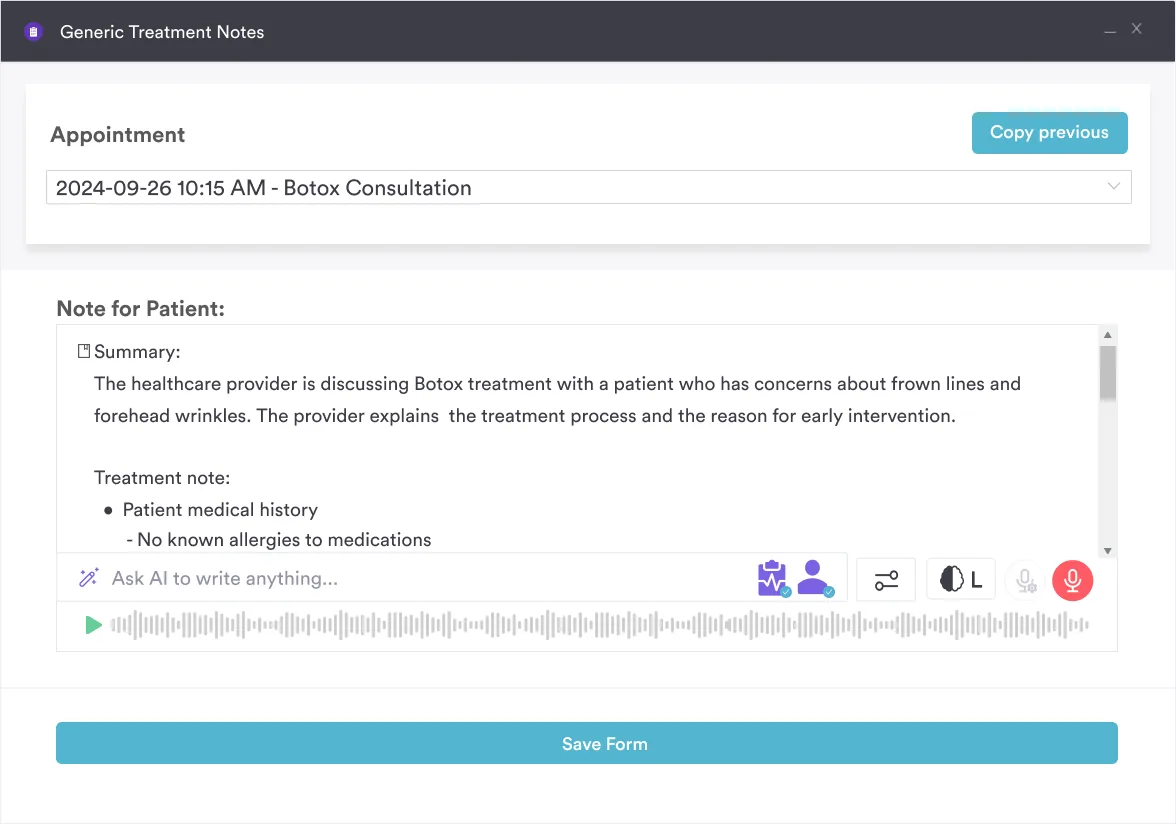
Many aesthetic practices now use Pabau Scribe, our AI scribe, to auto-populate sections like assessment summaries and aftercare instructions. This reduces manual transcription and keeps notes consistent across appointments.
Any aesthetic practitioner administering botulinum toxin injections must use a treatment note template – it is not optional.
This includes aesthetic nurses, non-medical prescribers, nurse prescribers, independent prescribers, doctors, and aesthetic practitioners working under medical supervision. They also see stronger compliance audit outcomes.
Medical spas, dermatology practices, cosmetic surgery practices, and independent aesthetic practices all rely on these templates. They set the standard of care expected by the CQC, Save Face, and professional bodies like JCCP and BCAM.
Clinical safety and adverse event reduction: Screening for contraindications lowers the risk of treating patients who should not receive treatment — for example, due to pregnancy, neuromuscular disease, or allergy. Spotting risk factors early protects patient safety.
Compliance and audit readiness: The CQC expects practices to keep records that show safe clinical practice. A completed template shows assessors that your practice runs pre-treatment screening and documents consent. It is the hallmark of a compliant practice.
Clinical continuity across repeat appointments: When a patient returns 4 months later for a top-up, the previous note still helps. It shows which sites received how many units, how the patient responded, and what aftercare feedback they gave. This guides your next appointment and builds a long-term safety record.
Practitioner confidence and risk mitigation: Suppose a complication occurs — for example, unilateral drooping or an asymmetrical result. A detailed note written at the time proves you followed proper process. It shows you carried out the assessment, obtained informed consent, and documented the injection technique. This is your legal protection in a complaint or claim.
Time savings: A template-driven workflow cuts time spent writing notes from scratch.
A complete template covers all elements the CQC, JCCP, and Save Face expect to see in aesthetic clinical records.
Every field should be completed at the time of treatment, not added later. Recording details as they happen is a legal requirement and best practice.
Botulinum toxin is a prescription-only medicine in the UK under the Human Medicines Regulations 2012. This means your treatment notes must show that a qualified prescriber has reviewed the patient and authorized the treatment.
If you are a non-medical practitioner, such as an aesthetic nurse or technician, a doctor or nurse prescriber must countersign your treatment note. Alternatively, they must provide a standing prescription, reviewed and signed before the treatment is delivered.
UK GDPR and UK data retention guidelines require you to keep patient health records for at least 8 years after the last treatment. US-based practices should keep an equivalent HIPAA privacy policy covering federal requirements. Store treatment notes in a secure, access-controlled system — either locked filing or encrypted digital storage.
Patient data — contact details, medical history, before-and-after photos — must never be shared with third parties without explicit written consent. If a referring physician, insurer, or solicitor requests records, document the request using a signed authorization for release of confidential information form.
The CQC’s core standards on record-keeping apply to all registered aesthetic providers. Your treatment notes are the primary evidence auditors review to confirm you ran a proper assessment, obtained consent, and delivered safe care. Missing contraindication checks, unsigned consent forms, or no post-treatment follow-up on file are all cited as non-compliance.
Beyond the template itself. A pre-appointment phone call or message asking patients to review their medical history and expectations sets the tone for a thorough assessment.
Many practices now use digital patient portals where clients complete consent and medical history forms online before they arrive. This auto-populates the practitioner’s template and cuts handwriting errors, while also creating a digital audit trail of when each patient interaction happened.
Practices often manage several aesthetic treatments — botulinum toxin, fillers, thread lifts, microneedling. A unified treatment note template, adapted for each modality, keeps documentation standards consistent across all services.
Practitioners can complete the note during or right after the appointment on a tablet or computer, so details stay accurate while they are fresh.
Vague unit documentation: Writing “Botox as usual” or “standard dose” instead of specific numbers per site. Every site should record the exact units and product. This matters if the patient complains of asymmetry or too little effect. Your note proves what you did.
Missing contraindication screening: Skipping the medical history form because “the patient seems healthy” is a common mistake. Pregnancy, bleeding disorders, and anticoagulant use are easy to miss if you do not ask. A single line on the form prevents serious adverse events.
Unsigned consent: A verbal conversation about risks is not legally sufficient. The patient must sign a document instead. It should confirm they understand three things: botulinum toxin is not reversible, onset takes days, and rare complications include ptosis and infection. Digital signatures on tablet-based forms are valid and verifiable.
No follow-up documentation: Forgetting to record the 2-week review outcome. Suppose the patient returns and says “I had no movement at all.” Your follow-up note proves whether you assessed this and agreed, or whether the practice never followed up. Missing follow-up records undermine your compliance defense.
The template above is printable as a paper form, or you can digitize it using practice management software. This lets you adapt the template to your practice’s branding and workflow without starting from scratch.
If you are a solo aesthetic nurse, a form printed on practice letterhead and filed in a secure cabinet is compliant. If you run a multi-location medical spa, you need a digital system instead. It should sync notes across locations, archive them after 8 years, and generate audit logs for CQC inspection.
An anti-wrinkle treatment note template is the foundation of safe, ethical, and compliant aesthetic practice. Every botulinum toxin treatment carries inherent risks, including infection, asymmetry, ptosis, and allergy.
Detailed notes, written at the time, prove you identified contraindications, obtained informed consent, applied safe injection technique, and monitored the patient’s response. This protects your patients. It also defends your practice if complications arise or auditors ask questions.
Download the free template above, adapt it to your practice setting, and add it to every botulinum toxin appointment starting today. Your patients will appreciate the thoroughness, and your regulators will commend your governance. Your practice liability will also decrease. Book a demo to see how Pabau’s integrated digital forms and treatment note system streamline documentation across your practice.

Need a pre-appointment medical history form? Aesthetic Interest Questionnaire Template provides a patient-friendly intake form that captures treatment preferences and medical contraindications before the consultation.
Thinking about opening your own practice? Aesthetics business launch guide covers licensing, legal setup, and the $30,000 to $250,000 in startup costs.
Also offering HydraFacial treatments? Hydrafacial tips and settings guide covers tip types, machine settings, and protocols for blue, orange, purple, teal, and clear tips.
Treating with Botox specifically? Botox Treatment Note Template offers a brand-specific version of this documentation for practices that primarily use Botox.
An anti-wrinkle treatment note must include patient demographics, medical and medication history, and contraindication screening (pregnancy, neuromuscular disease, recent other botulinum toxin treatment). It should also cover informed consent, pre-treatment assessment, product name and lot number, site-specific unit doses, and injection technique notes. Finally, add post-treatment aftercare instructions with patient initials and 2-week follow-up scheduling.
Practitioners complete a structured treatment note during or right after the appointment. It records the exact sites treated, units per site, product lot number, patient observations, and aftercare provided. Many practices now use digital forms in practice management software for consistency and automatic audit trails.
Yes. The CQC requires all registered aesthetic providers to keep clinical records written at the time of treatment. UK GDPR requires patient health records to be kept for at least 8 years after the last treatment. Treatment notes are the main evidence auditors review to confirm safe, consented care.
Standard aftercare has a few key rules. Avoid rubbing or massaging treated areas for 24 hours, and do not lie flat for 4 hours. Avoid strenuous exercise, saunas, and alcohol for 24-48 hours, and skip facials or professional skin treatments for 1-2 weeks. Expect onset in 3-7 days and peak effect by day 14, then schedule a 2-week review to assess results and rule out complications.
Botulinum toxin results typically last 3-6 months. Most patients see peak effect by day 14, with gradual fading after 12 weeks. Repeat treatments are usually scheduled every 12-16 weeks to maintain results. Practitioner notes from previous appointments help guide the right timing and dosing for each patient.