How to Start a Med Spa in 2026: Complete Step-by-Step Guide
The medical spa industry surpassed $21 billion in 2024 and shows no signs of slo...

March 31, 2026


Buy now, pay later is now available in Pabau

To start a med spa, you need a business plan, proper licensing, a qualified Medical Director, and full HIPAA and OSHA compliance. None of these are optional.
Startup costs range from $100,000 to $500,000 depending on location and services. Factor in liability, malpractice, and workers’ comp insurance from day one.
All-in-one practice management software for scheduling, records, compliance, and marketing reduces admin significantly.
Well-run med spas achieve 15 to 30% net profit margins, with average annual revenue near $1.4 million.
The medical spa industry surpassed $21 billion in 2024 and shows no signs of slowing down. If you’re figuring out how to start a med spa, this guide walks you through every step, from legal compliance to your grand opening and beyond.
We’ll cover licensing, business planning, startup costs, staffing, and equipment. Plus, the marketing strategies you need to open a medical spa that’s built to scale.
Opening a medical spa is more involved than launching a traditional spa or wellness center.
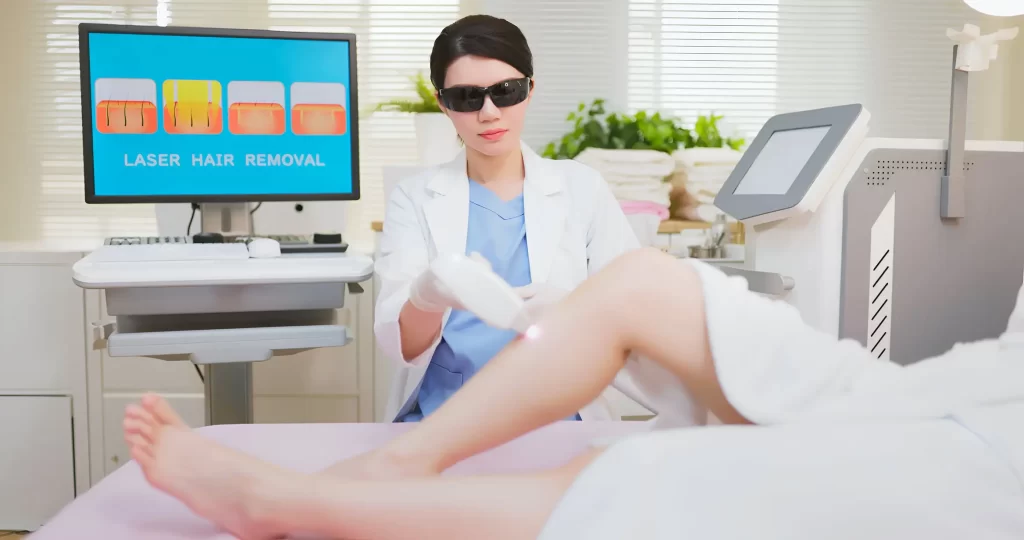
You’re offering medical treatments like dermal fillers, laser hair removal, chemical peels, and body contouring. As a result, your business falls under healthcare regulations in most states.
Here’s the step-by-step process for starting a med spa the right way.
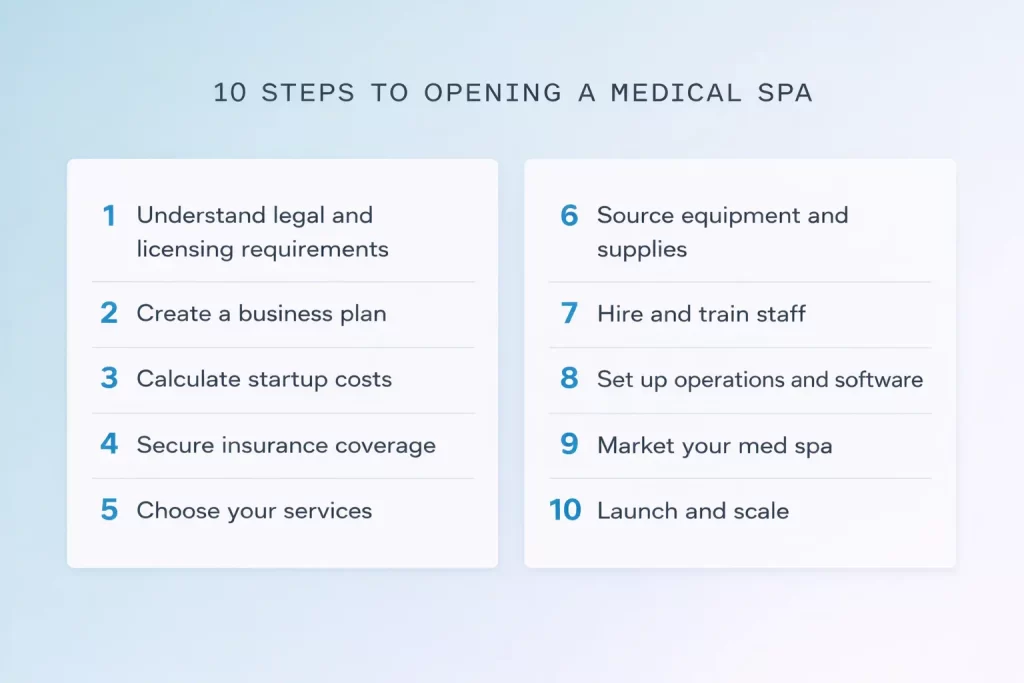
This is where most aspiring med spa owners underestimate the complexity.
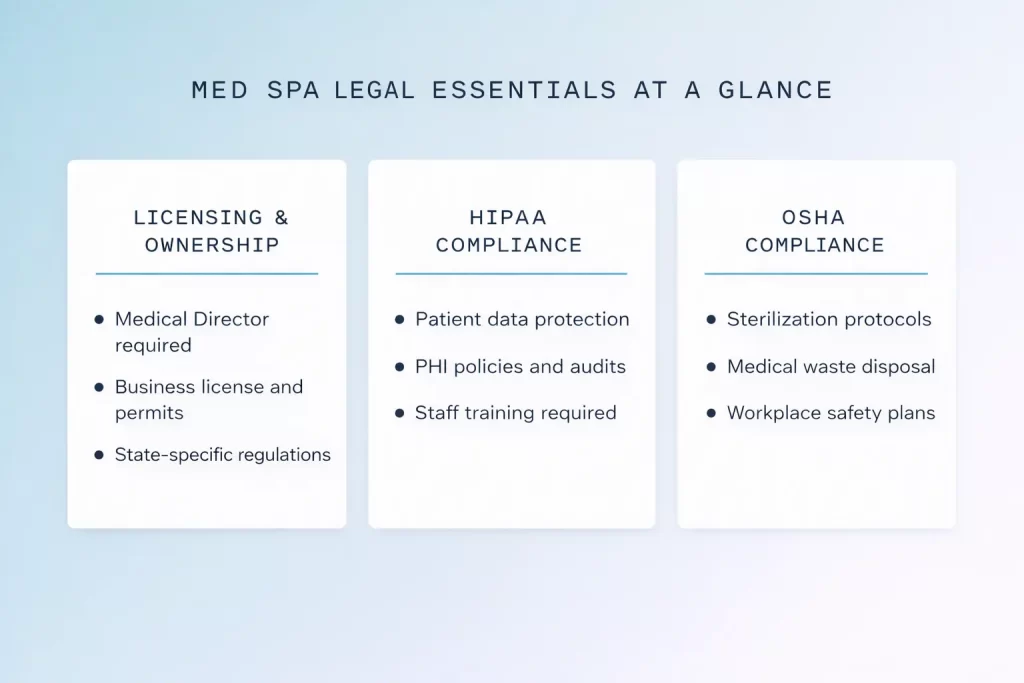
In the majority of U.S. states, medical spas are regulated similarly to medical practices. That means you’ll need to satisfy both standard business requirements and medical-specific regulations before opening your doors.
Here’s what to account for:
Don’t rely on general online summaries for legal compliance. Instead, consult a healthcare attorney who specializes in medical aesthetics in your state. Laws change frequently, and one oversight can lead to fines, lawsuits, or losing your medical licenses.
Every client at your med spa is a patient under the law.
You’ll be handling sensitive data like medical intake forms, informed consents, treatment histories, and before-and-after photos. All of it must comply with the HIPAA (Health Insurance Portability and Accountability Act).
What that means in practice:
HIPAA fines range from $100 to $50,000 per violation, and repeated violations can result in criminal charges. Beyond the financial hit, a HIPAA breach destroys patient trust and your reputation.
Your staff will handle bloodborne pathogens, sharps, and biohazardous materials during procedures like injectables and laser treatments. Because of this, your med spa falls under the Occupational Safety and Health Administration (OSHA) oversight.
You’ll need documented protocols for:
Following an OSHA compliance checklist helps you stay ahead of inspections and avoid penalties.
A med spa business plan isn’t just a formality. It’s how you secure funding, attract investors, and map your path to profitability.
Your business plan should cover:
According to the AmSpa’s 2024 report, average annual med spa revenue reached nearly $1.4 million, up from $1.3 million the year prior. The opportunity is real, but only if you plan for it
The startup costs for opening a medical spa range widely depending on your location, scope of services, and whether you buy or lease equipment.
Here’s a general breakdown:
| Expense Category | Estimated Range |
| Real estate and renovation | $100,000 – $200,000 |
| Medical equipment | $80,000 – $250,000 |
| Salaries and benefits | $180,000 – $520,000/year |
| Inventory (injectables, skincare, supplies) | $10,000 – $30,000/month |
| Marketing and advertising | $5,000 – $20,000/month |
| Insurance | $2,000 – $5,000/year |
| Legal and processing fees | $5,000 – $25,000/year |
| Total estimated range | $100,000 – $500,000+ |
Sources: IAPAM, CostAnswers, Workee, FinancialModel
Solo-practitioner setups can start around $50,000, while a full-service med spa in a competitive urban market can exceed $1 million. For a more detailed breakdown, see how much it costs to open a med spa.
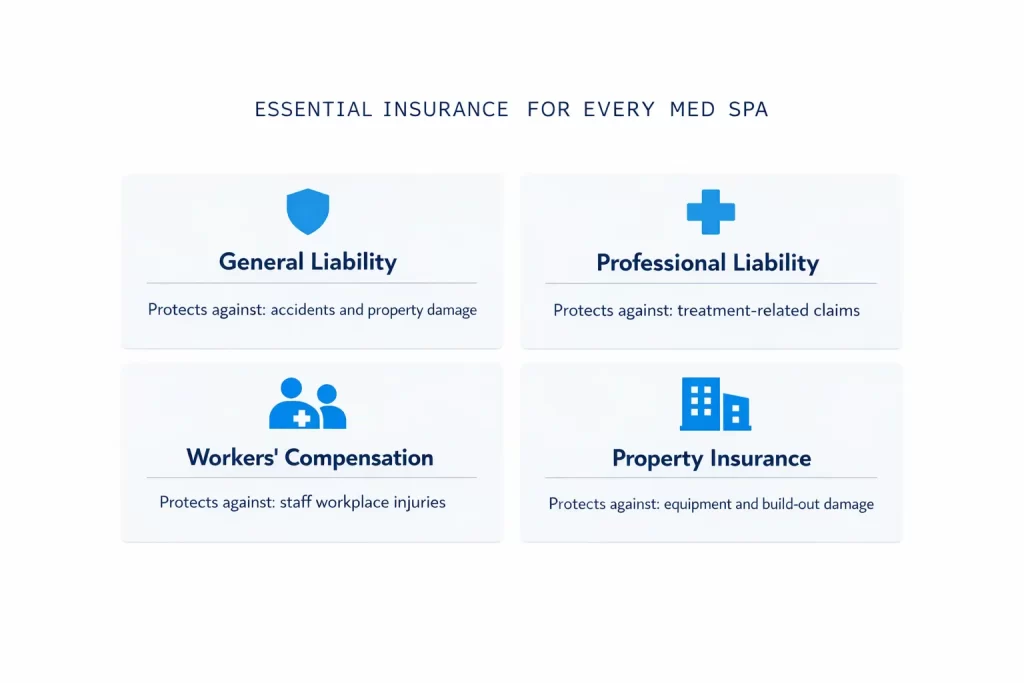
Operating without the right insurance coverage puts your entire business at risk. Median liability lawsuit costs start at around $54,000, and a malpractice claim can run much higher.
The key policies you’ll need:
Your insurance coverage can also be tailored to cover specific procedures like dermal filler injections, chemical peels, laser therapy, and anti-aging treatments.
Your service menu directly impacts your equipment needs, staffing, and revenue potential.
Most successful med spas launch with a focused menu and expand over time. Common starting services include:
The body contouring treatments market was valued at $1.46 billion in 2024 and is projected to reach $2.58 billion by 2029. If these treatments aren’t on your roadmap yet, they should be.
The equipment you invest in shapes the quality of care and the reputation of your med spa. So prioritize FDA-cleared equipment for all medical device categories. This protects both your patients and your business from liability.
Essential equipment typically includes:
Buy from reputable manufacturers and negotiate maintenance contracts upfront. Downtime from broken equipment means lost revenue. Also, confirm that your treatment rooms meet the electrical and ventilation requirements for each device before installing
Your team is the backbone of your med spa. Patients trust the people providing their care, which is why hiring and staff training are critical to long-term success.
The core roles you’ll need to fill:
Make sure all medical staff hold valid medical licenses and relevant certifications. Ongoing training keeps your team current on treatment protocols, patient safety, and evolving state regulations.
Your operations setup determines how smoothly your med spa runs from day one. The right technology stack eliminates manual work and keeps your team focused on patient care.
A good practice management software should handle:
Pabau is built specifically for medical-first practices. It covers everything listed above and more. From clinical documentation to marketing automation, it all runs from one dashboard.
Even the best medical spa will struggle without effective marketing strategies. Your goal is to build visibility, earn trust, and convert leads into repeat business.
Start with these marketing channels:
Healthcare marketing comes with rules. Avoid making false claims, promising specific results, or using misleading language in your ads. Instead, focus on education, transparency, and real results. That’s what builds client trust.
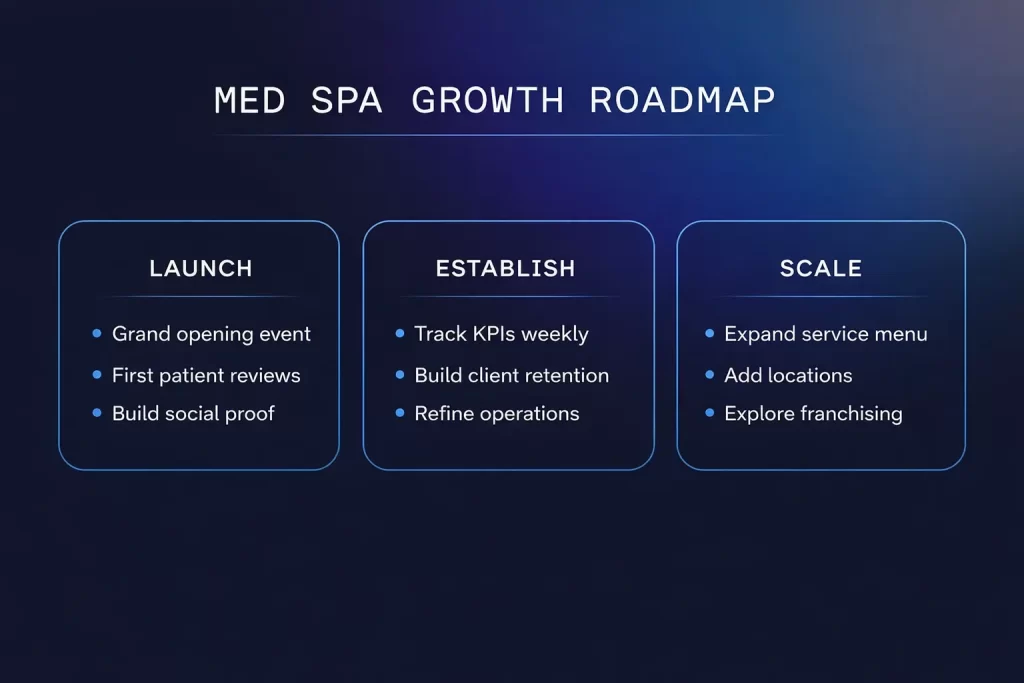
Your grand opening sets the tone for everything that follows. Plan it strategically:
Once you’re operational, shift your focus to scaling. Track your med spa KPIs weekly, including revenue per treatment, client retention rate, average spend per visit, and new patient acquisition cost.
As demand grows, consider expanding your service menu, adding treatment rooms, or opening a second location. Some owners eventually explore the med spa franchise model for faster growth.

Want to make sure you’re fully compliant before opening? Check out the ultimate medical spa compliance checklist.
Planning to open in Texas? Download the free eBook on how to successfully open a med spa in Texas.
Launching in California? Read a complete guide to California med spa licensing laws.
Even experienced healthcare professionals make avoidable errors during launch. Here are the most common ones:
| Mistake | Why It Hurts | What to Do Instead |
| Skipping the business plan | No roadmap means no funding and no clarity | Write a detailed med spa business plan before signing a lease |
| Underestimating startup costs | Cash shortfalls in the first 6 months are the top reason med spas fail | Budget for at least 6 months of operating expenses beyond your initial investment |
| Ignoring compliance | HIPAA and OSHA violations lead to fines, lawsuits, and lost trust | Build compliance into your operations from day one |
| Hiring unqualified staff | Poor patient outcomes damage your reputation fast | Verify all medical licenses and invest in ongoing staff training |
| Overbuying equipment at launch | Tying up capital in machines you don’t need yet | Start with core equipment and lease what you can |
| Neglecting marketing | “If you build it, they will come” doesn’t apply here | Allocate 7 to 10% of projected revenue to marketing from month one |
One of the biggest (and least talked about) mistakes is not having a Medical Director who is actively involved. A medical director who just signs off on paperwork without reviewing charts or supervising treatment protocols puts your entire operation at legal risk.
Once your med spa is up and running, the real work begins. You need to deliver consistent care, retain patients, and grow sustainably.
Customer retention is cheaper than acquisition. And in medical aesthetics, reputation drives everything.
Create a patient experience that goes beyond the treatment itself:
When patients feel genuinely cared for, they come back. And they refer friends.
Your financial plan doesn’t stop at launch. Ongoing financial management is what separates profitable med spas from those that barely break even.
| Metric | Benchmark |
| Net profit margin | 15 to 30% for well-run med spas |
| Injectable gross margins | 50 to 70% |
| Laser treatment margins | 40 to 60% |
| Payroll as % of revenue | Keep under 30% |
| Monthly marketing spend | 7 to 10% of revenue |
Pricing tips to keep in mind:
Patient safety is the foundation of your business. Cutting corners here isn’t just risky. It’s a fast track to lawsuits and losing your medical license.
Non-negotiable practices include:
Don’t wait for an inspection to find out you’re non-compliant. Run internal audits quarterly and document everything. If something does go wrong, that paper trail is what protects you.
The med spas that grow consistently treat marketing as a system, not a series of one-off campaigns.
Invest in:
For proven strategies, check out med spa marketing strategies.
The most successful med spa owners track performance daily, not monthly. Use reporting tools to monitor:
Your practice management software should surface these insights without requiring manual spreadsheet work. The faster you spot a trend, the faster you can act on it.
Use this checklist to make sure you’re covering every base before launch day.
Legal and Compliance:
☐ Research state regulations for med spa ownership and operations
☐ Determine ownership structure (physician-owned, MSO, partnership)
☐ Hire or contract a qualified Medical Director
☐ Obtain business license and facility permits
☐ Confirm zoning laws for your location
☐ Set up HIPAA-compliant systems and train all staff
☐ Establish OSHA protocols for waste disposal, sterilization, and safety
Business and Finance:
☐ Write a med spa business plan with financial projections
☐ Secure funding (personal savings, SBA loans, investors)
☐ Open a business bank account and set up accounting
☐ Purchase general liability, professional liability, and workers’ comp insurance
☐ Set pricing strategy based on market research
Operations and Technology:
☐ Lease or purchase your space and complete build-out
☐ Source and install FDA-cleared medical equipment
☐ Choose a practice management software with EMR, scheduling, and marketing tools
☐ Set up an inventory management system for supplies and medical-grade products
☐ Create treatment protocols and informed consent documentation
☐ Design patient intake forms (digital, HIPAA-compliant)
Staffing:
☐ Hire qualified healthcare professionals (RNs, NPs, PAs, licensed estheticians)
☐ Hire front desk, operations, and administrative staff
☐ Establish training programs and ongoing education plans
☐ Set up staff credentials verification and documentation
Marketing and Launch:
☐ Build a professional website with online booking
☐ Claim and optimize your Google Business Profile
☐ Set up social media profiles (Instagram, TikTok, Facebook)
☐ Plan your grand opening event and launch promotions
☐ Create an email/SMS marketing system for client communication
☐ Build a membership program strategy for customer retention
By now, you’ve got a solid handle on how to start a med spa. The next step is making sure your operations don’t slow you down. Pabau is an all-in-one platform that covers:
Whether it’s your first med spa or your fifth, Pabau scales with you. Book a demo to see how it works in practice.
Yes. Well-run medical spas achieve net profit margins between 15% and 30%. Profitability depends on your service mix, operational efficiency, patient retention, and how effectively you manage overhead.
Typically between $100,000 and $500,000, depending on location, services, equipment, and scale. Lean setups can start around $50,000, while a high-end, multi-room med spa in a major metro area can exceed $1 million.
It depends on your state. Many states require physician ownership, while others allow NPs, PAs, or even non-medical entrepreneurs to own a med spa. That said, nearly every state requires a licensed Medical Director to oversee all medical procedures. Consult your state medical board and a healthcare attorney for specifics.
Look for a platform that combines EMR, scheduling, online booking, HIPAA-compliant client management, marketing automation, and reporting in one system. Pabau is designed specifically for med spas and healthcare practices that need both clinical and business growth tools.
Plan for 6 to 12 months from initial planning to your grand opening. The timeline depends on securing funding, finding a location, completing build-out, hiring staff, and obtaining all necessary licenses and permits. Starting your business plan and legal research early helps avoid delays.