Patient financing: How to offer it and stay compliant
Patient financing lets patients spread the cost of treatment over weeks or month...

Last Updated: Oct 7, 2026

Size your loan by adding your one-time startup or expansion costs to a three- to six-month cash buffer, then check the payment against your projected monthly cash flow.
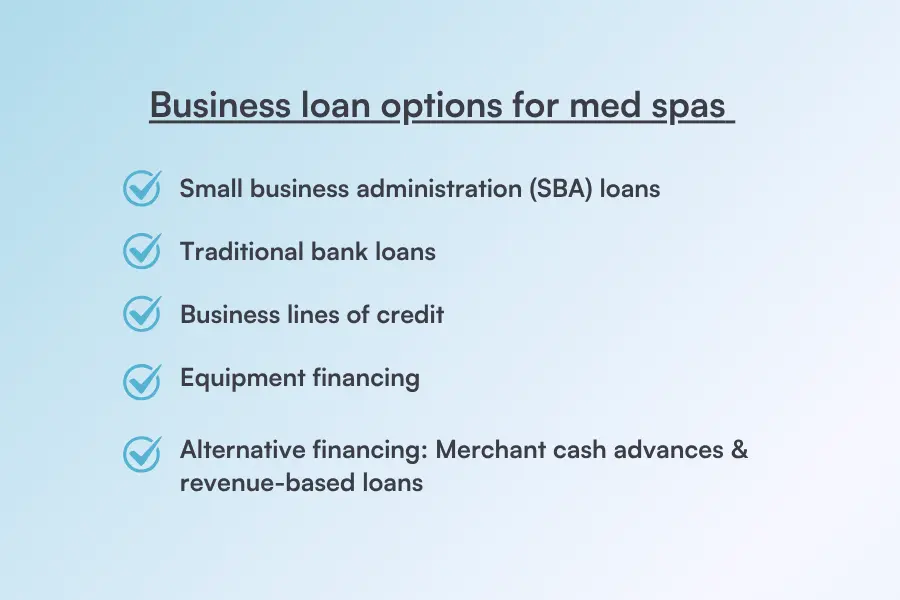
Match the loan type to the need: SBA loans and term loans cover large one-time costs, a line of credit covers ongoing expenses, equipment financing covers big-ticket purchases, and merchant cash advances cover short-term cash shortfalls.
Lenders weigh your credit score, time in business, monthly revenue, and business plan before approving a med spa loan.
Compare at least three lenders across banks, credit unions, and online lenders, since each differs on speed, rates, and approval standards.
Watch for predatory red flags such as upfront fees, unclear rates, and pressure to sign quickly, and consider CDFIs or revenue-based financing as ethical alternatives.
A single laser can cost as much as a new car, so most med spa owners take out a spa loan, or another form of medical spa financing, at some point. That financing can cover practice software too, so compare total cost of ownership in our ranking of the best medical spa software. Maybe the loan is to open the doors, add a treatment room, or simply get through a slow quarter.
A med spa is exactly the kind of business lenders like to fund, as long as you walk in prepared.
The rest of this guide walks through each step the way it plays out in practice, how underwriters actually read your file, what trips owners up, and a checklist to run before you hit submit.
Every financing decision starts with one number: how much you need, and why. So before you look at a single lender, get clear on your med spa finance needs.
Whether you’re still working out how to start a med spa or running one you’ve had for years, owners borrow for all sorts of reasons: adding a treatment room, replacing an aging laser, stocking up on injectables before a busy season, or bridging the slow months when revenue dips.
A single device can run into six figures, so a loan lets you invest in growth without draining the cash you need for payroll and rent. If you’re running a franchise location, for example, a spa franchise loan can cover the buy-in and build-out the same way.
The upfront investment covers equipment, build-out, staffing, and marketing, all before your first client books in.
What you’ll actually spend depends on your location, whether you lease or buy, the equipment you choose, and how many people you hire on day one.
As a rough guide, the cost of opening a med spa usually lands in one of three tiers:
Say your costs look like this:
Startup costs subtotal = $130,000. Add the cash buffer, and your total loan amount comes to $150,000.
Borrowing the right amount is only half the job. It’s also worth checking whether the loan will pay for itself, and a quick way to gauge that is the monthly return on investment (ROI) it generates:
(Revenue increase − loan payment) ÷ loan payment
Read the result like this:
For example, if the loan adds $9,000 in monthly revenue and the payment is $3,500: (9,000 − 3,500) ÷ 3,500 = 1.57. Multiply by 100, and you’re earning 157% more than you’re paying.
Anchor those projections in your actual med spa revenue, not best-case guesses. A healthy med spa profit margin also reassures them the repayment won’t stretch your cash flow thin.
Want to pressure-test it? Our free cash flow template lets you plug in your bank balance, expected costs, and projected sales to see how the next 12 months shake out.
Now for the money itself. The next step is choosing the right med spa financing option for your goals, and mapping the numbers with a loan cost template before you commit.
There’s no single best answer here. The right choice comes down to three things: your credit, how fast you need the funds, and what you’re spending them on.
Medical spa financing comes in several forms. Here’s how the most common spa financing options stack up, before we get into the detail of each.
SBA loans are the go-to for established owners with solid credit who are funding a big, one-time cost. Backed by the Small Business Administration, these spa small business loans carry the lowest rates and longest terms you’ll find. The trade-off is the slowest, most paperwork-heavy approval of the bunch, often 30 to 90 days.
You’ll usually need to personally guarantee the loan if you own 20% or more of the practice, and most lenders want a personal credit score around 680 or higher.
A conventional bank loan suits med spas with strong revenue and clean books. You get a fixed lump sum at a competitive rate, but the credit bar is high and the documentation is heavy. If your financials are tidy and you’re not in a rush, it’s one of the cheapest ways to borrow.
A line of credit is the flexible option, and the one owners reach for most after opening. Instead of a lump sum, you draw what you need up to a limit and pay interest only on what you use. It’s built for the unpredictable stuff like bulk inventory order, surprise repair, or lean month. Just keep an eye on variable rates and the occasional collateral requirement.
Buying a specific device, like laser, body-contouring system, therapy table? Equipment financing is usually the easiest loan to land, because the equipment itself is the collateral. Terms typically run two to seven years, matched to the useful life of the machine. Expect a slightly higher rate in exchange for the easy approval.
When your card sales are strong but your credit history is thin, a merchant cash advance can put money in your account within a day or two. The catch is real: repayment comes straight out of your daily card takings, and the effective cost is the highest of any option here. Use it for a short-term gap, never a big investment.
If you’re buying the building your med spa occupies rather than leasing, a DSCR loan is worth a look. Approval hinges on whether the property’s income covers the mortgage rather than on your personal income, though lenders still run a credit check.
Before a lender hands over a cent, they want proof you’re serious and that the business can carry the debt. Qualifying comes down to a few things you can strengthen ahead of time, and the stronger you look, the better the rate you’ll score.
Here’s how a med spa loan application usually moves:
Where does it stall? Almost always at underwriting: inconsistent revenue, financials that don’t reconcile with the bank statements, or a debt load with no room for another payment. The three moves below are how you keep that from happening.
Your credit score is the first thing a lender looks at, personal or business. But the number isn’t the whole story, as they’re also reading your track record.
To strengthen your profile before you apply:
Lenders can tell when you’ve put in the work, so start early.
A solid med spa business plan is for impressing both investors and lenders. It’s your proof that you’ve done the homework and have a clear path to paying the money back.
A complete business plan template packages the market analysis, projections, and repayment strategy into the single document lenders expect. At minimum, yours should cover:
Most lenders ask for the same core set of documents. Have these ready before you start:
Most of that list is financial history the lender expects you to produce on demand.
If your practice runs on practice management software like Pabau, the profit and loss statement, monthly revenue, and bank-matched payment records already live in one place. You export them in a few clicks instead of rebuilding them from spreadsheets the week before you apply.
Two owners with identical numbers can walk away with very different offers, because the lender you pick shapes the terms as much as your financials do.
Here’s how to size up your options.
Each lender type has a sweet spot. Many owners start with their existing spa banking relationship, but that’s not always where the best loan for a spa comes from.
Banks are cheap but slow, credit unions are flexible, and online lenders are fast but pricier.
Once you know which type fits, get at least three offers before you commit. Weigh the annual percentage rate, the repayment term, any origination or prepayment fees, and how quickly the lender funds.
Online marketplaces and broker sites list spa business loans side by side, which is handy (just read the fine print, because the headline rate is rarely the rate you’ll actually get).
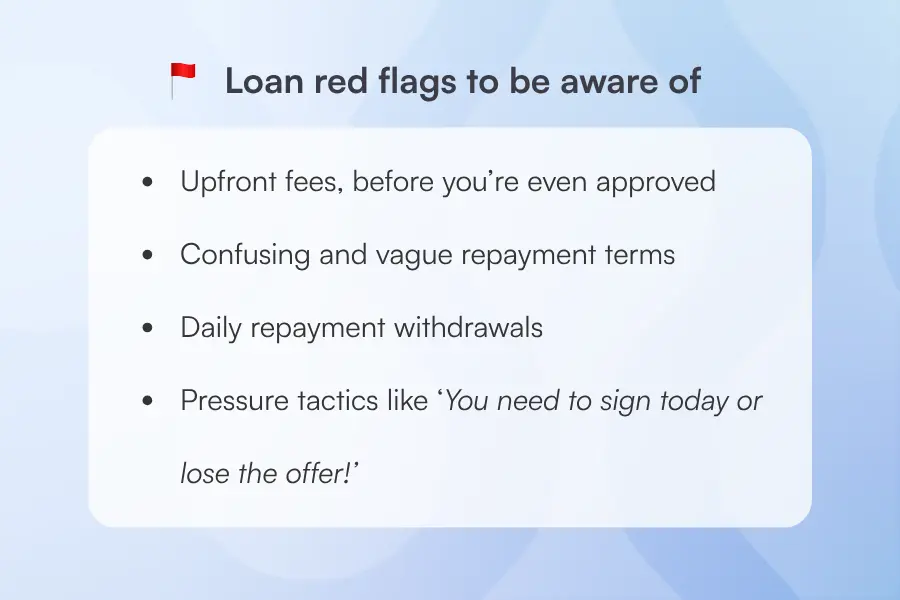
When you need cash fast, it’s easy to walk into a trap, and some lenders count on exactly that. Watch for these red flags:
Upfront fees and manufactured urgency to sign are the classic warning signs of a lender more interested in trapping you than helping. Vague payment terms, or repayments demanded too often, usually mean you’ll pay far more than you planned.
If the terms feel unclear or you sense pressure to sign quickly, treat it as a warning. Check the lender’s reviews, their BBB rating, and whether they’re licensed to lend in your state before you commit.
If you don’t like what you see, plenty of transparent alternatives exist, such as:
Exploring these costs you nothing, and it’s often where the fairest terms turn up.
Getting approved isn’t luck. A handful of moves, made before you apply, do most of the heavy lifting.
Think of your financial statements as your business’s report card. The single best habit here is payment reconciliation that regularly matches your internal records against your bank and card statements so the numbers agree.
Beyond that, three things keep your statements loan-ready:
Itemized, professional service quotes for med spa services help here too, documenting expected revenue clearly.
If your credit or history isn’t quite where you’d like it, two moves can tip the odds in your favor:
Bring in a co-signer. Someone with strong credit who agrees to share responsibility for the loan, often a trusted partner or family member, can improve both your approval odds and your rate.
Put up collateral. You pledge an asset as security, such as your med spa equipment, property, or inventory.
Either can unlock a better rate or a larger loan. Just make sure everyone understands the stakes before anyone signs.
Before you submit anything, run through this quick checklist. Ticking every box is what separates a smooth approval from a frustrating back-and-forth:
Finally, the errors that cost owners an approval or a good rate :
Getting funded is mostly prep: know your number, pick the right loan, tidy your books, and compare lenders. Do that, and a med spa is a business lenders are glad to back.
Once the money lands, the job shifts to proving it was worth it. Pabau keeps your booking, client records, payments, and financial reporting in one place, with AI features that trim the admin, so the figures your lender asked for are the same ones that show whether the loan is paying off. Curious how it compares? See our roundup of the best medical spa software.
Book a demo to see how Pabau’s reporting turns loan capital into growth you can actually measure.

Offering Teoxane filler treatments? Teoxane consent form gives a free, ready-to-use form covering contraindication screening and risk disclosures.
Building the plan lenders want to see? The med spa business plan template packages your market analysis, projections, and repayment strategy into one document.
Want to prove you can repay before you borrow? Financial reporting and analytics keeps your revenue, invoicing, and payment data in one place, so a lender’s questions are a click away.
Add your one-time startup or expansion costs to a three- to six-month cash buffer, then check the payment against your projected monthly cash flow. The guide’s example totals $130,000 in startup costs, covering a lease deposit and renovation, equipment, software, and three months of salaries, plus a $20,000 buffer, which gives a $150,000 loan. Anchor those projections in your actual revenue, not best-case guesses.
Match the loan to the purpose. SBA loans and traditional bank loans cover large one-time costs when your credit and books are strong. A business line of credit suits ongoing or unpredictable expenses, since you draw what you need and pay interest only on that. Equipment financing works for a specific device, which acts as the collateral. A merchant cash advance covers a short-term gap, but at the highest cost.
SBA loans carry the lowest rates and longest terms, but they come with the slowest, most paperwork-heavy approval of any option, often 30 to 90 days. You will usually need to personally guarantee the loan if you own 20% or more of the practice, and most lenders want a personal credit score around 680 or higher. Online lenders, by contrast, can fund within a day or two.
Most lenders request the same core set: personal and business tax returns for the last two years, profit and loss statements, balance sheets, business licenses and registrations, bank statements, equipment invoices, and collateral documentation if it applies. If your practice runs on practice management software like Pabau, your profit and loss statement, monthly revenue, and bank-matched payment records already live in one place, so you export them in a few clicks.
Watch for upfront fees, manufactured urgency to sign quickly, vague payment terms, and repayments demanded too often, all classic signs a lender is more interested in trapping you than helping. If something feels off, check the lender’s reviews, their BBB rating, and whether they are licensed to lend in your state. Transparent alternatives include Community Development Financial Institutions, peer-to-peer lenders like Kiva, and revenue-based financing.
Each has a sweet spot. Banks offer the lowest rates but underwrite slowly. Credit unions are competitive and relationship-based, though they may require membership or limit lending by area. Online lenders are fast, sometimes funding in 24 to 48 hours, but convenience costs more. Whichever you lean toward, get at least three offers and compare the APR, term, any fees, and funding speed before you commit.
The most common dealbreakers are a low personal credit score (many lenders want 650 or higher, and SBA loans often 680+), too little time in business, weak or inconsistent revenue, unpaid tax liens or a recent bankruptcy, and a debt load that leaves little room to repay. Fixing these before you apply is usually faster than switching lenders.
It depends on the rate and term. A $50,000 loan at 10% APR over five years runs roughly $1,060 a month. Over three years it’s about $1,610. Shorter terms mean higher payments but less total interest, so run the numbers against your projected revenue before signing.
Yes, but the options narrow. Equipment financing is often the most accessible, because the device secures the loan, and some SBA microloan programs serve early-stage practices. Strong personal credit and a detailed business plan carry the most weight when you can’t show revenue yet.
Med spa financing typically ranges from about $10,000 for small working-capital needs up to $5 million for equipment-heavy build-outs or an SBA-backed acquisition. What you qualify for depends mainly on your revenue, credit profile, and time in business.

Book a demo and see how Pabau brings booking, payments, and financial reporting into one place, so you can track the return on every dollar you borrow and show a lender exactly how it is working.