Facial skin treatment consent form template: Microneedling and phi-ion
A facial skin treatment consent form is the signed proof that a patient was scre...

2
Last Updated: Oct 21, 2026
How much does it cost to open a med spa? The answer runs from about $50,000 for a lean single room to over $1 million for a premium build-out. A typical two- or three-room location lands at $150,000 to $300,000.
A med spa, or medical spa, is a practice offering medical aesthetic treatments like injectables and lasers under a physician’s oversight. That oversight is the line that separates this budget from a day spa or the cost of opening a wellness center. Your medical director retainer of $1,500 to $8,000 a month arrives before rent or payroll does.
Below you’ll find every startup cost line by line, the monthly running costs, and the medical-director break-even. That last one is the number of memberships it takes to pay the retainer alone.

Opening a med spa costs $50,000 to over $1 million, with $150,000 to $300,000 covering a typical two- or three-room location.
A medical director retainer typically runs $1,500 to $8,000 a month, on top of payroll for estheticians, practitioners, and admin staff.
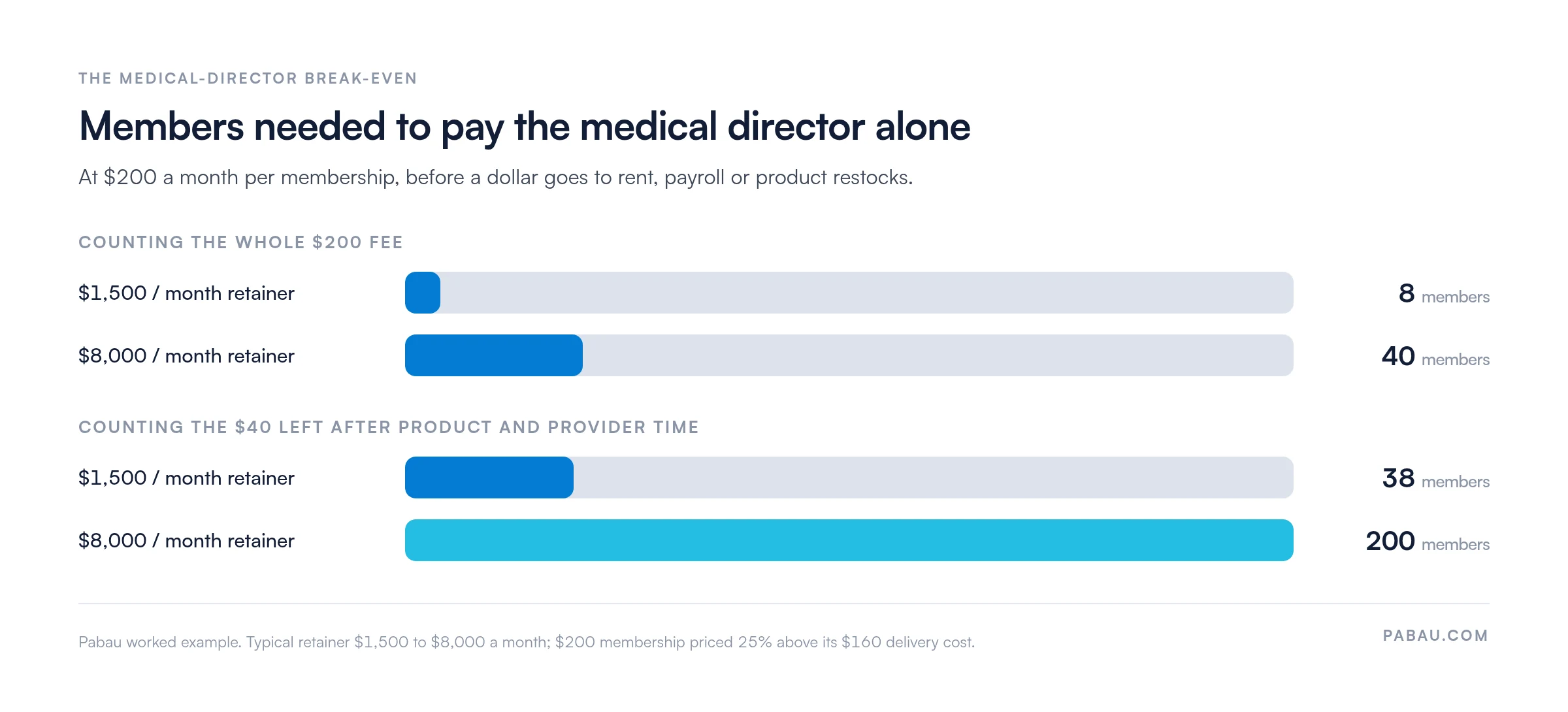
The medical-director break-even: at $200 a month, it takes 38 to 200 members to cover the retainer once product and provider time are paid.
Memberships priced at $150 to $300 a month create predictable revenue that cushions rent, payroll, and the retainer during slower weeks.
A well-run two-provider practice usually breaks even around month 10 to 14, then spends another two to three years paying back its launch costs.
Opening a med spa costs $150,000 to $300,000 for a standard two- or three-room location, from about $50,000 lean to over $1 million premium.
The spread comes down to your location, your service mix, and how much equipment you buy on day one. Renovations and equipment are usually the largest single line. Here’s the full budget at a glance, with the detail for each line below it.
| Cost category | Typical range | What drives it |
|---|---|---|
| Location and lease | $3,000–$10,000 a month rent, plus a deposit of up to six months’ rent | CAM fees, property taxes, and insurance can add $1,000–$5,000 a month |
| Renovations and equipment | $50,000 to over $150,000 | The condition and size of the space, and which treatments you offer |
| Licensing and permits | $10,000–$30,000 | Your state’s rules and your service mix |
| Initial staffing and training | $8,000–$12,000 a month in payroll for a team under five | Payroll starts at training, weeks before the first patient pays |
| Promoting your opening | $1,600–$15,000 a month, the typical marketing budget range | Launch events, giveaways, and opening ads sit on top |
| Legal and consulting fees | $1,500–$2,000 | Business formation, staff contracts, and compliance review |
| Typical all-in total | $150,000–$300,000 | Lean builds start near $50,000; premium ones pass $1 million |
Those six lines make up the whole launch bill. Here’s what sits inside each one.
Your lease is the first large payment you’ll make. Landlords decide the deposit terms, and prime commercial spaces in the US can ask for up to six months’ rent upfront. On a $10,000-a-month lease, that deposit alone reaches $60,000 before you’ve painted a wall.
Renovations and equipment run $50,000 to over $150,000, depending on how much work the space needs to meet med spa standards. Three factors set where you land:
Licenses and permits typically cost $10,000 to $30,000, and every US med spa needs them to operate legally. The exact bill depends on your state, your location, and the treatments you offer. Expect to budget for:
Staffing is one of the biggest costs a med spa carries, and it starts before opening day. A team of fewer than five typically costs $8,000 to $12,000 a month in payroll. We see new owners underbudget this line more than any other, because payroll begins at training while revenue begins weeks later.
Training isn’t optional either. Skilled injectors and estheticians deliver safer treatments, which builds the patient trust that drives rebooking. Experienced staff still need ongoing training on new protocols, safety, and hygiene standards.
A grand opening sets the tone, but it gets expensive without a plan. Most med spas spend $1,600 to $15,000 a month on marketing once open, and launch costs land on top of that. Budget for three kinds of spend:
Legal and consulting help typically costs $1,500 to $2,000 at launch. Med spa regulations are strict enough that you’ll want attorneys and consultants to handle:
Running a small med spa with under five staff costs roughly $17,500 to $57,000 a month, before the cost of injectables. That range is the sum of the monthly line items below, from the low end of each to the high end.
Three factors decide where you land. Rent is higher in busy urban areas than in suburbs. Lasers and premium injectables raise equipment, product, and staffing costs. And more patients means more staff hours and supplies, even as revenue climbs.
These costs recur every month, so build them into your plan before you sign a lease.
Payroll is the largest recurring expense at a med spa. A typical team includes a medical director, estheticians, practitioners, and administrative staff. With fewer than five employees, expect to spend around $8,000 to $12,000 a month on payroll.
Payroll isn’t the whole staffing bill, though. A med spa also needs a medical director on file, and that retainer runs roughly $1,500 to $8,000 a month depending on your state. Pay too little and you get a “paper director” who never does the oversight, which is a fast track to a board complaint.
Track revenue per provider from the first month. One injector can bring in far more than another on near-identical pay, and you’ll only spot it in a per-provider report.
Your service mix and patient volume dictate how often you restock injectables, skincare, and consumables. Here’s the breakdown:
As a rule of thumb, keep injectable cost of goods at or below 30 to 40 percent of the revenue those treatments generate. Waste is the usual reason it creeps higher. Half-used syringes, reconstituted toxin past its window, and over-ordered product that expires on the shelf all eat into it.
Medical-grade equipment can set a new med spa apart, but it’s rarely the right first purchase. Weigh every high-cost device against demand, return on investment, and the maintenance and upgrades it will need. Typical equipment costs include:
Professional liability insurance typically costs $2,000 to $5,000 a year when you start out, and med spa treatments carry enough risk to make it essential. A policy protects you in three ways:
Practice management software cuts admin hours by automating jobs your front desk would otherwise do by hand, like phone bookings and sending intake forms. Staff then spend that time on patients instead. The biggest savings come from:
One system that handles all six usually costs less than separate tools for each. For a shortlist, see our med spa software comparison, which weighs price, features, and fit.
The average med spa marketing cost runs $1,600 to $15,000 a month. Where you fall depends on how established you are, your revenue, specialty, location, service count, and local competition.
As a share of revenue, one med spa marketing agency recommends 15 to 20 percent for a new med spa. That falls to 10 to 15 percent in years one to three and 8 to 12 percent once established. The same guide suggests splitting the budget like this:
| Channel | Share of marketing budget | What it does for a med spa |
|---|---|---|
| Google Ads | 30%–40% | Reaches people already searching for treatments near them |
| Paid social media | 20%–30% | Builds awareness and fills launch and seasonal campaigns |
| SEO and local search | 15%–25% | Wins map and organic listings that keep paying off |
| Website optimization | 10%–15% | Turns visits into booked consultations |
| Email and SMS marketing | 5%–10% | Rebooks existing patients at the lowest cost per booking |
| Reputation management | 5%–10% | Keeps reviews strong enough to convert local searchers |
Set aside extra for one-off campaigns too, like a new service launch or a new membership program.
To start a med spa that survives its first year, turn those numbers into the financial section of your spa business plan. That section is a 12-month cash-flow projection with a cushion built in.
Our full guide to starting a medical spa covers the licensing and setup path. Here’s how the money side fits together.
Prefer a med spa business plan template to a blank spreadsheet? The one linked under Continue your research below gives you a structure to drop these numbers into.
The average med spa brings in about $1.4 million a year and keeps roughly 20 to 25 percent of that as net profit.
Average med spa revenue reached $1,398,833 in 2024, up from $1,307,587 in 2023, according to the American Med Spa Association. That’s an average across established locations, so a new single-provider practice will sit well below it in year one.
At a 20 to 25 percent net margin, that revenue leaves about $280,000 to $350,000 in annual profit. The best-run practices reach margins of 35 percent or more. That profit belongs to the business before any of it becomes the owner’s pay. In the early years, much of it repays launch costs.
Injectables and memberships usually carry the most med spa revenue. Memberships matter most for planning, because they’re the one revenue line you can count on before the month starts.
A typical med spa membership charges $150 to $300 a month. It bundles a set amount of treatment, such as Botox or filler credits, plus a discount on other services. Two hundred members at $200 a month is $40,000 in predictable revenue before a single walk-in books.
Before you sign a lease, run the medical-director break-even. The retainer is the one large fixed cost a med spa carries that a day spa doesn’t. So ask how many members it takes to pay that retainer alone, before rent or payroll.
On the whole fee, it looks easy. At $200 a month, a $1,500 retainer needs 8 members and an $8,000 retainer needs 40.
But a membership fee isn’t profit. Price a $200 membership 25 percent above what it costs to deliver, and $160 goes to product and provider time. That leaves $40 per member toward fixed costs.
On that $40, the $1,500 retainer takes 38 members. The $8,000 retainer takes 200, the entire 200-member book from the example above, before rent or payroll gets a cent. The chart below shows both views side by side.
That’s why the retainer deserves the same negotiation as the lease. Where your state allows it, agree the scope of oversight in writing and match it to your first-year patient volume.
Membership pricing follows the same math. If the included treatments cost more in product and provider time than the fee brings in, you’re discounting your best services. The recurring revenue is only for show.
Price each membership so the fee clears your cost per member by at least 25 to 30 percent. Our med spa pricing strategy guide walks through that math in more depth.
A med spa is worth opening if you can fund 10 to 14 months to break-even, after which net margins run 20 to 25 percent.
The challenges of running a med spa mostly come from costs that move without warning. These are the factors that push monthly spending above your plan:
A med spa business plan only works if the numbers stay under control after opening day. That means a clear, live view of both your costs and the revenue coming back in.
Practice management software like Pabau brings scheduling, patient records, billing, and marketing into one system, so your figures stay current. Pabau helps med spas protect their margins in five ways:
One multi-location med spa saved at least 10 minutes per patient after moving off paper records and consolidating booking into one system.

Pabau’s booking, billing, marketing, and inventory tools give med spas one live view of costs and revenue instead of scattered spreadsheets.

The startup number matters less than whether your monthly numbers hold up once the doors are open. A $150,000 launch that quietly loses $3,000 a month is a worse bet than a $250,000 launch that breaks even by month 10.
Build the medical director retainer and payroll into your monthly budget before you sign a lease, not after. Then let memberships smooth out the slow weeks, as long as each one clears your cost per member with margin to spare.
A leaner launch gets you open faster. A properly resourced one gives you the staff and the cash cushion to survive a slow first year. Model both first, then book a demo to see Pabau keep your med spa’s costs and revenue in one place from day one.

Need to cost your launch before you sign a lease? Starting a med spa walks through the licensing and setup path behind these numbers.
Ready to turn memberships into steady revenue? Med spa membership program covers pricing tiers and retention tactics.
Financing the launch instead of paying cash upfront? Getting a med spa loan breaks down what lenders look for.
Want a starting point for your own numbers? Business plan template gives you a structure to plug your own costs into.
Setting prices before you open? Med spa pricing strategy covers positioning your services for margin.
Opening a med spa typically costs $150,000 to $300,000 for a standard two- or three-room location. A lean single-room setup can start around $50,000, and a premium build-out can run over $1 million. The total depends on your location, service mix, and how much equipment you buy on day one.
A medical director retainer typically runs $1,500 to $8,000 a month, depending on your state’s supervision requirements. Paying too little for this role risks a “paper director” who never does the oversight, which is a fast track to a board complaint.
A well-run two-provider med spa usually covers its monthly costs around month 10 to 14. It then works toward paying back its launch costs over two to three years.
Most med spa memberships charge $150 to $300 a month, bundling a set amount of treatment credits plus a discount on other services. Price each membership so the fee clears your cost per member by at least 25 to 30 percent.
Renovations and equipment lead the startup budget at $50,000 to over $150,000. Next come lease deposits of up to six months’ rent, then licensing and permits at $10,000 to $30,000. Pre-opening payroll runs $8,000 to $12,000 a month, and opening marketing rounds out the five.
A new med spa should plan to spend 15 to 20 percent of annual revenue on marketing, falling to 8 to 12 percent once established. In dollars, a typical med spa marketing cost runs $1,600 to $15,000 a month.
Estheticians earned a median of $45,330 a year in May 2025, according to the Bureau of Labor Statistics. Those working in physicians’ offices, the closest category to a med spa, earned a median of $24.81 an hour.
A med spa owner’s pay comes out of profit, so it depends on revenue and margin. At the average $1.4 million in revenue and a 20 to 25 percent net margin, the profit pool is roughly $280,000 to $350,000 a year. In the first two to three years, much of that repays launch costs.
Yes. A med spa for sale comes with patients, staff, and equipment already in place, and the price is usually based on its profit. Check the medical director agreement, licenses, and equipment leases first, because they may not transfer to a new owner automatically.
Not usually upfront. A franchise adds an initial franchise fee and ongoing royalties to the same build-out, equipment, and staffing costs. What you pay for is a proven playbook and brand, so compare the best med spa franchises on total cost, not the fee alone.
It can be. The average med spa brought in $1,398,833 in 2024, according to the American Med Spa Association. Well-run practices keep 20 to 25 percent as profit. The catch is 10 to 14 months to break-even, so it’s worth it if you can fund that runway.