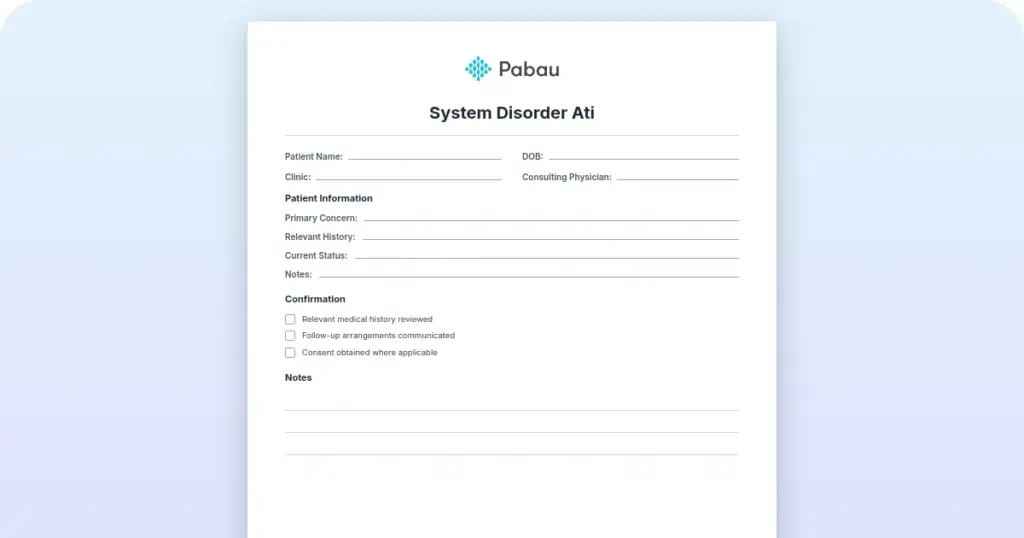
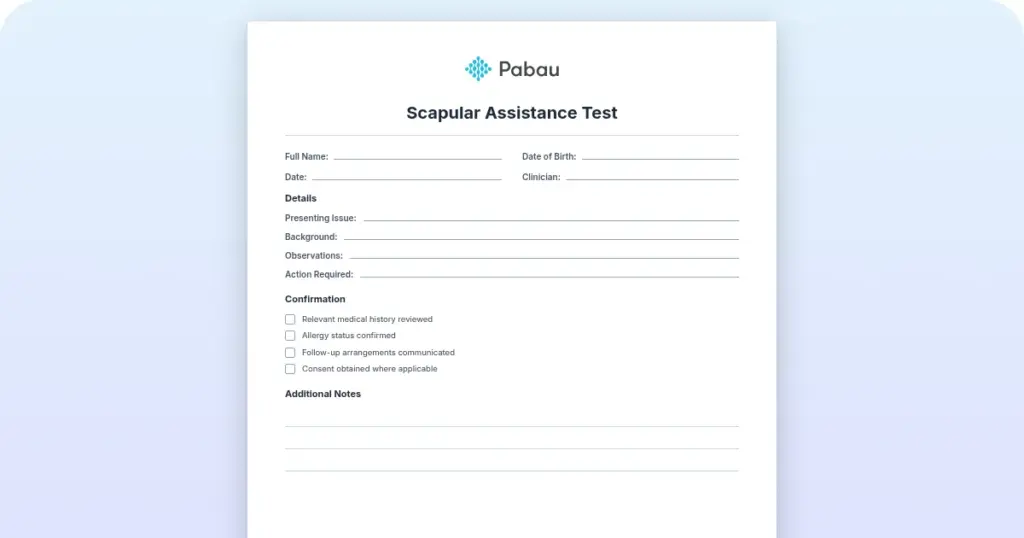
Nursing narrative note template
A nursing narrative note template is a structured PDF that guides you through re...

3
Last Updated: Oct 21, 2026

A visual perception test evaluates the brain’s ability to interpret visual information independently of motor ability. It is distinct from visual acuity (sharpness) and measured via tools like the MVPT-4.
The MVPT-4 measures five core subtests: spatial relationships, visual discrimination, figure-ground, visual closure, and visual memory; the TVPS-4 adds form constancy and sequential memory.
Test scores are interpreted using age-adjusted norms and percentile ranks; raw scores alone lack clinical meaning without standardized reference data.
Occupational therapists, neuropsychologists, and rehabilitation clinicians use visual perception tests to identify deficits in stroke, TBI, developmental delay, and learning disability populations.
A blank, structured documentation form for recording results across five visual perception subtests: spatial relationships, visual discrimination, figure-ground, visual closure, and visual memory. It includes a total score line and blank observation, strengths, and recommendations fields for you to complete after scoring with your chosen instrument’s manual.
Download templateA visual perception test measures how the brain processes and interprets visual information. This is a critical skill for learning, coordination, and daily functioning. Unlike visual acuity (the clarity of what you see), visual perception captures the nervous system’s ability to make sense of visual input.
It means recognizing shapes despite missing pieces, judging spatial distance, filtering important details from background clutter, and remembering visual patterns. Occupational therapists, neuropsychologists, and rehabilitation specialists use standardized visual perception tests to screen for possible deficits. These may follow a stroke, a traumatic brain injury, developmental delays, or learning disorders.
This guide explains what the most common visual perception tests assess and reviews the leading tools. It also covers scoring and interpretation, and provides a free downloadable assessment documentation template to streamline clinical recording.
A visual perception test is a standardized, norm-referenced assessment tool that evaluates non-motor aspects of visual processing. It deliberately removes the motor response requirement.
This means a client does not need to draw, write, or manipulate objects to demonstrate their perceptual ability. Instead, they may point, verbally respond, or select from multiple-choice options, isolating the perceptual deficit from any motor impairment.
Clinicians use visual perception tests to evaluate five to seven core domains, depending on which test is chosen. Some tests add form constancy (recognizing the same shape across different sizes, orientations, or textures) and sequential memory (remembering the order of a visual sequence).
Four standardized visual perception tests dominate clinical practice. Each targets specific age ranges, motor requirements, and clinical populations. Understanding their differences helps practitioners select the appropriate tool for their assessment question.
The MVPT-4 is the gold standard for pure visual perception assessment across the widest age range. It is the tool most commonly used in adult rehabilitation, including stroke and neurological recovery, and in occupational therapy practices.
The TVPS-4 is favored in pediatric settings and schools for learning disability identification. When a clinician suspects visual-motor coordination deficits, the Beery VMI provides motor-integrated assessment through copying geometric designs.
Visual perception test scores are expressed in multiple formats, and raw scores alone are clinically meaningless without conversion to norm-referenced data. Understanding the scoring system is essential for accurate interpretation and clinical documentation.
Standardized instruments convert a client’s raw score into a standard score, typically scaled with a mean of 100 and a standard deviation of 15. Clinicians then read the standard score against the test’s age-based normative tables to find a percentile rank, showing how the client compares with same-age peers.
Some publishers also report an age-equivalent score, the age at which the average child achieves that raw score. Age equivalents are easy to explain to parents, but clinicians should not use them alone for diagnostic decisions.
The MVPT-4, TVPS-4, and DTVP-3 each ship with their own manual containing the standard-score and percentile tables needed for scoring. Score with the publisher’s current manual rather than a general reference, since norms are periodically re-standardized.
Clinical indications for visual perception testing span multiple populations and practice settings. Occupational therapists, educational psychologists, neuropsychologists.
Pediatric populations: Children with learning disabilities, developmental delays, developmental coordination disorder (DCD), and attention-deficit/hyperactivity disorder (ADHD) often present with visual perception deficits. Teachers and school psychologists may refer for assessment when a child struggles with reading, math, or handwriting despite adequate visual acuity and intelligence.
Adult populations: Stroke survivors frequently experience visual perceptual impairments (unilateral neglect, figure-ground dysfunction) that limit return to work and independent living. Individuals with traumatic brain injury, multiple sclerosis, or Parkinson’s disease may benefit from visual perception screening to guide rehabilitation intensity. Cancer survivors undergoing chemotherapy-related cognitive impairment assessment may have visual perception deficits.
Use digital intake forms to standardize how clinicians record visual perception screening results. This keeps documentation consistent across your team and simplifies score entry into norm-reference tables.

Clear, standardized documentation of visual perception test findings is essential for inter-clinician communication, billing accuracy, and compliance with medical record standards. Many clinicians record raw scores and percentiles but miss the opportunity to document the functional implications. That means noting what the deficit means for the client’s daily activities and treatment priorities.
A structured documentation template should capture the following:
A common misconception is conflating visual perception with visual-motor integration. Visual perception is the non-motor interpretation of visual information.
Visual-motor integration is the coordinated use of visual information to guide motor action, such as copying a geometric design or tracking a moving target while moving the hand. A client may have intact visual perception but impaired visual-motor coordination due to a motor control deficit, or vice versa.
The MVPT-4 isolates pure perception by requiring no motor response beyond pointing or verbal answers. The Beery VMI requires drawing, which tests motor control as well as perception.
When assessing a client with known motor impairment, such as hemiparesis after a stroke, choose the MVPT-4 to avoid confounding motor limitations with perception deficits. When unsure whether a learning or functional deficit arises from perception or motor control, administer both tools to clarify the underlying impairment profile.
Strengthen your clinical client record by documenting which assessment framework (pure perception vs. motor-integrated) was used, so other clinicians understand the scope of evaluation and can plan appropriate interventions.
Before relying on a visual perception test for clinical decisions, verify its psychometric quality. Reliability measures consistency (does the test produce similar scores if given twice?). Validity measures accuracy (does the test actually measure visual perception, and does it distinguish between clinical and non-clinical populations?).
The MVPT-4 demonstrates good test-retest reliability and internal consistency. RehabMeasures reports an average Cronbach’s alpha of 0.80 for the MVPT-4, ranging from 0.70 to 0.87 across studies. Published validity evidence supports its ability to discriminate between typically developing children and those with learning disabilities, developmental delays, or visual processing disorders.
The TVPS-4 shows comparable reliability and validity data supporting its use in pediatric populations. Always consult the test publisher’s technical manual for the most current normative and reliability data for your client population. Western Psychological Services publishes the MVPT-4 manual, and Psychological Assessment Resources publishes the TVPS-4 manual.
Most occupational therapy and rehab practices still track visual perception testing on paper. A printed test booklet, a handwritten scoring sheet, and a separate note for the referring clinician rarely end up in the same file.
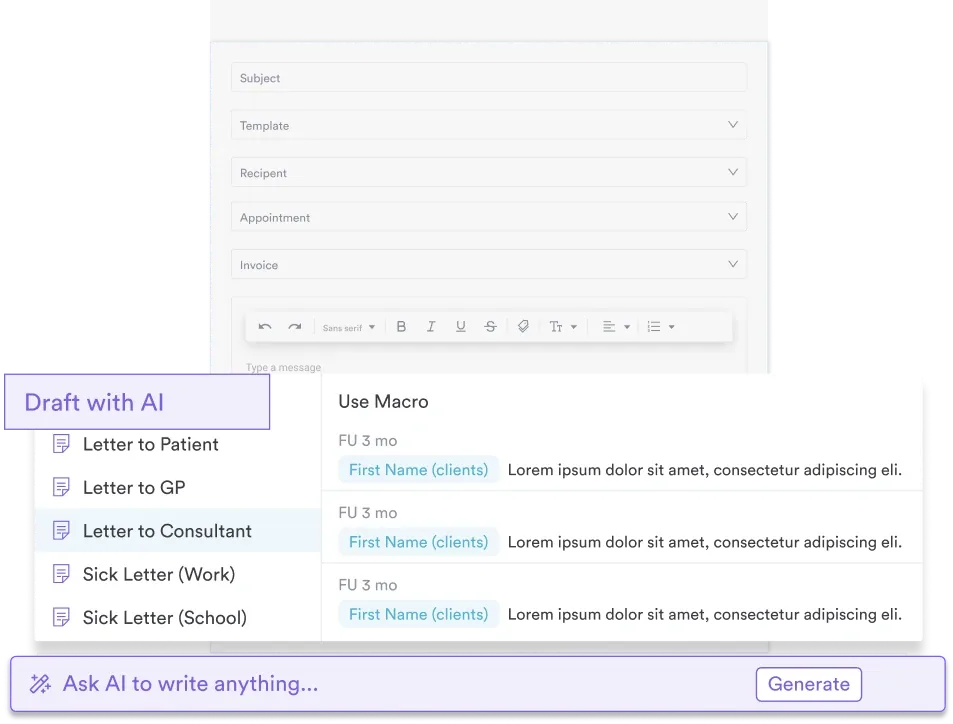
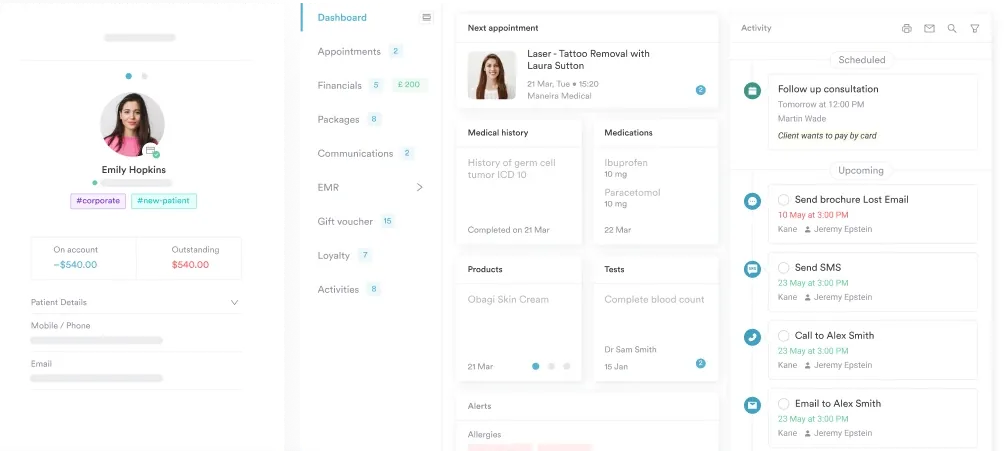
Practice management software like Pabau keeps that record in one place. A digital form captures the client’s raw scores and subtest breakdown directly in their record, so the file is complete the moment testing ends. Pabau Scribe, our AI scribe, can then help draft the narrative summary from your notes, cutting write-up time after each session.
That means referring clinicians and school teams get a consistent, complete report every time. Your practice ends up with one searchable record instead of a stack of loose paper.

Pabau’s digital forms and client records capture visual perception test scores and functional notes in one place. Pabau Scribe, our AI scribe, helps draft the narrative summary, keeping documentation complete and consistent across your team.

Choosing between the MVPT-4 and TVPS-4 comes down to the client in front of you. Use the MVPT-4 for adults and wider age ranges, and the TVPS-4 for pediatric and school-based referrals.
Whichever tool you administer, the score only holds up once you convert it against the publisher’s current norms. Record what the deficit means for the client’s daily function, not just the raw number.
Book a demo to see how Pabau’s client records and digital assessment forms streamline the capture, scoring, and reporting of visual perception test results in your practice.

Checking ACL or ankle stability? anterior drawer test grades tibial displacement from 0 to 3+ and comes with a free recording template.
Grading a spinal cord injury? ASIA Impairment Scale scores sensory and motor function to determine AIS grades A through E.
Suspecting hypermobility in a patient? Beighton score template scores five joint areas to flag hypermobility spectrum disorders or Ehlers-Danlos syndrome.
Tracking functional outcomes after rehab? The KOS-ADLS template scores daily-living function the same way you would score a perceptual test.
Rounding out a full neurological exam? The hypoglossal nerve test walks through cranial nerve XII assessment step by step.
Most visual perception tests require 15-30 minutes depending on the client’s age and cooperation level. The MVPT-4 typically takes 20-25 minutes for adults. The TVPS-4 takes approximately 25 minutes in pediatric populations. Administration time does not include scoring and interpretation, which adds another 10-15 minutes.
Most visual perception tests require only the published test kit (stimulus booklet and response sheet) plus a pencil for noting responses. No special equipment, computers, or motor materials are needed. Ensure adequate lighting and minimal visual distractions during administration.
Remote administration is generally not recommended for standardized visual perception tests due to inconsistent lighting, screen resolution, client distance, and inability to directly monitor response accuracy. If remote administration is necessary, document this limitation in your clinical notes and consider the results preliminary pending in-person confirmation.
The MVPT-4 covers ages 4 to 80+ and measures five core visual perception domains; the TVPS-4 covers ages 5-21 and measures seven domains (adding form constancy and sequential memory). The MVPT-4 is preferred for adult populations and wider age ranges; the TVPS-4 is standard for pediatric school-based assessments.
Visual perception assessment is a screening tool, not a diagnostic predictor. Low scores may suggest a contribution to reading or learning difficulty, but diagnosis requires comprehensive evaluation including cognitive, language, and academic achievement testing. Use visual perception results as one component of a multi-measure assessment battery.