Slocum test: How to perform, interpret and record it
The Slocum test is a knee drawer test performed with the tibia rotated. It check...

2
Last Updated: Oct 21, 2026

The Knee Outcome Survey measures knee function and pain across two standardized subscales.
KOS-ADLS demonstrates strong reliability (Cronbach’s alpha above 0.90) and is validated for ACL injury, knee OA, and post-surgical rehab.
To score it, sum the item responses, divide by the maximum possible score, and multiply by 100.
Pabau’s digital forms auto-score KOS responses and store them in the patient timeline for tracking over time.
A standardized patient-reported outcome measure (PROM) for assessing knee function, pain, and symptoms. This fillable form includes 6 symptom items and 8 functional activity items (14 total) rated on a 0-5 Likert scale, plus step-by-step scoring instructions.
Download templateThe knee outcome survey (KOS) is a patient-reported outcome measure (PROM) designed to assess functional limitations and symptoms resulting from knee impairments. Developed by Irrgang et al. in 1998, the KOS is validated across athletic, orthopedic, and rehabilitation populations.
It captures both symptom severity and functional capacity in a single standardized questionnaire.
The KOS consists of two subscales: the Activities of Daily Living Scale (KOS-ADLS) and the Sports Activity Scale (KOS-SAS). Each item uses a 6-point Likert scale (0 = unable to perform; 5 = no difficulty). The instrument is validated for ACL injury, knee osteoarthritis, post-surgical knee rehabilitation, and ligament injuries, as established in the original Irrgang et al. validation study.
The knee outcome survey is widely used in orthopedic and physical therapy practices. It measures both pain and functional limitation, giving clinicians a practical screening tool for rapid, standardized data on knee impairment severity.
The Activities of Daily Living Scale (KOS-ADLS) is the most commonly used subscale. It divides into two distinct sections that together paint a complete picture of knee-related functional limitation. Clinicians often pair it with a range of motion assessment for a fuller picture of knee function.
Symptoms Section (6 items): Patients rate pain, stiffness, swelling, giving way, weakness, and limping over the past few days using the 0-5 Likert scale. This captures the sensory/inflammatory component of knee dysfunction.
Functional Activities Section (8 items): Patients rate difficulty walking, using stairs, standing, squatting, kneeling, sitting with a bent knee, and rising from a chair. This captures the motor/performance component.
The digital intake forms in Pabau allow clinicians to administer the KOS-ADLS directly through the patient portal, eliminating paper distribution and manual entry. Responses are auto-scored within seconds, generating an instant functional baseline for the clinical record.

Scoring the KOS-ADLS follows a straightforward formula that converts raw item responses into a 0-100% functional scale.
KOS-ADLS Total Score = (Sum of all item responses ÷ 70) × 100
Example: If a patient scores a total of 56 out of 70 on the KOS-ADLS, the final score = (56 ÷ 70) × 100 = 80%. This represents mild functional limitation due to knee impairment.
If using the KOS-SAS (Sports Activity Scale), score all 11 items separately: (sum ÷ 55) × 100 = SAS percentage. Pabau’s automated scoring eliminates calculation errors and enables trend visualization in the patient dashboard.
With a tool that tracks clinical measurements, baseline and follow-up scores sit side by side in the patient record.
Raw scores become more useful when read against functional level descriptors. The ranges below are an informal, illustrative guide only — Irrgang’s original 1998 validation and later KOS-ADLS studies never established these as fixed clinical cutoffs. Use them as a rough gauge of treatment intensity and expected activity tolerance.
Minimal Clinically Important Difference (MCID): Published anchor-based studies put the KOS-ADLS MCID at approximately 7.1-7.4 percentage points. A change at or above this range reflects a clinically meaningful improvement, not measurement noise.
Pabau’s dashboard displays score trends alongside appointment history, supporting outcome-based decisions. Clinicians assessing older patients often pair the KOS-ADLS with a falls efficacy scale to capture fall-risk perception alongside functional recovery.
The KOOS (Knee Injury and Osteoarthritis Outcome Score) is a related but distinct PROM. Both instruments assess knee function, but differ in scope and validation.
When to use each: The KOS-ADLS is ideal for athletes, post-ACL rehab, functional limitation screening, and rapid practice assessments. The KOOS suits knee osteoarthritis, comprehensive baseline evaluations, and research studies requiring quality-of-life data.
Musculoskeletal special tests like the Steinman test complement patient-reported measures like the KOS in a broader outcome-measurement ecosystem. Practices using longitudinal patient record systems can aggregate scores across multiple outcome measures to create a rich functional profile.

Rather than printing PDFs and manually scoring responses, Pabau’s digital form builder enables clinicians to deliver, score, and track outcome measures in seconds.
This workflow transforms a static PDF into a dynamic clinical tool. Outcome data flows into your EMR, supporting both individual clinical decisions and population health initiatives.
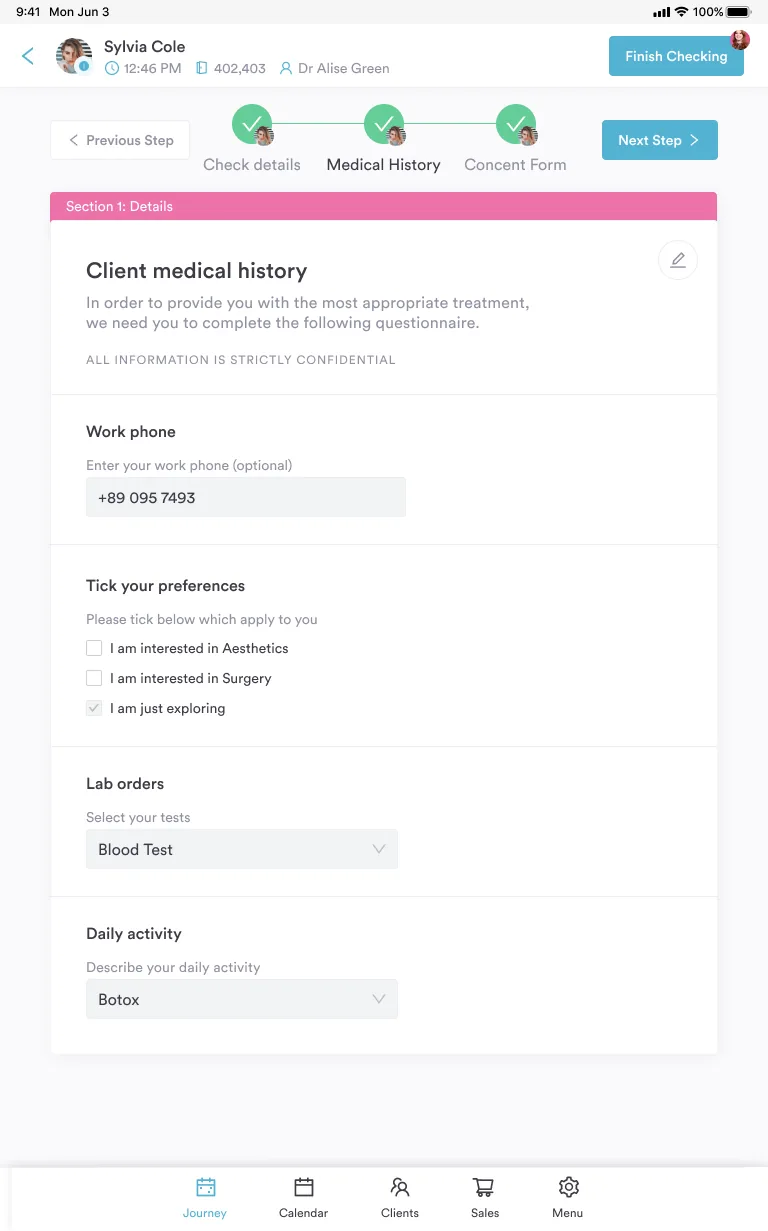

Pabau’s digital form builder lets you send the KOS-ADLS to patients before their visit and auto-calculates their score in seconds. That cuts manual scoring errors and gives you a functional baseline before the appointment starts.

Knee pain is one of the most common reasons patients seek physical therapy and orthopedic care. But tracking whether treatment works often comes down to a clinician’s subjective impression. The KOS-ADLS replaces that guesswork with a validated, patient-reported score that patients, insurers, and referring physicians can all interpret the same way.
Paper-based PROMs get lost, scored inconsistently, or skipped entirely once a practice gets busy. Digitizing the KOS-ADLS with patient outcome management tools turns a single assessment into a longitudinal record you can act on.
Book a demo to see how Pabau’s digital form builder scores the KOS-ADLS automatically and attaches every result to the patient’s record.

Need a validated pain-screening tool to pair with a functional score? DN4 questionnaire screens for neuropathic pain components a purely functional measure like the KOS can miss.
Want more predictable results from your marketing? chiropractic marketing strategies show how a connected system across patient touchpoints drives consistent results.
Patient reports a clumsy hand with normal grip strength? dexterity test scores hand speed and control the same way at every session.
The Knee Outcome Survey is a patient-reported outcome measure designed to assess knee pain, symptoms, and functional limitations. It consists of 6 symptom items and 8 functional activity items (14 total), each rated on a 0-5 scale. Total score is expressed as a percentage (0-100%), with higher scores indicating better function.
Sum all 14 item responses (0-70 possible), divide by 70, then multiply by 100 to convert to a percentage. For example, a sum of 56 out of 70 = (56÷70)×100 = 80%.
The Minimal Clinically Important Difference (MCID) for KOS-ADLS is approximately 7.1-7.4 percentage points, based on published anchor-based studies. A change at or above this range indicates clinically meaningful functional improvement, not just statistical noise.
The KOS-ADLS focuses on activities of daily living and sport function (14 items, 3-5 min). The KOOS is more comprehensive, assessing pain, symptoms, ADL, sport, and quality of life (42 items, 12-15 min). Use KOS-ADLS for rapid screening; KOOS for detailed baseline assessments.
Pabau’s digital form builder allows you to create a KOS-ADLS form, send it to patients via their portal, and auto-calculate scores upon submission. Scores attach to the patient record for longitudinal tracking and outcome reporting.
The KOS-ADLS is specifically validated for ACL injury, knee osteoarthritis, and post-surgical knee rehabilitation. Use it for these populations. For broader knee conditions, the KOOS may be more appropriate.