Despina Petrushevska
Nursing care plan for aggressive behavior
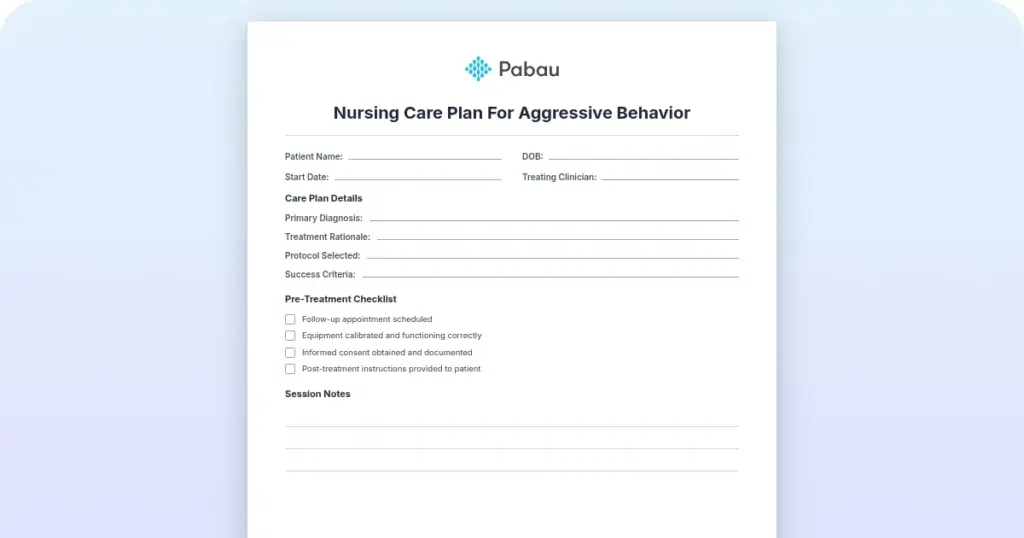
A nursing care plan for aggressive behavior is a structured clinical document fo...

2
Last Updated: Oct 26, 2026
Free PDF 1 page, print-ready Clinician-reviewed
Download Your Free Surprise Test Surprise Test A ready-to-use clinical assessment form for documenting patient responses to unexpected physical examination techniques, cognitive challenges, and sudden symptom triggers. Includes fields for reaction assessment, cognitive response scoring, and clinical interpretation. Download template The surprise test is a clinical assessment tool designed to evaluate how patients respond to […]
A ready-to-use clinical assessment form for documenting patient responses to unexpected physical examination techniques, cognitive challenges, and sudden symptom triggers. Includes fields for reaction assessment, cognitive response scoring, and clinical interpretation.
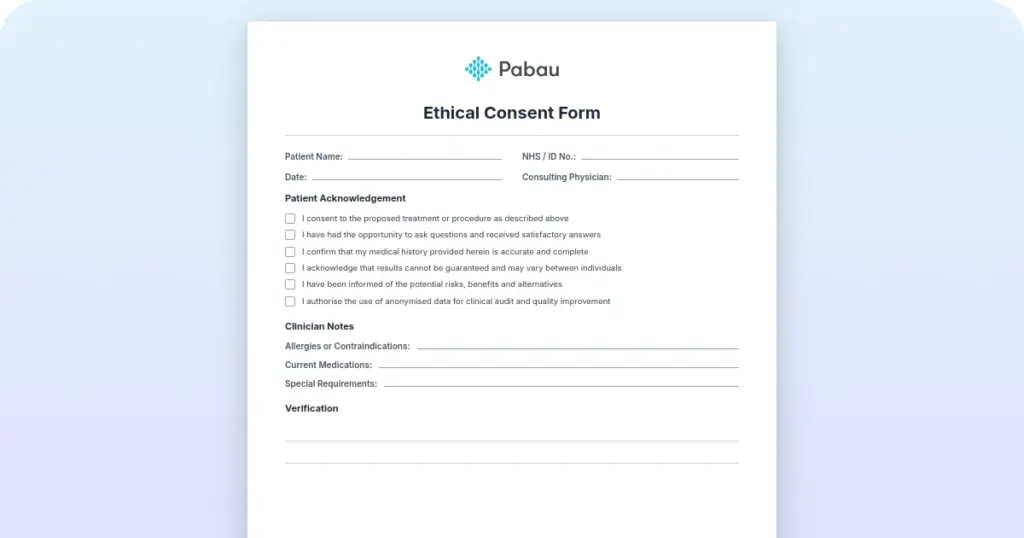
Upload this PDF, or any form you already use, and Pabau's AI Form rebuilds it with tick boxes, text fields and a signature. Attach it to the treatment once, and every patient gets it on time.
AI Form rebuilds the consent, history and aftercare forms you already use. You review each one, then publish.
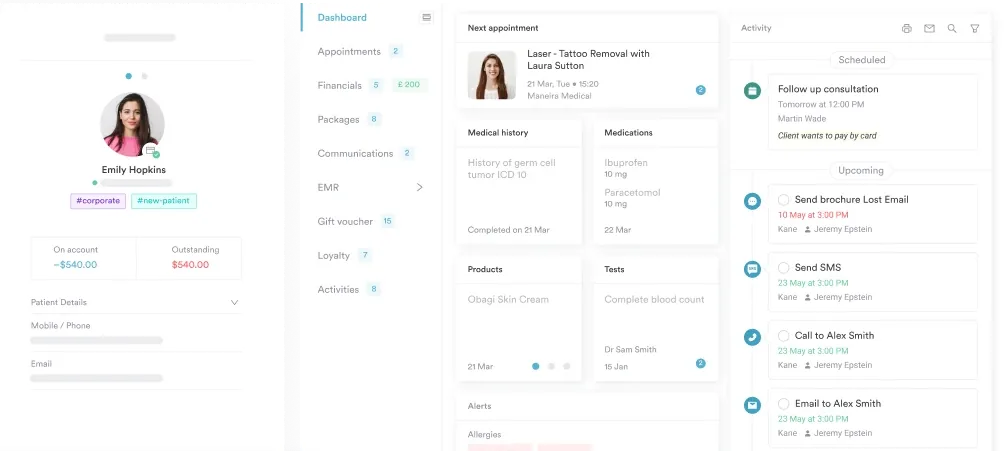
Patients complete forms on their phone before they arrive, so the front desk stops retyping paper.
Every signed form is versioned and attached to the treatment record, ready when you need it.
Set how long a consent stays valid. Returning patients skip forms they have already signed.
Supports HIPAA and GDPR compliance AES-256 encryption 4.8 on G2 4.7 on Capterra Trusted by 4,000+ practices worldwide

The surprise test is a clinical assessment tool that evaluates patient responses to unexpected stimuli or sudden symptom presentation.
Clinicians use this assessment to document cognitive function, emotional reactions, and physical responses during examination.
Structured documentation prevents missed findings and provides evidence for diagnosis and treatment planning.
Pabau’s digital forms and client records streamline surprise test documentation and ensure consistent clinical data capture.
The surprise test is a clinical assessment tool designed to evaluate how patients respond to unexpected stimuli, sudden physical examination findings, or unanticipated clinical interventions. This structured approach captures critical data about patient cognition, emotional regulation, and physiological reactions that standard assessments may miss. Whether used in psychology, neurology, physiotherapy, or general clinical practice, the surprise test provides objective documentation of cognitive and behavioral responses in real-time clinical settings.
A surprise test is a clinical assessment technique where the practitioner deliberately introduces an unexpected element-such as a novel physical examination maneuver, a sudden change in instruction, or an unfamiliar stimulus-and systematically documents the patient’s response. The surprise test captures how the patient’s cognitive function, emotional state, and physical condition respond to novelty or stress.
This assessment differs from standard questioning or planned examination sequences. It evaluates spontaneous, unguarded reactions. Clinicians observe and record eye contact, response time, verbal clarity, emotional affect, and physical signs-creating a comprehensive picture of the patient’s real-time cognitive and behavioral capacity. The surprise test is particularly valuable in psychology and mental health assessment, neurological evaluation.
In shoulder instability assessment, the surprise test (also called the anterior release test) involves sudden release of manual pressure during the relocation test and observation of whether apprehension returns-providing diagnostic sensitivity of 63.89% and specificity of 98.91% according to peer-reviewed orthopedic literature.
Clinicians implement the surprise test in five key workflow steps that maximize clinical validity and documentation accuracy.
Each step produces structured data that feeds into the clinical record.
Multiple healthcare disciplines rely on the surprise test for specific clinical questions.
The surprise test template is most valuable when standard assessments yield ambiguous results or when the clinician suspects symptom inconsistency.
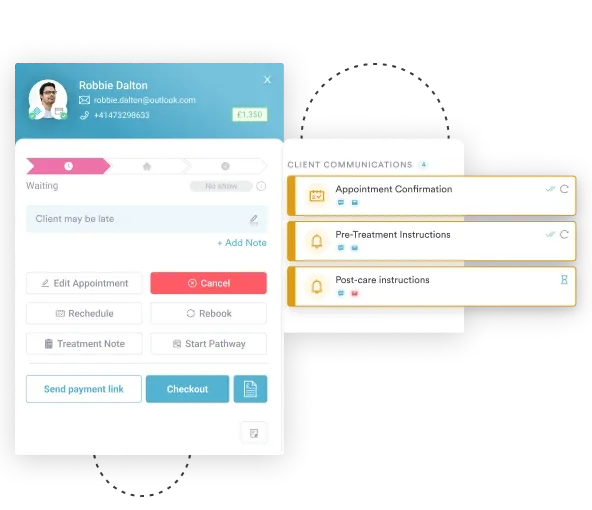
Book a demo to see how Pabau’s workflow automation and digital assessment tools help clinicians integrate specialized tests like the surprise test into routine practice.
Many practices log scores like these in measurements tracking software, so progress charts update the moment a reassessment is saved.
Unstructured surprise test administration risks missing important clinical observations or recording inconsistent data across patients. A standardized template ensures every clinician in your practice documents the surprise test the same way.
In shoulder instability assessment, the relocation test (Jobe’s relocation test) applies manual posterior pressure to the humeral head during abduction, and the clinician asks whether apprehension improves. The surprise test follows-the clinician suddenly releases the pressure to see whether apprehension returns.
The relocation test answers: Does posterior pressure improve apprehension? The surprise test answers: Is the relief genuinely due to humeral head position, or is it placebo/non-organic? Together, they create a diagnostic sequence that improves specificity. Research shows that the surprise test alone has 98.91% specificity for anterior shoulder instability, making it the most accurate single test of the apprehension-relocation-surprise triad.
Use the relocation test first. If apprehension improves with posterior pressure, proceed to the surprise test. A positive surprise test (apprehension returns on sudden release) strongly supports anterior shoulder instability diagnosis.
The surprise test template works best when embedded in your existing assessment protocol. Insert it after completing standard history and baseline examination, before any intervention or reassurance statement.
Timing matters: the patient should not expect the surprise element, so administer it mid-assessment rather than as a standalone test at the end.

Document findings in real-time using your practice management system. This prevents recall bias and creates an accurate contemporaneous record. Pabau integrates assessment forms directly into the patient’s clinical record, so surprise test data flows automatically into your summary and supports evidence-based clinical notes. A rehab practice reporting these outcomes to a payer needs consistent measures, not narrative summaries.
The surprise test is a valid clinical assessment tool, but it requires informed clinical judgment and appropriate patient communication.
The surprise test is a powerful assessment tool that captures authentic patient responses under stress or novelty. Whether you use it for shoulder instability diagnosis, neuropsychological evaluation, or cognitive function assessment, structured documentation ensures reliable findings and clinical clarity.
Download the free surprise test template today and begin integrating this assessment into your clinical practice. For clinics using Pabau, book a demo to discover how Pabau’s digital forms and clinical record system streamline surprise test documentation and improve outcome tracking across your team.

Suspecting a full-thickness rotator cuff tear? drop arm test guide explains the procedure, interpretation, and diagnostic accuracy behind this shoulder test.
Looking for a comprehensive occupational therapy template library? Pabau’s occupational therapy platform includes task-based cognitive assessment templates for functional capacity evaluation.
Working up radial-sided wrist pain? Finkelstein test guide walks through the procedure, interpretation, and clinical workflow for this wrist provocation test.
Yes, in shoulder instability assessment. The surprise test (anterior release test) is a specific maneuver where the clinician suddenly removes posterior pressure on the humeral head and observes whether apprehension returns, confirming anterior instability.
A positive surprise test (apprehension returns after sudden release of posterior pressure) has 98.91% specificity for anterior shoulder instability, making it one of the most specific clinical tests for this diagnosis. A negative surprise test (no apprehension on release) suggests anterior instability is unlikely.
Yes. The surprise test evaluates cognitive function, emotional regulation, and attention by observing how patients respond to unexpected questions or stimuli. It is used in neuropsychological assessment, ADHD evaluation, and detection of non-organic cognitive deficits.
Training depends on the clinical context. For shoulder instability testing, standard physiotherapy or orthopedic training covers the maneuver. For neuropsychological or psychological surprise testing, specialized assessment training is recommended to ensure reliable observation and valid interpretation.
Record the patient’s exact observable response (facial expression, verbal comment, timing, any changes in apprehension or cognitive clarity) immediately after the test. Use the surprise test template to standardize your documentation across all patients, ensuring accurate comparison and audit readiness.