Anja Dodevska

Values exploration worksheet
Download your free values exploration worksheet A two-page printable form that o...

5
Last Updated: Nov 6, 2026
Free PDF 1 page, print-ready Clinician-reviewed
A support system worksheet is a one-page form that helps patients list the people they can turn to for support. For each person, it records their strengths and role, how to reach them, and when they are available. Therapists, counselors and coaches use it at intake or in early sessions to see how much support a patient has outside therapy. Three reflection prompts then cover the support the patient needs now and how the network could be stronger. A final prompt asks which self-care strategies help when no one is available. The completed sheet gives each review session a concrete starting point.
A ready-to-use assessment form for mapping a patient's personal support network, including people, strengths and roles, communication methods, and availability, with space for reflection notes.
Start from scratch, or upload this PDF or any form you already use, and Pabau's AI Form rebuilds it with tick boxes, text fields and a signature. Attach it to the treatment once, and every patient gets it on time.
AI Form rebuilds the consent, history and aftercare forms you already use. You review each one, then publish.
Patients complete forms on their phone before they arrive, so the front desk stops retyping paper.
Every signed form is versioned and attached to the treatment record, ready when you need it.
Set how long a consent stays valid. Returning patients skip forms they have already signed.
Supports HIPAA and GDPR compliance AES-256 encryption 4.8 on G2 4.7 on Capterra Trusted by 4,000+ practices worldwide

A support system worksheet records who a patient can turn to, with each person’s strengths and role, contact method and availability.
Three reflection prompts cover current support needs, ways to strengthen the network, and self-care for times when no one is available.
Reading every supporter’s availability side by side shows the hours when no one is reachable, which is where coping plans should focus.
Store each completed copy in the patient record so the network can be compared across sessions, with access limited to authorized staff.
The worksheet supports therapy planning, but it does not replace a clinical assessment.
A support system worksheet is a clinical prompt sheet listing the people and groups a patient can turn to. It also asks what each one offers. It is used in mental health, psychology, therapy and coaching settings to make an informal network visible and open to discussion.
Social support is consistently linked with better mental health in peer-reviewed research. In a 2021 study of 481 college students, social support weakened the link between perceived stress and depression symptoms. Patients with a thin network often carry more of the load alone during stressful periods.
Mapping a network also shows which coping strategies a patient already uses with others, such as asking a friend for a ride to an appointment. Those examples give the clinician a starting point for practical planning.
To measure how supported a patient feels, rather than who is in the network, pair the worksheet with a social support scale.
The worksheet fits on one page. It opens with name and date fields and short instructions, then asks for an entry for each person or group the patient can turn to. The table sets out each part and what it adds to the review.
The last reflection prompt asks which self-care activities help when the support system may not be available. Its answers can feed straight into a self-care plan. The diagram pairs each part of the form with a question worth asking when you go through it together.
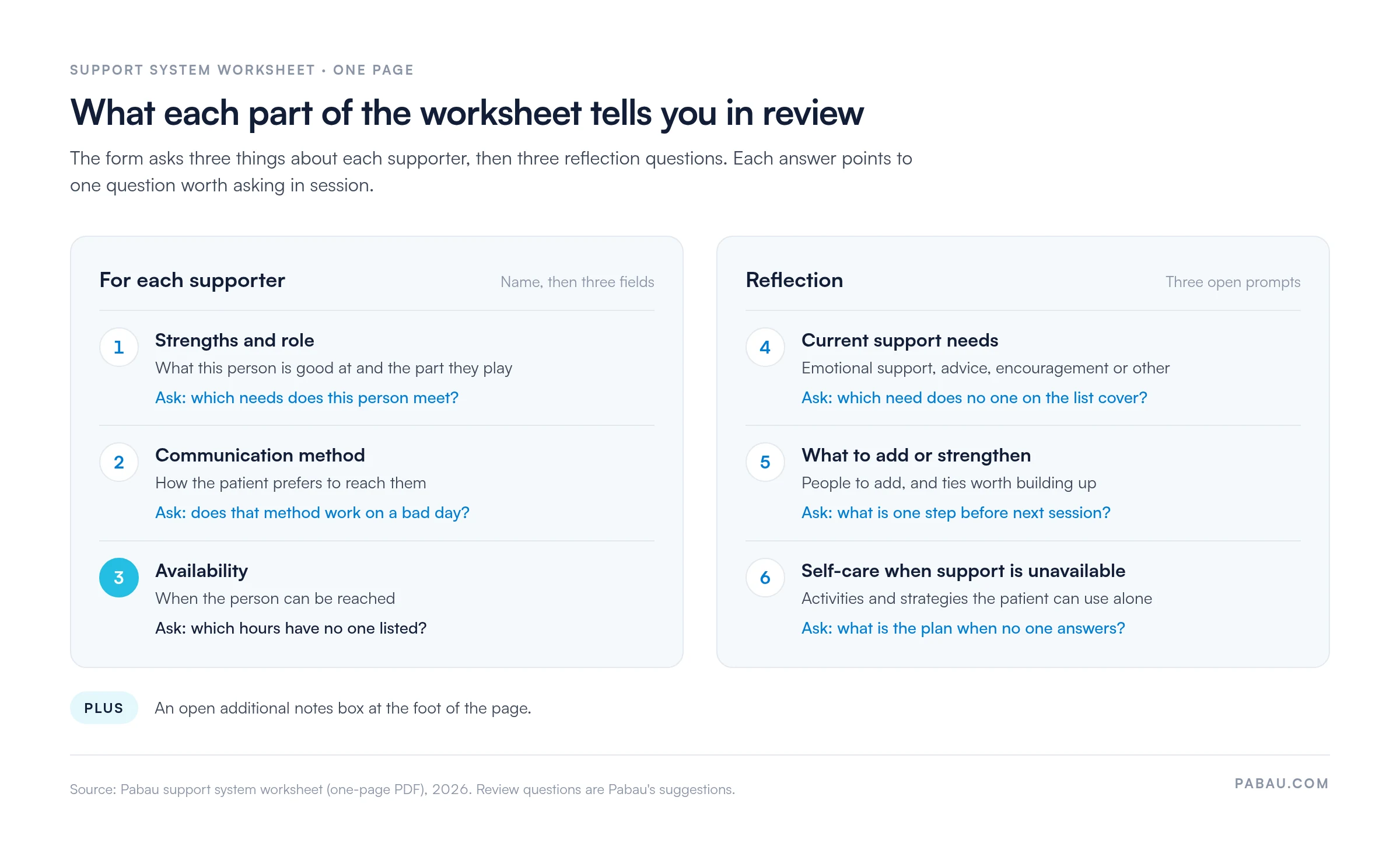
The worksheet does not sort supporters into fixed categories. Instead, its first reflection prompt asks whether the patient is looking for emotional support, advice, encouragement or something else. The strengths and role answers then show who already provides each kind of help. Common types to listen for include:
If a patient thinks in pictures, an ecomap draws the same network as a diagram of connections. It works well alongside the worksheet.
Introduce the worksheet early, ideally at intake or in the first few sessions, and frame it as a planning tool rather than a test. Print it for in-person sessions, or send it as a digital form before a telehealth appointment so the patient can complete it at home.
Availability is the field most worth reading as a set. Line up every supporter’s answer and look for the hours nobody covers, such as late evenings or weekends. If those hours match the times the patient usually struggles most, the self-care prompt becomes the plan for that window. Build it out in session rather than leaving it as a one-line answer.
In group therapy, ask participants to share one supporter they chose to add. That builds peer connection without requiring detailed disclosure. Keep the group discussion to general kinds of support so that no one is pressed to reveal private relationships.
Adjust the language and length to the patient’s age and cognitive load. Younger patients may respond better to a drawn circle, while older adults may prefer a shorter list. For patients in crisis, complete the worksheet only after a safety plan is in place.
Paper worksheets tend to live in a folder or a scanned file, away from the session notes they inform. That makes it hard to see how a patient’s network changed between intake and discharge.
Pabau, the practice software we build for therapy and mental health teams, lets you send the worksheet as a digital form before a session. Patients fill it in through the patient portal, and the completed form lands in their client records next to session notes.
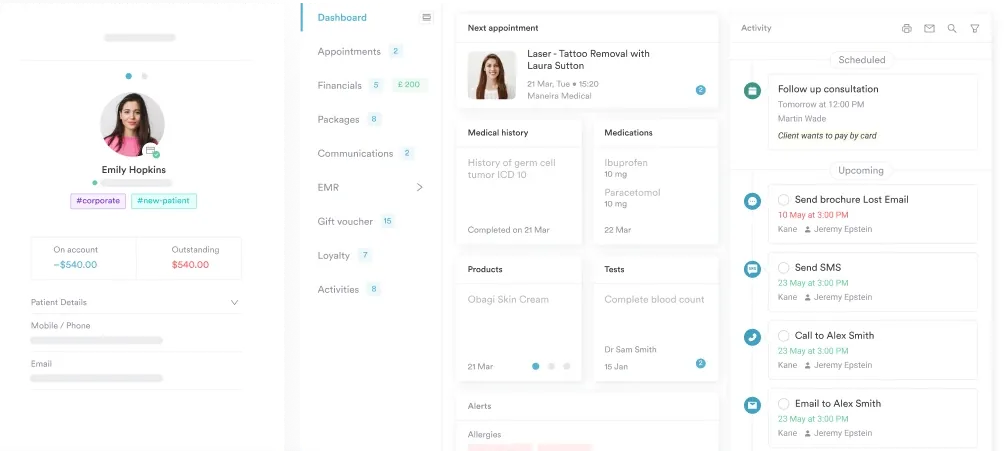
Because each copy sits in the record, you can open last month’s worksheet beside today’s and see who was added or dropped. Restrict access to the clinical staff who need it, and check your local rules on how long records are retained. Data protection duties differ by region, including HIPAA in the United States and GDPR in the UK and EU.
The forms sit inside Pabau’s therapy practice management software, alongside booking, reminders and billing.

Pabau sends the support system worksheet as a digital form and files each completed copy in the patient record. Compare a patient’s network across sessions without digging through paper folders.

The worksheet earns its place when you treat it as a working document rather than an intake formality. Revisit it whenever a patient’s circumstances shift, such as a move, a breakup or a change in treatment.
Pay most attention to the availability answers and the self-care prompt. Together they show when the patient will be on their own and what they plan to do then. That window is what a coping plan or safety plan has to cover.
Book a demo to see how Pabau sends the worksheet as a digital form and keeps every completed copy in the patient record.

Want a structured count of social ties? Social Network Index counts the roles and regular contacts in a patient’s network.
Is loneliness part of the picture? UCLA Loneliness Scale template gives a standard self-report measure of how isolated a patient feels.
Working on what a patient can change? Circle of influence worksheet separates concerns a patient can act on from those they cannot.
Building coping strategies alongside the network? Coping skills worksheet helps patients list the strategies that work for them.
Starting with a new patient? Mental health intake form collects history, symptoms and goals at the first visit.
A support system worksheet is a structured form that helps patients list and evaluate the people and services they rely on. Clinicians use it to make an informal network visible and to plan how to strengthen it.
Yes, clinicians can use it in individual sessions, group therapy and intake. Its use should sit within the wider clinical assessment rather than replace it.
A circle of support worksheet usually places the patient at the center, with rings showing closeness. A support system worksheet is a list-based format that records each supporter’s strengths and role, communication method and availability.
The free support system worksheet PDF is available through the download button on this page. It is ready to print or to share as a digital form.