GLP-1 diet plan
A GLP-1 diet plan is a structured eating framework for patients taking semagluti...

2
Last Updated: Oct 13, 2026

The Social Network Index (SNI) is a validated 12-item assessment measuring social integration via role diversity and network size-developed by Sheldon Cohen and widely used in clinical research.
SNI produces three scores: number of high-contact roles (network diversity), number of people in the social network, and number of embedded networks-together flagging patients at risk for social isolation.
The tool captures spouse/partner, children, close family, colleagues, volunteers, and religious group membership-12 relationship categories covering the breadth of a person’s social world.
Pabau, an all-in-one practice management platform, lets therapists and psychiatrists embed SNI assessments into intake workflows using its digital forms and client records, automatically tracking social integration trends over time.
A ready-to-use assessment form covering social role participation, network connections, and social integration scoring-for immediate clinical use in therapy, psychiatry, and mental health practice.
Download templateUnderstanding a patient’s social environment is central to mental health treatment, therapy outcomes, and overall well-being. The social network index is a clinician-friendly tool that quantifies social integration in under five minutes, helping you identify isolation risk, guide interventions, and track the social health of your patient population.
This guide covers what the SNI’s 12 role categories measure and how to score and interpret results. You’ll also learn how therapy practice management teams can fold SNI assessments into their intake workflow with digital forms.
The social network index is a brief, validated assessment developed by Sheldon Cohen and colleagues at Carnegie Mellon University. It measures the degree of social integration a person experiences by quantifying the diversity of their social roles, the size of their social network, and how many distinct network domains they’re embedded in.
Social integration-the breadth and depth of a person’s connections-predicts resilience, immune function, and treatment compliance. Patients with limited social roles or small networks show higher rates of depression, anxiety, and medical non-adherence. The SNI provides a quick numeric snapshot that helps clinicians identify at-risk patients and tailor support strategies. A bipolar treatment plan can incorporate these social integration findings alongside mood monitoring and crisis safety planning.
The SNI has been translated and validated in multiple languages, including Chinese adaptations used in international mental health research. It remains a widely used tool in psychology, psychiatry.
The SNI evaluates participation in 12 distinct relationship types, capturing the full spectrum of how people connect. Each role category is weighted equally, and the assessment looks at whether the person has regular contact with someone in that role.
The breadth of these categories means the SNI captures loneliness, seen as an absence of roles altogether, alongside social isolation, seen as weak participation within the roles a person does have. A patient with a rich social life will show participation across many of these categories, while a patient with few roles will show engagement concentrated in just one or two.
The SNI produces three scores that together paint a picture of social integration: the number of high-contact roles (network diversity), the number of people in the social network, and the number of embedded networks.
This score, also called network diversity, counts how many of the 12 role categories a person has high-contact participation in. High contact means the person interacts with at least one person in that role at least once every 2 weeks.
Calculation: Add up the number of role categories in which the person has contact with one or more people at least once every 2 weeks. This score ranges from 0 to 12.
This score sums the total number of people across all 12 roles in which a person participates, measuring the absolute size of someone’s social network.
Calculation: For each role category, count the number of people with frequency-weighted contact, then sum across all roles. This score has no fixed ceiling.
The third score counts how many distinct network domains a patient is actively embedded in, out of a possible 8: family, friends, work, school, neighbors, church or temple, volunteering, and other groups. A domain only counts toward this score if the patient has regular contact with at least four people within it. Because the five family roles are combined into a single family domain, that domain also requires at least three high-contact family roles.
This score flags patients whose contacts are concentrated in just one or two domains, such as family alone, even if their role diversity or network size looks reasonable on paper.
Detailed scoring instructions are embedded in the downloadable social network index template above, with worked examples for all three scores.
Practices that digitize paper scales with software for capturing forms cut scoring errors and filing time.
Interpretation depends on clinical context and the patient’s own baseline, not a universal cutoff. The SNI diversity score is reported as a raw count from 0 to 12; lower scores generally indicate fewer active social roles. The instrument does not define fixed clinical risk cutoffs, so interpret scores alongside clinical judgment and the patient’s history.
In practice, a meaningful drop from a patient’s own typical role diversity, network size, or embedded-network count is often more clinically useful than any fixed number. Patients whose scores are sparse across all three measures, or who show a marked decline from their baseline, tend to benefit from targeted clinical interventions to build and strengthen social connections.
Clinicians use the SNI to:
In therapy practice, the SNI opens conversations: “I notice your network is mainly family. Would building friendships or joining a group be helpful right now?” This clinical insight, paired with measurement.
The SNI template above is ready to print or email. For practices wanting to streamline assessment. Responses populate directly into each client record, eliminating manual transcription and ensuring consistent administration.
Clinicians who prefer to capture SNI findings inside a session note can drop the score straight into a SOAP note alongside the rest of that visit’s documentation.
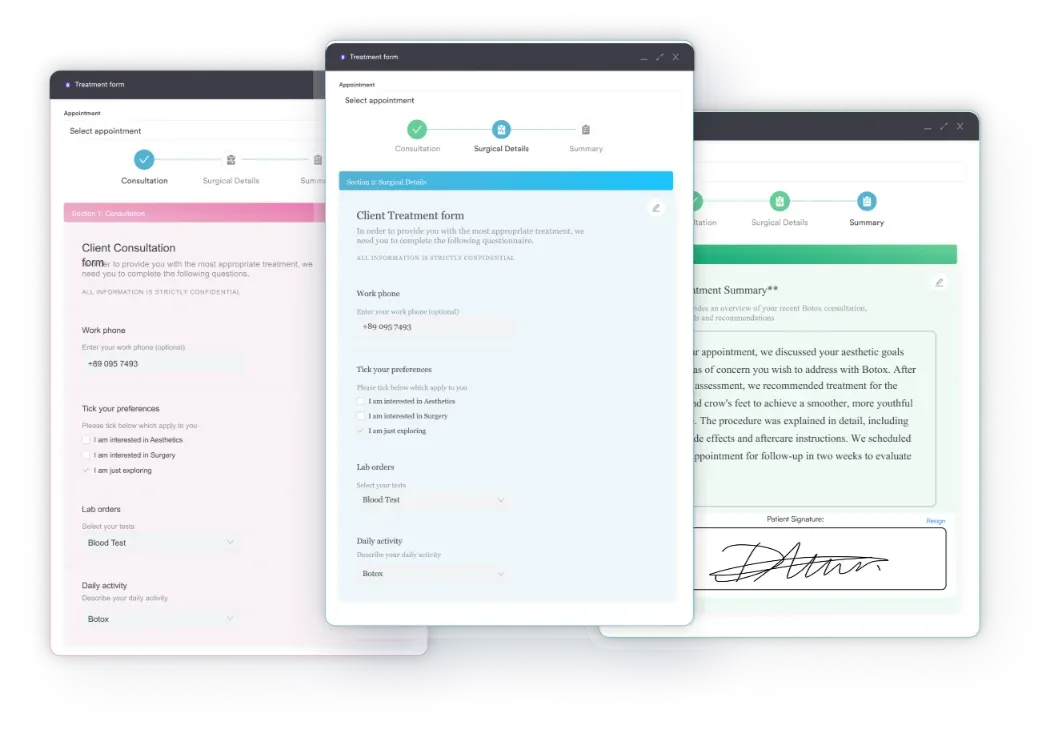
Once scored, SNI data lives in the patient’s file-instantly retrievable during appointments or clinical team discussions. For therapy practices wanting to track aggregate social health trends.

Pabau’s digital intake forms and client records let therapists embed the Social Network Index directly into their workflow-track social health, flag at-risk patients, and measure outcomes over time.

The modern SNI you’ll use today is descended from the Berkman-Syme Social Network Index, developed in the 1970s by epidemiologists Lisa Berkman and Len Syme at UC Berkeley. Their landmark study showed that social isolation predicted mortality risk independently of medical variables.
Sheldon Cohen at Carnegie Mellon later refined and validated the instrument for use in psychology and clinical settings, producing the 12-item version now standard in research and practice. Both versions measure the same construct-social integration-but Cohen’s 12-item format is faster and better suited to practice settings.
The SNI has been validated across cultures, age groups, and clinical populations. It appears in CMU’s official scoring guide and is cited in thousands of peer-reviewed studies on social isolation, loneliness, and health outcomes.
Administer the SNI early in the therapeutic relationship. Some patients feel vulnerable discussing isolation; frame it as ‘understanding your world’ rather than ‘checking if you’re lonely.’ Retest every 6-12 months to measure whether therapy is expanding their social participation and roles.
The social network index is a brief, evidence-based tool that helps clinicians quantify one of the strongest predictors of mental and physical health: social integration. Measuring role diversity, network size, and embedded networks gives you objective insight into whether a patient is at risk for isolation, plus a concrete metric to track whether your interventions are working.
Download the template above and start using it in your next intake. For practices wanting to automate scoring and track SNI trends across your patient base, book a demo with Pabau to see how digital intake forms and client records streamline social health assessments.

Evaluating a client for an emotional support animal? emotional support animal assessment covers mental health diagnosis, functional impairment, animal suitability, and the documentation ESA eligibility requires.
Want another way to map a patient’s overall wellbeing? The wellness worksheet covers eight life domains alongside social connection, giving you a fuller picture to pair with SNI results.
Curious how early attachment shapes adult relationships? The attachment theory worksheet helps you assess how a patient’s attachment style influences their support-seeking behavior.
The Social Network Index is a validated 12-item assessment tool that measures social integration by quantifying the number of high-contact social roles a person participates in, the total number of people in their network, and the number of embedded networks they’re active in. It was developed by Sheldon Cohen at Carnegie Mellon University and is widely used in clinical and research settings to identify social isolation risk and guide mental health interventions.
The SNI takes 3-5 minutes to complete and score. It is brief enough to fit into routine intake appointments while providing clinically meaningful data about a patient’s social world.
No. The SNI does not define fixed clinical risk cutoffs. The diversity score is a raw count from 0 to 12, and lower scores generally reflect fewer active social roles, but interpretation depends on the patient’s own baseline and clinical context rather than a universal threshold.
The SNI measures objective social integration-how many roles and how many people-while loneliness scales measure subjective distress. A person can be socially isolated (low SNI) but not lonely (low UCLA), or lonely (high UCLA) despite having many social connections. Both are clinically useful; the SNI identifies structural gaps in someone’s social network that therapy can address.
Yes, the SNI has been validated across ages, cultures, and clinical diagnoses. It works equally well in therapy, psychiatry, medical settings, and research. Adaptations exist for non-English-speaking populations, and cultural validation studies confirm its reliability across diverse groups.
Yes. Repeat the SNI every 6-12 months to track whether therapy is expanding a patient’s social participation and role diversity. Rising scores indicate successful work on social connection; flat or declining scores suggest the need to adjust interventions or increase focus on building relationships.