Antipsychotic medication list
An antipsychotic medication list is a structured reference that organizes psychi...

2
Last Updated: Oct 13, 2026
A self-care plan is a written record of the habits you use to protect your wellbeing, set out across seven areas of life. Those areas run from physical and mental care through to work-life balance. What makes it work is the honest scoring you do first, followed by two or three changes you can keep.
Good intentions fade in a busy week, which is why writing them down matters. The National Institute of Mental Health treats structured self-care as a core part of mental health maintenance.
Below you get the template, a walkthrough of all seven areas, and three worked plans. You will also see how practice management software like Pabau keeps a finished plan in the patient’s record.
The two-page PDF opens with your name, the date, an emergency contact, and a Personal Goals for this Plan box. After a short set of instructions, you get one open writing space for each of the seven care areas.
Download template
A self-care plan covers seven areas: physical, mental, emotional, social, spiritual, and creative care, plus work-life balance.
The free template gives you one open writing space per area, so you describe the practices that fit your own week.
Creative care covers making or playing with no productive goal attached, which is why it earns an area of its own.
Choosing two or three areas to work on first keeps the plan realistic instead of overwhelming.
Clinicians can share the template after a consultation and store the completed plan in the patient record using Pabau’s digital forms.
A self-care plan sets out what you need, what you intend to do about it, and how often. The template gives that a structured home, so the plan stops living in your head. From there it becomes a document you revisit and adjust as your circumstances change.
Five qualities separate a plan from a list of good intentions.
Miss the first one and the rest of the plan aims at the wrong target.
Healthcare professionals carry a particular burnout risk. A therapist experiencing burnout brings fatigue, cynicism, and reduced empathy into the room, and patients feel it. Structured self-care is what keeps you present and functional at work.
For patients, a written plan replaces a vague wish to feel better with a short list of steps to take this week. People managing anxiety, depression, chronic pain, or a major life change get clarity on what helps and when.
The CDC’s guidance on managing stress names the same practical habits, including sleep, exercise, connection, and breaks from the news. None of that is new advice. Writing it into a dated plan is what turns it into something you do.
Knowing which stressors you are managing makes those habits easier to choose. A worksheet for managing stress maps the triggers, then pairs each one with a coping response.
A written plan also cuts down on decision fatigue. Rather than asking yourself what your wellbeing needs today, you check the plan. Thursday is therapy, Wednesday evening is the pottery class, Saturday is friend time.
Clarity drives consistency, and consistency is what turns a practice into a habit. For clinicians, a documented plan also models the behavior you ask patients to adopt. It is hard to ask someone to protect their boundaries while visibly neglecting your own.
Patients get something similar from it. A quiet evening stops being an indulgence and becomes part of the treatment.
Each section of the template covers a distinct type of wellbeing. A plan that draws on all seven holds up better than one built on exercise or therapy alone.
Creative care is the section people skip first, usually because it looks like a hobby rather than health. It earns its place precisely because no target is attached to it.
You never have to finish it or show it to anyone. That is what makes an hour of it restorative after a day of clinical decisions.
Work-life balance sits last in the template for a reason. It holds the boundaries that protect the other six areas. A plan with a blank work-life section rarely survives a busy month, however strong the rest of it looks.
One common mistake is to work hard on one area and leave the rest blank. Physical training without emotional processing, or therapy without sleep, leaves the plan lopsided. When the emotional section stays blank, a personification worksheet helps the patient describe the feeling as a character. Write something into all seven and the picture stays complete.
Filling in the template takes about an hour the first time. Set aside a quiet block where you can think honestly without interruption.
Before you start, have these to hand:
Start at the top of the template with your name, the date, and an emergency contact. Then write two or three sentences in the Personal Goals for this Plan box.
Keep it concrete, because the rest of the plan works toward it. Sleeping through the night beats a goal like being healthier. So does getting back to swimming, or finishing the week with something left in the tank.
Before you write anything in the seven sections, score each one from 1 (neglected) to 10 (thriving). Gut feeling is fine, and the template has no scoring grid, so jot the numbers in the margin. A busy clinician’s scores might read physical 6, mental 7, emotional 4, social 5, spiritual 3, creative 2, and work-life balance 4.
Set out side by side, the weakest areas stop being a vague feeling.
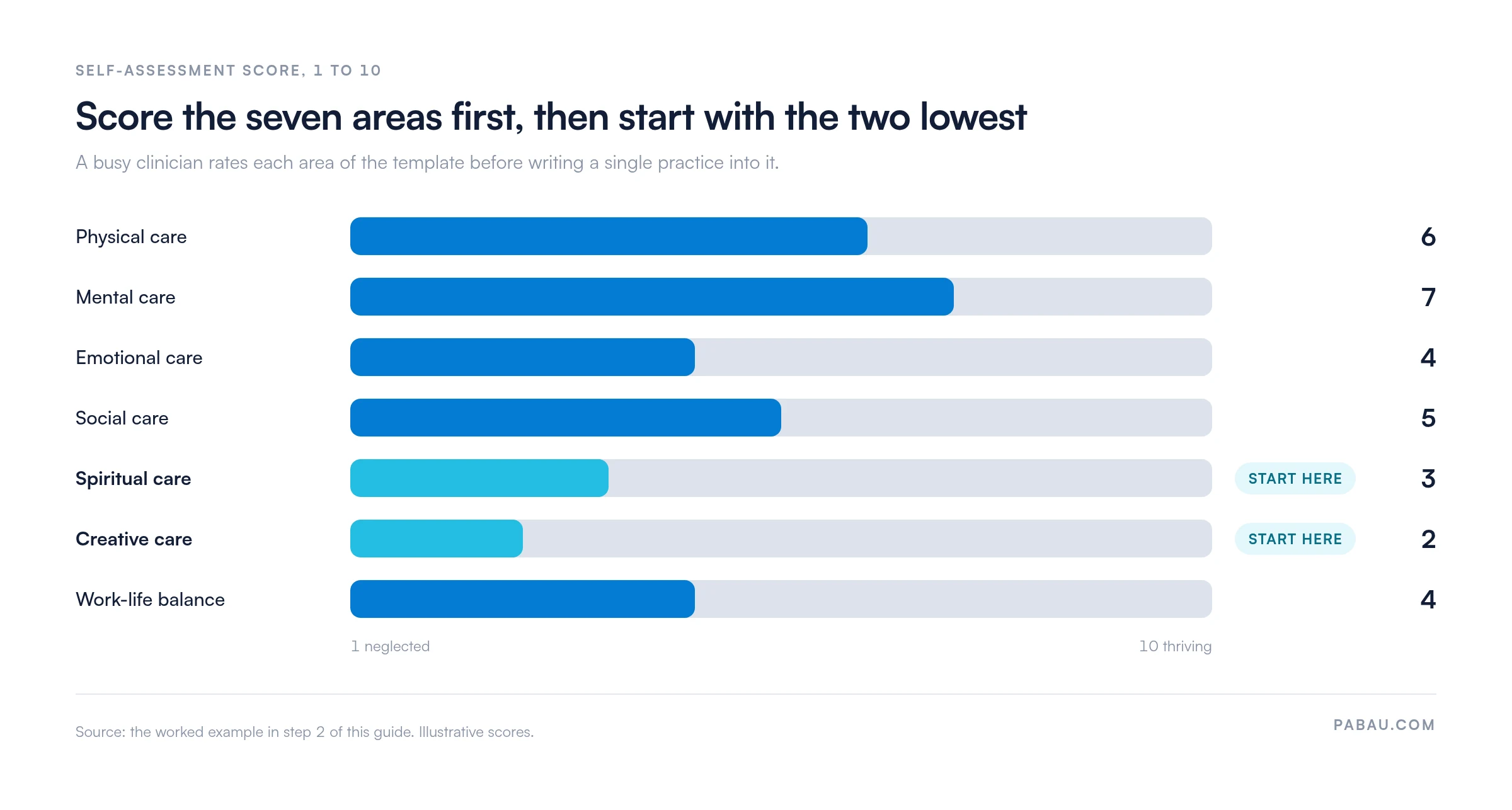
Mark the two or three lowest sections and leave the rest for the next review. Those are where the plan does its work first.
Each of the seven sections is one open writing space, so you decide what goes in it. Write practices rather than intentions. Therapy with Dr Ahmed on Tuesdays at 3pm, or ten minutes of guided breathing before bed, both tell you exactly what to do.
Use the same level of detail in the areas you scored highest. Those entries record what already works for you, which makes it easier to protect them when the week gets busy.
Move the plan into your calendar. Entries like Tuesday 3pm therapy, or Monday, Wednesday and Friday 7am walk, turn intentions into appointments with reminders attached.
Set a monthly date to reread the plan. Keep what worked, change what did not fit, and print a fresh copy once your goals move on. If the Wednesday walk keeps getting canceled, shift it to Saturday rather than dropping it altogether.
Schedule a quarterly review with your therapist, mentor, or supervisor. Bring the plan, compare what you did against what you wrote, and adjust for the season ahead. Winter often calls for more social care, while summer makes outdoor movement easy. A plan you never reread stops describing your life within a couple of months.
Three worked examples follow, each using the template’s seven sections.
Lowest sections: creative 2, emotional 3, work-life balance 4. Personal goal: end the week with enough left to enjoy a Saturday.
Entries: therapy every two weeks with a clinician who works with burnout. A 15-minute wind-down block at 5:30pm, with email closed. Peer consultation monthly, plus a Sunday afternoon life-drawing class. Within three months, sleep improved and case formulation felt fresher.
Lowest sections: physical 2, emotional 3, creative 3. Personal goal: sleep seven hours on five nights a week and move three times a week.
Entries: no screens after 10pm, a 7am walk on Monday, Wednesday and Friday, and five minutes of breathing practice daily. Therapy runs every two weeks, with one evening a week at a ceramics class. Shared with the therapist, the plan slots into mental health practice management workflows and sits in the patient’s record.
Lowest sections: work-life balance 3, mental 4. Personal goal: stop taking admin home.
Entries: a protected 12pm to 1pm break away from the desk, one continuing education module a month, and non-clinical tasks delegated. Peer supervision is monthly, and one evening a week the laptop stays shut. Six weeks in, admin ran to time and morale steadied.
Mental health practitioners use the template with patients working through anxiety, depression, trauma, or a life transition. Wellness coaches use it for preventive health. Staff wellbeing programs hand it out as a structured starting point.
Patients managing chronic illness, persistent pain, or an autoimmune condition get a clear place to record what helps. So does anyone in a period of sustained change, such as a new parent, someone grieving, or someone switching careers.
For clinicians, the plan counts as part of the job rather than a perk. When you protect your own boundaries visibly, patients take their own plan more seriously.
One limit is worth naming. Someone at risk of a crisis needs a mental health safety plan as well, since that document covers the worst days.
Handing a patient a PDF at the end of a session is the easy part. The process usually breaks down afterward. You have to get the completed plan back, store it where you can both see it, and revisit it at the next appointment.
Pabau closes that loop. It is therapy practice management software, so the seven areas can be rebuilt as a structured intake form. The patient scores each area from 1 to 10, names two or three priorities, then writes the practices for each one.
The answers land in the patient’s record, so you open the plan at the next visit instead of asking them to recall it. Automated reminders cover the appointments the plan depends on, from a therapy session to the monthly review.
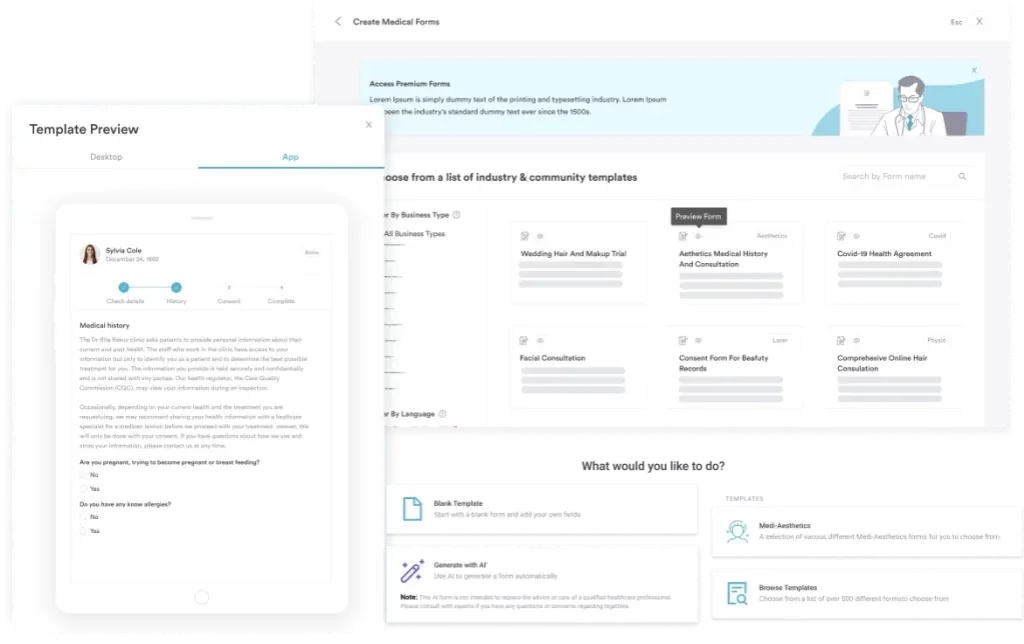
The template still works on paper. Print it for patients who prefer to write by hand, then scan the finished sheet into their record. The next review starts from what they wrote.

Pabau’s digital forms capture a self-care plan at intake and file it in the patient’s record. You review and update it at the next appointment, while automated reminders keep the sessions booked.

A self-care plan only does its job once it exists on paper. The seven areas give you somewhere to put the practices you keep meaning to start. The personal goals box keeps them pointed at an outcome you want.
Download the template, block out an hour, and fill in the two areas you scored lowest. Leave the rest for next month’s review rather than fixing all seven at once. A plan you can finish is worth more than a plan you abandon in week two.
If you support patients, the same template doubles as a shared document between sessions. Book a demo to see how Pabau captures self-care plans at intake and keeps them in the patient’s record.

Not sure how to score each area honestly? The self-care inventory walks through a fuller assessment you can run before you fill in the plan.
Struggling with the work-life balance section? The healthy boundaries worksheet gives you the wording for the limits this section asks you to set.
Want to measure burnout rather than guess at it? The Maslach Burnout Inventory is the scored tool clinicians use to track exhaustion and cynicism over time.
Need more ideas for the emotional care section? The coping skills checklist lists practices patients can try between sessions.
Protect one practice per area and let the rest slide. A plan survives a hard month when it has a floor you can always hit. Pick the smallest version of each entry, such as a ten-minute walk instead of an hour, and put that in the calendar.
A safety plan covers a crisis, while a self-care plan covers ordinary weeks. Safety plans list warning signs, coping steps, and who to call when risk rises. Anyone at risk of a mental health crisis needs both documents, written with their clinician.
One or two per area is plenty. Seven areas with two entries each already gives you fourteen commitments, which is more than most weeks hold. Add a third only in the areas you scored lowest.
Yes, with two changes. Let them write the entries themselves, since a plan handed down gets ignored. Then shorten the review cycle to every two weeks, because school terms and friendships shift faster than an adult routine does.
No, the template works on your own. A clinician helps most with the scoring step, where people tend to rate themselves generously. If you are in treatment, bring the finished plan to a session so it lines up with your goals.