Getting along with siblings worksheet
A getting along with siblings worksheet is a printable that helps children and t...

2
Last Updated: Oct 23, 2026

A schizophrenia treatment plan records the DSM-5 diagnosis, measurable recovery goals, prescribed antipsychotics, psychosocial interventions, crisis steps, and a review date.
Every medication entry needs a rationale, a monitoring schedule, and an adherence plan, not just a drug name and a dose.
Name a clinician and a session frequency against each psychosocial intervention, so nobody assumes someone else booked it.
Quarterly review is the outpatient default, but a hospitalization or a dose change pulls the plan forward immediately.
Practice management software like Pabau keeps the plan, the notes, and the review reminders in one record your team shares.
A structured template covering patient demographics, DSM-5 diagnosis, SMART goals, and antipsychotic prescriptions with their monitoring schedule. Psychosocial interventions, a crisis escalation protocol, and a quarterly review log are built in too.
Download templateA schizophrenia treatment plan is the document that keeps a whole care team working from the same decisions. It names the diagnosis, the goals, the medication and its monitoring, the therapy, and the crisis pathway. Download the template above, then use the sections below to fill it in.
Most plans are written well and then left to go stale. Doses change, therapists change, and patients get admitted, so the document has to keep up. Below is what belongs in each section, and when the plan comes back out for review.
A schizophrenia treatment plan is a clinical document that guides the coordinated care of a patient diagnosed with schizophrenia. The clinician and patient write it together, with family involved where that helps. It sets out the presenting problem, the formal DSM-5 diagnosis, and measurable recovery goals. It also records the prescribed medication with its monitoring protocol, the psychosocial interventions, the crisis steps, and the date of the next review.
The plan does three jobs. It clarifies who is responsible for what, it establishes accountability for outcomes, and it keeps care continuous when clinicians change.
It is also a compliance document. The Centers for Medicare and Medicaid Services (CMS) and the American Psychiatric Association (APA) Practice Guidelines for Schizophrenia both expect one. Auditors look for documented goals, named interventions, and evidence that progress was reviewed.
Schizophrenia is a chronic psychiatric condition with three symptom groups:
A plan that treats medication and psychosocial needs together gives the best chance of symptom control, functional recovery, and quality of life.
A complete plan contains the following eight core sections:
Filling in the plan follows a five-step workflow:
Complete the crisis plan, monitoring schedule, and team roles before the first appointment. Share the plan with the patient and family, and record what they asked to change. If the assessment itself is still open, the psychiatric evaluation template covers the history and mental status exam you need first.
Schizophrenia treatment plans are standard practice for psychiatrists, clinical psychologists, and psychiatric nurse practitioners. Community mental health centers, inpatient psychiatric units, assertive outreach teams, and private mental health practices all keep them. Any clinician who diagnoses or manages schizophrenia benefits from one structured document.
The template earns its place fastest in team-based or multi-site practices, where continuity depends on paperwork rather than memory. Practices running several clinicians off one schedule keep the plan inside their therapy practice management software. The psychiatrist and the therapist then read the same version, not two copies. Coordinated Specialty Care (CSC) early psychosis programs and forensic mental health services depend on the same clarity.
Clinical clarity: A written plan removes any doubt about who is responsible for what, when appointments happen, and what success looks like. The psychiatrist, therapist, case manager, and family all work from the same goals.
Regulatory compliance: CMS, state licensing boards, and accreditation bodies such as CARF and JCAHO expect a documented plan for every psychiatric patient. An audit-ready plan lowers your compliance risk and shows standard-of-care documentation.
Outcome accountability: Measurable goals and scheduled reviews let you track progress against a target instead of an impression. If symptoms worsen or stall, the plan tells you to adjust the medication or intensify the therapy.
Crisis readiness: When a patient decompensates, the documented crisis plan gives every clinician the escalation pathway, the numbers to call, and the hospitalization criteria. That speeds up the response and reduces harm.
Antipsychotic medications are the cornerstone of schizophrenia treatment. Second-generation (atypical) agents include risperidone, olanzapine, quetiapine, aripiprazole, paliperidone, and lurasidone. The NICE schizophrenia guidelines ask the clinician and patient to choose together, weighing the full side-effect profile rather than defaulting to one drug class.
That means metabolic, cardiovascular, hormonal, and extrapyramidal risks all get compared against the likely benefit for this patient. Record that reasoning in the plan, because it is the part an auditor cannot infer. Clozapine sits outside the discussion until two adequate trials have failed. It then carries Risk Evaluation and Mitigation Strategy (REMS) requirements, including mandatory monitoring for agranulocytosis.
Your psychiatry EMR software should carry the medication template. That way the rationale, the expected onset of two to four weeks, and the monitoring schedule sit in one place.
Metabolic side effects such as weight gain, glucose dysregulation, and lipid changes need a baseline panel and a repeat every three months. Order an ECG where clozapine is prescribed. Prolactin elevation is common with risperidone and paliperidone, so raise sexual side effects and amenorrhea early rather than at month six.
Medication alone is not enough. SAMHSA’s Coordinated Specialty Care resources set out how to combine antipsychotics with evidence-based psychotherapy. Cognitive behavioral therapy for psychosis (CBTp) helps patients challenge delusional beliefs and build coping strategies for hallucinations.
Family psychoeducation teaches relatives to spot early warning signs, which lowers relapse rates. Social skills training and vocational support improve employment and independence.
In the plan itself, name the intervention, the clinician, and the frequency. A workable entry gives weekly 50-minute CBT for psychosis to the clinical psychologist, targeting command hallucinations through reality testing. Family psychoeducation then follows monthly, in 90-minute sessions with the social worker. Written that way, nobody has to remember who books the next session.
Every plan needs a crisis protocol. Record the patient’s early warning signs, such as rising paranoia, less sleep, or voices telling him to harm himself. Set the escalation pathway in order, from therapist to psychiatrist to the emergency department where there is intent to harm. List the emergency contacts alongside it.
Hospitalization criteria usually cover imminent danger to self or others, acute decompensation that stops self-care, and nonadherence with worsening symptoms. A mental health safety plan gives the patient their own copy of the warning signs, coping steps, and contact numbers. Keep the two documents consistent, so the version the patient holds matches the one in the record.
Early intervention in first-episode psychosis changes long-term outcomes. CSC programs that reach patients within two years of onset report fewer hospitalizations and better functional recovery than standard care. If your patient is in a first episode, prioritize a CSC referral and record it in the plan.
The template includes a completed example for a 28-year-old man with paranoid delusions, command hallucinations, and three months of symptoms. It shows the level of detail each section expects.
The goals are written to be scored. One tracks paranoid thoughts down to two or three episodes a day by week eight, with risperidone named as the agent. Interventions carry a person and a slot, such as family psychoeducation on Saturdays at 10 AM with the case manager. The crisis section is explicit, down to calling 911 if the patient states intent to harm his parents.
Use the example as a pattern rather than a script. Swap in your patient’s presentation and medication, and keep the structure as it is. The wording is already evidence-aligned and audit-ready, so adapting it beats writing from scratch.
Treatment plans go stale unless somebody owns the review date. Outpatient care reviews every three months as a rule. Intensive CSC programs review monthly, and any hospitalization or medication change pulls the review forward. At each one, record progress against the goals, side-effect changes, adherence barriers, and whether the therapy is happening.
The monitoring obligations and the review dates run on the same calendar, so it helps to see them side by side.
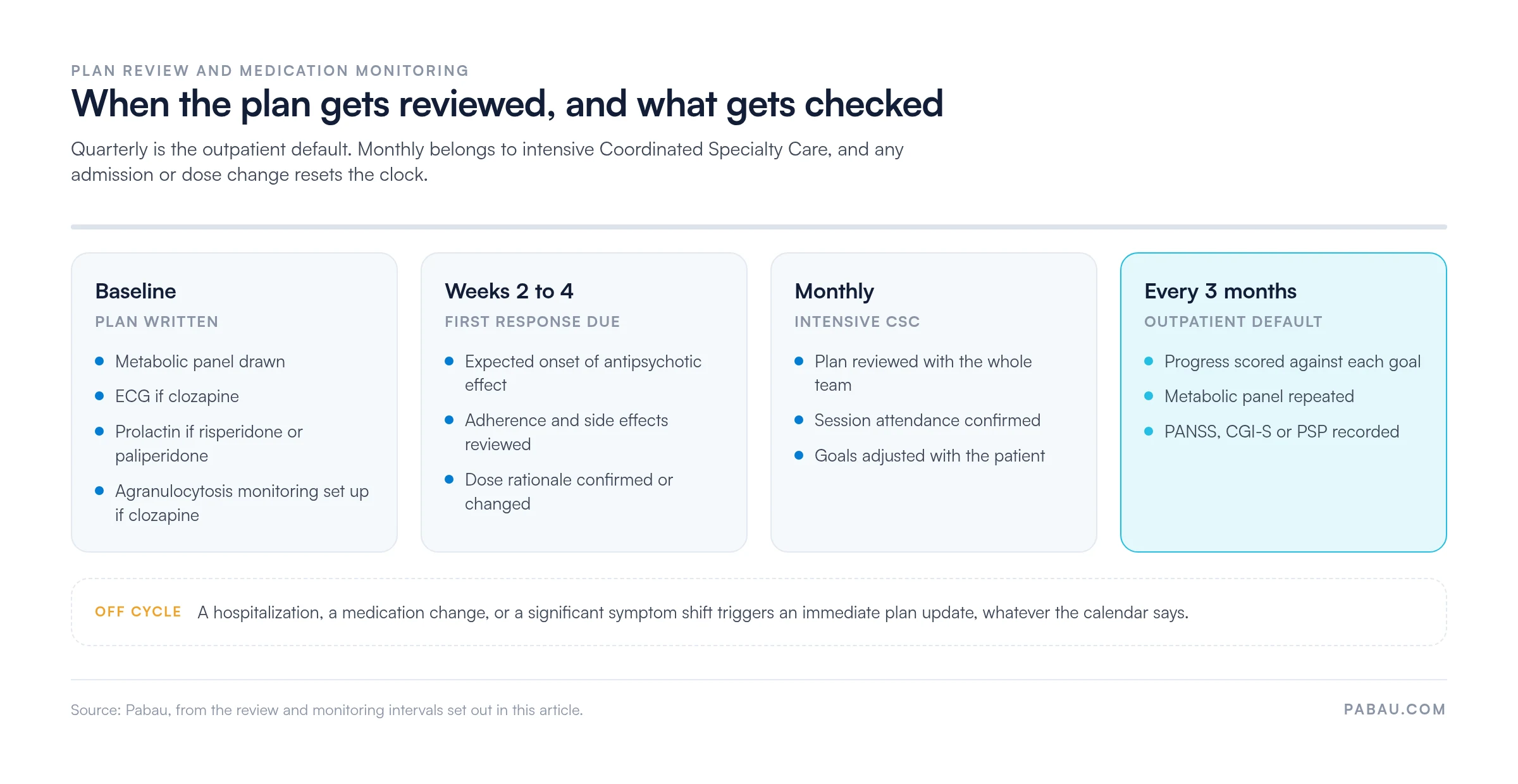
Outcome measures make a review defensible. Use the Positive and Negative Syndrome Scale (PANSS) for symptom severity, or the Clinical Global Impression Scale (CGI-S) for overall functioning. The Personal and Social Performance (PSP) scale covers work and social outcomes. Trending any of them over time shows whether the plan is working.
A static PDF is a fine starting point, but it stops being current the moment the dose changes. Practice management software like Pabau keeps the plan attached to the patient record instead of a shared drive.
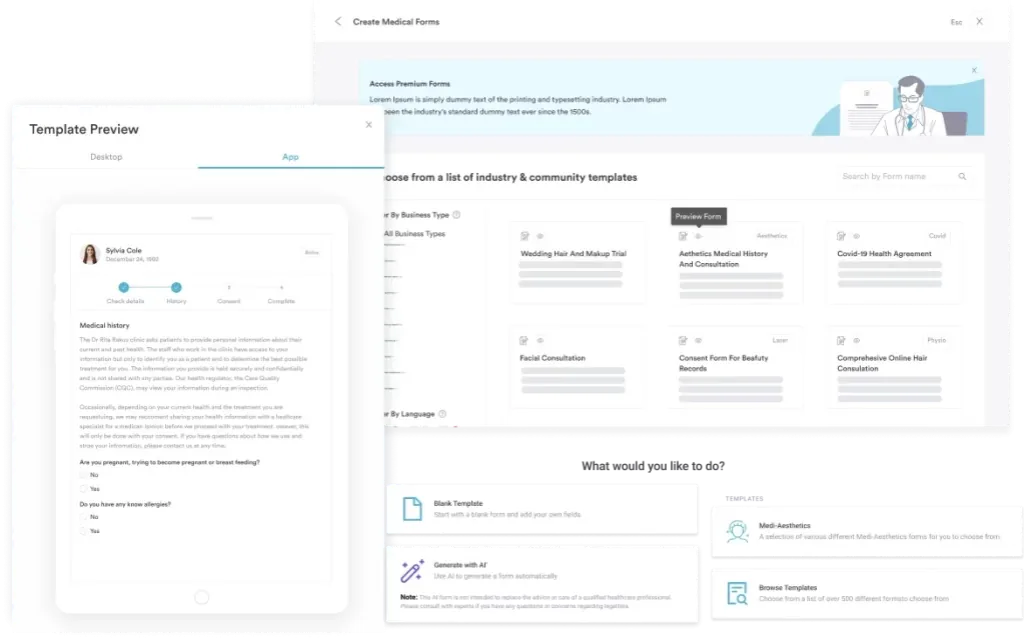
Pabau’s digital forms capture the presenting problem, goals, and medication details at the first appointment, and file them against the patient. That saves your front desk retyping the intake into the chart.
Pabau’s mental health EMR links the plan to appointment scheduling, progress notes, and medication refills. At the review appointment, template-driven notes prompt you for the PANSS score, the CGI-S rating, and adherence against the original goals.
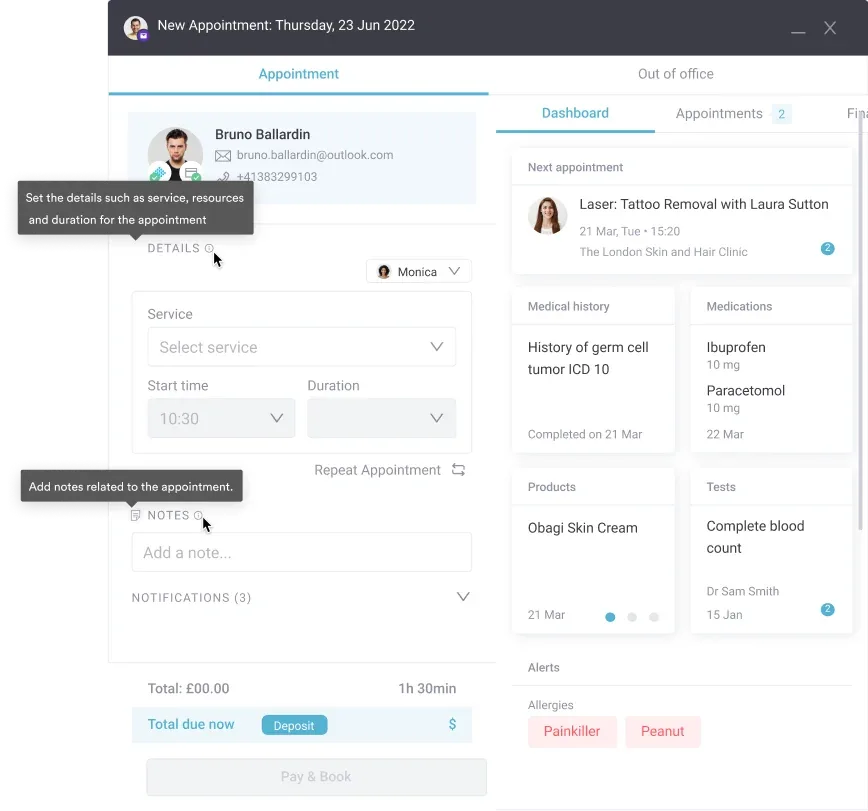
The psychiatrist, therapist, and case manager all work in one shared record, so a medication change reaches the team the same day. Automated appointment reminders keep patients turning up for medication reviews and therapy. The patient portal shares appointment summaries and between-session resources, which reinforces the psychoeducation you delivered in the room.
Progress tracking across months and years gives you the auditable evidence an inspector or payer asks for. It also shows you when the current plan has stopped working.

Pabau brings the schizophrenia treatment plan, progress tracking, care team messaging, and patient reminders into one clinical workflow. Your team works from the same up-to-date plan, and the review never depends on somebody remembering it.

Getting the diagnosis, goals, medication, and crisis pathway onto paper is the easy half of this job. The plan is only ever as good as its last update.
The half that decides outcomes is the review. Someone has to own the date, score the goals against the outcome measures, and change the plan when the evidence says so. Build that owner and that date into the document itself, and the rest holds.
Download the template, fill it in for your next new patient, and set the review date before you close the file. If your team loses track of plans between appointments, book a demo and see how Pabau keeps every version in one shared record.

Need the crisis pathway in more detail? Crisis intervention strategies for clinicians covers de-escalation, safety planning, and how a team coordinates during a psychiatric crisis.
Writing the nursing side of the plan? Schizophrenia nursing care plan sets out nursing diagnoses, interventions, and evaluation criteria for the same patient.
Trying to catch psychosis earlier? The 5 stages of psychosis explains what the prodrome looks like and when to refer for specialty care.
Treating a mood disorder alongside psychosis? Bipolar treatment plan handles mood stabilizers, cycle tracking, and relapse prevention in the same format.
A plan needs eight sections. Those are patient information and presenting problem, the DSM-5 diagnosis with specifiers, and treatment goals with measurable objectives. It also names the antipsychotic with its rationale and monitoring schedule. The last four sections are the psychosocial interventions with named clinicians, the crisis plan, the review schedule, and the team roles.
Review an outpatient plan at least every three months. Intensive Coordinated Specialty Care (CSC) programs review monthly. Update the plan immediately after a hospitalization, a medication change, or a significant symptom shift. Beyond that, the interval follows the patient’s stability and the intensity of treatment.
First-generation (typical) antipsychotics, such as haloperidol and chlorpromazine, carry a higher risk of movement disorders, tardive dyskinesia, and neuroleptic malignant syndrome. Second-generation (atypical) agents, such as risperidone and olanzapine, carry less movement-disorder risk but more metabolic risk. Neither class is automatically first-line. APA and NICE guidance asks the clinician and patient to choose together, weighing the whole side-effect profile against the expected benefit.
Clozapine is a second-generation antipsychotic kept for treatment-resistant schizophrenia. That means the patient has already failed at least two adequate trials of other antipsychotics. It is the most effective option, but it needs mandatory blood monitoring for agranulocytosis. Sedation, drooling, and weight gain are common, and prescribing requires REMS enrollment.
CSC is a SAMHSA-endorsed care model for first-episode psychosis. It combines antipsychotic medication, psychiatric review, CBT for psychosis, family psychoeducation, case management, and supported employment or education. Programs target patients within two years of psychosis onset. Compared with standard care, they report fewer hospitalizations and better functional recovery.