OSHA respirator medical evaluation questionnaire
The OSHA respirator medical evaluation questionnaire is the mandatory health for...

3
Last Updated: Oct 15, 2026
A presenting problem is the patient’s chief reason for seeking care — the complaint, concern, or symptom that brought them to you today.
It is separate from a formal diagnosis, and it is what the assessment, the case formulation, and the treatment plan are all built on.
Recorded well, it tells the next clinician what the patient asked for and why. This guide covers the five elements of a complete statement, plus worked examples from therapy through general practice. It also gives you a free template that carries the statement into formulation.
Whether you work in a mental health practice or in primary care, the presenting problem is the clinical starting point.
A one-page formulation form with a free-text field for the presenting problem in the patient’s own words. Four factor fields follow it: predisposing, precipitating, perpetuating, and protective.
Download template
A presenting problem is the patient’s chief reason for seeking care, and it is separate from any formal diagnosis.
Accurate documentation protects clinical continuity and legal standing, and keeps treatment pointed at what the patient asked for.
A complete statement covers the chief concern, onset, severity, impact on functioning, associated symptoms, and current coping.
The downloadable template carries that statement into the five Ps, so formulation starts from the patient’s own words.
Practice management software like Pabau captures the statement at intake, and Pabau Scribe, our AI scribe, drafts the note.
A presenting problem is the primary reason a patient seeks clinical care. It is the chief complaint, the symptom or difficulty that prompted them to contact your practice. A diagnosis comes later, after assessment. The presenting problem is what the patient reports at the very start.
In therapy it might be “anxiety affecting work performance” or “relationship conflict.” In psychiatry it could be “recurrent depressive episodes.” In general practice it is often “chronic back pain” or “difficulty sleeping.” The statement sets the clinical agenda for the assessment that follows.
The presenting problem and the diagnostic impression are different records, and the file should show both. Software for therapy practices keeps the intake statement and the later diagnosis in one patient record, so neither one overwrites the other.
A precise statement protects both clinical quality and legal standing. It also travels: colleagues, payers, and regulators all read it at some point.
A complete statement covers five elements. Each one adds something a later reader would otherwise have to ask the patient for a second time.
These statements read differently by specialty. Here is the shape they take in day-to-day practice.
Each one carries the chief symptom, the onset, and the functional impact. That level of detail is what makes a statement usable by a clinician who was not in the room.
Case conceptualization turns the patient’s complaint into an explanation. The documented statement is the input, and the formulation is the output.
The template on this page runs step three through the five Ps. The statement sits at the top of the form, and four factor fields underneath turn it into a working formulation.
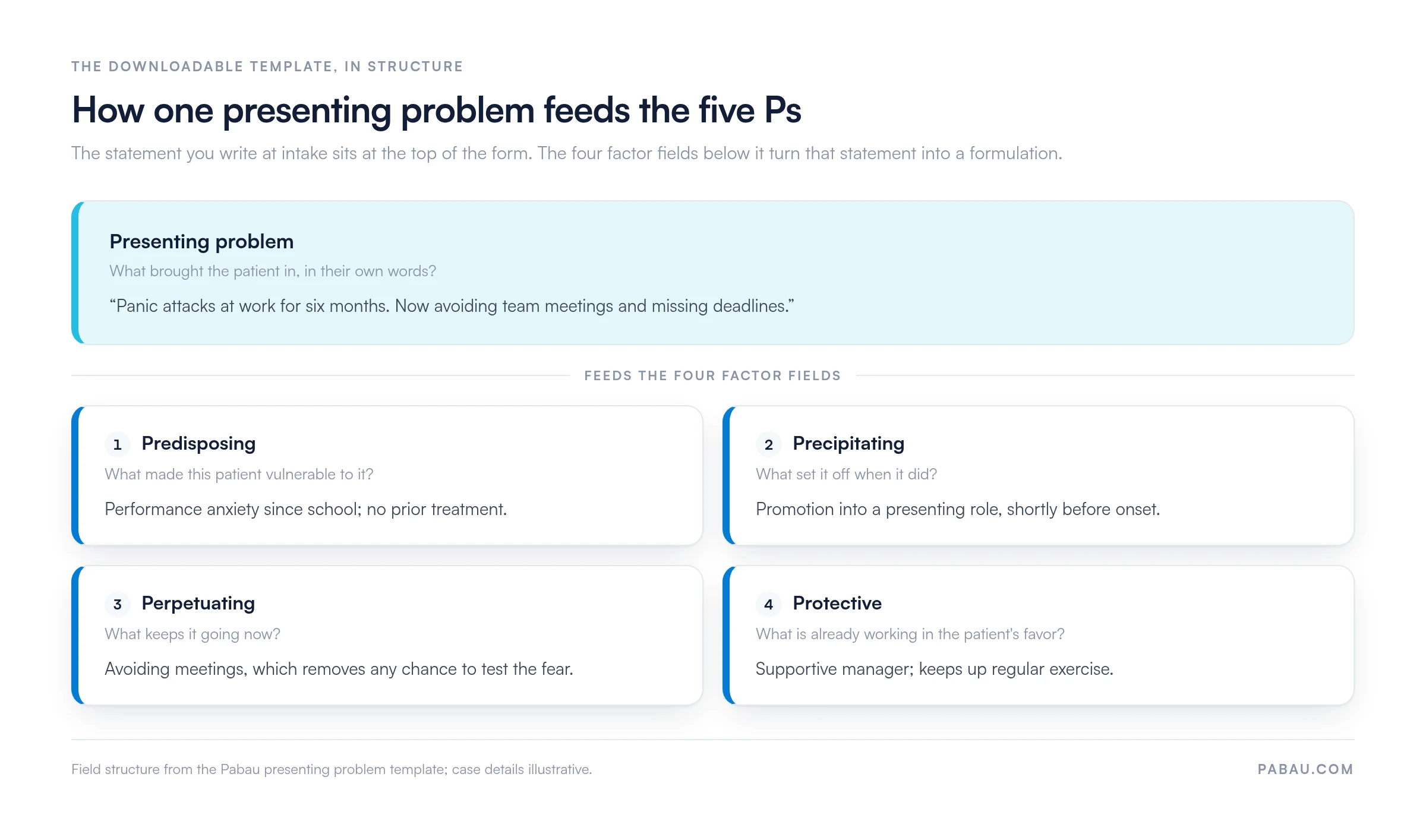
Predisposing and precipitating factors come out of history-taking, so a structured biopsychosocial assessment is usually where you collect them. The protective column is the one clinicians most often leave blank, and it is the one that shapes what treatment can lean on.
These are two different records written at two different moments. Treating them as one causes trouble later, when someone tries to work out what the patient actually said.
The two often converge, but they are written at different stages and serve different purposes. Patients engage with the concern they recognize, which is usually the complaint they brought in rather than the diagnostic label attached to it.
A structured intake keeps the capture consistent between clinicians. Digital intake forms can prompt each element in order, so none of them is left to memory at the end of a long day.

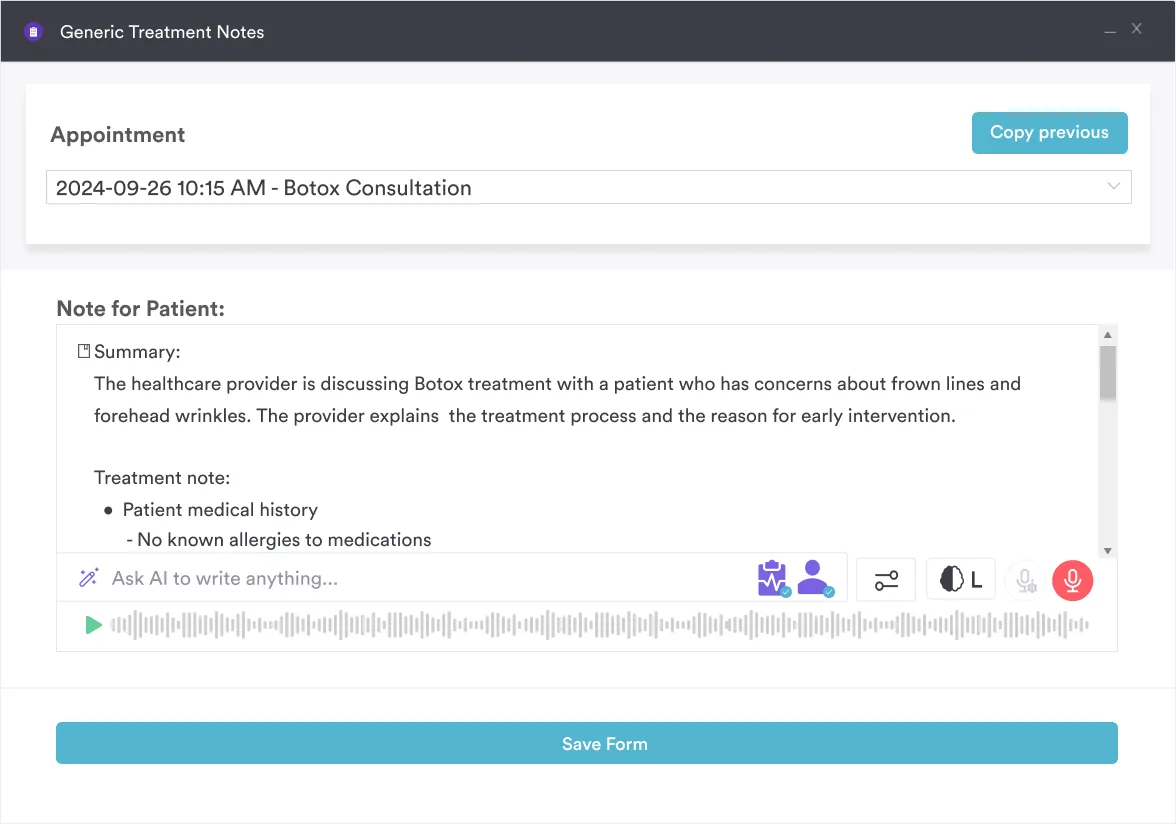
An AI medical scribe can draft that summary from the intake conversation itself. Pabau Scribe listens, writes the draft, and leaves you correcting wording rather than typing it from scratch.
Paper intake forms create a second copy of the same information. Someone retypes the statement into the record after the session, and the wording drifts a little each time it moves.
Practice management software like Pabau removes that second copy. The intake form writes straight into the patient record, so the statement is stored once, in the words the patient used.
Patients can read back what was recorded through their own portal. Seeing their concern written down in their own words is often what convinces them the practice was listening.

Pabau’s intake forms and clinical notes capture the patient’s chief concern once. Pabau Scribe drafts it, and the whole care team can search it.

A thin statement puts a ceiling on the formulation built on top of it. No amount of later assessment recovers the wording the patient used on the first day.
So write it while the patient is still in front of you, in their language, with the onset and the functional impact attached. Download the template above and let the form prompt the elements you would otherwise skip.
The trade-off worth remembering is time. Capturing this properly costs a few minutes at intake, and it saves the next clinician a conversation the patient has already had. Book a demo to see how Pabau keeps that statement in the patient record from first contact.

Looking for guidance on structuring clinical notes? SOAP notes for social work walks through a framework where the chief complaint sits under the subjective and assessment sections.
Need a full mental health assessment? Psychiatric evaluation template gives you the wider evaluation that the intake statement opens.
Starting the intake from scratch? Mental health intake form collects history, risk, and presenting concerns in one pass.
Writing the session note afterwards? SOAP note for mental health carries the same statement forward into every subsequent session.
A presenting problem is the chief reason a patient seeks mental health care. It is their primary symptom or concern at the start of treatment, documented in their own language at the first appointment. Examples include “anxiety affecting work performance” and “difficulty managing anger in relationships.”
Write one clear statement covering the chief symptom, onset, severity, and impact on functioning. Use the patient’s language where you can, and keep diagnostic terminology out of it. For example: “35-year-old with panic attacks at work for three months, now avoiding team meetings.”
Common examples include anxiety, depression, disturbed sleep, relationship conflict, grief, work stress, chronic pain, attention difficulties, and substance use concerns. Each one is written in the patient’s terms, with the onset, the severity, and the functional impact attached.
A presenting problem is what the patient reports at intake, so it is subjective and immediate. A diagnosis is your judgment after assessment, measured against criteria such as DSM-5-TR or ICD-10. The presenting problem comes first, and the diagnosis follows once you have the full picture.
Record it in the subjective section of the clinical note, or at the top of the intake form. Include the chief concern, the timeline, the effect on daily functioning, any associated symptoms, and what the patient has already tried. Keep the language specific enough that any colleague reading it understands why the patient came in.