Mental health color chart
A mental health color chart is a reference guide that maps colors to mental heal...

Last Updated: Oct 5, 2026
The Relationship Scales Questionnaire (RSQ) is a 30-item self-report measure of adult attachment, published by Griffin and Bartholomew in 1994. Clients rate each statement from 1 (not at all like me) to 5 (very much like me). Only 17 of those 30 items feed the original four-subscale key, and items 6, 9 and 28 get reversed first.
That key has not held up under testing. Subscale reliabilities as low as 0.26 mean a four-style result is not safe to record. The template below therefore scores two dimensions, attachment anxiety and attachment avoidance. What follows is the full scoring key, the evidence behind that choice, and how to use the form in session.
All 30 RSQ statements in their published order, each with a 1 to 5 response row. Name, date and assessor fields sit at the top. The results box at the end records the two dimension means, attachment anxiety and attachment avoidance.
Download template
The RSQ has 30 items rated from 1 to 5, but the original four-subscale key scores only 17 of them.
Items 6, 9 and 28 are reverse-scored, and item 6 counts in two subscales, once reversed and once as written.
Secure uses items 3, 9, 10, 15 and 28, and fearful uses 1, 5, 12 and 24. Preoccupied uses 6, 8, 16 and 25, and dismissing uses 2, 6, 19, 22 and 26.
No confirmatory factor analysis has reproduced the four subscales, so scoring the RSQ on attachment anxiety and avoidance is better supported.
Practice management software like Pabau can send the RSQ before the session and file every completed form in the client record.
The Relationship Scales Questionnaire is a 30-item self-report form. It measures how an adult handles closeness, trust and dependence in intimate relationships.
Each item is a short statement, such as “I find it easy to get emotionally close to others.” The client rates how well it describes them.
Griffin and Bartholomew built the RSQ in 1994 by pooling items from three earlier measures:
That pooling explains an oddity clinicians notice as soon as they try to score it. The four attachment subscales draw on only 17 items, which leaves 13 items outside the original key. Those spare items belong to the scales the RSQ borrowed from, and other published scoring schemes do use them.
So the RSQ is a research instrument rather than a diagnostic test. It produces continuous scores and has no published cut-offs. Its design does not sort a client into one attachment category. Mental health EMR software commonly carries it alongside outcome measures as an intake and reflection tool.
Bartholomew’s model crosses two internal working models. One is how positively a person views themselves, the other how positively they view other people. Those two axes produce the four prototypes the RSQ subscales are named after.
A client gets a score on all four, not one label. Mixed profiles are normal, and the pattern across the four scores usually says more than the highest one.
Every item uses the same two anchors. A 1 means “not at all like me”, and a 5 means “very much like me”. Only the two ends are labeled, so the client places themselves on the scale rather than picking a named category.
The statements cover four recurring themes. Dependence shows up in item 1, “I find it difficult to depend on other people.” Closeness runs through item 30, “I find it relatively easy to get close to others.”
Worry drives item 23, “I worry about being abandoned.” Independence sits behind item 19, “It is very important to me to feel self-sufficient.” Most clients finish all 30 in five to ten minutes.
Item order matters if you plan to compare scores. Give the whole 30-item form every time, even though the scoring key uses fewer items. A shortened version changes the context a client answers in.
Scoring the RSQ with the original key takes three steps. Reverse three items, average each of the four subscales, then combine those means into two underlying dimensions. Only 17 of the 30 items are involved.
Three items run against the direction of the scale they sit on, so they are reverse-scored first. A 1 becomes 5, a 2 becomes 4, a 3 stays 3, a 4 becomes 2 and a 5 becomes 1.
Item 6, “I am comfortable without close emotional relationships,” is the awkward one. It is the only item counted in two subscales. In one it is reversed, in the other it is scored as written.
Reversed, it reads as discomfort with distance, which is what the preoccupied scale measures. Left alone, it reads as comfort with distance, which is the dismissing scale.
Each subscale score is the mean of its items, not a sum. That keeps all four on the same 1.0 to 5.0 scale even though the subscales hold different numbers of items.
Item 6 is the only item that appears twice, which is why the four counts add up to 18 against 17 scored items. Item 28 belongs to the secure subscale alone, reverse-scored there. The 13 items left out of this key entirely are 4, 7, 11, 13, 14, 17, 18, 20, 21, 23, 27, 29 and 30.
Griffin and Bartholomew’s two underlying dimensions come from the four subscale means, using these equations:
A positive model of self points to someone who does not need other people’s approval to feel worthwhile. Someone with a positive model of other expects people to be available when needed. Both dimensions are relative, so read them against each other rather than against a threshold.
Three errors turn up again and again when a practice scores this by hand:
The results box on the downloadable template records two dimension means, attachment anxiety and attachment avoidance, rather than four style scores. That choice follows the evidence rather than the original manual.
Zortea, Gray and O’Connor tested ten factor models of the RSQ on 717 UK adults. The results appeared in the Journal of Clinical Psychology in 2019. The original four-category model fit worst of all of them. Their best-supported solution was two-dimensional, and both of its factors were reliable.
The mechanics are simple. Take the mean of the items listed, on the same 1 to 5 scale you used for the form. None of these items is reverse-scored here, so the reversal rule for items 6, 9 and 28 applies only to the four-subscale key.
The authors are careful about their own model. It was built after the fact, by combining factors from two exploratory analyses. They say plainly that it needs testing on other datasets. Treat it as the best-supported option available rather than a settled standard.
The four-subscale scoring has weak psychometric support. It is not reliable enough to report as a result. Two-dimensional scoring sits on firmer ground, though not uniformly so. Put the published alpha coefficients side by side and the difference is hard to miss.
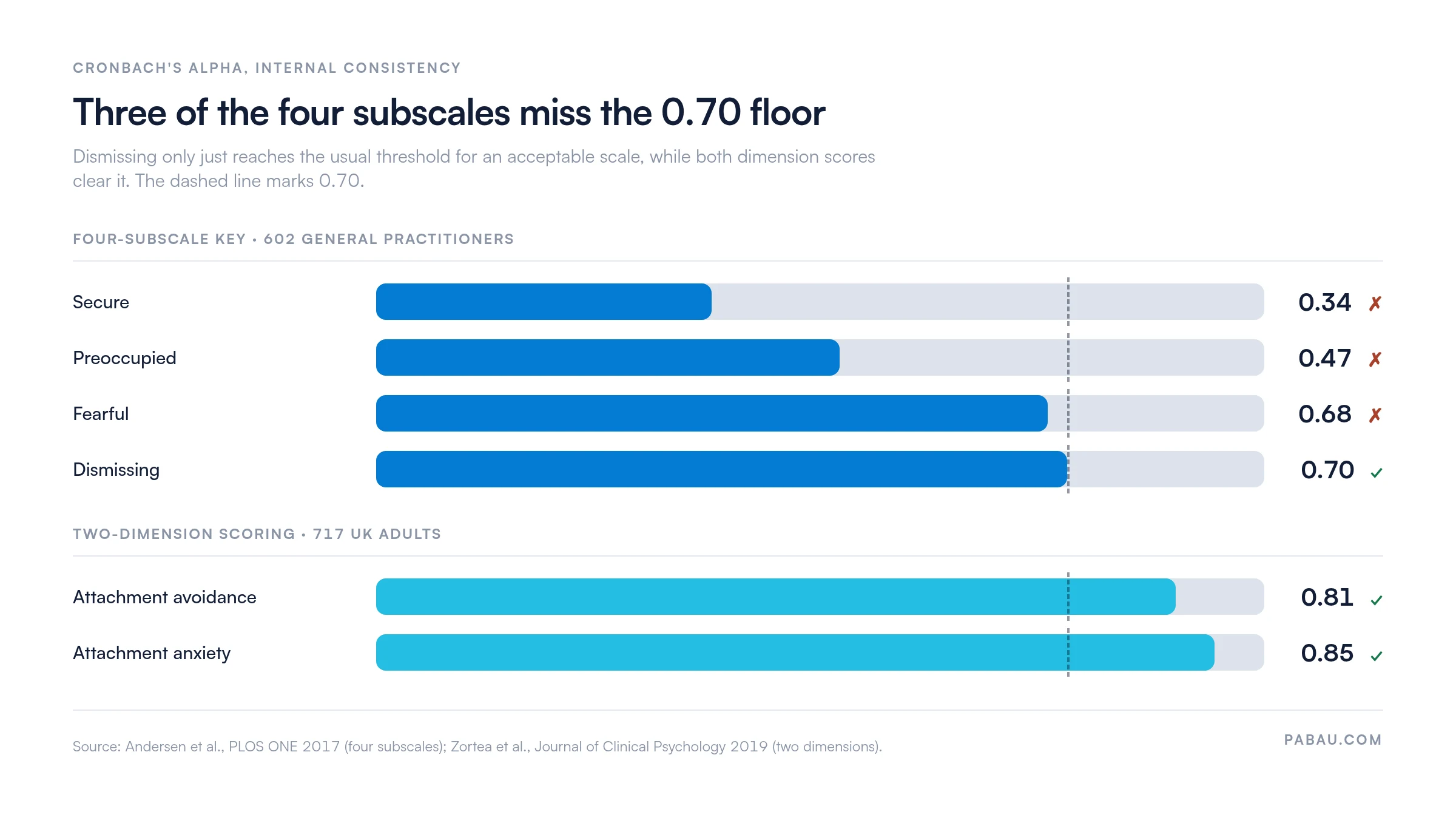
Andersen and colleagues tested the Danish RSQ on 602 general practitioners and 611 cancer patients, publishing in PLOS ONE in 2017. Their confirmatory factor analysis of the four subscales did not fit, and the internal consistency figures were low.
An alpha of 0.70 is the usual floor for an acceptable scale. Only one of these eight figures reaches it. A separate validation in 368 Iranian undergraduates reported four-subscale alphas between 0.26 and 0.48, which is the same picture in a different population.
The test-retest column comes from 76 of those general practitioners, who completed the RSQ twice between 9 and 20 months apart. The intraclass correlations ran from 0.56 for preoccupied to 0.72 for fearful, so only one subscale cleared the 0.70 threshold the authors set.
Zortea and colleagues reached the same conclusion in 2019. In their confirmatory analyses the original four-category model returned a comparative fit index of 0.749, against a 0.90 threshold. Its root mean square error of approximation was 0.137, against a 0.10 ceiling. Their abstract states that a two-dimensional approach is optimal.
The anxiety dimension is the part of the RSQ that holds up across studies. Reported alphas sit between 0.80 and 0.85 in three separate samples. Avoidance is less consistent. The same item set produced 0.85 in one study and 0.39 in another, depending on which items the researcher assigned to it.
Translated versions carry the same pattern. The Danish, German and Persian validations each produced a factor structure that differs from the original four. No published confirmatory analysis has reproduced Bartholomew and Horowitz’s subscales.
Read the two dimension means first, because they are the scores with evidence behind them. Anxiety and avoidance are independent, so a client can be high on one, both, or neither.
Still, the RSQ has no published cut-off scores, no severity bands and no clinical norms. The instrument does not support a statement like “this client scored in the insecure range”. Compare a client against their own earlier scores instead.
The four subscale means still have a use, as long as you do not report them as findings. They give you four concrete statements to open a conversation with. A client’s reaction to one item often tells you more than the mean it sits inside.
The RSQ works best as a structured way into relationship material rather than as a reportable measure. Five settings make good use of it:
Trauma-informed work is where the dimension scores pay off most. Knowing that a client sits high on both anxiety and avoidance changes how fast you move. It also changes how much you lean on the therapeutic relationship early on.
Each of those uses rests on finding the previous form quickly. Therapy practice management software stores completed questionnaires against the client record, which keeps a six-month comparison practical.
Administration is straightforward, and the choices that matter are about consistency rather than format. Work through these five before the form goes out:
Sending the form ahead of the appointment through digital intake forms raises completion rates. You then have the scores before the client sits down. The RSQ then becomes an opening for the session rather than a form you file afterward.
On paper, the RSQ has a habit of going missing. The form goes into a folder and the scores get copied into a session note. A year later, nobody can find the baseline to compare against.
Practice management software like Pabau handles the whole loop in one place. Build the 30 items as a digital form, attach it to the appointment type, and it goes out automatically before the session. The client completes it on their phone, and the responses land in their record rather than in an inbox.
From there the form joins the rest of the client’s history. Built-in medical records management shows last year’s scores next to the new ones, so nobody digs through paper for the baseline. Automated workflows chase the clients who have not completed it, which is usually where paper administration falls down.
The payoff is a reassessment you can work from. You open the session already knowing where the client started and where they are now. Documentation for supervision or audit is written as you go.

Pabau sends questionnaires like the RSQ before the appointment and files every completed form in the client record. Baseline and follow-up scores end up side by side. Your team stops chasing paper and starts each session with the numbers already in front of them.

The RSQ is worth using, as long as you score it the way the evidence supports. Take the two dimension means and let them shape how you work with the client. Keep the four attachment categories out of the written record.
The trade-off is that you give up a tidy label. What you get back is a pair of numbers that hold up across studies. You also get 30 statements that reliably open conversations a client would not otherwise start.
Whatever you decide to record, date it and keep it in one place. An attachment score only carries meaning next to the last one. Book a demo to see how Pabau collects assessment forms before the appointment and keeps every score in the client’s record.

Need a session-by-session outcome measure? The CORE-10 questionnaire gives you a 0-40 score with published cut-offs, which is what the RSQ deliberately does not provide.
Screening for trauma history at intake? The trauma history questionnaire covers the events that often sit behind high anxiety and avoidance scores.
Working with families rather than couples? The parenting style questionnaire maps the caregiving patterns attachment theory grew out of.
Looking beyond romantic relationships? The friendship questionnaire covers closeness and trust outside intimate partnerships.
The Relationship Questionnaire (RQ) is four short paragraphs, one per attachment style, each rated on a 7-point scale. The RSQ breaks those descriptions into 30 separate statements, which gives you item-level detail the RQ cannot.
The published wording asks about close relationships in general, so clients answer with their overall pattern in mind. Researchers sometimes reword it for one named partner, but that version is not the standard form.
For measuring anxiety and avoidance, often yes. The ECR was built around those two dimensions from the start, across 36 items. Pick the RSQ when you also want the four prototype statements as discussion material.
No. Handing out a self-report form and averaging the items needs no qualification. Interpreting what the scores mean for treatment belongs with a clinician trained in attachment work.
Ask them to finish it before you score. Each subscale mean rests on only four or five items, so a single blank moves the result. A blank among the 13 unused items has no effect.