High functioning ADHD test: what your score actually means
Most adults who are finally diagnosed with ADHD spent years being told they were...

Last Updated: Sep 22, 2026
A piercing consent form is a signed record that a client understood a piercing’s risks, received aftercare instructions, and agreed to the procedure. It protects the client and the studio alike by proving what was explained before the piercing.
Minors need more paperwork, and the rules change from state to state. Florida, for example, requires notarized parental consent for every client under 18. Download the free PDF template below, customize it to your studio’s policies, and use it with every client, adult or minor.
A ready-to-use consent form covering client details, health disclosure, contraindication screening, risk acknowledgment, liability waiver, aftercare acknowledgment, and signature blocks for piercing studios.
Download template
A piercing consent form records informed consent, health screening, and a liability waiver, and most US states expect studios to keep one for every client.
An adult form covers client details, health disclosure, risk acknowledgment, aftercare confirmation, and signatures.
Minors need parental or guardian consent, and Florida also requires that consent to be notarized for every client under 18.
In Florida, a parent or guardian must also accompany any minor under 16 during the piercing.
Digital consent forms in Pabau, the practice software we build, collect e-signatures before the visit and file each signed form in the client record.
A body piercing consent form is a document the client signs to confirm informed consent and acknowledge the risks of the procedure. It serves three functions:
Piercing studios operate in a regulated environment. Most US states treat body piercing as a regulated procedure and require studios to follow state health department rules. The consent form is your main evidence that the client was informed, understood the risks, and agreed to proceed. That evidence matters most if a complication arises or a client later disputes the service.
A booking confirmation can’t do this job. The consent form also covers health contraindications, allergies, infection risks, scarring potential, and aftercare requirements. Regulators and insurers expect regulated studios to use one for every client.
Studios that also tattoo need a separate tattoo waiver form, because the minor consent rules and the disclosed risks are different. Florida, for example, requires notarized parental consent for a minor piercing but written parental consent to tattoo a 16- or 17-year-old.
A complete form covers the client’s medical and procedural context in five sections.
This section carries the core legal protection. The client confirms in writing that they understand the risks of body piercing. These include infection, allergic reaction to jewelry material, scarring, keloid formation, bleeding, nerve damage, and delayed healing. The waiver should state that the studio isn’t responsible for complications caused by skipped aftercare or pre-existing health conditions.
A strong waiver names the specific risks of the procedure. Courts often refuse to enforce a waiver that tries to remove all liability. The waiver’s job is to show the client was informed and accepted the known risks. If you’d like the release as a separate document, our indemnity waiver form breaks the language down section by section.
When the client is under 18, the consent requirements become stricter. Parental or legal guardian consent is required in most US states, but the documentation needed varies by state.
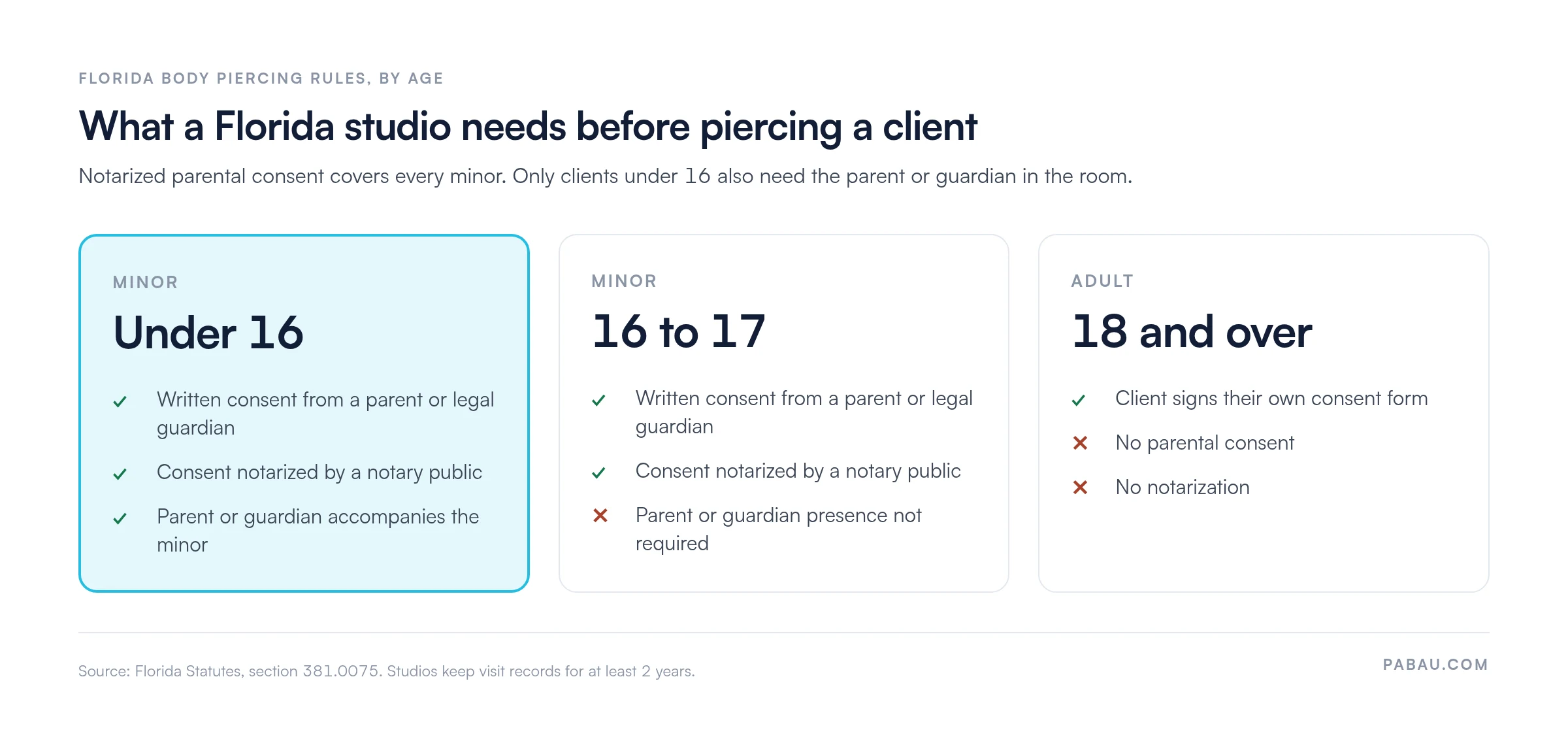
Florida requires a notarized parental consent form for minor piercings under Florida Statute 381.0075. The parent or legal guardian signs the form in front of a notary public, and the notary’s seal must appear on the document. This is one of the strictest minor piercing requirements in the US.
Other states have less stringent requirements: Most require parental presence at the appointment and a parental signature, but do not mandate notarization. A few states may also ask for a copy of the parent’s government ID or a witness signature. Even so, notarization is not universally required outside Florida.
Always verify the current requirements with your state or local health department before piercing a minor, as regulations change.
Florida’s rules come from section 381.0075 of the Florida Statutes. The Florida Department of Health also publishes an official notarized parental consent form you can keep alongside your own. If you operate a piercing studio in Florida, here is what you must do for minor clients:
The statute doesn’t cover mechanized ear-piercing systems used on the earlobe or the outer edge of the ear. For every other piercing, the requirements step down as the client gets older, as the breakdown below shows.
No national standard exists for piercing consent, but most states regulate body art studios and set minimum consent requirements. Here is a summary of key state rules:
This table covers five large US states. Verify current rules with your state health department or body art regulatory board before piercing any minor client. Requirements change, and they can vary by county or local health jurisdiction.
Six steps take the form from download to a signed, filed record.
Paper forms work, but digital forms cut the risk of a missing signature or a skipped health question. Many studios now send consent forms by email or hand over a tablet before the appointment, which speeds up intake.
Many studios still hand clients a clipboard at the front desk, then file the paper in a cabinet. With paperless client intake in Pabau, you build a custom piercing consent form that clients complete before or at arrival. Pabau captures the e-signature and stores the form in the client record automatically.
Once a client books an appointment, you can trigger an automated workflow: They receive a pre-appointment email with a link to the digital consent form. They complete it on their phone or computer, and the signed form appears instantly in their Pabau client record.
For minors, you can flag the appointment based on date of birth and send a separate guardian consent link. Automated aftercare messaging can then send healing instructions and studio contact details as soon as the piercing is logged.
The result is no paper storage, no misplaced consent forms, and an auditable trail for regulatory compliance. Going paperless also frees up your front desk, so your team can greet the next client instead of chasing signatures.

See how Pabau’s digital forms, e-signatures, and automated aftercare messaging cut front-desk paperwork and keep every signed consent form in the client record.

A consent form only protects your studio if it matches your state’s rules and gets signed before every piercing. Check your state’s requirements for minors first, then adapt the template before your next appointment.
The trade-off is front-desk time. Paper works for a small studio, but signatures and health answers go missing as bookings grow. A missing signature leaves you without evidence when a client disputes a piercing.
Book a demo to see how Pabau collects signed piercing consent forms before clients reach your studio.

Need consent before treating a minor? Consent to treat minor form covers the parental authorization a provider needs before treating someone under 18.
Want written aftercare to hand over? Aftercare guidelines template gives clients clear recovery steps to follow at home after their appointment.
Photographing finished piercings for your portfolio? Photo release form explains when you need written permission and includes a free template.
Need a standalone liability release? Indemnity waiver form walks through waiver language section by section.
Handling paperwork for a client under 18? Medical release form for minor covers guardian authorization, with a free template and practice guide.
A piercing consent form should include client details such as name, date of birth, and ID. It also needs a health disclosure covering medications, allergies, pregnancy, and keloid history. Add a risk acknowledgment, liability waiver language, aftercare confirmation, and piercing details such as location, jewelry material, and gauge. Finish with dated signatures from the client, plus a parent or guardian for minors.
Notarization is required in Florida under Florida Statute 381.0075 but not in most other US states. California and Texas require parental presence or physical appearance. New York and Illinois require signed written consent. None of these four states mandates notarization. Always verify your state or local health department rules before piercing a minor.
In most US states, yes. Most states regulate body piercing studios and require documented informed consent as a condition of operation. The form protects the client and the studio by recording that the client was informed of risks, understood aftercare, and agreed to the procedure. Insurers expect it too.
A consent form documents the client’s informed consent to the procedure and their understanding of risks and aftercare. A waiver is the liability release clause within the form. It aims to release the studio from claims arising from known risks. A complete piercing consent form includes both informed consent and waiver language.
Yes. Florida law requires written consent from a parent or legal guardian for every minor, notarized by a notary public. A parent or guardian must also accompany any minor under 16 during the piercing. The form must bear the notary’s official seal and signature, and both the parent or guardian and the minor should bring government-issued photo ID.
Yes. Electronic signatures are legally valid under the federal ESIGN Act and state electronic signature laws. Many studios now send forms by email or through an online portal, collect an e-signature, and store the signed copy digitally. This method is faster, uses less paper, and keeps forms from going missing.
Clients aged 18 and older can consent to piercing without parental involvement. Below age 18, parental or legal guardian consent is required in most states, though the documentation rules vary. Most states use 18 as the threshold, but always confirm your specific state’s age-of-majority law.