Piercing consent form
A piercing consent form is a signed record that a client understood a piercing&#...

6
Last Updated: Oct 2, 2026

High-functioning ADHD is not a DSM-5 diagnosis. It describes people whose ADHD stays hidden behind intelligence, routines, and hard-won coping systems.
A high functioning ADHD test only screens. A result above threshold points toward a clinical evaluation, never toward a diagnosis.
Four or more marks in the shaded boxes of ASRS Part A means further investigation is needed.
Scoring below the threshold does not rule ADHD out, because strong coping systems hide the impairment self-report questions ask about.
Practice management software like Pabau gives ADHD clinicians digital intake forms and structured client records for assessment workflows.
Most adults who are finally diagnosed with ADHD spent years being told they were disorganized, anxious, or not living up to their potential. A high functioning adhd test is often the first step that puts a name to that experience.
In 2023, an estimated 15.5 million U.S. adults had a current ADHD diagnosis, according to CDC survey data. That is 6.0% of all US adults, and about half of them were diagnosed at 18 or older.
Online screening tools cannot diagnose ADHD. What they can do is show whether your symptom pattern needs a formal clinical evaluation. This article covers how high-functioning ADHD presents, what self-report tools measure, what a score means, and how to reach a formal assessment.
“High-functioning ADHD” does not appear in the DSM-5. The American Psychiatric Association classifies ADHD by presentation and by severity. The three presentations are predominantly inattentive, predominantly hyperactive-impulsive, and combined.
“High-functioning” is an informal term for people who have diagnosable ADHD but compensate through intelligence, rigid routines, or sheer force of will. The external picture often looks fine while the internal one does not.
Chronic mental overload, uneven performance, and missed deadlines rescued by three all-nighters are common. So is the sense of working twice as hard as peers for the same results. According to the National Institute of Mental Health, ADHD involves persistent inattention or hyperactivity-impulsivity that interferes with functioning. That interference is not always visible from outside.
The predominantly inattentive presentation, formerly called ADD, is the most common one in high-functioning adults. It produces fewer of the classroom disruptions that used to trigger referrals. Clinicians using ADHD clinic software increasingly see the result, as adults in their 30s and 40s finally get answers.
High grades and a demanding career are not evidence against ADHD. They are often evidence of how hard someone has been compensating.
Several factors combine to delay or prevent diagnosis, and spotting them matters for both patients and clinicians.
Hyperactivity in adults rarely looks like a child running across a classroom. It looks more like trouble sitting through a meeting without mentally scripting the next five tasks. It can also be a low-level physical restlessness that gets turned into productivity until it stops working.
Common symptom areas in high-functioning adult ADHD:
Executive dysfunction is the reason behind most of the symptoms above. Psychologist Russell Barkley’s model frames ADHD as a disorder of self-regulation rather than purely an attention deficit. It covers working memory, inhibition, planning, and emotional control.
For high-functioning adults, that dysfunction is invisible outside and exhausting inside. Systems, apps, and calendars substitute for the internal structure other people take for granted. Most validated instruments assess these domains, including the Vanderbilt ADHD rating scale.
Women with ADHD tend to turn their symptoms inward. Where a man might show frustration outward, a woman more often blames herself for feeling like she’s not good enough. Her ADHD then presents as anxiety, perfectionism, and chronic self-criticism rather than disruptive behavior.
Masking is also encouraged more, starting in childhood. Girls are praised for obeying and reading social cues, which pushes them harder to hide ADHD-related behaviors. Many women learned to act “normal” so well that they stopped noticing they were acting.
Diagnosis rates in adult women have risen sharply over the last decade. Any high functioning adhd test should therefore ask about internalized symptoms as well as observable hyperactivity.
The distinction turns on visibility rather than severity. Both presentations involve the same neurological differences. What changes is whether an outside observer can see them.
This matters for anyone considering a high functioning adhd test. Questions written to capture a combined-type presentation can undercount the inattentive, internalized symptoms most common in high-functioning adults.
No online tool can diagnose ADHD. Diagnosis under DSM-5 criteria requires a clinician-administered evaluation covering symptom history, onset, cross-setting impairment, and differential diagnosis. A self-report screen does none of that.
What a high functioning adhd test can do is compare your reported symptom pattern against patterns associated with ADHD. It then flags whether a professional evaluation is warranted.
The most widely validated instrument is the Adult ADHD Self-Report Scale (ASRS), developed by Kessler and colleagues for the World Health Organization. Part A of that checklist is the ASRS v1.1 Screener, and it holds the six questions that best predict ADHD in adults.
Research published in Psychological Medicine (Kessler et al., 2005) confirmed its sensitivity and specificity as a pre-screening tool. The full 18-item checklist covers the nine inattentive and nine hyperactive-impulsive symptom criteria. You can download the ASRS v1.1 checklist from the Attention Deficit Disorder Association.
Part A asks how often, over the past six months, six specific difficulties come up:
When taking any high functioning adhd test, use it as a reflective tool:
Track your symptom frequency for two weeks before completing a screening tool. Note specific examples. Count how many times you were late this week, how often you reread the same paragraph, and how many tasks you left unfinished. Concrete records make for a more accurate screen and a more productive first clinical conversation.
Different tools use different thresholds. On the ASRS Screener, four or more marks in the darkly shaded boxes of Part A counts as highly consistent with adult ADHD. That is not a diagnosis. It means your answers line up with the most predictive markers, and that further investigation is appropriate.
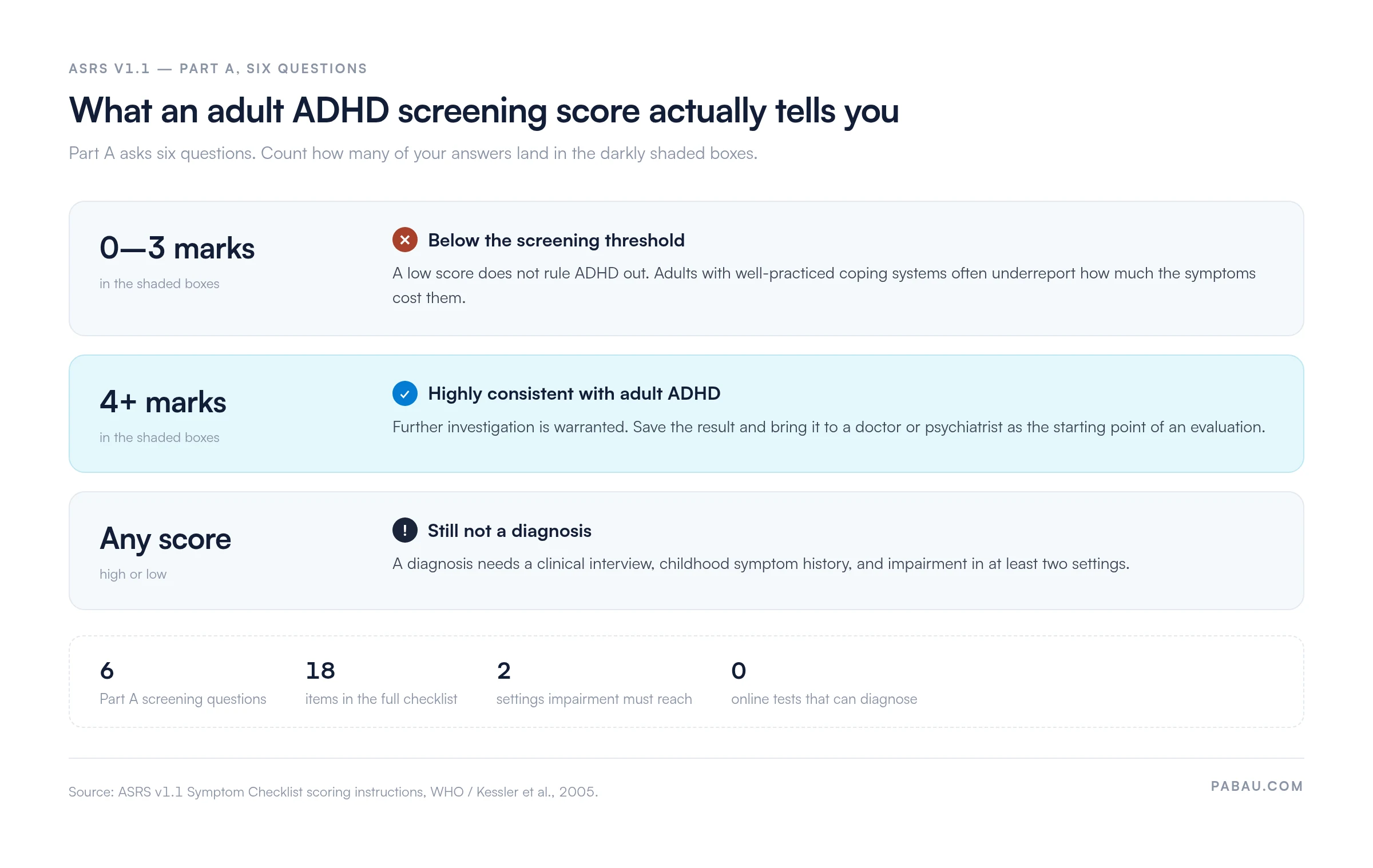
A score below threshold does not rule ADHD out either. Well-developed coping strategies lead people to underreport how much ADHD affects daily life, because they have already adapted around it. Many high-functioning adults land in the moderate range on self-report tools and still meet diagnostic criteria in a clinical evaluation.
A screening result is a reason to seek an evaluation, not a diagnosis to carry with you. The clinical assessment process is more thorough than any self-report tool.
A formal ADHD evaluation typically involves:
In the US, a primary care physician can start a referral to a psychiatrist or neuropsychologist. In the UK, referrals usually go through a general practitioner to NHS or private ADHD services. Private assessment is available in both markets.
A diagnosis opens access to evidence-based treatment. For high-functioning adults, the goal is usually to reduce the hidden cost of maintaining a level of functioning that already looks fine from outside.
Evidence-based pathways include:
Practices that treat ADHD alongside other conditions carry a heavy documentation load across long-running cases. Therapy practice management software keeps the assessment, the notes, and the follow-up appointments in one client record.
An ADHD assessment generates more paperwork than most appointments. The intake questionnaire, the rating scales, the collateral report, and the interview notes usually sit in four different places. Pulling them together before a follow-up costs administrative time nobody billed for.
Practice management software like Pabau keeps that material in one client record. Digital intake forms go out before the first appointment and come back scored and timestamped. Clinical notes, referral letters, and follow-up bookings attach to the same file.
The result is a shorter path from screening result to documented diagnosis. Clinicians spend the assessment hour on the patient instead of chasing paperwork afterward.

Pabau brings digital intake forms, rating scale results, and clinical notes into one client record. ADHD clinicians spend the appointment with the patient instead of chasing paperwork afterwards.

High-functioning ADHD is common, and doctors miss it far too often, especially among adults who built their lives around working around it. A high functioning adhd test earns its place as a first step. It gives your symptom pattern a framework and, when the score is elevated, the reason to book an evaluation.
The trade-off worth remembering is that the coping systems making you look fine also depress your score. If the result comes back below threshold and the exhaustion is still there, take that to a clinician anyway.
For practices running these assessments, documentation is the part that scales badly. Book a demo to see how Pabau keeps ADHD intake forms, rating scales, and clinical notes in one client record.

Want a screening form your practice can hand out? ADHD screening test template gives clinicians a structured intake form for adult and pediatric ADHD assessment.
Need a scoring reference for validated ADHD rating tools? How to score the Vanderbilt ADHD Rating Scale walks through interpretation for one of the most widely used instruments in ADHD assessment.
Running a structured psychiatric evaluation at your practice? Psychiatric evaluation template gives clinicians a documentation framework for initial and follow-up mental health assessments.
Looking for clinician-ready ADHD therapy resources? ADHD therapy activities to enhance focus and control covers evidence-informed activities for use in structured therapy sessions.
High-functioning ADHD is not a separate clinical diagnosis. It describes people with diagnosable ADHD who compensate through intelligence, routines, or environmental support, which makes their difficulties less visible from outside. The underlying neurology matches other ADHD presentations, and the difference lies in how well someone has learned to mask it. Most high-functioning adults have the predominantly inattentive presentation and are diagnosed later in life, often after a life change removes their compensatory scaffolding.
Online tests are screening tools rather than diagnostic instruments. Validated tools like the ASRS identify adults whose symptom patterns warrant clinical evaluation, but they cannot confirm a diagnosis. A positive screen means you should pursue a formal assessment. An elevated score on a high functioning adhd test is a starting point, not a conclusion.
It is missed primarily because masking works. High intelligence, strong coping strategies, and social pressure to perform competence all conceal ADHD symptoms from observers, and often from the person themselves. Women are particularly affected. Inattentive presentations and stronger social masking hide the condition. Symptoms that surface as anxiety or perfectionism push an accurate diagnosis into a woman’s 30s or 40s.
ADHD is not more neurologically common in women, but high-functioning and late-diagnosed ADHD shows up far more often in women. Women with ADHD are more likely to have the predominantly inattentive presentation and to develop stronger masking behaviors from childhood, which delays referral and diagnosis. Diagnostic rates for adult women have risen sharply over the past decade as awareness of these differences in presentation has improved.