SBAR nursing handoff template: Free download and step-by-step guide
Download your free SBAR nursing handoff template A ready-to-use form with guided...

55
Last Updated: Sep 9, 2026

The SIAS is a 20-item self-report questionnaire from Mattick and Clarke (1998) that measures anxiety during everyday social interaction, not performance situations.
Every item is rated 0 to 4, items 5, 9 and 11 are reverse-scored, and the total runs from 0 to 80.
Validation studies place the clinical cut-off between 34 and 36, with 43 and above suggesting probable social anxiety disorder.
Items about blushing, eating while being watched, or another person’s eyes directed at you belong to the Social Phobia Scale, not the SIAS.
Pabau’s digital forms collect SIAS responses in the client record, so each total sits beside the notes from that session.
A print-ready copy of all 20 SIAS items, with the 0 to 4 response anchors beside every one. The form is blank and ready for a client to complete, so you score and interpret it using the guidance on this page.
Download templateThe Social Interaction Anxiety Scale (SIAS) measures the fear of ordinary conversation, not the fear of an audience. Twenty items, each rated 0 to 4, give you a total between 0 and 80. Three of those items are reverse-scored, and missing them inflates the total.
Getting the item list right matters just as much. Copies circulating online mix SIAS items with items from the Social Phobia Scale, its companion measure from the same 1998 paper. A blended form no longer maps to the SIAS validation samples.
Below you get the verified items, the scoring steps, the cut-off bands, and the administration details worth logging.
The SIAS measures fear and distress during everyday social interaction. That covers conversations, meeting people, disagreeing, and joining a group.
Mattick and Clarke published it in 1998 in Behaviour Research and Therapy, alongside the Social Phobia Scale. Mental health clinicians use it to gauge symptom severity and to track treatment response.
Performance anxiety sits outside the scale. That belongs to the Social Phobia Scale (SPS), which covers being observed while eating, writing, or blushing in front of others. The two fears often travel together, so many practices administer both scales at once.
Each item is rated on a five-point scale, from 0 (not at all characteristic of me) to 4 (extremely characteristic of me). Clients answer for how they generally feel, not for one recent event.
Items 5, 9 and 11 are worded positively, so reverse them before you total anything. The other 17 are scored exactly as the client reported them.
Item 14 carries the original 1998 wording. Some publishers modernize it to “I have difficulty talking to people I am attracted to”, which measures the same construct. Either version is defensible. Pick one, then keep it consistent across a client’s timeline.
Read the form for items about eating or drinking while being watched, blushing, or another person’s eyes directed at you. Those belong to the Social Phobia Scale. Count the items as well, because anything other than 20 is a redraft rather than the published scale.
Mixing the two instruments breaks the cut-offs. A blended form no longer maps to the SIAS validation samples, so its total carries no clinical meaning. Scoring it anyway produces a number that looks authoritative and means nothing.
Reverse-score items 5, 9 and 11, then add all 20 responses for a total between 0 and 80. Reversing flips the response. A 0 becomes 4, a 1 becomes 3, a 3 becomes 1, and a 4 becomes 0, while a 2 stays where it is.
That first step carries more weight than it looks. A client who answers 4 on item 5 is telling you they make friends easily, which is low anxiety. Scored as reported, that 4 would push the total up. Reversed, it becomes 0.
Work an example through. Suppose the 17 standard items sum to 38, and the client answered 4, 3 and 4 on items 5, 9 and 11. Reversed, those three become 0, 1 and 0, so they add 1. The total is 39, which sits above the cut-off band and below 43.
Score the same answers without reversing, and the total comes out at 49. That reads as probable social anxiety disorder. One skipped step moved the client across two bands.
The bands below say what a total means and what to do with it next.
Validation work places the first threshold between 34 and 36, depending on the sample. Treat it as a band rather than a single number, and say which figure you used when you write the score up.
A single total tells you where a client sits against the cut-offs. A series tells you whether treatment is working, which is the more useful answer.
Re-administer on a fixed schedule, monthly or at every review. Use the same version and the same instructions each time. Then compare each total against the previous one, and against the cut-off band.
The SIAS has no published severity tiers. Labels such as minimal, mild, moderate and severe circulate widely for this scale, but they are not part of the instrument. Keep them out of the client’s record.
The SIAS is a self-report measure, so hand it over rather than reading the items out. Reading them aloud puts an observer in the room, and observation is what the SPS measures.
Give the standard instruction, which is to rate each item for how characteristic it is of you. Ask the client to answer every item, because one missing response makes the 0 to 80 total non-comparable.
Each of these turns a completed form into a number nobody can use.
The SIAS has been tested repeatedly since 1998, across clinical, student and community samples. Psychology practices lean on that evidence when they choose between social anxiety measures.
None of that makes the scale diagnostic. It measures severity, and the diagnosis still comes from the interview and the clinical picture.
Start from the situation the client avoids. A dreaded conversation points to the SIAS, while a dread of being watched points to the SPS. Practices that give both then read the two totals side by side.
Reach for the Liebowitz Social Anxiety Scale (LSAS) when you need breadth across both interaction and performance situations. For a narrower question, the SIAS is quicker and repeats more easily.
The SIAS-6 is a six-item version drawn from the full scale, published by Peters and colleagues in 2012. It takes a couple of minutes, which makes it practical for between-session monitoring.
The two versions do not share a total range, so their scores are not interchangeable. A SIAS-6 total runs from 0 to 24, which ends below the 20-item cut-off band altogether.
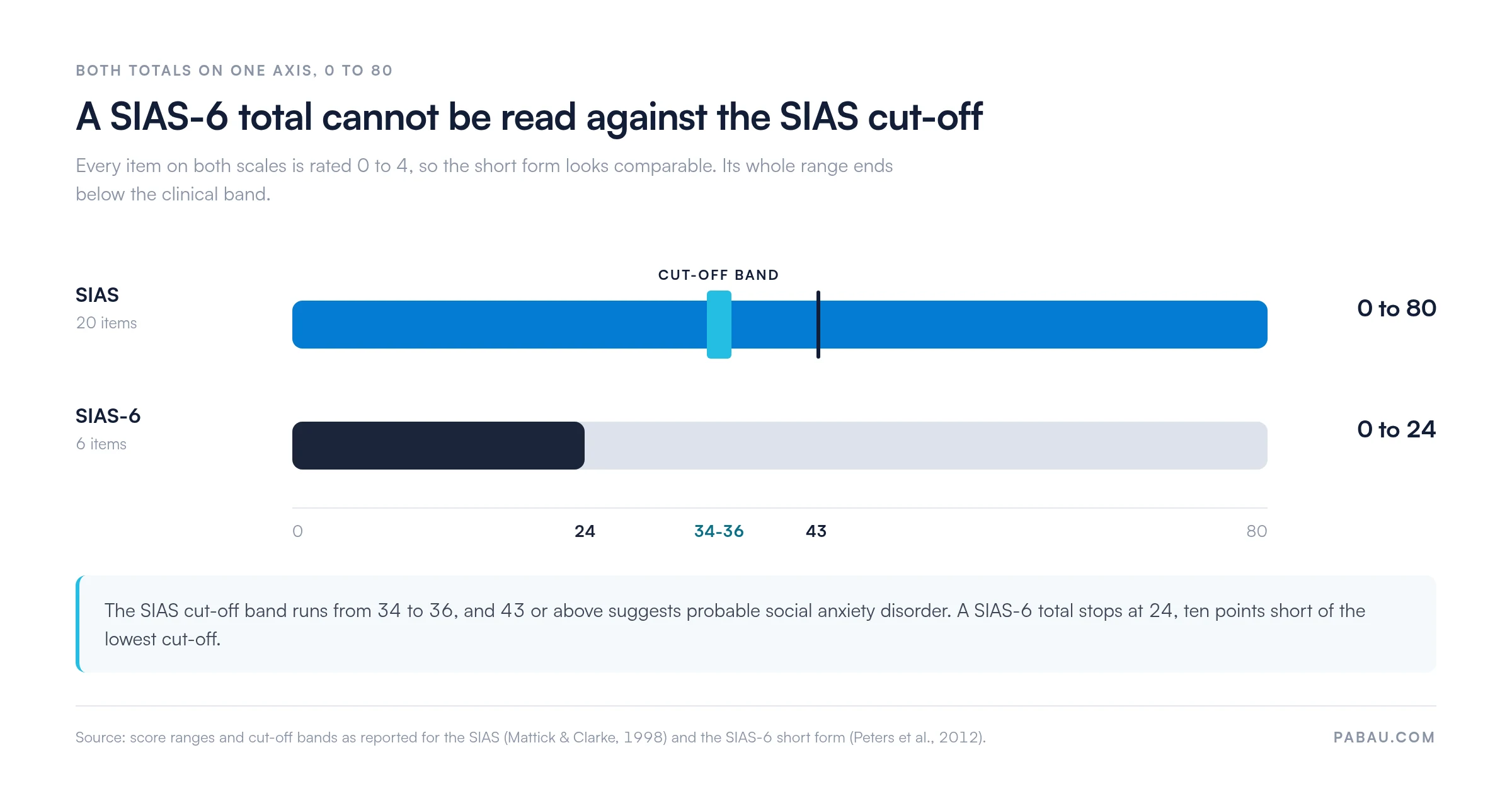
Use the full 20-item scale for initial assessment and annual review. Use the SIAS-6 when time is short, and stay with one version inside a single client’s timeline.
Therapy practices use the SIAS at intake and then for treatment monitoring. Psychiatry practices fold it into diagnostic assessments, and ADHD services use it to screen for comorbid social anxiety.
It also travels well outside specialist mental health. Counselors, occupational therapists and rehabilitation practitioners reach for it because it is short and freely available. In primary care it helps decide whether a specialist referral is warranted.
Three practical uses justify the few minutes the form takes.
Paper forms create two problems. The score ends up in a folder rather than the clinical record. Someone also has to add up 20 items by hand, with three of them reversed.
Practice management software like Pabau moves the whole exercise into the client’s file. Pabau’s digital intake forms let you publish the 20 SIAS items for the client to complete before the appointment.
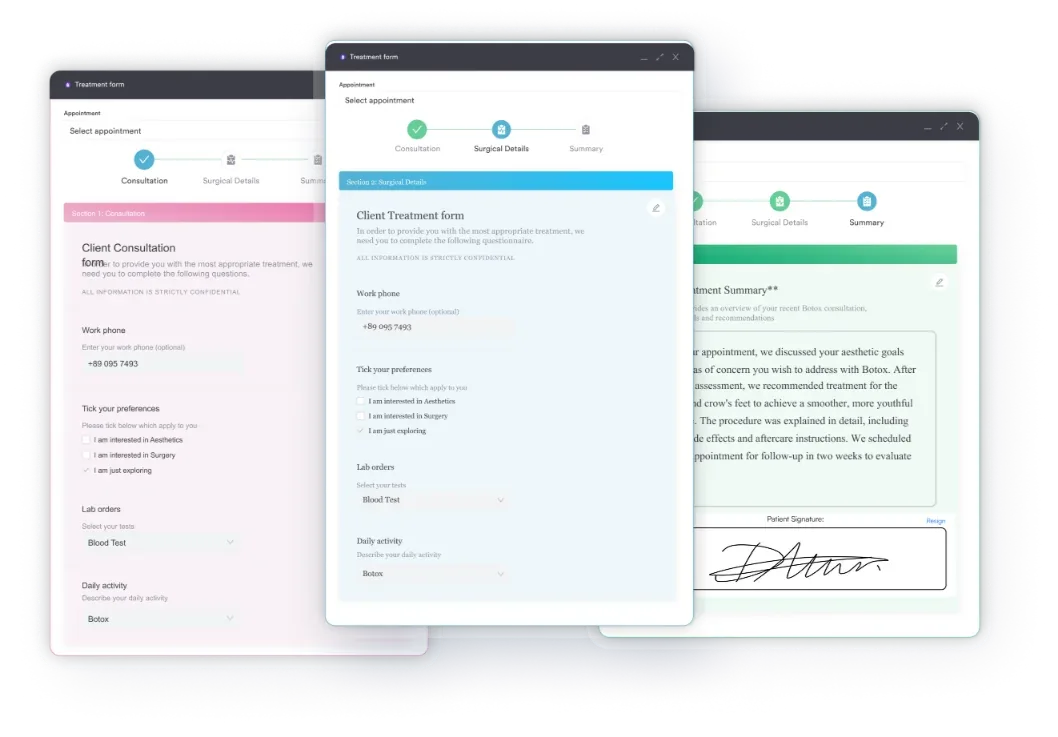
Responses land straight in the clinical record, so the total sits beside the notes from that session. Pabau’s measurements tracking then charts each score across appointments, which gives you the trend a single total cannot show.
Clients can complete the form through our online booking portal before they arrive. That keeps session time for the conversation, and it removes the hand-scoring step where the reversals go wrong.

Pabau’s digital forms collect the 20 SIAS items before the appointment, and measurements tracking charts each total over time. Scores stay beside the clinical notes instead of sitting in a paper folder.

The SIAS earns its place because it is short, free, and aimed at the fear most clients describe first. Its accuracy rests on using the correct 20 items and reversing three of them.
Check your copy against the list above before your next intake. Score it with items 5, 9 and 11 reversed, then read the total against the 34 to 36 band. Leave the invented severity labels off the record.
Do that consistently and the SIAS becomes an outcome measure rather than a form in a drawer. Book a demo to see how Pabau collects SIAS responses and charts each total inside the client record.

Measuring how connected a client feels? Social Connectedness Scale scores belonging and social isolation, which pairs naturally with a SIAS total.
Screening for generalized anxiety at the same time? GAD-7 anxiety assessment template gives you a seven-item measure with published severity bands.
Need a broader trait anxiety measure? Taylor Manifest Anxiety Scale (TMAS) covers general anxiety proneness rather than specific social situations.
Tracking session-by-session outcomes? CORE-10 questionnaire is a 10-item distress measure with a validated cut-off of 11 and a single risk item.
Is loneliness driving the avoidance? Chronic loneliness test separates a situational dip from a chronic pattern, and includes referral guidance.
No minimal clinically important difference has been established for the SIAS. Read a drop alongside the client’s own account and your clinical judgment. A fall that carries the total below the 34 to 36 band is worth recording, but it is not proof on its own.
Ask them to complete it before you score the form. The 0 to 80 total assumes all 20 responses, so a blank item makes it non-comparable. Do not substitute an average or scale the total up, because the cut-offs were not built for a prorated score.
The original validation samples were adults, so treat an adolescent total with care. Several items assume work colleagues and adult social settings. Where those items do not fit a young client, a measure validated for that age group gives you firmer ground.
No. The scale is freely available for clinical and research use, and citing Mattick and Clarke (1998) is customary. Building the 20 items into a digital form inside your practice software adds no licensing cost.