Piercing consent form
A piercing consent form is a signed record that a client understood a piercing&#...

6
Last Updated: Oct 2, 2026

A childhood ADHD questionnaire is a validated rating scale built on the 18 DSM-5 symptoms. It points toward ADHD and never confirms it.
The NICHQ Vanderbilt, the SNAP-IV, and the Conners scales are the instruments in common use, and all three start at age 6.
Scoring counts symptoms instead of adding them, and the summed 0 to 54 total only tracks change between visits.
Six of nine items in a subscale must be rated often or very often, plus one performance item at 4 or 5. From age 17 the count drops to five.
Practice management software like Pabau sends, collects, and stores both informant forms, so the parent and teacher responses land in one record.
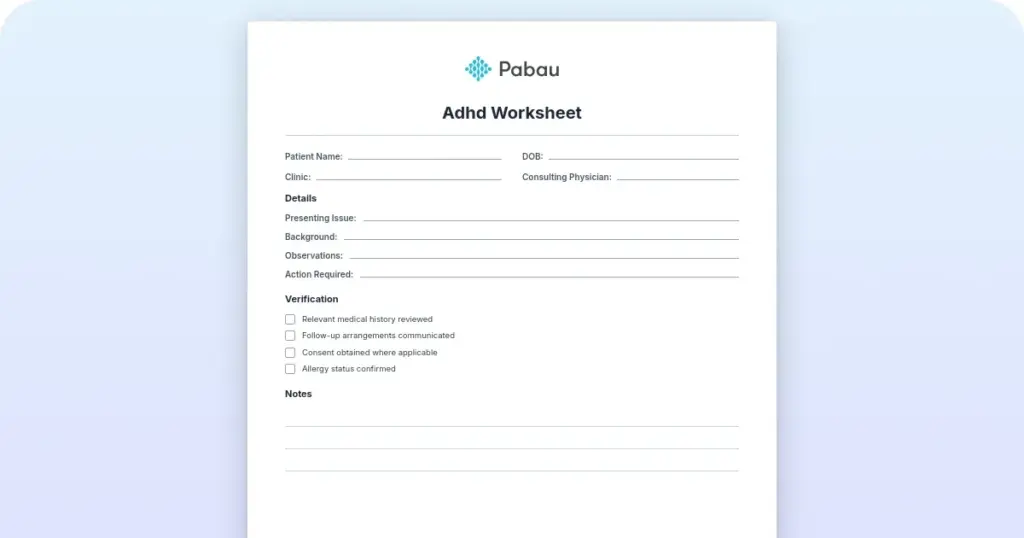
Adapted from the public-domain NICHQ Vanderbilt Assessment Scale. Six pages carrying the 18 DSM-5 symptom items, the performance items, separate parent and teacher forms, and the symptom-count scoring instructions.
Download templateA childhood ADHD questionnaire turns scattered behavior reports into 18 scored items you can compare. One adult describes a child who cannot stay seated. Another describes a quiet daydreamer. The form is what lets you hold both accounts against the same DSM-5 criteria.
The scoring counts symptoms. It does not add them up. Six of nine items rated often or very often, plus one performance item rated 4 or 5, is what indicates a presentation. Get that backwards and you refer the wrong child, or you reassure a family you should have referred.
Below you get the 18 items, the three scales worth using, a six-step scoring walkthrough, a worked example, and the mistakes that trip people up.
It measures how often one adult observes each of the 18 DSM-5 ADHD symptoms in a child, and how much the child’s functioning suffers. It cannot diagnose ADHD. Only a comprehensive evaluation by a licensed clinician does that.
Each form asks a single informant to rate behavior over the past 6 months. Parents and teachers are the standard pair, and some scales add a self-report from age 8. Because symptoms often look different at home and at school, one informant’s view can miss the pattern.
The DSM-5 defines two symptom domains, inattention and hyperactivity-impulsivity, and the questionnaire covers both. A form that reaches threshold in either domain starts a referral, never a prescription.
Nine items describe inattention and nine describe hyperactivity and impulsivity. Every informant rates all 18 on the same 0 to 3 frequency scale, looking back over the past 6 months.
The inattentive presentation is quiet, which is why it gets missed. A child loses homework, drifts during instructions, and needs an adult reminder for every step of a task. Teachers rarely flag it, because the child is not interrupting the class.
Hyperactive and impulsive behavior is easier to spot. The child leaves their seat, talks over other people, and answers before the question finishes. Group settings show it most clearly, so teacher ratings often run higher than parent ratings on these nine items.
Reach for the Vanderbilt in pediatric primary care, the SNAP-IV when the child is older than 12, and the Conners when you need normed T-scores. The first two cost nothing. The third has to be purchased.
The NICHQ Vanderbilt Assessment Scales come from the National Initiative for Children’s Healthcare Quality. Pediatric primary care leans on them because they are free, and because they screen for the conditions that travel with ADHD. Anxiety and oppositional defiant disorder both sit on the same form.
The Conners scales cost money, and what they buy you is age-normed and gender-normed T-scores. That matters when you need to show how far a child sits from their peer group rather than report a raw symptom count. Multi-Health Systems publishes them, and Pearson distributes them in the US.
Because behavior changes with the setting, and each form reports one setting. A parent sees mornings, homework, and bedtime. A teacher sees 30 minutes of sustained seat work with 25 other children in the room. Neither account on its own tells you whether the DSM-5 criteria are met.
Most validated scales ship parallel parent and teacher versions with identical item sets, so the two counts compare directly. Have each rater complete their form independently. Comparing notes first pulls the two accounts toward each other, and that costs you the comparison you were after.
Digital forms make that independence easier to hold, because each rater gets their own link and never sees the other’s answers.
Five things go wrong before a single item gets rated, and all five are cheap to prevent. Work through them the first time you set an ADHD screening workflow up, then again whenever a returned form looks odd.
Count the items rated 2 or 3 in each subscale, then check the performance items. Six of nine in a subscale, plus at least one performance item rated 4 or 5, indicates that presentation. Adding the ratings up produces a different number, and it answers a different question.
The two rating scales on the form run in opposite directions, which is where most scoring errors start. Symptom items climb from 0 (never) to 3 (very often). Performance items climb from 1 (excellent) through 3 (average) to 5 (problematic).
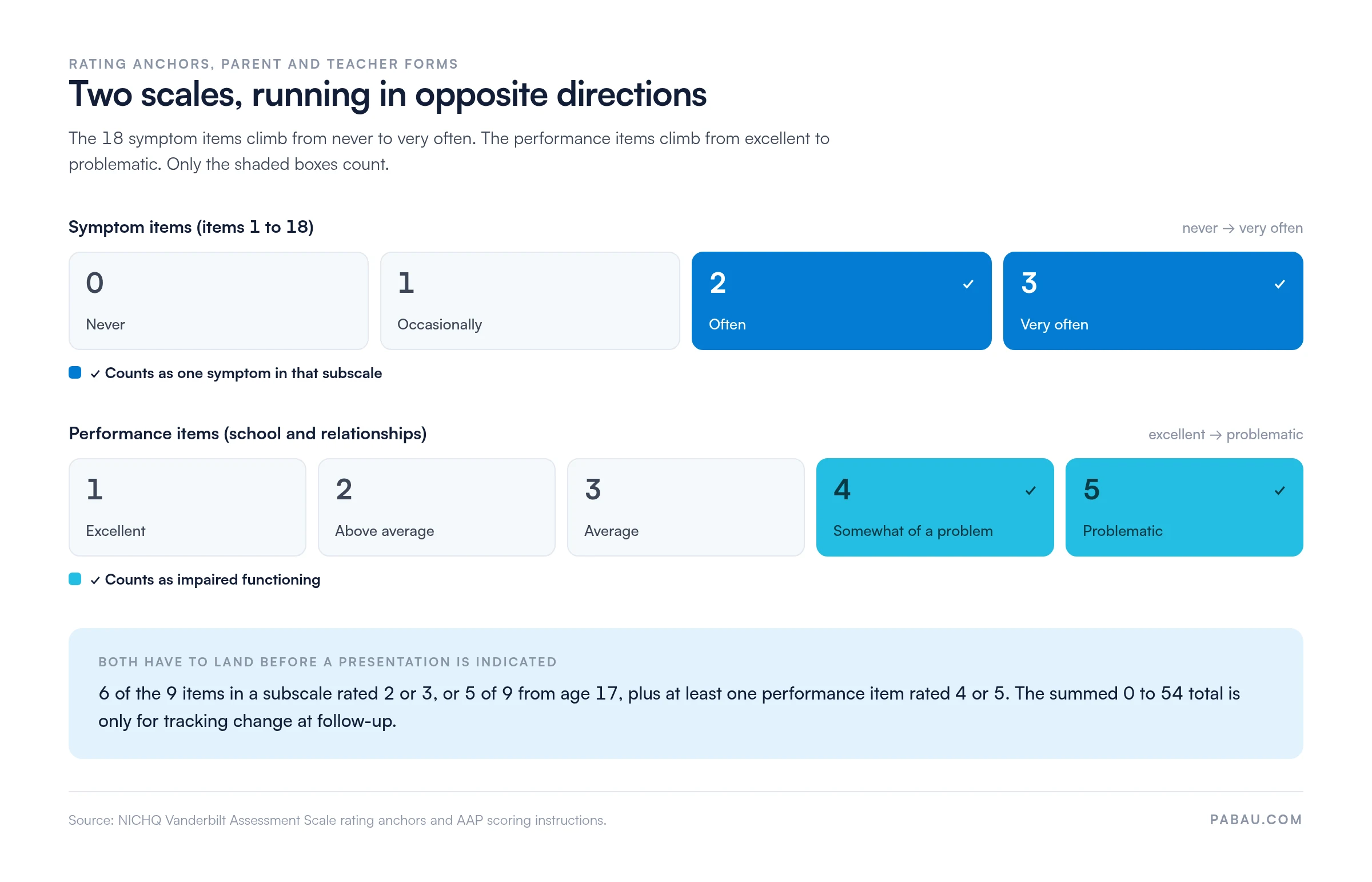
The instrument carries no summed subscale cut-off, so a total of 15 on inattention means nothing on its own. What decides the result is how many individual items reached often or very often, and whether the child’s functioning suffers. Our Vanderbilt scoring guide works through that threshold decision item by item.
From age 17, the DSM-5 lowers the required symptom count from six to five. Record which threshold you applied, so the next clinician reading the chart can see how you reached the result.
Performance items ask how the child is doing in school subjects and in relationships. Only a 4 or a 5 describes a problem. Treating a 2 as a warning sign would flag above-average performance as impairment.
That impairment requirement stops a high symptom count from standing on its own. A child can be rated often on six inattention items and still function well at school and at home. The official scoring indicates no presentation in that case.
Take a 9-year-old whose parent form comes back at 24 out of 54. Against a maximum of 54, that reads as serious. Now count instead of adding. On the inattention items, seven ratings sit at 1 (occasionally) and two sit at 2 (often). On the hyperactivity items, five sit at 1 and four sit at 2.
So the inattention count is two and the hyperactivity count is four. Both fall well short of six. The highest performance rating is a 3, which the form calls average. This child screens negative, and the 24 carried no diagnostic information at all.
Record the 24 anyway. It becomes the baseline you compare against if the family comes back in six months with the same concerns.
Adding all 18 symptom items gives a number between 0 and 54. It is the only summed score the instrument produces, and it exists to compare one visit against the next. Record it at the first assessment, then at each follow-up, and read the direction of travel rather than the number.
These five turn up most often when a scored form gets a second look.
It starts a referral for comprehensive evaluation, owned by a licensed mental health professional, pediatrician, or psychiatrist. The questionnaire hands that clinician a starting point. It does not hand them a diagnosis.
The evaluation draws on a clinical interview, a developmental history, and a review of school records and prior assessments.
It weighs both informants’ ratings alongside direct observation, and often adds psychological or educational testing. Our psychiatric evaluation template sets that assessment out in the order a clinician works through it.
The trauma option on that list has an instrument of its own. The Childhood Trauma Questionnaire scores five types of abuse and neglect from a retrospective self-report, and clinicians use it at intake.
Record the scale you used, how you administered it, the completion date, and the informant’s name. Then record both symptom counts, the highest performance rating, the total out of 54, and your recommendation.
Completed forms carry sensitive behavioral data about a minor. Store them with access logging, and keep them as long as your jurisdiction requires.
That is commonly 3 to 7 years past the age of majority. Name the scale explicitly too, because thresholds differ between instruments.
Paper makes that record hard to keep whole, since the parent form, the teacher form, and the scored result usually sit in three places. Practices running on therapy practice management software keep all three in one client record, with the access log attached.
Write the threshold you applied into the note, not just the score. Six of nine and five of nine are both correct, depending on the child’s age. A chart that records only a count leaves the next clinician guessing which rule produced it.
Paper questionnaires create work that has nothing to do with the child. Forms go missing between the front desk and the school. Parents miss the return date. Teacher responses arrive a month late, and someone re-keys 18 ratings by hand into a note.
Practice management software like Pabau sends each informant their own secure link on a schedule you set. Responses file straight into the client record, so the parent form and the teacher form sit side by side when you score them.
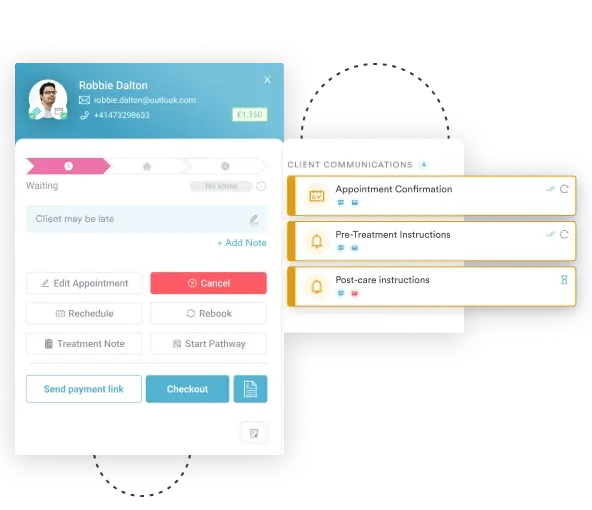
Because the ratings arrive as structured data, you read both counts without re-keying anything. Purpose-built ADHD practice software also holds the follow-up schedule, so the 4-to-6-week form goes out on time instead of when someone remembers.
The stored responses are HIPAA-compliant, encrypted, and access-logged. A completed questionnaire and its scored result stand up to a records request years later.

Pabau sends the parent and teacher questionnaires as secure links and files each response into the client record. Automated reminders chase the forms still outstanding, so you score both counts side by side without re-keying.

The value of a childhood ADHD questionnaire sits in the discipline around it. Two informants, the same 6-month window, independent completion, and a count rather than a sum. Skip any one of those and a number still comes back, which is the whole problem.
So treat the form as the cheap part. The expensive part is chasing a teacher response for three weeks, then finding out the parent version was filled in a month earlier.
If that chase is where your ADHD assessments stall, book a demo. We will show you how Pabau gets both informant forms back, scored, and filed in one client record.

Need the scoring worked through item by item? Vanderbilt ADHD Rating Scale scoring explained takes the threshold decision apart step by step.
Want the DSM-5 criteria as a standalone checklist? DSM-5 ADHD checklist template lists the 18 items with the age and duration conditions attached.
Diagnosis confirmed, and now you need a plan? ADHD treatment plan template covers goals, interventions, and review dates in one document.
Looking for something to hand the parents? ADHD handout for parents explains the condition and the next steps in plain language.
Tracking a child who has just started medication? ADHD medication side effects monitoring sheet logs what to watch for between visits.
From age 6, for the instruments on this page. The Vanderbilt is normed for ages 6 to 12, and the SNAP-IV for 6 to 18. Conners 3 parent and teacher forms cover ages 6 to 18, with self-report from 8 to 18. No scale here starts below age 6.
Yes. The NICHQ Vanderbilt Assessment Scale is public domain and free in both parent and teacher versions, and the SNAP-IV is free too. The Conners scales are proprietary and have to be purchased from Multi-Health Systems, their publisher, with Pearson distributing them in the US. The template on this page is adapted from the Vanderbilt.
Plan on about 10 minutes per rater. The 18 symptom items move quickly. The performance items at the end are what people stop and think about, so leave room for that rather than pushing for a same-day return.
They can. A rating scale reports what adults notice, and quiet inattention draws less attention than a child out of their seat. Girls more often present as inattentive, so a form can land just below threshold while the child struggles daily. Treat a count of four or five as a reason to look again.
Yes. Sending the teacher form tells the school that the child is being assessed, which is a disclosure. Get written authorization from the parent or guardian first, and record it. The same applies when the completed form comes back into the child’s clinical record.