Piercing consent form
A piercing consent form is a signed record that a client understood a piercing&#...

6
Last Updated: Oct 2, 2026

Inattentive ADHD makes it hard to sustain attention, organize tasks, and hold information in mind, without the hyperactivity of the other presentations.
This template scores the nine DSM-5 inattention symptoms. It screens for a pattern, so it never produces a diagnosis on its own.
Five or more symptoms rated often or very often is a positive screen. Every positive screen goes to a licensed clinician.
Practice management software like Pabau keeps the completed form in the client record, so the score and the referral stay together.
A nine-item DSM-5 symptom checklist with a five-point frequency scale. It carries the scoring threshold, the interpretation bands, and space for your clinical impression and referral note.
Download templateInattentive ADHD is easy to miss in adults.
Nothing about it looks hyperactive, so the symptoms read as disorganization, lateness, or a poor memory. That is why this presentation often goes years without anyone screening for it.
This template hands you the nine DSM-5 inattention criteria, a five-point frequency scale, and a threshold you can defend in a referral letter. Below you get the administration steps, what each score band means, and the workup a positive screen starts.
The inattentive ADD test is a structured self-report screen for the attention symptoms of ADHD’s predominantly inattentive presentation. It scores symptom frequency against DSM-5 criteria rather than asking the patient to describe their focus in general terms.
That is what separates it from a casual symptom quiz. Frequency and duration do the diagnostic work, so the form asks how often each symptom happened and over how long a stretch.
Inattentive ADHD was called ADD before DSM-IV folded the presentations into one diagnosis with subtypes. Adults with this presentation report chronic trouble finishing tasks, staying organized, tracking time, and holding instructions in working memory. Those difficulties add up to impairment at work, at home, and in relationships.
DSM-5 lists nine inattention symptoms. An adult diagnosis needs five or more of them, present for at least six months and causing impairment. Under age 17 the threshold rises to six. The symptoms also have to show up in more than one setting, such as work and home.
Each symptom is rated Never, Rarely, Sometimes, Often, or Very often. Only Often and Very often count toward the threshold, which keeps one stressful month from reading as a lifelong pattern.
Administering the form takes five steps, and all five fit inside a standard intake appointment.
The form produces a symptom count from zero to nine, built only from the items rated Often or Very often. Here is how to read it.
One caveat worth repeating: a screen is not a diagnostic instrument. A positive score says further evaluation is warranted, and nothing more. Formal diagnosis needs a licensed clinician to take a full history, rule out medical and psychiatric mimics, and weigh the findings together.
DSM-5 applies the same nine criteria at every age, but the consequences differ. Adults tend to arrive with a long history of underachievement, job changes, unstable relationships, and chronic procrastination. Children present with school difficulty and trouble following instructions, before those adult losses have had time to accumulate.
An adult who reports anxiety alongside inattention is the harder case. The attention problem may be primary, or it may be what untreated anxiety looks like from the outside. Scoring the nine criteria on their own gives you a number to compare against once the anxiety is treated.
Practice management software like Pabau keeps each completed screen in the client record. Its mental health practice software then puts this year’s score beside last year’s.
A positive screen starts the workup rather than ending it, and most of what follows happens somewhere else. The pathway below shows how little of it belongs to you.
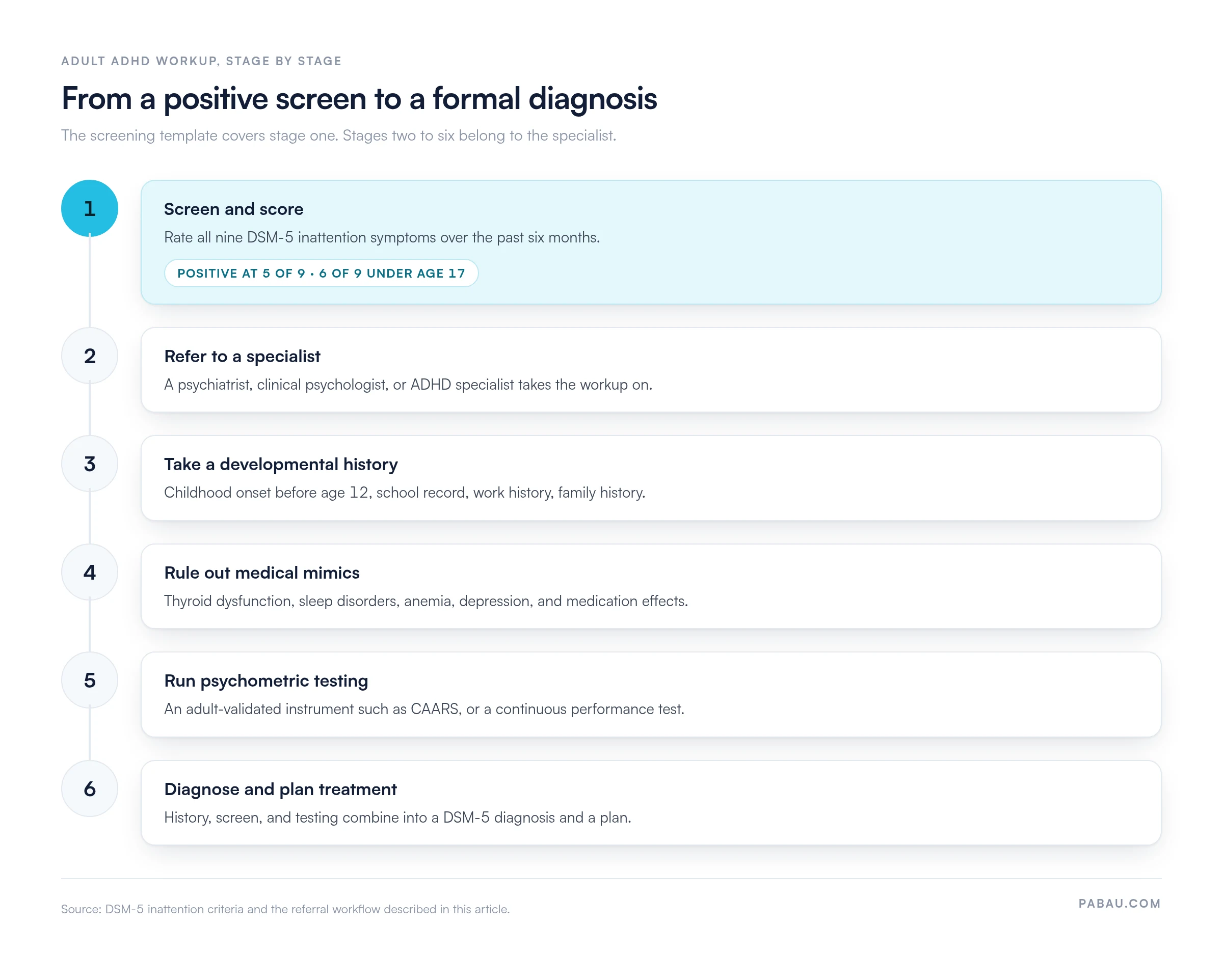
Treatment usually means medication, behavioral therapy, coaching, or some combination of the three. Structured ADHD therapy activities often run alongside medication rather than instead of it.
Screening scores and psychiatric notes are among the most sensitive records a practice holds. Keep them in an encrypted, audit-logged system rather than a shared drive or a paper tray by the front desk.
Reading a positive score as a diagnosis: a high score identifies a symptom pattern and stops there. Confirming ADHD takes a comprehensive evaluation by a licensed clinician.
Skipping the impairment criterion: DSM-5 asks for documented impairment at work, socially, or in another important area of life. A patient with five symptoms who functions well in every domain may not meet the criteria.
Ignoring onset and duration: symptoms have to begin before age 12 and persist for at least six months. Attention problems that start in adulthood usually point to depression, anxiety, or an untreated medical condition.
This template follows the ASRS-v1.1, the screening scale the World Health Organization developed with its Workgroup on Adult ADHD. The ASRS carries 18 items covering the ADHD criteria, split into a six-item Part A screener and a 12-item Part B.
Part A is what most practices use, because six items take about a minute and still track formal diagnosis closely. Naming a published scale also tells the referring specialist exactly what you administered. If you would rather run the full instrument, the adult ADHD self-report scale is available as its own template.
Sensitivity and specificity: in the WHO validation study, ASRS Part A reached 68.7% sensitivity and 99.5% specificity for DSM-IV ADHD. So it almost never flags someone who does not have ADHD, and it misses roughly three in ten who do.
That asymmetry is worth explaining to the patient. A negative Part A screen does not clear them, which is exactly why the nine-item form in this template asks about all of the criteria.
Most practices run this screen on paper. The form gets printed, filled in at reception, scored by hand, then scanned or filed. The score ends up in one place and the referral letter in another, and nobody can pull last year’s number quickly.
Pabau turns the same nine items into a digital intake form the patient completes before the appointment. The answers arrive already scored, so nobody at the front desk counts checkboxes by hand.
The score, the date, and your clinical impression then sit in the client record next to the appointment and the referral letter. When the specialist asks what you administered and when, the answer is one click away instead of a hunt through a paper file.
Every Pabau subscription includes the full feature set, so digital intake, charting, and reporting come with the platform rather than as add-ons. Practices running mostly talk-therapy caseloads can see how that fits in our therapy practice management overview.

Streamline inattentive ADHD assessment with Pabau’s customizable intake templates, automated scoring, and secure clinical record storage.

Screening is the cheap part of adult ADHD assessment, and it is the part a general practice can own outright. It takes nine items, a frequency scale, and a threshold you can point to in a referral letter.
The judgment worth keeping is where the screen stops. A count of five tells you to refer, and it never tells you the patient has ADHD. Practices that blur the two send confident referrals the specialist then has to unpick.
Download the template, run it as part of intake, and record the score where the referral letter can find it. Book a demo to see how Pabau scores screening forms and files them in the client record.

Need the full adult psychological assessment? ADHD psychological assessment for adults sets out what a specialist workup covers once the screen comes back positive.
Which cognitive skills are actually affected? Executive function assessment breaks inattention down into planning, working memory, and task initiation.
What happens once ADHD is confirmed? ADHD treatment plan gives you a structure for goals, interventions, and review dates.
How do you track symptoms between visits? ADHD symptom tracker shows how to log daily patterns without turning it into homework for the patient.
Just started medication and watching for side effects? ADHD medication side effects monitoring sheet records appetite, sleep, and mood week by week.
ADD (Attention Deficit Disorder) and ADHD (Attention Deficit Hyperactivity Disorder) are the same condition under current diagnostic criteria. ADD was the term used before DSM-IV. Today, “ADHD” encompasses three presentations: inattentive type (formerly called ADD), hyperactive-impulsive type, and combined type. The term “ADD” persists colloquially but is not current clinical terminology.
No. This inattentive ADD test is a screening tool, not a diagnostic instrument. A positive score suggests ADHD may be present and warrants professional evaluation. Only a licensed psychiatrist, psychologist, or ADHD specialist can issue a formal DSM-5 diagnosis after a comprehensive assessment.
This test is designed for adults (age 18+) and healthcare practitioners administering it to patients. It is appropriate for primary care, mental health, occupational health, and educational settings. It is NOT intended for pediatric use; children require age-appropriate ADHD screening instruments.
Most patients complete the test in 5-10 minutes. The nine items are straightforward symptom frequency ratings. Scoring and interpretation add another 5 minutes if done manually, or are instant if using digital forms with auto-scoring.
Document the screening result in the patient’s clinical record. Provide psychoeducation explaining that the positive screen indicates further evaluation is recommended, not that they have ADHD. Issue a referral to a psychiatrist, psychologist, or ADHD specialist. Discuss expected timelines for specialist appointment and interim coping strategies.
Yes. Hypothyroidism, sleep apnea, anemia, depression, anxiety, substance use, and medication side effects can all present as inattention. A comprehensive diagnostic evaluation rules these out before confirming ADHD diagnosis.