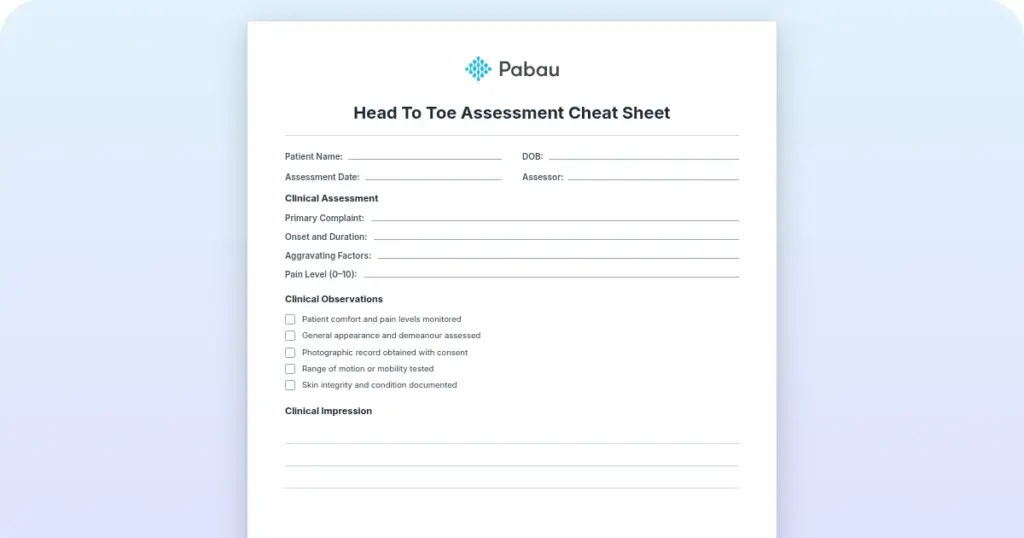
Head to toe assessment cheat sheet: Printable nursing guide
A head to toe assessment cheat sheet gives you one fixed order at the bedside, s...

3
Last Updated: Oct 23, 2026

A record of conversation is a written summary of a discussion, covering the date, the people present, the key points, and the agreed actions.
Practices use one after consultations, welfare checks, complaints, consent discussions, and staff meetings, wherever a decision or a dispute could follow.
Six fields make a record complete: participants, date and time, location, discussion summary, agreed actions, and signatures from both parties.
Write what was said and done rather than what you concluded, and complete the form the same day while the detail is accurate.
Practice management software like Pabau stores the signed record inside the patient file, so the conversation travels with the rest of the chart.
A one-page form with fields for participants, date, time, location, a discussion summary, agreed actions with owners and deadlines, and signature lines for both parties. Print it for the consultation room or attach the signed copy to the patient record.
Download templateA record of conversation is a written account of a discussion between a healthcare professional and a patient or colleague. It sets down who was there, when it happened, what was said, and what each side agreed to do next. It is a summary rather than a transcript, which is what makes it usable in a busy practice.
Teams reach for one after consultations, welfare checks, complaints, consent discussions, and difficult staff meetings. Writing the conversation down protects the patient and the practice, because both sides can point to the same account later.
This guide covers the six fields to fill in, the five steps to follow, and the wording that holds up at audit.
A record of conversation is a structured written account of a discussion between a clinician and a patient, colleague, or family member. It captures who was present, when and where it happened, the points discussed, and the actions each party accepted.
It sits alongside the treatment note rather than replacing it. A clinical progress note records what you found and did. The record of conversation records the discussion that surrounded it, including anything the patient asked for or turned down.
The record also differs from an audio recording. An audio file captures every word, including the pauses and the small talk. A written record captures the clinical substance, so it stays readable and avoids the consent problems that recording brings.
Document the conversation whenever it produces a clinical decision, an agreed action, or a risk of later disagreement. That test applies to staff conversations as much as patient ones.
Six fields make a record complete. The template above already carries all of them, so the work is filling them in rather than designing the form. Practices that already collect digital intake forms can rebuild the same six fields there and skip the paper entirely.
Fill the form in straight after the conversation ends. Accuracy drops fast once you have seen two more patients, and a record written the next morning is easier to challenge.
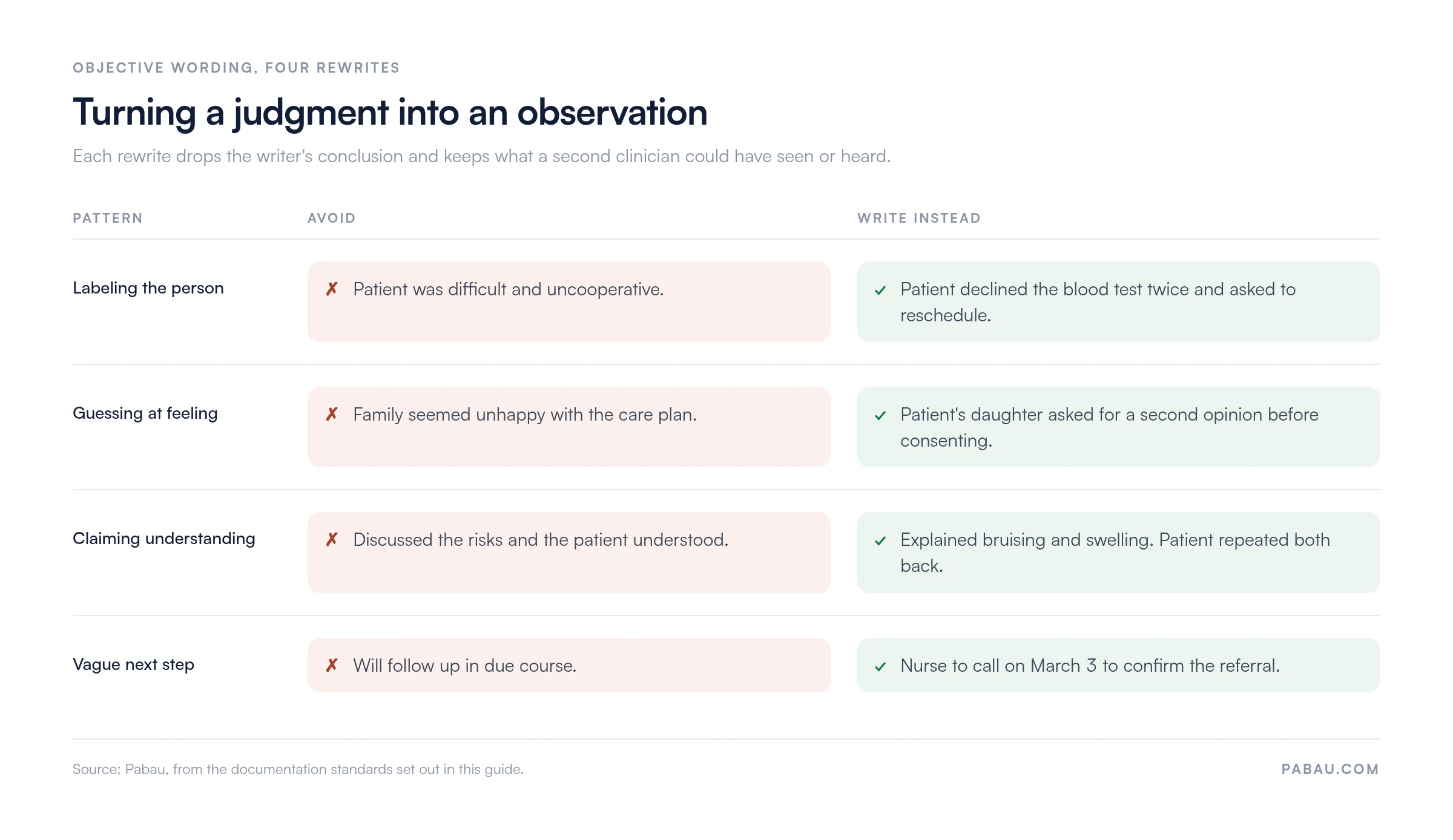
Objective wording is the part clinicians get wrong most often. A record that reads as a judgment tells the reader what you thought. A record that reports behavior and speech tells them what happened, which is what a colleague or a regulator needs, in line with clinical documentation integrity standards.
One test settles most sentences. Could a clinician who was not in the room picture the moment from your wording? If not, you have written a label rather than an observation. The four rewrites below cover the patterns that come up most.
Direct quotes are the exception worth using freely. Where a patient’s own phrasing carries weight, put it in quotation marks and attribute it. That preserves their words without you interpreting them.
Once the form is signed, three questions decide what happens next. Where does it live, who gets to see it, and how long do you keep it? A digital records management system answers the first two by default, because the file sits in the chart and access follows the user’s role.
Inspectors rarely ask whether you had the conversation. They ask you to show it. A signed, dated summary answers that in one page, which is why practices treat these records as part of healthcare compliance rather than optional paperwork.
For the patient, the value is different. A record they signed confirms they were heard and that they knew what they were agreeing to. That is often what keeps a complaint from escalating.
Most practices keep these records on paper or in a shared drive. The form gets printed, signed, scanned, and then filed somewhere separate from the patient’s chart. Eighteen months later, finding it is the hard part.
Practice management software like Pabau keeps the record inside the patient file instead. Digital forms capture the participants, the discussion, and the agreed actions, and the signed copy attaches to the same chart as the treatment notes. Pabau Scribe, our AI scribe, can draft the summary from the consultation so the clinician edits rather than types.
Agreed actions become tasks with an owner and a due date, so nobody has to remember to chase the referral. The audit trail records who created or amended each version. When an inspector or a patient asks what was agreed, the answer is a search rather than a hunt through a filing cabinet.

Pabau’s digital forms capture the discussion, the agreed actions, and both signatures, then file the record against the patient it belongs to. Your team stops scanning paper and starts finding conversations in seconds.

The habit matters more than the form. A practice where every consequential conversation earns three minutes of writing afterward can answer questions months later without leaning on anyone’s memory.
Start with the conversations most likely to be revisited. Consent discussions, complaints, and safeguarding concerns repay the effort straight away. Widen the habit once the routine holds.
The trade-off is honest enough. Writing objectively takes longer than writing an impression, and asking for a signature can feel awkward in the moment. Both cost less than reconstructing a conversation you cannot evidence. Book a demo to see how Pabau files these records against the patient chart instead of a folder nobody can find.

Handing a patient over between shifts? The bedside shift report template structures the handover so the incoming clinician hears the same detail the patient did.
Asked to share the record with a third party? The authorization for release form captures consent before anything leaves the practice.
Closing an episode of care? A discharge summary pulls the decisions from those conversations into one document the next clinician can act on.
Still writing records on paper? Clinical notes software explains what changes when documentation lives in the patient file rather than a drawer.
A record of conversation is a written summary of a discussion between a healthcare professional and a patient or colleague. It documents the date, the participants, the key points, the decisions made, and the agreed actions. It is not a word-for-word transcript. It is a professional account suitable for the clinical or employment record.
A signed record is not a contract, but it is strong evidence of what was discussed and agreed. In a dispute or a complaint, an account signed by both parties carries significant weight. Always ask the clinician and the patient or staff member to sign and date it.
Clinical records, including documented conversations, are commonly retained for at least seven years after the patient’s last contact. Employment records are often kept for six years. Check your local regulatory requirements and your organization’s own retention policy for the exact period.
A written record is a professional summary of the substance. An audio file captures the entire conversation, word for word. Recording someone without their consent is unlawful in many jurisdictions. A written record is simpler, easier to store, and sufficient for most healthcare and employment purposes.
Complete the form anyway and note that the patient declined, along with the reason they gave. An unsigned record still shows the conversation happened and what you documented at the time. Ask a colleague who was present to countersign it if one was in the room.