Scapular assistance test: Procedure, interpretation and free template
The scapular assistance test is a manual examination in which the clinician supp...

1
Last Updated: Oct 19, 2026

A discharge summary is the final clinical document that records a patient’s diagnosis, treatment and post-discharge care plan.
Required fields include admission history, discharge diagnosis, treatment summary, medications, pending results, follow-up instructions and the attending clinician’s signature.
Incomplete or late summaries drive medication errors, missed follow-ups and readmissions, so timing matters as much as content.
Aim to finish the summary within 24 hours of discharge, while the clinical detail is still fresh.
Structured templates and automated note workflows help clinicians document faster and stay aligned with CMS and Joint Commission standards.
A ready-to-use form with fields for patient details, treatment progress, medications at discharge, follow-up instructions and risk assessment. It is written for substance use disorder transitions, and the section structure works across any care setting.
Download templateA discharge summary is the document that carries a patient from one care setting to the next. It tells the receiving clinician what happened, what the patient is taking, and what still needs to be done.
This guide walks through every required section, with worked examples from hospital medicine, physical therapy and behavioral health. The free template above gives you the same structure as a form you can fill in today.
A discharge summary is a clinical document completed at the end of a patient’s care episode. It sets out why the patient presented, what treatment was provided, how they responded, and what happens next.
It serves three audiences at once. The primary care provider uses it to act on the specialist’s findings. The patient uses it to understand their medications and self-management responsibilities.
Your practice is the third audience. The summary is the record that demonstrates continuity of care to The Joint Commission and to payers. It is also the first document requested when a transition is questioned.
Practitioners often confuse a discharge summary with a termination note, the shorter record written at the final contact. A summary reviews the whole course of care.
Every summary, whatever the specialty, contains the same core sections. These are mandated by The Joint Commission, CMS, state licensing boards and professional associations such as the American Physical Therapy Association.
The core structure above holds everywhere, but the emphasis and the clinical detail change. Here is what a completed document looks like in two very different settings.
Admission history: 68-year-old male presenting with acute chest pain and dyspnea. EKG showed ST elevation in the inferior leads.
Discharge diagnosis: Acute ST-elevation myocardial infarction, treated with percutaneous coronary intervention to the right coronary artery. Ejection fraction 42%.
Treatment summary: PCI with stent placement, then admission to the coronary care unit for arrhythmia monitoring. Troponin peaked at 8.5 ng/mL on day 2. Echocardiography showed inferior wall hypokinesis. Discharged on day 3 in stable condition.
Medications: Aspirin 81 mg daily, clopidogrel 75 mg daily for 12 months, metoprolol 50 mg twice daily, lisinopril 10 mg daily, atorvastatin 80 mg daily.
Follow-up: Cardiology in 1 week, stress testing at 6 weeks, and primary care in 1 week for medication review.
Admission history: 52-year-old female, day 3 after total knee replacement. Goal: restore knee range of motion and functional mobility for independent ambulation.
Progress toward goals: Achieved 95° knee flexion against a 100° target, with the extension lag resolved from 20° to 5°. Ambulation progressed from parallel bars to crutches, then to a single point cane. Stairs managed independently with a rail.
Status at discharge: Discharged home after 12 sessions over 4 weeks. Range of motion adequate for independent daily activities. Pain 2/10 with activity.
Home program: Quad sets three times daily, straight leg raises, standing hip abduction and step-ups, issued as a written home exercise program. Continue for 6 weeks, then reassess.
Follow-up: Return to therapy if range of motion plateaus or pain increases. Orthopedic surgeon at the 6-week postoperative mark.
The strongest summaries are written within 24 to 48 hours of discharge, while the clinical detail is fresh. Here is how to work through it efficiently.
A well-structured summary reduces readmissions and improves outcomes. These are the failures that undermine both safety and compliance.
In hospital and ambulatory settings, discharge day management is a billable service. Two CPT codes apply, 99238 and 99239, and the split between them is based on time and complexity.
Documentation rule: CMS requires explicit time documentation on the day of discharge for 99238 and 99239. Completing the summary is not enough on its own. Note the minutes spent and the complexity level, and enter them the same day, because retrospective time entries are audited closely.
Time-based codes shift with annual updates, so check the current year’s guidance with the American Medical Association or your payer. A medical coding cheat sheet is a useful desk reference for the rest of the episode.
Most practices rebuild the same document from scratch every time. A clinician reads back through the chart, retypes the treatment course into prose, then copies medications across by hand. That is where the omissions creep in.
Practice management software like Pabau turns that into a structured form. Digital forms embed the discharge template directly in the patient record, so your clinician fills defined fields instead of writing prose. Pabau Scribe, our AI scribe, drafts the narrative sections from dictation.
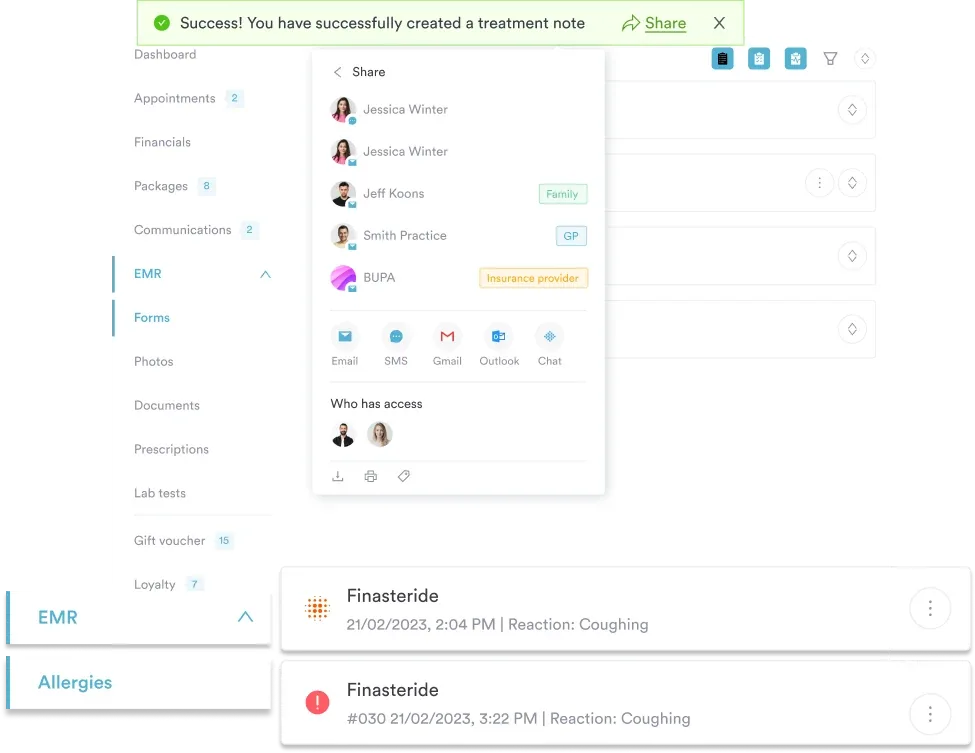
The finished summary is then shared from the patient record with the primary care provider and the patient. It is stored against the episode for audit. Clinicians get their documentation time back, and the receiving clinician gets the handoff on the day of discharge.

Built-in discharge templates and Pabau Scribe, our AI scribe, save your practice hours each week and keep every note audit-ready.

The discharge summary is your last clinical communication with both the patient and the next clinician. If it is late, thin, or missing a medication, the patient carries that error into the next setting.
Fixing that rarely means writing better prose. A structured form with defined fields is faster to complete, and much harder to leave half-finished. Start with the template above and keep the same section order in every setting you work in.
The trade-off worth remembering is that structure only pays off if the document actually reaches the receiving clinician the same day. Book a demo to see how Pabau shortens documentation time and delivers each summary automatically.

Need the history before you can write the summary? The medical information form captures conditions, allergies and current medications in one pass.
Onboarding patients into an episode of care? The new patient questionnaire collects the baseline detail your discharge documentation later depends on.
Assessing a patient’s learning needs at discharge? ATI Active Learning Template structures cognitive assessments and documents learning patterns to support therapeutic planning.
Monitoring neurological status before discharge? The neuro checks assessment standardizes how those observations are recorded.
Handing a patient off at the bedside? Bedside shift report template structures the handover with patient identification, vital signs, medications, and the shift care plan.
A discharge summary is a clinical document completed at the end of a patient’s care episode. It records the diagnosis, treatment received, medications and follow-up plan, so the next clinician can continue treatment without guesswork.
Required sections are admission history, discharge diagnosis, treatment summary, medications at discharge with doses and frequencies, pending results, follow-up instructions and the clinician signature. The Joint Commission and CMS mandate these elements for compliance.
A straightforward summary typically takes 20 to 30 minutes. Complex cases with multiple comorbidities can take 45 minutes or more. Best practice is to complete it within 24 to 48 hours of discharge.
A discharge note is the final daily progress note written on the day of discharge. A discharge summary synthesizes the whole episode of care, so it is longer and gives the receiving clinician the continuity context.
CPT 99238 covers straightforward discharge day management of 30 minutes or less. CPT 99239 covers complex discharge above 30 minutes. Both require explicit time documentation on the day of discharge for CMS compliance.
Within 24 to 48 hours. Late summaries raise the risk of medication errors, missed follow-ups and preventable readmissions. Joint Commission standards recommend same-day or next-business-day completion wherever that is possible.