Monika Lazarevska

CBT activity sheets
What CBT activity sheets are and how they work CBT activity sheets are structure...

2
Last Updated: Nov 4, 2026
Free PDF 2 pages, print-ready Clinician-reviewed
The Panic and Agoraphobia Scale (PAS) is a 13-item questionnaire that rates how severe panic disorder is, with or without agoraphobia, over the past week. Psychiatrist Borwin Bandelow developed it, and each item scores 0 to 4, for a total between 0 and 52.
The items fall into five subscales: panic attacks, agoraphobic avoidance, anticipatory anxiety, disability and health concerns. It measures severity and does not diagnose, so practices give it at baseline and at set review points during treatment. A falling total across those reviews is one of the clearest signs that therapy or medication is working.
A ready-to-use assessment form covering panic attack frequency, agoraphobic avoidance, anticipatory anxiety, disability, and health concerns, with space for a total score.
Start from scratch, or upload this PDF or any form you already use, and Pabau's AI Form rebuilds it with tick boxes, text fields and a signature. Attach it to the treatment once, and every patient gets it on time.
AI Form rebuilds the consent, history and aftercare forms you already use. You review each one, then publish.
Patients complete forms on their phone before they arrive, so the front desk stops retyping paper.
Every signed form is versioned and attached to the treatment record, ready when you need it.
Set how long a consent stays valid. Returning patients skip forms they have already signed.
Supports HIPAA and GDPR compliance AES-256 encryption 4.8 on G2 4.7 on Capterra Trusted by 4,000+ practices worldwide

The Panic and Agoraphobia Scale (PAS) has 13 scored items rated 0 to 4, for a total between 0 and 52.
Item U asks whether attacks were expected or spontaneous, and it never counts toward the total.
The scale measures severity and change over time, and it does not diagnose panic disorder on its own.
Self-rated and clinician-rated scores use different bands, so keep one version and one rater for a whole treatment course.
Record the five subscale scores as well as the total, because two equal totals can hide very different symptom patterns.
The panic and agoraphobia scale is a 13-item rating scale for the severity of panic disorder, with or without agoraphobia. Psychiatrist Borwin Bandelow published it in 1995, and Hogrefe publishes the manual and norms.
It comes in two versions. Patients fill in the self-rated form, while a clinician completes the observer-rated form after an interview. Both cover the same five areas, but each version has its own score bands.
The scale’s strength is that it picks up change. In a 1998 placebo-controlled trial, Broocks and colleagues randomized 46 outpatients with panic disorder to aerobic exercise, clomipramine or placebo. Both active treatments beat placebo, and clomipramine worked sooner and more strongly than exercise.
A 2000 paper by Bandelow and colleagues analyzed the PAS results from that trial. The scale separated the treatments, and its subscale scores showed that exercise worked mainly on anticipatory anxiety and disability.
That makes it a natural way to measure progress during panic disorder treatment, whether the plan is cognitive behavioral therapy (CBT), medication or both.
Each scored item belongs to one of five subscales. Two patients with the same total can need very different plans, so the subscale scores matter as much as the sum.
Read the subscales side by side and the next step often becomes clearer. When avoidance stays high while attacks fall, an exposure hierarchy worksheet turns the feared situations from the B items into graded steps.
When anticipatory anxiety leads instead, an anticipatory anxiety worksheet gives the patient structured practice between sessions. The chart below shows how the 52 available points split across the five areas.
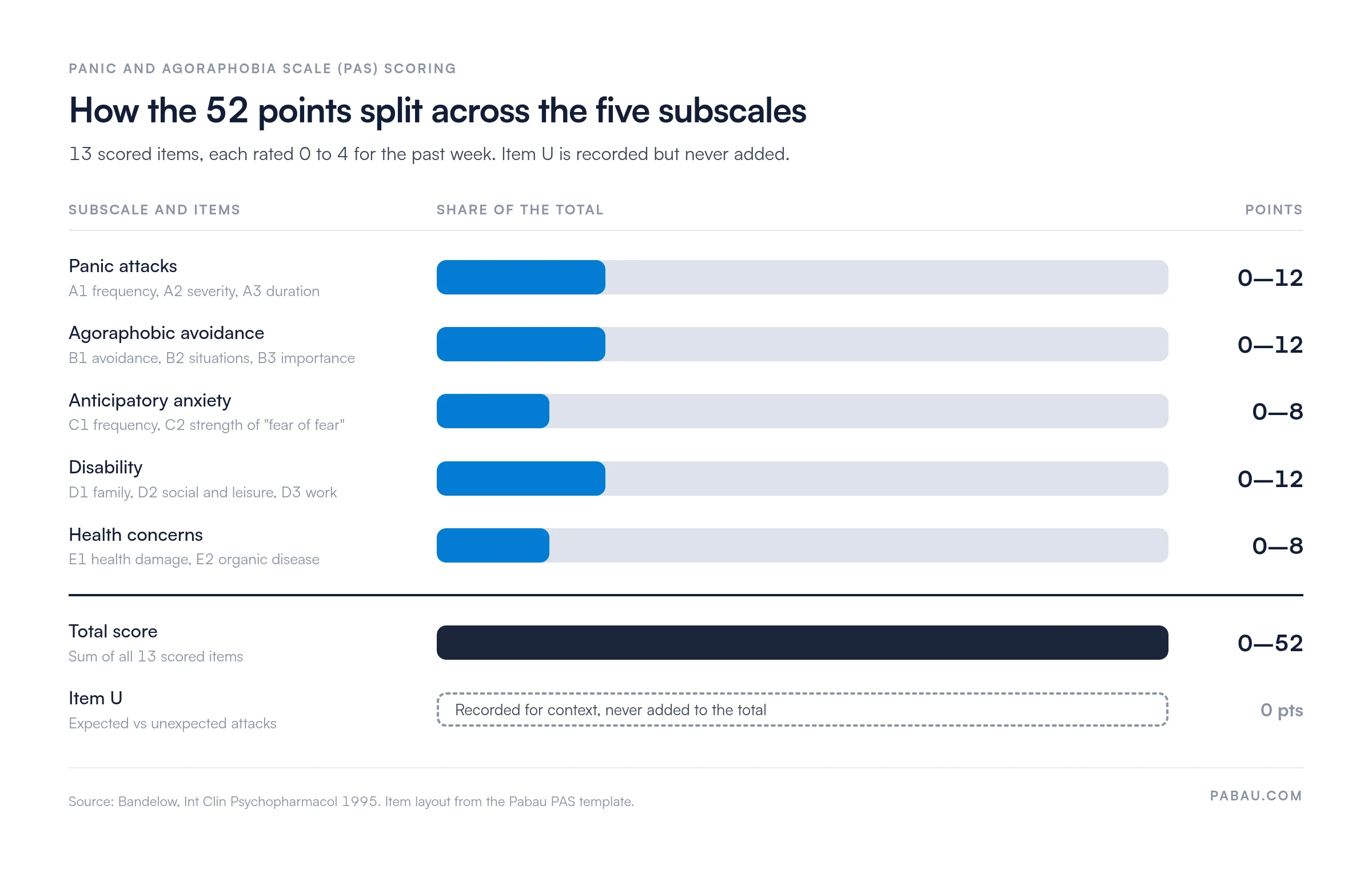
Scoring is simple addition once you know which item to leave out. Each of the 13 scored items is rated from 0 to 4, and the total runs from 0 to 52.
One wording slip in the PDF is worth flagging to patients. C1’s first option reads “No fear or having a panic attack”, which is a typo for “of”. It means no fear of an attack, and it scores 0.
Here’s a worked example. A patient scores 6 on panic attacks, 5 on avoidance, 4 on anticipatory anxiety, 6 on disability and 2 on health concerns. The total is 23 out of 52, and item U stays out of it.
Self-rated and clinician-rated bands are not interchangeable, so never read a self-rated total against clinician cut-offs. A high score signals that treatment needs attention, but it never confirms a diagnosis on its own.
A score series only means something if every point was collected the same way. Switch from the self-rated to the clinician-rated form mid-treatment, and a drop may say more about the form than the patient.
In practice, the routine that holds up best is a simple one.
Between reviews, an anxiety tracker lets patients log daily episodes without waiting for the next full scale.
Store every PAS result against the same episode of care, with the form version and the rater noted. Months later, those two details are what make one score comparable with the next.
A minute of checking at the desk saves a confusing trend line later.
Most scoring errors come from a handful of habits, and each one is easy to fix once you spot it.
Clinicians often weigh the PAS against the Panic Disorder Severity Scale (PDSS) and the Beck Anxiety Inventory (BAI). Each one answers a different question, so pick the tool that matches yours.
Panic attacks, avoidance, anticipatory anxiety, disability and health worries, each as its own subscale.
Overall severity of panic disorder, summed into one score.
General anxiety symptoms across presentations, not panic alone.
Time frames follow the current published forms, so check the edition you use. Choose the PAS when you need subscale scores, the PDSS for a short clinician rating and the BAI for broad anxiety.
The template is a single-form layout with space for the name, date, item responses and a total score (all items except item U). It runs to two pages and has no clinician notes field, so keep notes in the patient record.
The scale itself is © Borwin Bandelow, and Hogrefe sells the manual and norms. The Pabau PDF carries no copyright notice of its own, so confirm licensing before any clinical or commercial reuse.
On paper, PAS sheets tend to end up in a scanned folder, with totals added by hand and trends rebuilt at each review. In Pabau, every result sits in the patient record next to the session notes, so you see each score beside the decision it informed.
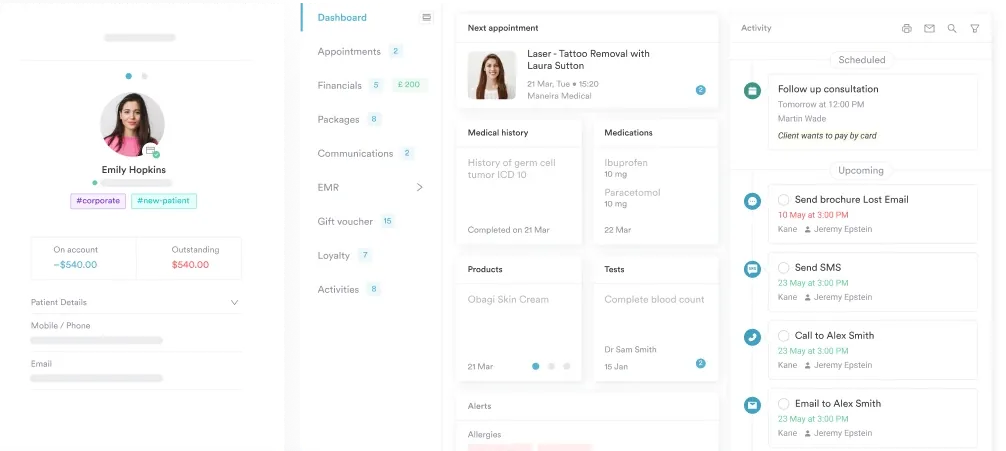
You can build the scale once with digital intake forms and send it before the appointment. Measurement tracking then maps each answer to its value, adds up the total on submission and plots it across visits.
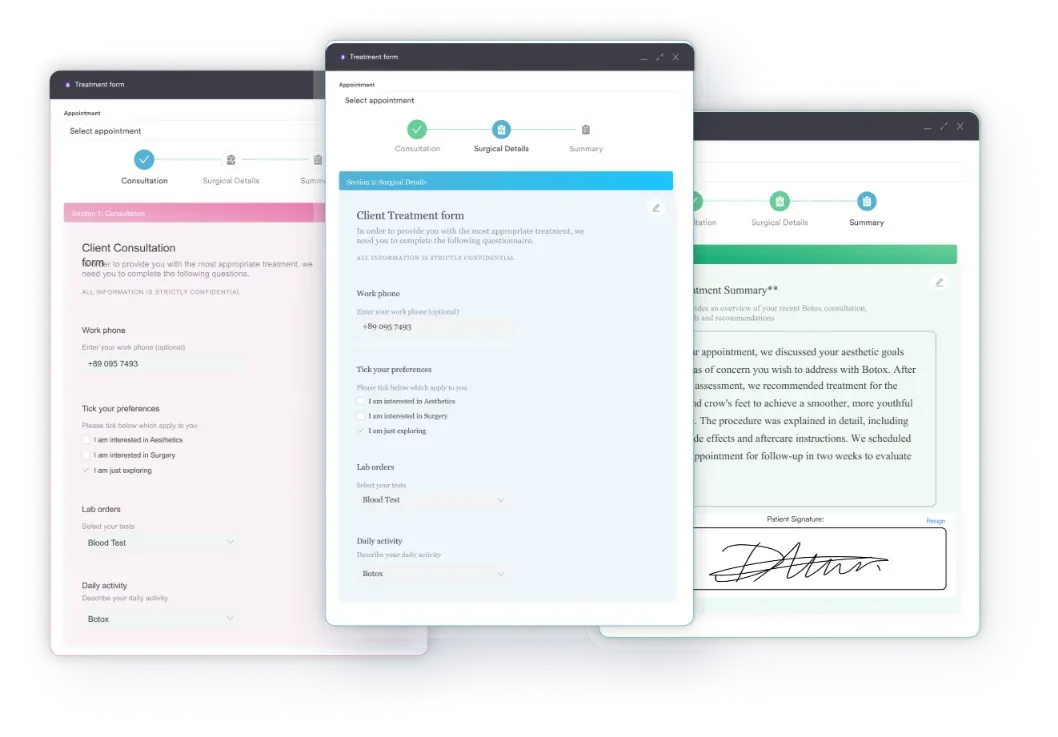
Recurring sends can go out weekly, fortnightly or monthly, which keeps review points on schedule without anyone chasing them. It all runs inside Pabau’s therapy practice management platform, alongside scheduling, billing and telehealth.

Pabau scores the Panic and Agoraphobia Scale on submission and charts every total against the patient record. Your team sees progress at each review without adding up scores by hand.

The PAS earns its place when it’s used the same way every time. Pick one version, name the rater, leave item U out of the total and repeat it on a fixed schedule.
Do that, and the numbers start to guide decisions. A stubborn avoidance score can tell you when to step up exposure work, and a flat total can prompt an earlier treatment review. The cost is discipline, because one switched form can make months of data hard to read.
Book a demo to see how Pabau scores the PAS for you and keeps every result in the patient record.

Planning graded exposure for panic? Interoceptive exposure worksheet helps patients practice facing the body sensations that trigger attacks.
Need a clinician-rated anxiety measure too? Hamilton anxiety scales covers the interview-based scale many practices pair with self-reports.
Screening for anxiety at intake? GAD-7 anxiety assessment gives you a quick seven-item screen for generalized anxiety.
Choosing a treatment approach? Panic disorder treatment compares the therapy and medication options the PAS helps you monitor.
Need a structured mental health record? Mental health EMR software covers how therapy practices organize clinical notes and assessments.
No. The PAS measures how severe panic disorder and agoraphobia are and how they change over time. A diagnosis still comes from a clinical interview against DSM-5 or ICD criteria.
No more than once a week, because the items ask about the past week. Most practices use it at intake, at fixed review points during treatment and again at discharge.
Lower is better, and 0 means no symptoms in the past week. For exact cut-offs, use the Hogrefe manual bands for your version, since self-rated and clinician-rated bands differ. A falling trend usually tells you more than one number.
Yes. Send the self-rated form before a video session, or complete the clinician-rated form during the call. Keep the same version for every review, whether the visit is in person or remote.