Despina Petrushevska

Nursing care plan for aggressive behavior
A nursing care plan for aggressive behavior is a structured clinical document fo...

3
Last Updated: Oct 26, 2026
Free PDF 1 page, print-ready Clinician-reviewed
An anxiety tracker is a structured log that records anxiety symptoms, severity, triggers and coping across days or weeks. It lets clinicians and patients see patterns that a single session can't show. Used well, it turns vague reports like "I felt anxious all week" into data you can compare.
Clinicians use one to support treatment planning, CBT homework and progress review. The free PDF covers the situation, thoughts and feelings, coping strategies tried and how the patient felt afterward. This page shows which fields to add, how to run the log daily and how to read the patterns.
A one-page anxiety tracker with prompts for the date and time, the triggering situation, thoughts and feelings, coping strategies tried, and how you felt afterward.
Start from scratch, or upload this PDF or any form you already use, and Pabau's AI Form rebuilds it with tick boxes, text fields and a signature. Attach it to the treatment once, and every patient gets it on time.
AI Form rebuilds the consent, history and aftercare forms you already use. You review each one, then publish.
Patients complete forms on their phone before they arrive, so the front desk stops retyping paper.
Every signed form is versioned and attached to the treatment record, ready when you need it.
Set how long a consent stays valid. Returning patients skip forms they have already signed.
Supports HIPAA and GDPR compliance AES-256 encryption 4.8 on G2 4.7 on Capterra Trusted by 4,000+ practices worldwide

An anxiety tracker is a structured daily log of symptoms, severity and triggers.
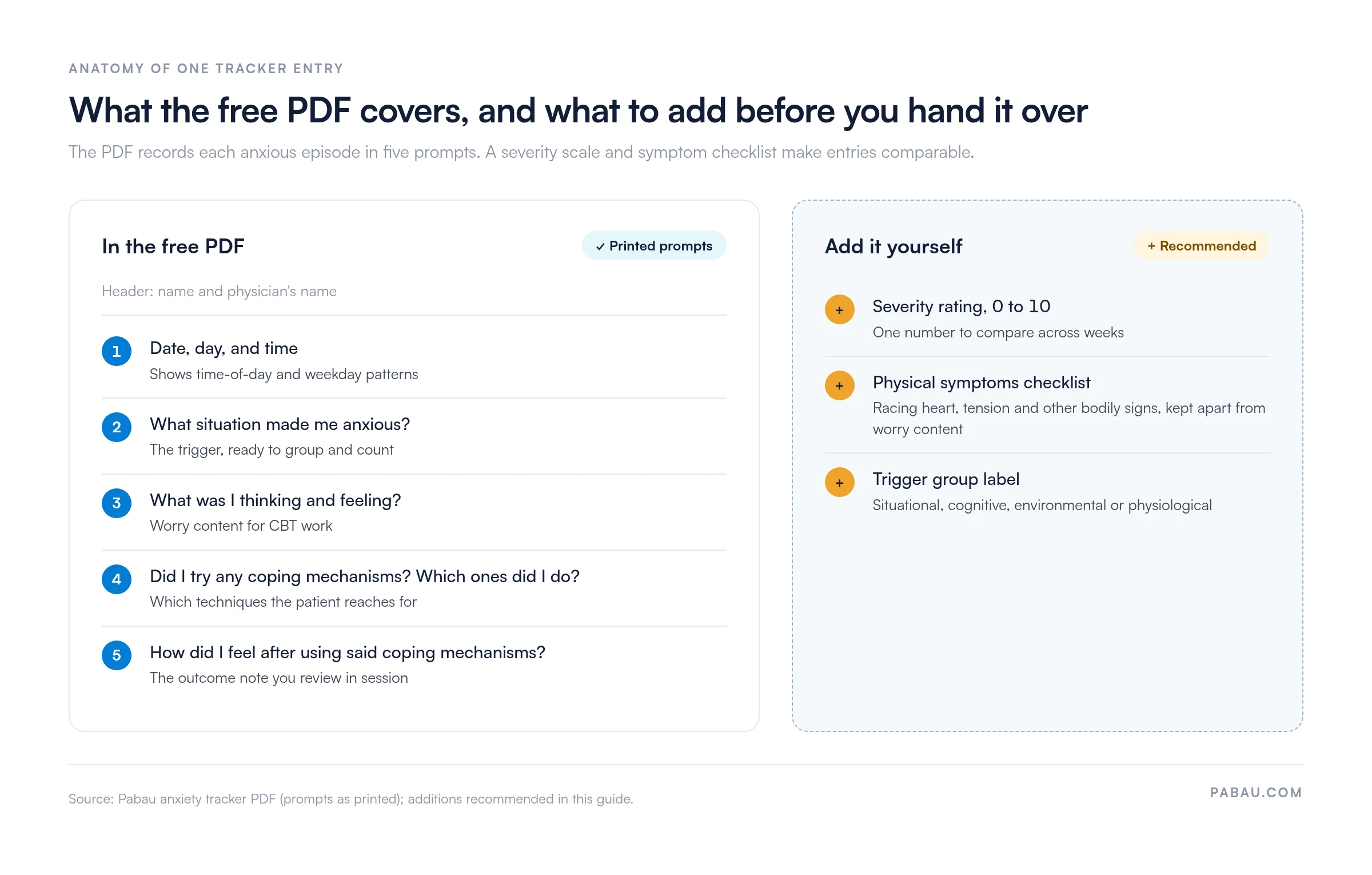
The free PDF covers the situation, thoughts, coping and outcome, so add a severity scale and symptom checklist yourself.
Track physical symptoms and situational triggers separately to spot recurring patterns.
Review the log at each session to compare progress against the treatment plan.
Keep tracker data inside the patient record so it stays linked to treatment notes.
An anxiety tracker is a fixed-field record that captures the same information each time, while a journal is open-ended. The fixed fields make entries comparable across weeks, which is what clinicians need when they review progress.
A journal shows what a patient chose to write that day. A tracker shows whether severity, sleep disruption or avoidance changed between Monday and Friday. The table below shows where each format fits.
Clinicians use a tracker for pattern recognition, treatment planning and session-to-session comparison. Each function depends on the same data being recorded consistently.
A useful anxiety tracker records the date and time, a severity rating and the physical symptoms present. It also captures the trigger, the coping strategy used and a short outcome note. Keep each field short enough that the patient completes it in under two minutes.
The downloadable template covers the date and time plus prompts for the situation, thoughts and feelings, coping tried and how the patient felt afterward. The severity rating and physical-symptom checklist are recommended additions, so add them to the sheet by hand.
The panel below splits the PDF’s printed prompts from the fields to add before you hand it over.
A daily anxiety tracker works when the patient fills it in at a fixed point each day, usually the evening. The clinician then reviews it at the start of each session. Agree the routine in the first session so the entries stay consistent.
Most clinicians ask for one entry per day, completed at the same time, for four to six weeks. Daily entries give enough data to spot patterns without overwhelming the patient.
Triggers fall into four groups: situational, cognitive, environmental and physiological. A patient may report a meeting (situational), a catastrophic thought (cognitive), a crowded room (environmental) or a poor night of sleep (physiological).
If a patient struggles to name triggers at all, an anxiety triggers worksheet can map them before daily logging starts.
Counting how often each group appears over four weeks tells the clinician where to focus. Recurring cognitive triggers, for example, suggest a thought record may be the right next exercise.
Most trackers use a simple 0 to 10 severity rating, which can be mapped onto validated instruments. The GAD-7 is a seven-item scale that screens for and measures the severity of generalized anxiety disorder. It’s widely used in NHS Talking Therapies services and US primary care.
Scores from a validated instrument should be taken and interpreted by a qualified clinician, not inferred from a self-rating tracker alone.
On paper, a tracker travels in the patient’s bag between sessions. Sheets come back creased or half-filled, and the history ends up scattered across a folder.
Pabau, the platform we build for simpler therapy practice management, keeps patient records and digital forms in one place. Tracker-style questions can be set up as a digital form, so each entry sits in the patient record next to your treatment notes.
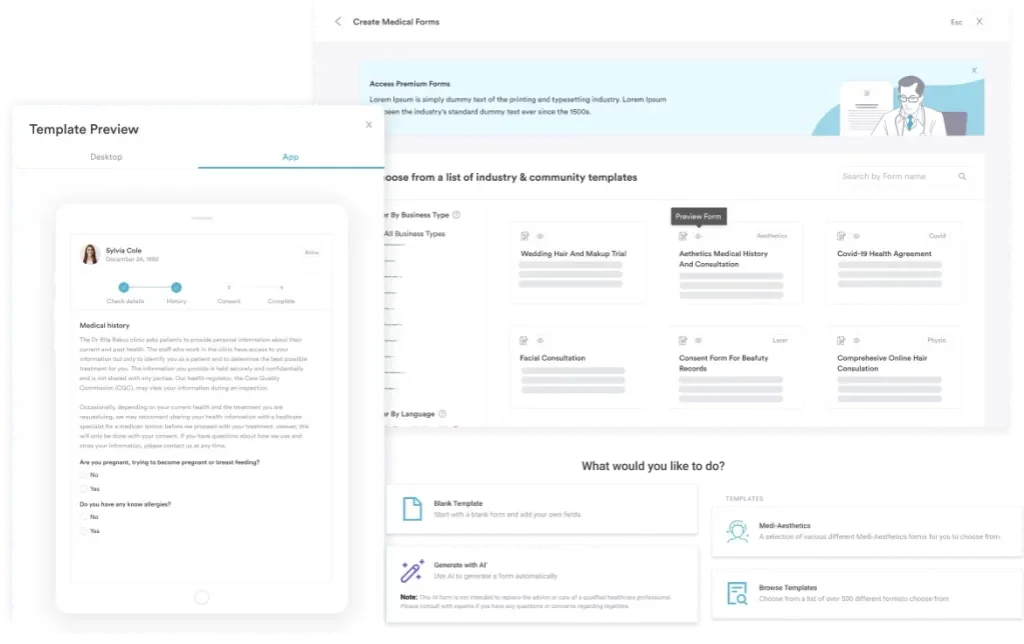
You can then review weeks of entries during appointments instead of reconciling paper sheets. Whether a given form replicates every field in this template should be confirmed against current Pabau documentation before rollout.

Book a demo to see how Pabau keeps tracker entries linked to the patient record.

Start with the free PDF, but don’t hand it over unchanged. Add a 0 to 10 severity line and a short physical-symptom checklist first, so every entry gives you a number to compare.
Then agree one completion time and review the log at every session for four to six weeks. The trade-off is effort: each extra field costs the patient time, so keep the sheet to what you’ll discuss together.
Book a demo to see how Pabau keeps each tracker entry in the patient record, ready for your next session.

Does the worry start days before the event? Anticipatory anxiety worksheet helps patients challenge the forecasts that build up before a feared situation.
Need a way to sort worries the patient can act on? The Worry Tree walks patients through deciding whether a worry needs action or can be let go.
Looking for a coping strategy to log? Grounding worksheet gives patients a structured technique to try in the moment and record afterward.
Want patients to see their coping options at a glance? Coping wheel template lays out strategies on one page that patients can pick from between sessions.
Need a clinician-rated anxiety measure? Hamilton Anxiety Scale explains the clinician-administered scale that complements self-rated tracker data.
An anxiety tracker is a structured log that records anxiety severity, physical symptoms, triggers and coping strategies over time. It produces comparable entries that support clinical review.
Yes, a tracker supports CBT by providing homework data and showing which triggers and thoughts recur. The clinician then uses that evidence to choose the next exercise.
Yes, the anxiety tracker template above is a free PDF download. Print it or use it digitally. The PDF covers the situation, thoughts, coping and outcome, so add severity and symptom fields if you want them.