Psychosis spectrum test: What it screens for and how it works
A psychosis spectrum test is a short clinical screening tool that checks for hal...

Last Updated: Oct 5, 2026

An exposure hierarchy worksheet lists the situations a client fears, ranked by distress on the SUDS scale of 0 to 100.
Therapists use it for specific phobias, social anxiety, generalized anxiety disorder, OCD, and PTSD, because it replaces avoidance with a graded plan.
Building one takes six steps: identify the trigger, list situations, rate each on SUDS, rank them, introduce the plan, then track progress.
The free download is a one-page form with a SUDS legend and open fields for triggers, feared situations, and coping strategies.
Practice management software like Pabau stores completed hierarchies in the client record, so SUDS ratings stay trackable across sessions.
A one-page clinical form for building an exposure hierarchy with a client in session. It carries a name and date line plus a one-line SUDS legend. In addition, the open fields cover what provokes the client’s anxiety, the fear-provoking situations, and their coping strategies.
Download templateExposure therapy is one of the most effective treatments for anxiety, phobias, and trauma-related disorders. Indeed, an exposure hierarchy worksheet turns that approach into a plan the client can see and work through.
Specifically, the form above is a single page with a SUDS legend and open fields for triggers, feared situations, and coping strategies. The method sits on this page rather than in the file, so print the form and work from the six steps below.
In short, the download is a single-page clinical form, not a workbook. You print it, then complete it by hand with the client in session. It contains four things:
Every field is free text, so you write the client’s own wording straight onto the page. There is no pre-drawn grid and no printed instructions, which means you decide the layout inside each box. Generally, most therapists list one situation per line and write its SUDS rating beside it.
The worked examples live on this page too. Print the form, then use the six steps and the sample hierarchies below alongside it.
An exposure hierarchy worksheet is a structured clinical document that lists feared situations, objects, or activities. In particular, it ranks them by distress level using the SUDS scale (Subjective Units of Distress), which runs from 0 to 100. It helps clients face their fears gradually. Therefore, they start with the least anxiety-provoking situation and work toward the most challenging ones.
In fact, this worksheet sits at the heart of cognitive behavioral therapy (CBT) and exposure therapy. Rather than avoiding feared situations (which reinforces anxiety), clients systematically confront them under therapeutic guidance. Consequently, the worksheet documents each step, making progress visible and measurable across sessions.
In general, exposure hierarchies work for anxiety disorders, specific phobias, social anxiety disorder, generalized anxiety disorder (GAD), obsessive-compulsive disorder (OCD), and post-traumatic stress disorder (PTSD). They are also called fear hierarchies or fear ladders.
The terminology varies slightly, but the clinical purpose is identical. In addition, storing completed worksheets in therapy practice management software keeps them part of the permanent clinical record.
Building an exposure hierarchy with a client is a collaborative, session-based process. The worksheet should feel like a tool that helps the client understand their anxiety, not a document imposed by the therapist.
This structured approach contrasts with avoidance, which maintains anxiety. In addition, Psychiatric assessment templates that capture initial fear severity can be paired with the exposure hierarchy to track change over treatment.
The SUDS scale (0-100) is the measurement backbone of every exposure hierarchy worksheet. It is a subjective self-report tool rather than a standardized clinical test. Specifically, its job is to help clients quantify their anxiety in the moment.
As the client repeatedly faces a feared situation, their SUDS rating for that item naturally decreases. Thus, that drop signals habituation, the brain learning that the feared outcome did not occur. Once a SUDS rating falls to 20 or 30, the client is typically ready to progress to the next hierarchy item. In short, the rail below puts the four bands and that progression window on one scale.
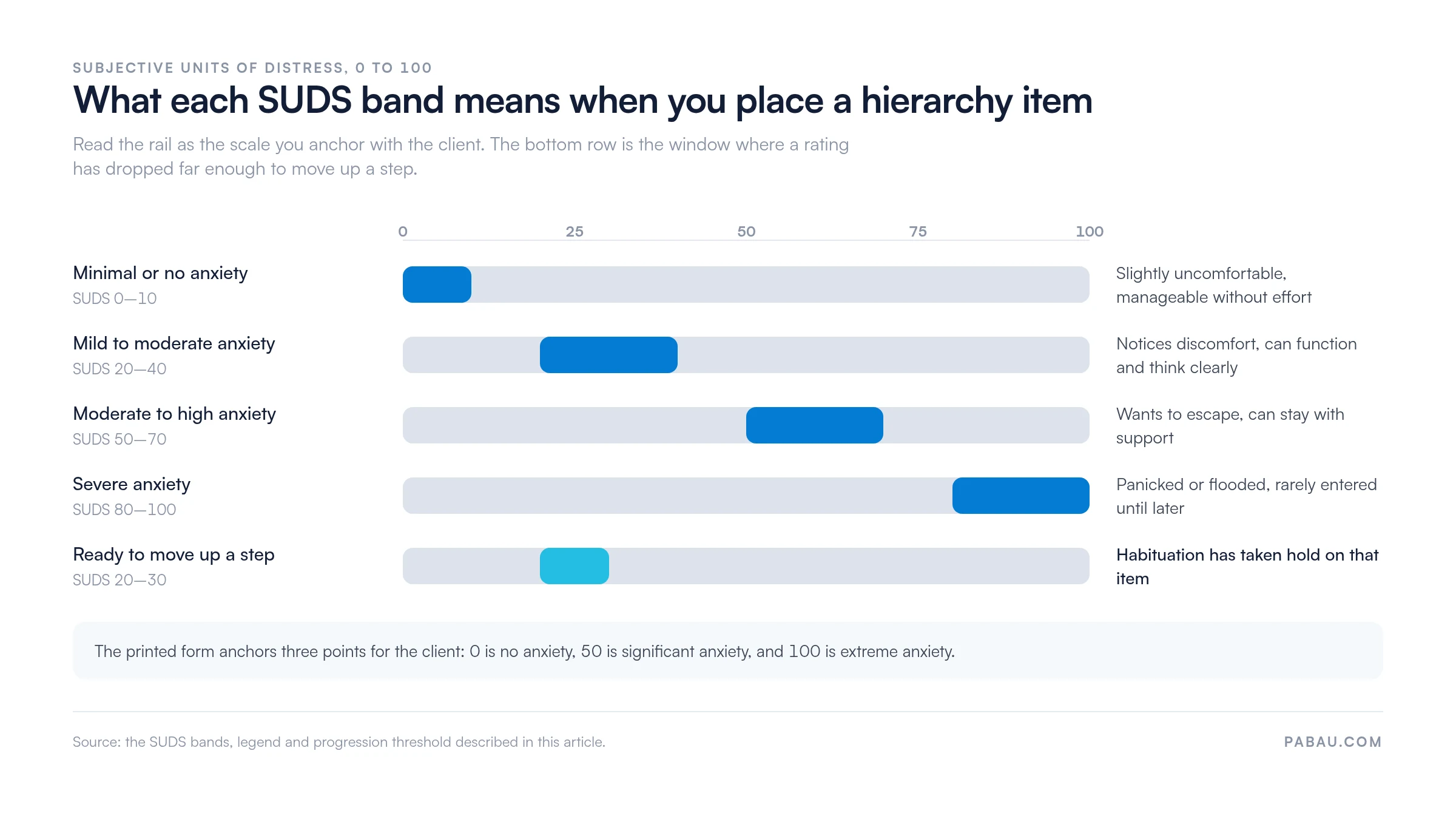
Overall, the form does different work at different points in treatment.
Use digital intake forms alongside the worksheet. As a result, you capture the initial hierarchy and the weekly exposure outcomes in one place.

Hierarchies vary widely depending on the disorder and the client’s own triggers. Specifically, the two examples below show how the same scale plays out across common presentations.
Both hierarchies span the full SUDS range and name concrete situations rather than vague categories. “Be less anxious” is not a hierarchy item, while “make eye contact with the cashier for 10 seconds” is. Consequently, specificity makes exposure measurable and repeatable.
The exposure hierarchy worksheet is a guide, but the skill lies in how you introduce and manage the emotional experience. However, clients often feel apprehensive about facing their fears, even with a clear plan.
Frame the hierarchy as collaborative. Use language like “we have built a plan together that starts small and builds gradually, and you set the pace.” Normalize anxiety during exposure. Explain that anxiety naturally decreases with repeated contact (habituation), so feeling anxious is the mechanism of change rather than a sign of failure.
If a client struggles mid-exposure, crisis intervention strategies keep safety paramount. Occasionally, you pause the exposure briefly, use grounding techniques, or drop back to a less challenging hierarchy item. Progress is not linear, and that is expected. Clients stay with a plan when they feel heard through the difficult moments.
Celebrate small wins. When a client completes an exposure exercise, even if their SUDS rating stayed high, they showed up and faced the fear. That is the core work. Over weeks and months, the cumulative effect of repeated exposures eventually reshapes the client’s fear response.
Overall, graded exposure sits inside mainstream clinical guidance. NICE guideline CG31 on obsessive-compulsive disorder and body dysmorphic disorder recommends CBT that includes exposure and response prevention (ERP).
Similarly, NICE guideline CG113 makes CBT a first-line psychological treatment for generalized anxiety disorder and panic disorder. Additionally, NHS patient information on anxiety describes the same graded approach in plain language for clients.
None of that guidance prescribes a particular form. Instead, the hierarchy is simply how you sequence the exposure work and record what the client agreed to. That is why the worksheet is worth keeping consistent across a caseload.
From a practice perspective, the worksheet documents treatment and demonstrates progress. For example, if a client questions whether they have improved, the SUDS ratings show the change. Similarly, if a supervisor or auditor reviews the case, they can see a systematic, documented approach to exposure treatment.
Many therapists print the worksheet and file it in a paper folder. That works, but it separates the hierarchy from the treatment plan, the session notes, and any progress measure you report on. In contrast, Pabau keeps all of it in the same client file.
Store the completed hierarchy alongside each client’s intake assessment, treatment plan, and session notes in your client records. Across a course of treatment you can watch SUDS ratings fall. As a result, that gives you exposure progress you can quantify and outcomes you can evidence for a supervisor or an insurer.
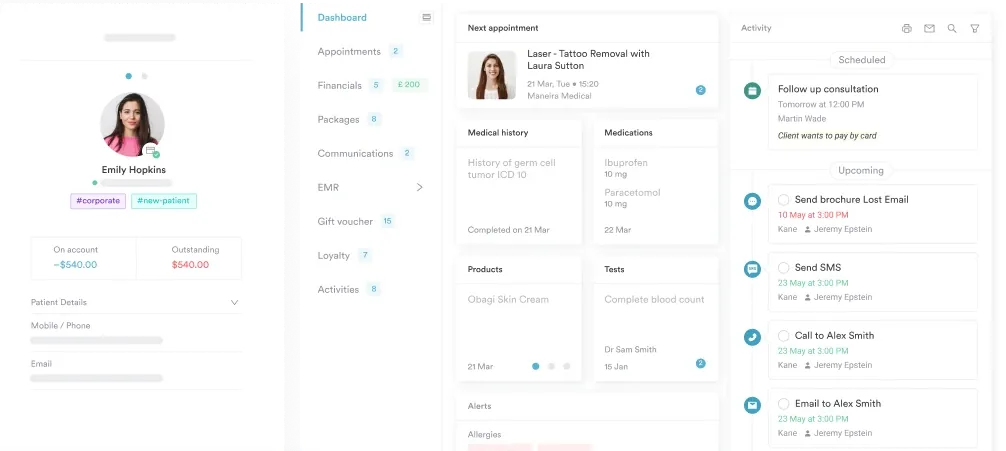
You can also set automated reminders for follow-up exposure sessions and see whether clients completed their between-session homework.
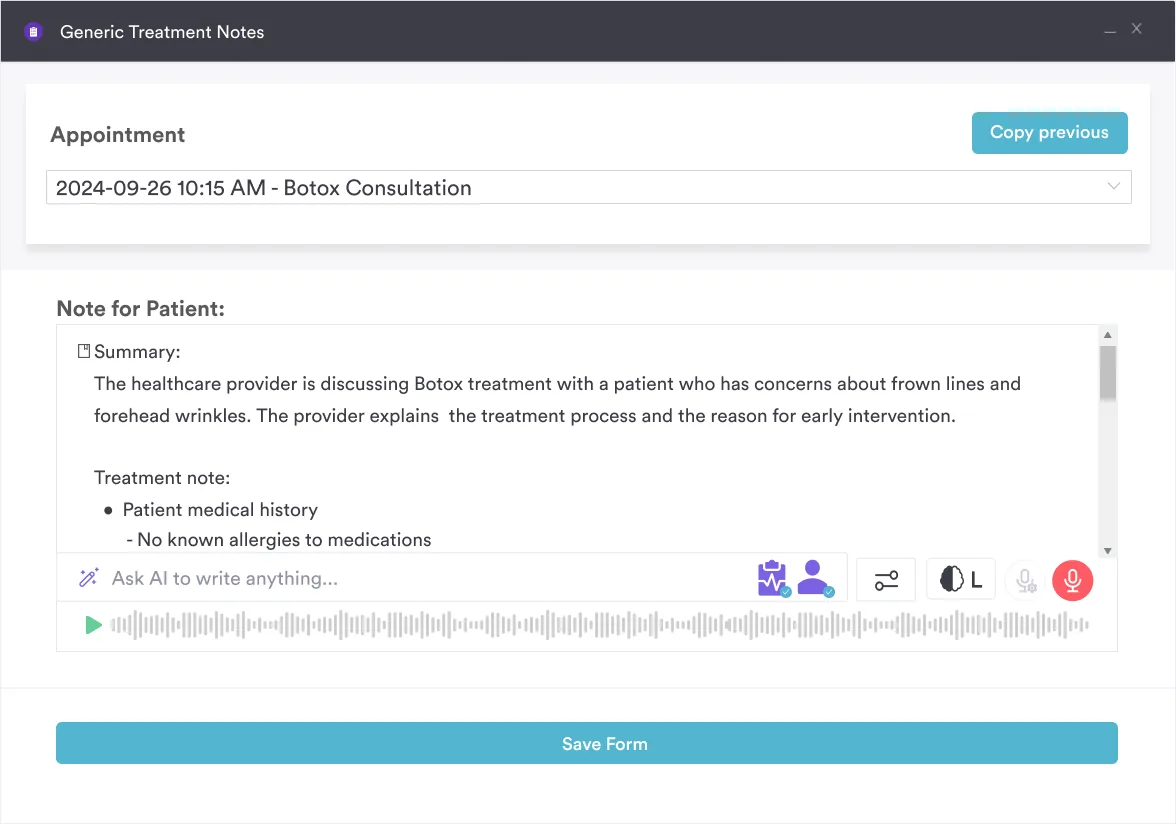
Version history matters too. When a client’s hierarchy changes, because new triggers emerge or early items resolve, you keep every version rather than overwriting a single sheet. In short, that trail is what supervision and treatment reviews need.

Completed exposure hierarchy worksheets sit inside your client records, treatment plans, and session notes. You keep a permanent clinical record and can track SUDS ratings across a course of treatment.

A hierarchy earns its place because it takes the guesswork out of exposure work. Therefore, the client knows what comes next, and you can show what changed. Print the one-page form, build the first hierarchy with the client in the room, and write each situation in their own words.
Expect the plan to move. For example, items get inserted, some resolve early, and a few need splitting into smaller steps. What matters is that each change is written down, because that record is what proves progress to the client, a supervisor, or a reviewer.
Keep the finished sheet where the rest of the client’s care lives rather than in a paper file. Book a demo to see how Pabau stores exposure hierarchies alongside session notes and tracks SUDS ratings over time.

Need a second exposure route when the trigger is a bodily sensation? Interoceptive exposure worksheet covers the sensation-based exercises that sit alongside a situational hierarchy.
Struggling to get past the first hierarchy step with a client? Anxiety triggers worksheet gives you a wider trigger list to draw the low-SUDS items from.
Need something to hand a client who floods mid-exposure? Grounding techniques worksheet is the handout to pair with a session that has to pause.
Want a validated measure to sit next to the SUDS ratings? GAD-7 anxiety assessment template scores overall anxiety severity across a course of exposure treatment.
Running exposure and response prevention with an OCD client? Weekly goals tracker for OCD records the between-session homework each hierarchy step depends on.
An exposure hierarchy worksheet is a structured clinical document that lists feared situations or objects ranked by anxiety level (SUDS 0-100). Specifically, therapists and clients use it collaboratively to guide systematic exposure therapy, starting with the least distressing situation and progressing to the most challenging ones. The worksheet documents progress as clients repeat exposures and anxiety naturally decreases.
SUDS (Subjective Units of Distress Scale) runs from 0 to 100 and measures the client’s perceived anxiety in each feared situation. During hierarchy construction, the therapist asks the client to rate each situation’s anxiety level. Consequently, as the client repeats exposures and anxiety habituates, SUDS ratings for that situation drop. When a rating falls to 20-30, the client is typically ready to progress to the next item. Overall, SUDS provides a concrete, measurable way to track exposure progress across sessions.
Yes. Exposure hierarchies are central to exposure and response prevention (ERP), the gold-standard CBT treatment for OCD. OCD hierarchies list feared situations (e.g. contamination, harm concerns, unwanted thoughts) and the compulsions the client performs to reduce anxiety (e.g. washing, checking, reassurance-seeking). Specifically, ERP exposure items include the situation without the compulsion. The client sits with the discomfort until anxiety naturally drops. As a result, this breaks the compulsion cycle and teaches the brain that feared outcomes do not occur.
Most exposure hierarchies contain 8-15 items, spanning the full SUDS range (roughly 10-15 at the low end to 80-90 at the high end). Generally, the exact number depends on the client’s feared situations and the breadth of their anxiety. A social anxiety hierarchy might focus tightly on social situations, while a health anxiety hierarchy might include a wider range of medical concerns. However, quality matters more than quantity. Each item should be concrete, specific, and meaningful to the client.
Absolutely. Social anxiety hierarchies list feared social situations ranked by distress: making eye contact, speaking in meetings, initiating conversations, attending group events, giving presentations. The same SUDS scale applies, and the same exposure-based treatment works. Consequently, as clients repeatedly face social situations without experiencing the feared outcome (judgment, rejection, embarrassment), their anxiety naturally decreases. Overall, hierarchies make social anxiety treatment structured and trackable.
In vivo exposure means facing the real-world feared situation (as opposed to imagining it). Hierarchies guide which real-world exposures to pursue and in what order. As an illustration, for a client with flying phobia, early hierarchy items might be in vivo (watching planes take off from an airport observation area). Later items might also be in vivo (sitting in the plane on the runway, then a full flight). The hierarchy prioritizes real-world exposures whenever possible, as they typically produce stronger habituation than imaginal exposure alone.