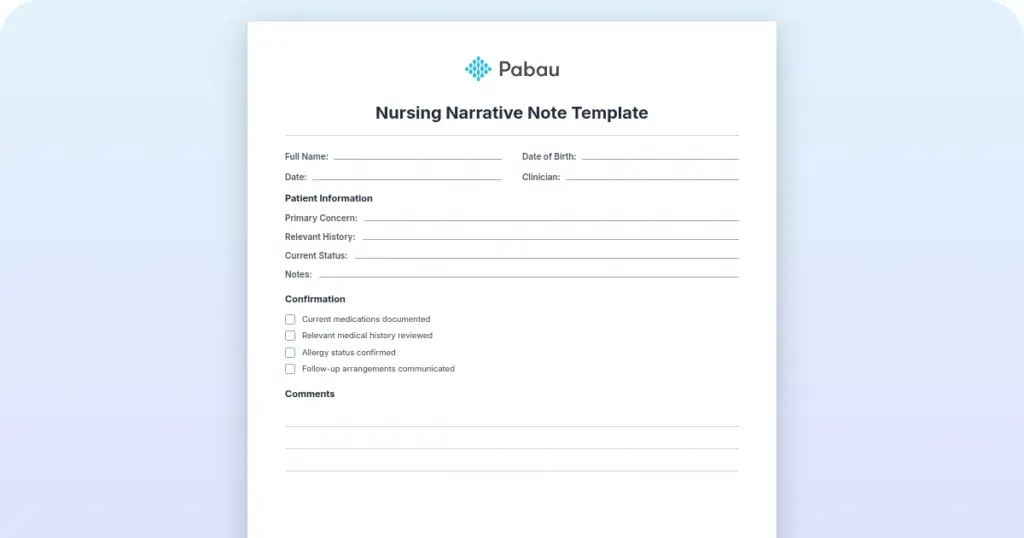
Nursing narrative note template
A nursing narrative note template is a structured PDF that guides you through re...

3
Last Updated: Oct 21, 2026
A nursing home admission checklist is a step-by-step record of the documents, assessments, and consents a skilled nursing facility completes for each new resident.
It starts with pre-admission paperwork three to five days before arrival. It closes with the comprehensive care plan, which federal rules require by day 21.
Admissions coordinators, charge nurses, social workers, and the director of nursing each own part of it. The checklist below groups the work by the deadlines they share, so no form or assessment depends on someone’s memory.
A printable checklist covering pre-admission verification, PASRR screening, clinical intake, room setup, legal documentation, and resident rights notification. It also includes the Medicare and Medicaid eligibility checks your admissions team runs before arrival.
Download template
A nursing home admission checklist keeps intake on schedule across admissions, nursing, social work, and administration.
Pre-admission documentation covers insurance verification, medical history, advance directives, PASRR screening, and Medicare or Medicaid status.
Clinical deadlines run from the admission-day nursing assessment to a baseline care plan within 48 hours and the MDS 3.0 by day 14.
The comprehensive care plan is due within seven days of the MDS 3.0 admission assessment, so by day 21 at the latest.
Digital forms in a single resident record replace paper binders and show at a glance which admission tasks are still open.
A nursing home admission checklist is an administrative and clinical tool that guides skilled nursing facility staff through every required intake task. It keeps each admission consistent and documents compliance with the federal rules for long-term care facilities in 42 CFR Part 483.
Staff start it before the resident arrives and keep it open until the comprehensive care plan is signed, which is due by day 21.
Several roles share each admission, so the checklist shows who owns which task.
Each role needs training on the parts of the checklist it owns. A staff learning preference assessment records how a new hire says they prefer to be shown a procedure. Research does not support teaching to that stated preference alone, so treat it as a conversation starter.
Assign one admission owner for each new resident, usually the admissions coordinator or the charge nurse. That person tracks every checklist item, coordinates between departments, and confirms final sign-off. Without a named owner, tasks that sit between two departments are the ones left unfinished.
Completing pre-admission paperwork three to five days before the resident arrives shortens admission day and avoids last-minute delays. This phase needs coordination between the admissions team and the referring hospital, physician’s office, or family.
When hospital records arrive incomplete, a general medical application form collects the resident’s history, medications, and allergies from the resident or surrogate.
Collect these documents before admission, so you have signed consent and clear legal authority for care decisions. If the resident has no DNR order on file, a DNR form template gives the physician and surrogate a standard document to complete.
Medicaid-certified facilities must complete a Pre-Admission Screening and Resident Review (PASRR) per 42 CFR § 483.20 before admission. A positive Level I screen points to possible mental illness or intellectual disability. It triggers a Level II evaluation by the state before the resident can be admitted.
Build the pre-admission timeline backwards from the arrival date. Start collecting documents five days out, finish the PASRR screen three days out, and have consent forms ready to sign on arrival. Each role then knows which tasks land on them, and when.
The clinical side of admission starts on day 1 and runs until the comprehensive care plan is in place. The charge nurse records the first assessment in an admission nursing note, which feeds the baseline care plan and the MDS 3.0 (Minimum Data Set). The timeline below shows how the six deadlines stack up.
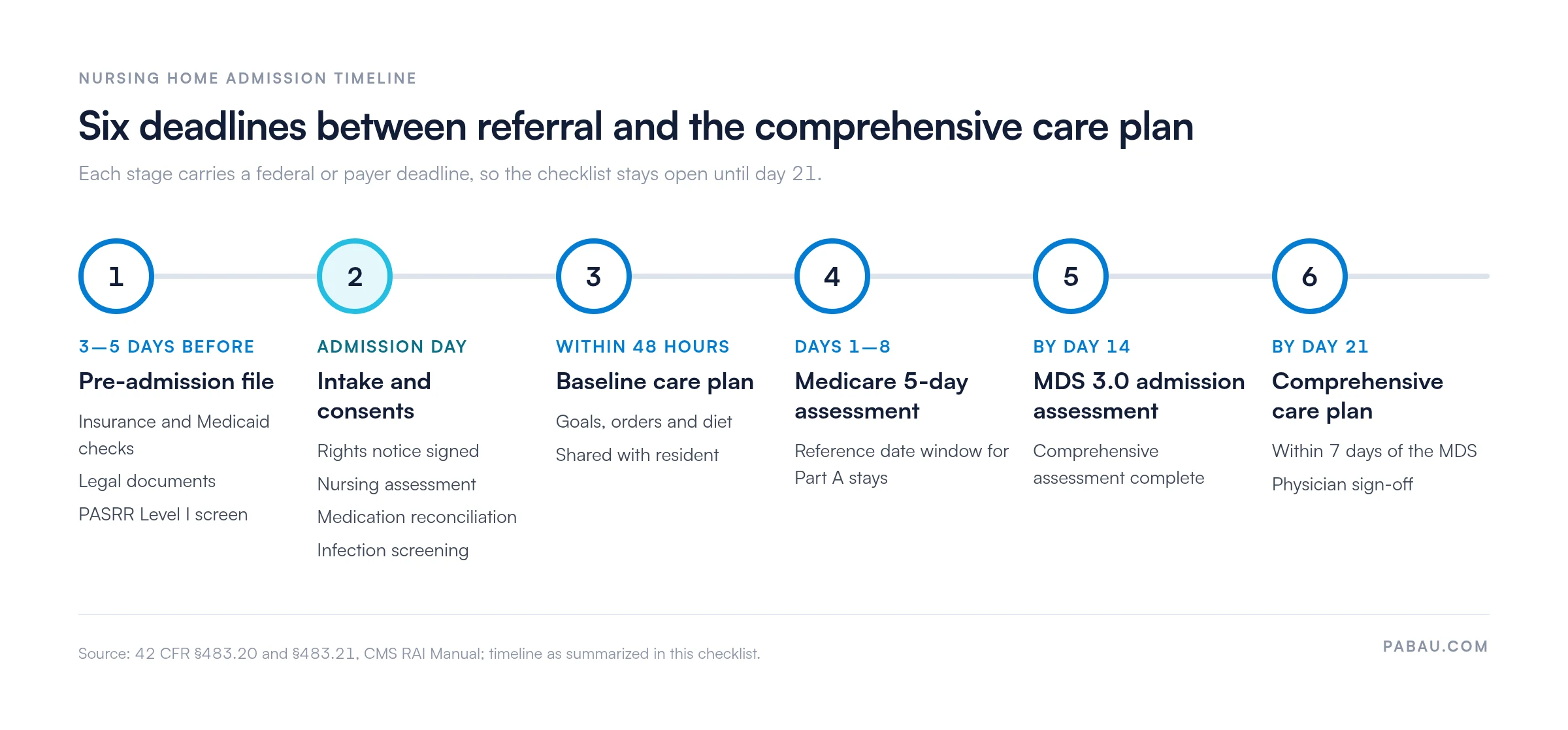
Federal rules (42 CFR § 483.21(a)) require a baseline care plan within 48 hours of admission. It covers what staff need to care for the resident safely until the comprehensive plan is ready. Alongside it, a nursing home report sheet carries each resident’s code status, allergies, and pending orders to the incoming nurse at every shift change.
A well-prepared room eases the move for the new resident and removes safety hazards before they arrive. Housekeeping and nursing should finish room readiness the day before or the morning of admission.
Federal law (42 CFR § 483.10) requires skilled nursing facilities to give each resident a written statement of their rights at admission. Staff then collect signatures confirming the resident understands those rights and the admission agreement.
Provide materials in large print or alternative formats if the resident has visual or hearing impairments. Use an interpreter if the resident speaks a language other than English. Document all accommodations made.
Infections spread quickly in skilled nursing facilities, where residents share rooms, dining areas, and staff. CMS requires facilities to screen new residents for active infections and communicable diseases, and to isolate them where needed until cleared.
Record all screening results, any precautions started, and the physician notification in the resident’s clinical record. Update precautions as new test results or clinical information arrive.
Many facilities still run admission from a paper binder, with forms scanned into the record days later. Finding an unsigned consent or an overdue assessment means flipping through that binder page by page.
Practice management software like Pabau moves the checklist into digital forms. Structured intake forms flag missing fields and collect e-signatures on the rights notice, admission agreement, and consents at the bedside.
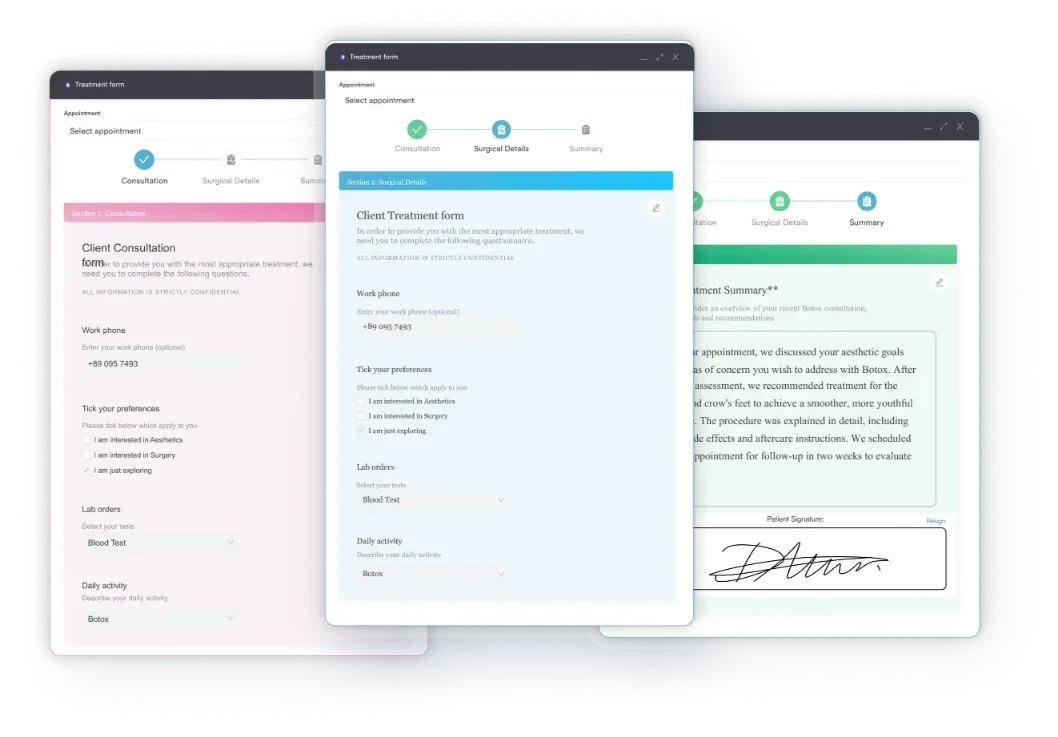
Each completed form lands in a centralized resident record, next to the nursing assessment, medication list, and care plan. The director of nursing can then see which admission tasks are still open for every new resident.
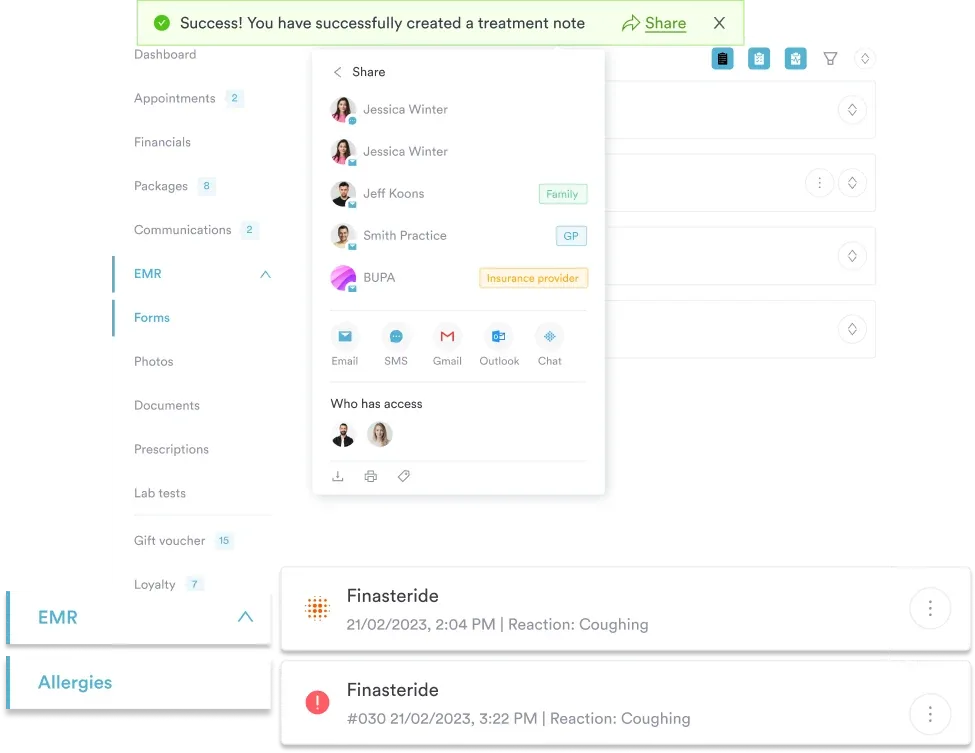
For the admission note itself, Pabau Scribe, our AI scribe, drafts the note from the nurse’s conversation with the resident. The charge nurse reviews and signs it instead of typing it from scratch.

Collect admission consents digitally, keep every form in one resident record, and see which tasks are still open before day 21.

An admission checklist is only as useful as its dates. Treating admission as a single day is how the 48-hour baseline care plan and the day-21 comprehensive plan slip.
Start with the download, name one owner per resident, and put each deadline on the calendar the day the referral arrives. That costs a little planning before arrival and buys a calmer admission day and a cleaner survey record.
Book a demo to see how Pabau keeps each resident’s admission forms, assessments, and care plan in one record.

Need a HIPAA form for the admission packet? HIPAA authorization form gives residents a standard way to approve who can receive their health information.
Running a fuller intake evaluation? Intake assessment template structures the history, risk and functional questions behind a first assessment.
Want admission notes that hold up at survey? Nursing documentation best practices covers the principles and legal requirements behind every nursing entry.
Planning ahead for the resident’s discharge? Discharge planning checklist picks up where the admission checklist ends, from care transfer to follow-up.
A nursing home admission checklist tracks the documents, assessments, consents, and room tasks for each new resident of a skilled nursing facility. It keeps admission consistent and supports compliance with federal CMS regulations.
You need Medicare or Medicaid cards, the hospital discharge summary, a medication list, and physician orders. Legal documents include power of attorney, an advance directive, a POLST or MOLST form, and any DNR order. The facility adds the admission agreement, HIPAA privacy notice, and resident rights notice, plus financial forms for Medicaid admissions.
It should cover pre-admission verification of insurance, medical history, and legal documents. It then covers clinical assessments, including nursing intake, the MDS 3.0, and medication reconciliation. Room readiness, resident rights notification, infection screening, and care planning deadlines complete it.
Pre-admission tasks take three to five days before arrival, and day-of-admission clinical work often takes four to eight hours. The baseline care plan is due within 48 hours and the MDS 3.0 admission assessment by day 14. The comprehensive care plan follows within seven days, so by day 21.
Admission depends on a physician confirming the person needs daily skilled nursing or rehabilitation care. For Medicare Part A to pay, the person also needs a qualifying three-day inpatient hospital stay. State Medicaid agencies set their own clinical and financial criteria.
Medicare Part A covers up to 100 days in a skilled nursing facility after a qualifying three-day hospital stay. Days 1 to 20 are fully covered, and days 21 to 100 carry a daily coinsurance. From day 101 the resident pays the full cost. Medicaid coverage varies by state and depends on asset limits and spend-down rules.