Scapular assistance test: Procedure, interpretation and free template
The scapular assistance test is a manual examination in which the clinician supp...

2
Last Updated: Oct 19, 2026
An ear infection test checks whether ear pain, pressure, or muffled hearing comes from an infection in the outer, middle, or inner ear. At home, the tragus pressure test can point to an outer ear infection, but it can’t see the eardrum.
A clinician confirms the diagnosis with otoscopy, then adds tympanometry, audiometry, or an ear swab when the findings call for it. According to the Centers for Disease Control and Prevention (CDC), acute otitis media is one of the most common reasons children visit a doctor. Adults are regularly affected too.
Mild symptoms can usually be watched at home for 48 to 72 hours. A high fever, neck stiffness, facial weakness, or swelling behind the ear needs care the same day. Infants under 6 months should always see a clinician.

An ear infection test ranges from a simple home self-check to clinical procedures like otoscopy and tympanometry.
The tragus pressure test can flag an outer ear infection at home, but it can’t diagnose a middle ear infection or rule out complications.
Doctors start with otoscopy to view the eardrum, then add tympanometry, audiometry, or a swab culture depending on the findings.
High fever, neck stiffness, facial weakness, or swelling behind the ear needs same-day or emergency care.
Mild symptoms without red flags can usually be watched for 48 to 72 hours, but worsening or longer-lasting symptoms need a clinician.
An ear infection test is any examination that identifies whether bacteria, a virus, or fluid is causing pain or pressure in the ear. It covers a quick home pressure check through to a full clinical workup with an otoscope, tympanometer, and swab culture.
Most ear infections fall into two groups. Otitis externa affects the outer ear canal, and otitis media affects the middle ear behind the eardrum. The right test differs for each, as the table below shows.
Before choosing tests, clinicians review the patient’s symptom onset, prior ear infections, and antibiotic history. That background shapes the diagnostic approach as much as the physical findings do.
Ear pain alone doesn’t always mean infection. Temporomandibular joint (TMJ) dysfunction, referred dental pain, and eustachian tube dysfunction can all mimic it. Testing becomes worthwhile when specific symptom combinations appear.
Adults and children often present differently. Children account for most acute otitis media cases and may not be able to describe ear pain. Instead, they pull at the ear, become unusually irritable, or have trouble sleeping. Adults more often report fullness, muffled hearing, and a sharp or throbbing pain.
For practices, capturing presenting symptoms at booking lets the front desk flag likely urgent cases before the patient arrives.
Yes, but only partially. Home checks can help you tell outer ear pain from middle ear pain. They can’t show the eardrum, measure middle ear pressure, or identify the pathogen, so use them for triage and never for diagnosis.
The tragus is the small cartilage flap that partly covers the ear canal opening. Pressing firmly on it and releasing changes the pressure in the outer ear canal. Sharp pain when you do this strongly suggests otitis externa, the outer ear infection commonly called swimmer’s ear.
How to perform it:
A positive result (significant pain on pressing) points to outer ear inflammation. A negative result (no change in pain) makes otitis externa less likely but does not rule out a middle ear infection. The test has no value for diagnosing otitis media, fluid behind the eardrum, or eardrum perforation.
Home tests can’t detect several clinically important findings. That’s why moderate or severe symptoms need a professional evaluation.
A primary care physician, urgent care provider, or ENT specialist will usually start with otoscopy. Further tests depend on what they find, and four main tests make up the standard toolkit. The pathway below shows which finding leads to which test.
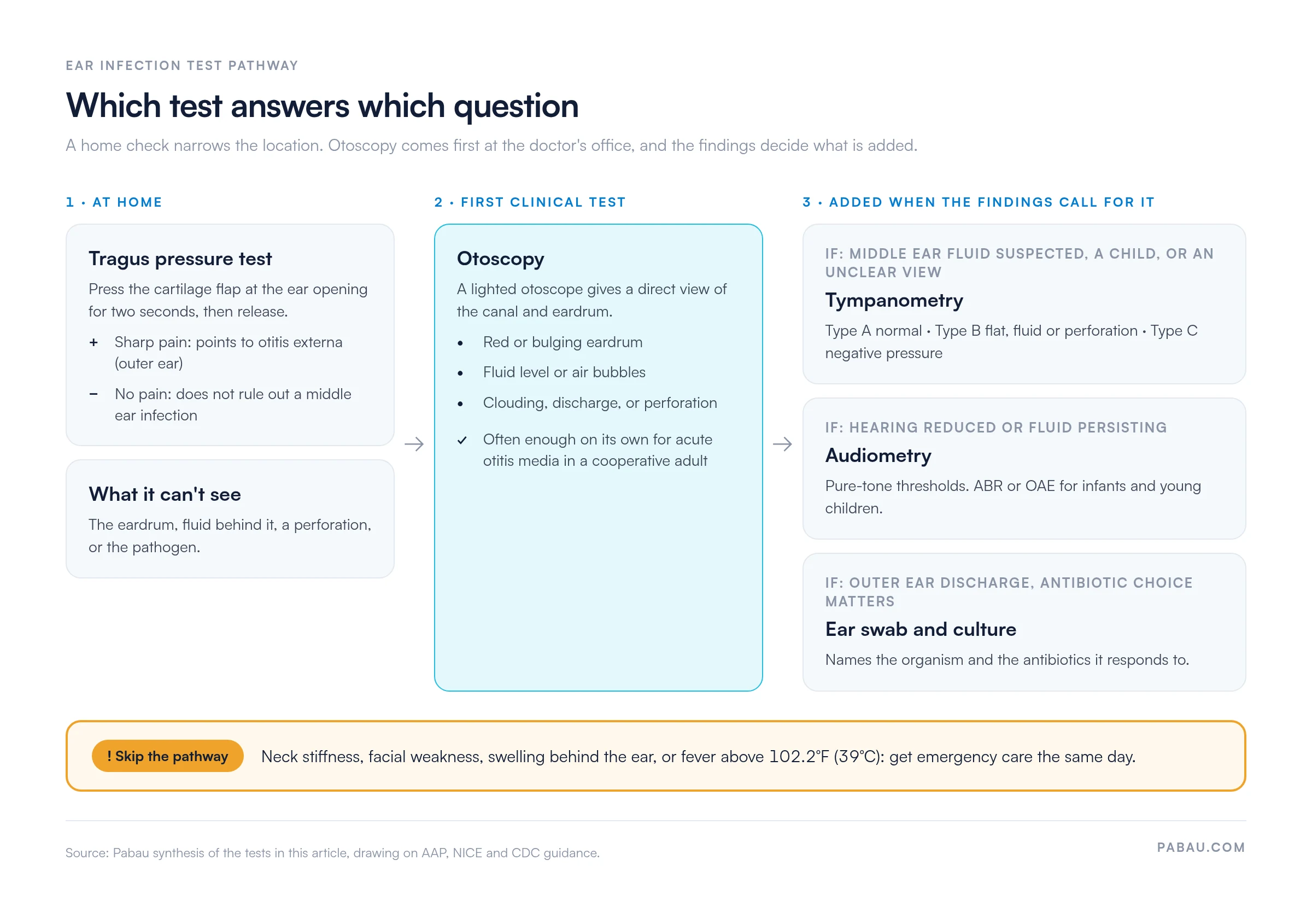
An otoscope examination is the standard first step in any ear infection test. The clinician places a small, lighted otoscope in the outer ear canal to view the eardrum and canal walls directly.
Signs of infection include a red or bulging eardrum and a visible fluid level or air bubbles behind it. The clinician also looks for clouding of the normally translucent eardrum, discharge, or a perforation.
Otoscopy alone is usually enough to diagnose acute otitis media in a cooperative adult. In children or complex cases, it’s combined with tympanometry for greater accuracy. A structured note of the findings lets the clinician compare views when the patient returns for a follow-up test.
A tympanometry test measures how well the eardrum moves as air pressure changes. A probe seals the entrance to the ear canal, and a soft tone plays while the pressure varies. The result is a tympanogram, a graph of eardrum compliance across a pressure range.
Tympanogram results are read from the curve shape, which falls into three main types:
A Type B tympanogram is especially useful because it confirms fluid behind the eardrum even when the otoscopy view is unclear. Tympanometry is painless and takes under two minutes, which makes it an efficient addition for children in particular.
Audiometry is ordered when a patient reports significant hearing loss alongside ear infection symptoms. It’s also used when middle ear fluid has lasted long enough to raise concern about conductive hearing loss. Pure-tone audiometry plays tones at different volumes across the standard hearing test frequencies to map hearing thresholds.
In complex cases, or in young children who can’t take part in standard audiometry, clinicians may order:
Preterm infants are usually screened at term-corrected age, so note the gestational age at birth before interpreting an OAE result.
Hearing loss caused by a middle ear infection is usually temporary and resolves once the infection clears. Audiometry confirms this and establishes a baseline if further monitoring is needed.
An ear swab is taken from outer ear canal discharge when a bacterial or fungal infection is suspected and antibiotic choice matters. The lab runs culture and sensitivity testing to identify the organism and the antibiotics it responds to.
Ear swab cultures are most commonly used for otitis externa rather than otitis media. Reaching the middle ear requires tympanocentesis (needle aspiration through the eardrum), which is reserved for severe, recurrent, or antibiotic-resistant cases. Most uncomplicated middle ear infections don’t need a swab culture at the first visit.
Document which ear infection test was performed and the exact findings at every visit. When a patient returns with recurrent symptoms, that record helps the clinician choose between watchful waiting and prescribing antibiotics straight away.
Most mild ear infections in adults can be monitored safely at home for 48 to 72 hours, an approach known as watchful waiting. Certain symptoms need same-day or emergency assessment, however the infection started.
Go to an emergency department or call emergency services if any of the following come with ear symptoms. These can signal serious complications such as mastoiditis, an infection of the bone behind the ear, or, rarely, spread inside the skull.
Practices handling these calls need a written triage protocol, so callers who describe red-flag symptoms reach the right care setting without delay.
Both the UK’s National Institute for Health and Care Excellence (NICE) and the AAP support watchful waiting for mild, uncomplicated ear infections in specific cases.
Watchful waiting is generally appropriate when:
During watchful waiting, ibuprofen or acetaminophen can ease the pain. A fever temperature chart makes it easy to spot a fever developing across the monitoring window. Return for a formal evaluation if symptoms worsen, a fever develops, or there’s no improvement after 72 hours.
Once a clinician confirms an ear infection, treatment depends on the infection type, its severity, and the patient’s age and history.
For acute otitis media, AAP clinical practice guidelines name amoxicillin as the first-line antibiotic for patients without a penicillin allergy. Otitis externa is usually treated with topical antibiotic ear drops. Over-the-counter ear drops are typically analgesic or antiseptic, and antibiotic drops need a prescription in most markets.
Alongside antibiotic prescribing, clinicians commonly recommend:
Patients often stop antibiotics early once symptoms improve. Clear aftercare instructions and a booked follow-up cut down on missed rechecks and preventable return visits.
Ear infection consultations are high-volume and time-sensitive. A practice seeing 30 patients a day in primary or urgent care needs documentation, follow-up, and patient messages handled without extra admin.
Pabau is time-saving primary care software built around that visit. Digital intake forms capture symptom onset, prior antibiotic history, and allergy status before the patient arrives, so the clinician walks in prepared.
After the visit, automated workflows send personalized aftercare instructions as soon as the appointment is completed. A recall can go out four to six weeks after an otitis media diagnosis. It prompts patients with lingering hearing concerns to book a repeat test or an audiometry referral.
Scheduling keeps urgent and routine slots separate across practitioners and locations. A same-day red-flag call doesn’t wait behind a routine recheck.

Pabau helps practices record ear infection test findings, automate follow-up recalls, and keep each patient’s treatment history in one place. See how it works for your practice.

Start with the tragus press if the pain sits close to the ear opening, but treat a negative result as unfinished. Middle ear infections and fluid behind the eardrum only show up under an otoscope or on a tympanogram.
If symptoms stay mild, 72 hours of watchful waiting with pain relief is a reasonable plan for adults and children over 2. Any red flag, or no improvement by day three, hands the decision to a clinician.
For practices, the test itself takes minutes. The harder part is recording the tympanogram type, recalling patients whose hearing hasn’t returned, and comparing findings across visits. Book a demo to see how Pabau keeps ear infection findings and follow-up recalls in one patient record.

Need to separate conductive from sensorineural hearing loss? Weber test explains the tuning-fork check clinicians use alongside audiometry.
Examining a child with ear pain? Pediatric assessment walks through a structured exam for young patients.
Checking the ears as part of a wider exam? Head and neck assessment covers the exam steps around the ears, nose, and throat.
Investigating dizziness alongside ear symptoms? Caloric testing explains how clinicians assess the inner ear balance system.
Want consultation notes that support follow-up decisions? Safer clinical notes covers how to structure records the next clinician can act on.
An ear infection test is any clinical or home check used to find out whether bacteria, a virus, or fluid is causing ear symptoms. In a doctor’s office, it usually means otoscopy and tympanometry. At home, the tragus pressure test helps separate outer ear pain from middle ear pain before you seek care.
The most widely used home check is the tragus pressure test. Press firmly on the small cartilage flap at the entrance of the ear canal. If this causes sharp, worsening pain, an outer ear infection (otitis externa) is likely. This test cannot detect middle ear infections, fluid behind the eardrum, or eardrum perforation, so a clinician should confirm any suspected infection before treatment starts.
A doctor primarily uses an otoscope, a small lighted instrument that gives a direct view of the ear canal and eardrum. For the middle ear, a tympanometer may be added to measure eardrum movement and middle ear pressure. With outer ear discharge, an ear swab culture identifies the organism and guides antibiotic choice.
See a doctor the same day if ear symptoms come with a fever above 102.2°F (39°C), neck stiffness, facial weakness, or swelling behind the ear. Sudden discharge or complete hearing loss also needs same-day care. Without these features, watchful waiting for 48 to 72 hours generally suits adults and children over 2 years old. NICE and AAP guidance both support this approach. Children under 6 months should always be assessed by a clinician.
A tympanometry test is a painless procedure that measures how the eardrum moves as air pressure changes inside the sealed ear canal. The result is a tympanogram. Type A is normal, Type B is flat and points to fluid or a perforation, and Type C shows negative pressure from eustachian tube dysfunction. A Type B result is especially useful for confirming fluid when the otoscopy view is inconclusive.
Yes, many mild ear infections resolve without antibiotics. NICE and the AAP both support watchful waiting for uncomplicated otitis media in children over 6 months and adults with mild symptoms. Pain relief manages discomfort during a 48- to 72-hour monitoring window. Antibiotics are indicated if symptoms worsen, persist beyond 72 hours, or red-flag features appear.