Psychological flexibility worksheet
A psychological flexibility worksheet is a clinician-guided handout that helps p...

1
Last Updated: Oct 19, 2026
Mood disorders questionnaire scoring checks three answers on the Mood Disorder Questionnaire (MDQ), a self-report screen for bipolar disorder. A screen is positive when the patient answers “Yes” to 7 or more of 13 symptom items. Several of those symptoms must also have happened in the same period, and the patient must rate the resulting problems as moderate or serious. Missing any one of the three makes the screen negative.
Developed by psychiatrist Robert M.A. Hirschfeld and colleagues in 2000, the MDQ remains one of the most widely used bipolar screening tools in primary care and mental health settings. A positive screen doesn’t diagnose bipolar disorder. It prompts further evaluation, and it catches many patients who might otherwise be treated for depression alone.
A one-page general clinical form with 10 statements rated from “not at all” to “nearly every day”, plus a total score box. It does not contain the MDQ items and does not score the MDQ, so record MDQ results using the three steps below.
Download template
Mood disorders questionnaire scoring requires 7 or more of 13 symptom “Yes” responses, co-occurrence in the same time period, and moderate-to-serious functional impairment.
A positive MDQ screen identifies bipolar risk and triggers psychiatric evaluation. It does not diagnose bipolar disorder on its own.
MDQ had about 73% sensitivity for bipolar spectrum disorder in outpatient psychiatric samples, but lower sensitivity in primary care and for bipolar II. Use it alongside clinical interview and DSM-5 criteria.
Pabau, the practice software we build, has digital forms and clinical documentation features that help you capture and track MDQ results in the patient record.
The Mood Disorder Questionnaire is a self-report screening instrument designed to identify adult patients with bipolar I or II disorder in clinical settings. Patients complete the 13-item form by marking “Yes” or “No” to questions about manic and hypomanic symptoms. Those symptoms relate to distinct periods of elevated or expansive mood.
Unlike a diagnostic interview, the MDQ is a rapid, low-cost screening tool. It doesn’t replace a full psychiatric evaluation, but it efficiently identifies patients who warrant further assessment. Clinicians use positive screens to decide when to refer or adjust treatment. A positive screen can also prompt a closer look at a presenting depression for bipolar features.
Primary care physicians, psychiatrists, nurse practitioners, physician assistants, therapists, and counselors all use the MDQ. It is particularly valuable in primary care, where bipolar disorder is often missed or misdiagnosed as unipolar depression, delaying appropriate treatment.
Scoring the MDQ follows a three-step rule, and each step must be satisfied for a screen to be positive. The flow below shows how a single “no” ends scoring early, however high the symptom count.
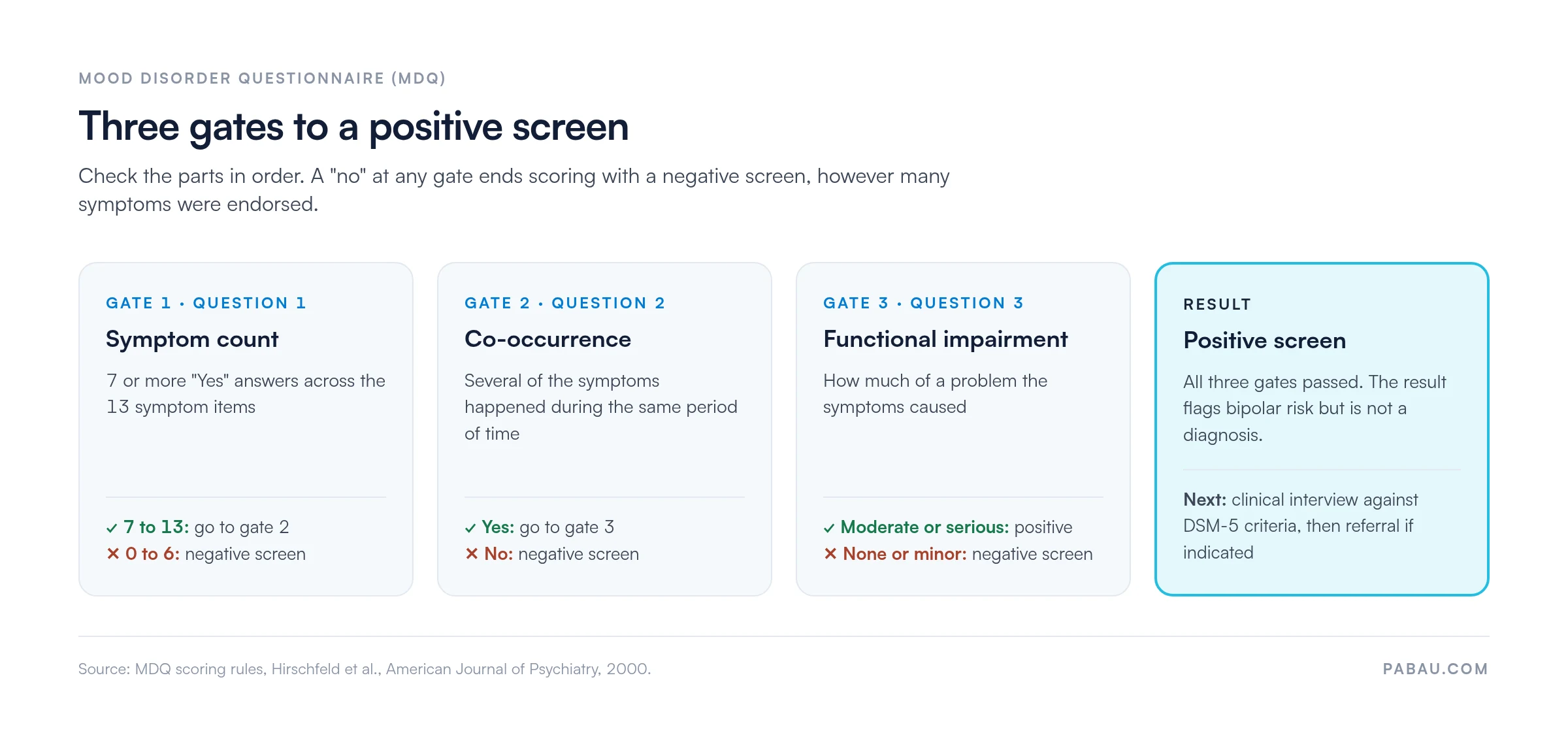
The patient marks “Yes” or “No” to 13 items describing manic or hypomanic symptoms. Examples include needing less sleep, feeling unusually energetic, talking more than usual, racing thoughts, and excessive spending. Count the total number of “Yes” responses. If the count is 7 or higher, go to Step 2. If it is lower than 7, the screen is negative.
Question 2 asks whether several of these symptoms happened during the same period of time. This confirms the symptoms cluster in one episode of elevated mood, rather than being scattered across years. A “Yes” confirms co-occurrence. A “No” makes the screen negative, whatever the symptom count.
Question 3 asks how much of a problem the symptoms caused: no problem, minor, moderate, or serious. Only “moderate” or “serious” produces a positive screen. Together, enough symptoms, co-occurrence, and functional impact separate clinically significant bipolar risk from subclinical mood variation.
A positive MDQ result meets all three criteria at once. Knowing what each threshold means helps you explain results to patients and decide next steps.
The most frequent error is stopping at the symptom count. A patient who endorses nine items but rates the impact as a minor problem has a negative screen. Nine is well over the threshold, but the impairment gate still decides the result.
Two other slips are worth checking for:
A positive MDQ screen is a red flag for bipolar risk, not a diagnosis. Your next step depends on the patient’s presentation, history, and current symptoms.
Conduct a structured psychiatric interview using DSM-5 bipolar disorder criteria to confirm or rule out bipolar I, bipolar II, or related conditions. Then work through these checks:
If the MDQ is negative but the patient reports significant mood episodes or treatment resistance, consider rescreening in 6 to 12 months. Some bipolar II presentations are subtle and may not trigger a positive screen on first administration. A mood tracker kept between visits can surface episodes the patient forgets to mention. Document the screening result and the rationale for any follow-up evaluation.
The MDQ’s diagnostic accuracy varies by setting and patient population. The original validation study was Hirschfeld et al., 2000, published in the American Journal of Psychiatry. It reported approximately 73% sensitivity and 90% specificity for bipolar spectrum disorder (bipolar I and II combined) in outpatient psychiatric samples.
Sensitivity is lower for bipolar II, because hypomanic episodes are subtler and often under-reported. In primary care settings, sensitivity drops further because patients may have less clear-cut manic episodes. Where bipolar II is still suspected, the Bipolar Spectrum Diagnostic Scale is another self-report screen to consider.
Bottom line: A positive screen warrants a full evaluation. A negative screen doesn’t rule out bipolar disorder, especially bipolar II, so clinical judgment should guide further workup.
The MDQ symptom items map closely to DSM-5 manic and hypomanic episode criteria. Both require a distinct period of elevated or expansive mood. Both also look for additional symptoms such as reduced need for sleep, talkativeness, racing thoughts, distractibility, more goal-directed activity, and risky behavior.
The MDQ is a practical shortcut. A positive screen should prompt a full DSM-5 assessment to confirm the diagnosis. That assessment also separates bipolar I from bipolar II, based on episode duration and severity.
The MDQ can produce false positives in patients with ADHD, borderline personality disorder features, substance use disorders, or anxiety disorders with activation. These patients may endorse racing thoughts, goal-directed activity, or decreased need for sleep without meeting criteria for mania or hypomania.
Always combine the MDQ with a thorough clinical interview, collateral history from family or previous records, and a review of medical and substance-use history. Only then conclude bipolar disorder. The MDQ is a starting point, not a finished diagnosis.
Primary care clinicians often use the MDQ during a depression workup, when a patient with depressive symptoms may have underlying bipolar disorder. It fits naturally alongside a depression screen such as the PHQ-9. Psychiatrists use it to confirm or rule out bipolar features in more complex presentations. Both settings benefit from a standardized, quick tool, though psychiatric settings allow deeper evaluation when a screen is positive.
Many practices still hand patients a paper questionnaire, count the answers by hand, and type the result into the notes later. Each handoff adds a chance to miscount or misfile a positive screen.
In Pabau, that work moves into digital intake forms. You set up your licensed screening questionnaire once and send it before the appointment. The completed form lands in the patient record, ready to review alongside the clinician’s notes.
The outcome is a screening record your team can find and act on. A positive result, the referral decision, and the rescreening date sit in one place for the next appointment. Booking, notes, and billing run on the same software for therapy practices, so screening never lives in a separate system.
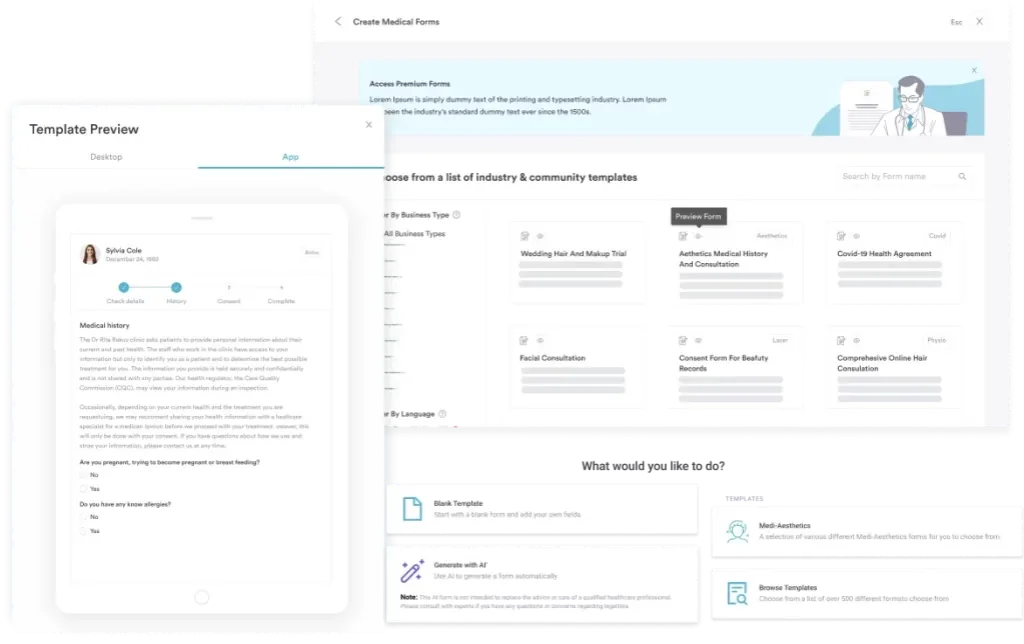

Send your licensed screening questionnaire online and keep completed results and referral decisions in the patient record.

Mood disorders questionnaire scoring is a practical, validated screening method that helps clinicians identify bipolar risk early. Apply all three criteria every time, and treat a positive screen as the start of a clinical assessment, not its end.
Record the number of Yes answers, the co-occurrence answer, the impairment rating, and the result in the patient’s notes. The free download is a general clinical documentation form rather than an MDQ scoring sheet, so pair it with your licensed copy of the MDQ.
Book a demo to see how Pabau can send your licensed screening questionnaire online and keep completed results and referral decisions in the patient record.

Need to document the patient’s full mental health history? Psychiatric Evaluation Template provides a complete structure for comprehensive mental health assessment and treatment planning.
Want to streamline your screening intake process? Pabau’s mental health EMR lets you send your licensed screening questionnaire online and keep completed results and referral decisions in the patient record.
Running a psychiatry practice? Psychiatry EMR software shows how Pabau handles psychiatric documentation, scheduling, and follow-up in one system.
Need to rate manic symptoms after a positive screen? Altman Self-Rating Mania Scale gives patients a short self-report measure of current manic symptom severity.
A positive MDQ screen requires all three criteria. The patient endorses 7 or more of 13 symptoms with ‘Yes’ and confirms several occurred in the same time period. Those symptoms also caused moderate or serious functional impairment.
No. The MDQ is a screening tool that flags bipolar risk and prompts further psychiatric evaluation. Only a full clinical assessment using DSM-5 criteria can diagnose bipolar disorder.
The MDQ is brief (13 items, 5-minute completion), validated across settings, and has high specificity. Other tools like the Rapid Mood Screener or Bipolar Spectrum Diagnostic Scale differ in length, item focus, and sensitivity for bipolar II detection.
Conduct a structured psychiatric interview and explore the timeline and context of reported symptoms. Screen for medical or substance-use causes, then refer to psychiatry if bipolar disorder appears likely or diagnostic clarity is needed.
Yes, but with lower sensitivity. The MDQ catches bipolar II patients, but because hypomanic episodes are subtler than manic episodes, some bipolar II cases may be missed on first screening. Clinical judgment and repeat screening over time improve detection.
Yes. ADHD, borderline personality disorder, substance use, and anxiety can produce false positives. Always confirm positive screens with a full psychiatric interview and collateral history before concluding bipolar disorder.