Maja Popovska

Stylage filler: Grades, consent form and aftercare
Download your free Stylage consent form A ready-to-use patient consent form for ...

1
Last Updated: Oct 28, 2026
Free PDF 5 pages, print-ready Clinician-reviewed
A bipolar disorder ATI template is a system disorder worksheet for nursing students. It organizes the pathophysiology, risk factors, expected findings, medications, and nursing care for a patient with bipolar disorder. Pabau's free version is a 12-section assessment form. It covers history, current symptoms, cognitive and functional testing, behavior, the treatment plan, patient education, and follow-up. Lithium levels and suicide risk have no field of their own, so this guide shows where to add them. Bipolar disorder affects roughly 2.8% of US adults each year, according to the National Institute of Mental Health (survey data from 2001-2003).
A 12-section bipolar disorder assessment form covering patient details, medical and psychiatric history, current symptoms, and cognitive, functional, and behavioral assessment. It closes with the treatment plan, patient education, care team collaboration, follow-up, and documentation.
Start from scratch, or upload this PDF or any form you already use, and Pabau's AI Form rebuilds it with tick boxes, text fields and a signature. Attach it to the treatment once, and every patient gets it on time.
AI Form rebuilds the consent, history and aftercare forms you already use. You review each one, then publish.
Patients complete forms on their phone before they arrive, so the front desk stops retyping paper.
Every signed form is versioned and attached to the treatment record, ready when you need it.
Set how long a consent stays valid. Returning patients skip forms they have already signed.
Supports HIPAA and GDPR compliance AES-256 encryption 4.8 on G2 4.7 on Capterra Trusted by 4,000+ practices worldwide

A bipolar disorder ATI template turns one patient’s mood episode into a system disorder worksheet, from DSM-5-TR diagnosis to discharge teaching.
Current FDA labeling targets a serum lithium level of 0.8 to 1.2 mEq/L for acute mania and 0.8 to 1.0 mEq/L for maintenance.
Lithium becomes toxic at 1.5 mEq/L or higher, and dehydration, NSAIDs, diuretics and ACE inhibitors all push the level up.
Mania calls for low stimulation, portable food and consistent limits, while depression calls for a suicide risk check at every contact.
Most lost marks come from generic entries, so tie every field to your patient’s own findings, labs and medications.
A bipolar disorder ATI template is a system disorder worksheet built around the ATI Active Learning format. It asks you to record the disorder’s definition, pathophysiology, risk factors, expected findings, diagnostic tests, medications, safety concerns and nursing care in one place.
Nursing programs use the format because it links cause, presentation and care in a single document. A finished template shows why a manic patient needs finger foods and why lithium levels need checking. It also shows why discharge teaching decides whether the patient comes back.
You’ll meet the condition often on a psychiatric rotation. The National Institute of Mental Health estimates, in survey data from 2001-2003, that 2.8% of US adults had bipolar disorder in the past year. Around 4.4% will have it at some point in their lives. Past-year rates peak at 4.7% among adults aged 18 to 29.
The downloadable PDF is an assessment form with 12 numbered sections. It runs from patient information and psychiatric history through cognitive, functional and behavioral assessment to the treatment plan, education, interprofessional collaboration and follow-up.
Work through the form in order, using your assigned patient’s chart and your course text as sources. Each step below maps to a field a clinical instructor will expect to see.
The PDF’s sections don’t carry ATI’s box labels, so the table below shows where each ATI heading belongs on the form.
The form has no dedicated lab box. Record lithium levels and baseline labs in Section 8, next to the drug they belong to. Your instructor can then match each value to its medication.
The table below summarizes what belongs in each field of a completed template and the level of detail instructors expect.
The exact cause of bipolar disorder is unknown, according to NIMH. Research points to differences in brain structure and function, with dysregulation of dopamine, serotonin and norepinephrine and disrupted circadian rhythms.
For the template, explain the mechanism in plain language and link it to what you saw. A patient who hasn’t slept in three nights shows the circadian piece. Rising energy and goal-directed activity reflect the excess dopamine activity linked to mania.
Bipolar disorder often runs in families. NIMH notes that heredity explains most of that pattern, with many genes involved and no single gene causing the disorder. Having a parent or sibling with the condition raises risk, but identical twins can still differ.
Other factors to check in the chart include the following:
Record only the factors that apply to your patient. A copied list of every possible risk factor tells your instructor you didn’t read the chart.
DSM-5-TR separates the three main forms by the most severe episode the person has had. Use the table to pick the right label for the alterations in health box.
A manic episode needs three or more symptoms, or four if the mood is only irritable. Hypomania needs the same symptoms for at least four consecutive days, without marked impairment or hospitalization. A major depressive episode needs five symptoms lasting at least two weeks.
Sort your findings by episode type rather than listing every symptom of bipolar disorder. The table shows what instructors look for in each column. Describe what you observe in the domains of a mental state examination, such as speech, mood and thought process.
NIMH calls four or more mood episodes within one year rapid cycling. Note it in the template if the history shows it, because it changes the treatment plan.
No blood test diagnoses bipolar disorder. Labs rule out medical causes such as thyroid disease and set a baseline before mood stabilizers start. The table lists the baseline checks for the drugs you’ll see most.
Sources for the table are the FDA labels for lithium and Depakote, plus the ADA and APA consensus statement on antipsychotics. The cognitive tests in Section 5 of the PDF, such as the MMSE, belong under diagnostic procedures.
Mood stabilizers such as lithium, valproate and lamotrigine form the core of treatment, with atypical antipsychotics used for acute episodes. Antidepressant monotherapy can trigger mania, so it isn’t presented as a first-line choice.
The FDA prescribing information for lithium sets a target serum level of 0.8 to 1.2 mEq/L for acute manic or mixed episodes. For maintenance, the target is 0.8 to 1.0 mEq/L. Many nursing texts still quote 0.6 to 1.2 mEq/L, so use the range your program tests.
The first level is drawn after three days, 12 hours after the last dose, and regularly until the patient is stable. Levels are rechecked after any dose change, a new interacting drug, a change in exercise or a new illness.
The FDA label puts toxic concentrations at 1.5 mEq/L or higher, close to the therapeutic range. Some patients show toxic signs at levels inside the range, so assess the patient as well as the number. The scale below sets the target ranges against the toxic threshold.
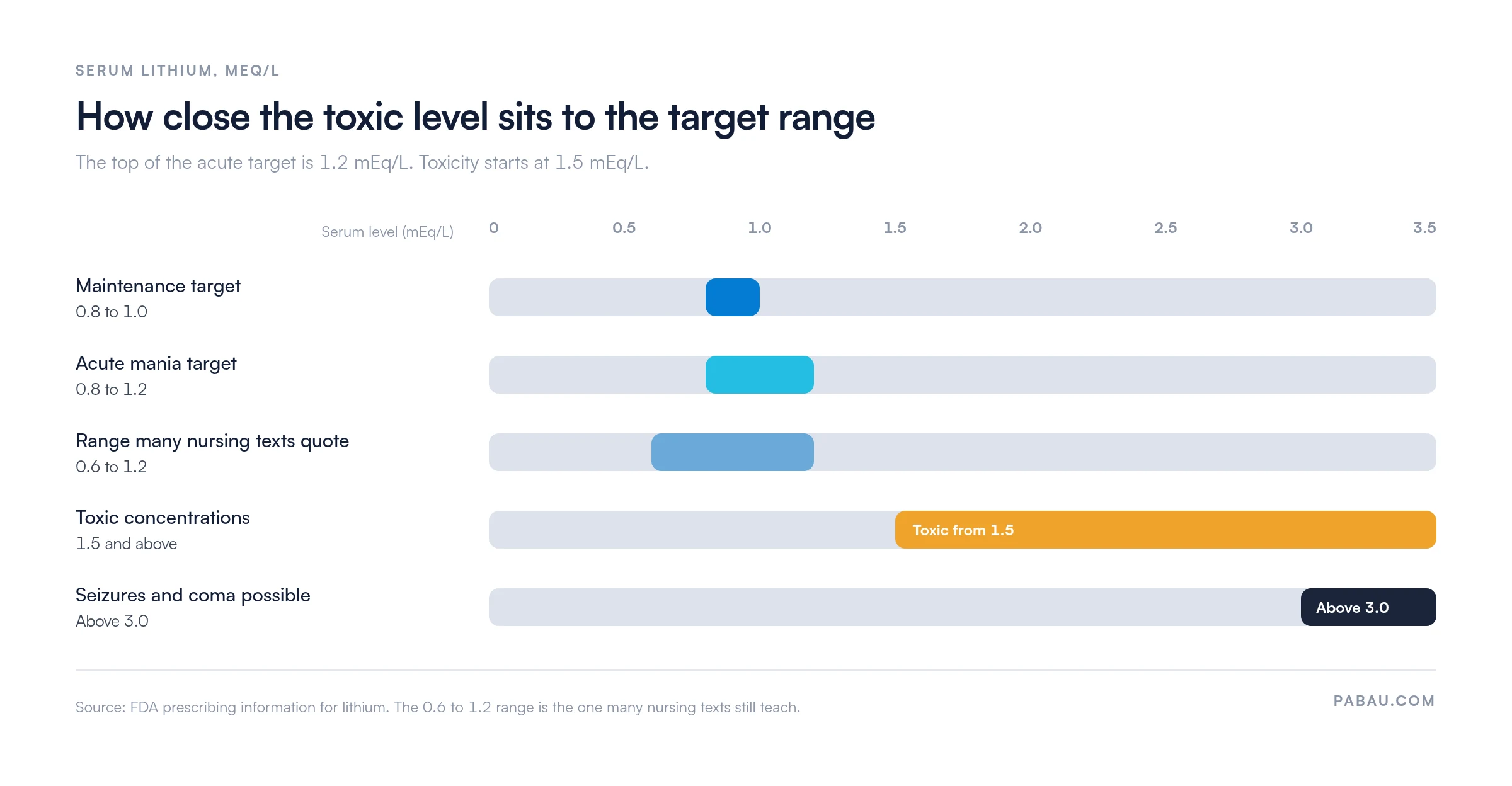
Course texts often split toxicity into bands by serum level, but the cutoffs differ between sources. Write the bands your program teaches, and add the nursing action: Hold the dose, notify the provider and get a stat level.
Nursing care changes with the episode. Write interventions with a rationale for each, because instructors grade the reasoning as much as the action. If your program also asks for a nursing care plan, these interventions carry over with their rationales.
Keep the unit free of items that can be used for self-harm or as weapons. Check belongings on admission and remove cords, belts and sharps per facility policy.
Use the least restrictive measure first. Seclusion or restraint is a last resort, ordered and documented under facility policy, with frequent checks on the patient’s safety and needs.
Suicide risk is the most serious safety concern in bipolar disorder, and it must be assessed at every contact. It rises during depressive and mixed episodes and in the early recovery period.
Escalate according to facility policy and record the patient’s own words. A written safety plan, such as the Stanley-Brown safety plan, lists warning signs, coping steps and crisis contacts. It belongs in the discharge packet.
List the drug-specific risks in the same box:
Bipolar disorder causes heavy disability. The National Institute of Mental Health reports, in survey data from 2001-2003, that 82.9% of US adults with the condition had serious impairment. That was the highest share among mood disorders.
Record which complications apply to your patient and the monitoring plan for each.
Health promotion centers on keeping episodes from starting. The template should name the steps that fit your patient’s triggers.
ATI labels this box client education. It covers why medication must be taken daily during stable periods, and how to recognize early signs of an episode. Teach the patient when to seek emergency care, including any thoughts of self-harm.
Lithium teaching is where most of the detail sits. Base it on the FDA prescribing information for lithium:
The entries below show the depth a strong submission reaches for one fictional patient. The patient is a teaching composite, invented for this example.
Notice that each entry names something seen, measured or said. That specificity is what separates a top grade from a pass.
Run through this checklist before you submit:
Once you’re qualified, the same assessment moves from a student worksheet to a working record. In many practices it’s still a printed PDF that gets scanned, filed and retyped into the chart.
Pabau, the therapy practice management software we build for mental health teams, turns a paper form like this into a digital form. Patients complete their history on a phone or tablet before the visit, and it lands in their patient record automatically.
Clinicians then add findings, treatment notes and follow-up plans to the same record. Automated appointment reminders help patients turn up for their medication reviews and blood draws.

Pabau stores intake forms, treatment notes and follow-up plans against each patient record. Your team can review a mood history in one place before every appointment.

A bipolar disorder template earns its marks in the details tied to one patient. Get the diagnosis type right, sort findings by episode, and pair every lab with the drug that needs it.
If you only polish two fields, make them safety and lithium teaching. Those are the boxes instructors read first, and they’re the ones that protect your future patients. Book a demo to see how Pabau keeps mental health assessments and follow-up plans in one patient record.

Writing a full care plan next? Bipolar disorder nursing care plan turns the same assessment into diagnoses, goals and evaluated interventions.
Need the drug details in one place? Mood stabilizer medication list covers doses, side effects and monitoring for each mood stabilizer.
Want to measure mania over time? Altman Self-Rating Mania Scale gives you a five-item score to track manic symptoms between visits.
Preparing a discharge safety plan? Stanley-Brown safety plan walks a patient through warning signs, coping steps and crisis contacts.
Documenting appearance, mood and thought process? Mental state examination explains how to record each domain of the exam clearly.
The bipolar disorder ATI template is a system disorder worksheet that organizes the diagnosis, pathophysiology, risk factors, findings, medications and nursing care for one patient. Nursing students complete it during psychiatric rotations and for ATI mental health preparation. A strong one ties every entry to the patient’s own findings, labs and teaching needs.
The etiology of bipolar disorder is not fully known, but it combines genetic and environmental factors. NIMH reports that it often runs in families and involves many genes, with no single gene causing it. Stress, sleep disruption and substance use can trigger episodes in people who are already at risk.
The seven types are the diagnoses listed in the DSM-5-TR chapter on bipolar and related disorders. The three main forms are bipolar I disorder, bipolar II disorder and cyclothymic disorder. The other four cover symptoms caused by a substance or medication, symptoms due to another medical condition, and other specified or unspecified presentations.
SMART goals for bipolar disorder are specific, measurable, achievable, relevant and time-bound. Examples include attending three follow-up visits in one month or keeping a daily sleep and mood log for two weeks. For a patient on lithium, a good goal is completing every scheduled blood draw before the next appointment.