Physician credentialing checklist
A physician credentialing checklist lists every license, certificate, verificati...

Last Updated: Oct 23, 2026
The general behavior inventory (GBI) is a self-report questionnaire clinicians use to screen for hypomanic, manic, and depressive symptoms linked to bipolar spectrum disorder. The full version has 73 items, each rated from 0 to 3 for how often it happened over the past year. It’s a screening instrument, not a standalone diagnostic test.
Many practices record mood history in unstructured intake notes, which makes findings hard to compare across visits. A standard form keeps the questions consistent, and the free template below gives you the full 73-item version.
The full 73-item revised GBI long form, with name and date fields and the 0–3 frequency scale printed above the items. Patients rate how often each behavior happened over the past year.
Download template
The GBI is a self-report screening instrument for bipolar spectrum symptoms, not a diagnostic test.
The full form has 73 items rated 0 to 3, split into a 46-item depression scale and a 28-item hypomanic/biphasic scale.
A parent-report version and its 10-item mania scale cover children and adolescents.
Scoring follows the published guidance for each version, so confirm cutoffs against the original research.
Digitizing GBI responses in your EHR keeps results linked to the patient record over time.
The general behavior inventory is a self-report screening questionnaire for bipolar spectrum symptoms. Richard Depue and colleagues developed it, and it’s widely cited in psychiatric research on mood disorders. Clinicians use it to prompt patients to describe their mood and behavior over time.
The instrument is a research and clinical aid. It supports, but does not replace, a structured clinical interview. Any diagnosis still rests on the clinician’s full assessment.
The GBI asks about symptom patterns that cluster around mood episodes. Patients answer each item about their own experience.
The questions cover both directions of mood change. That makes the GBI useful when a clinician needs to know whether a patient’s history may fall on the bipolar spectrum.
The GBI comes in more than one form, and the right one depends on the patient. The standard instrument is a longer self-report scale for adults. A parent-report version lets a parent or guardian rate a child or adolescent. A 10-item mania scale (PGBI-10M) was derived from the parent-report version and screens children and adolescents for mania.
Scoring the general behavior inventory means totaling item responses according to the published scoring guidance for the version you use. Scoring rules differ by version, so the template does not replace the original instrument manual.
On the full form, each of the 73 items is rated from 0 (never or hardly ever) to 3 (very often or almost constantly). The items feed two subscales, a 46-item depression scale and a 28-item hypomanic/biphasic scale. Item 44 counts toward both, and the breakdown below shows how the full total reaches 219.
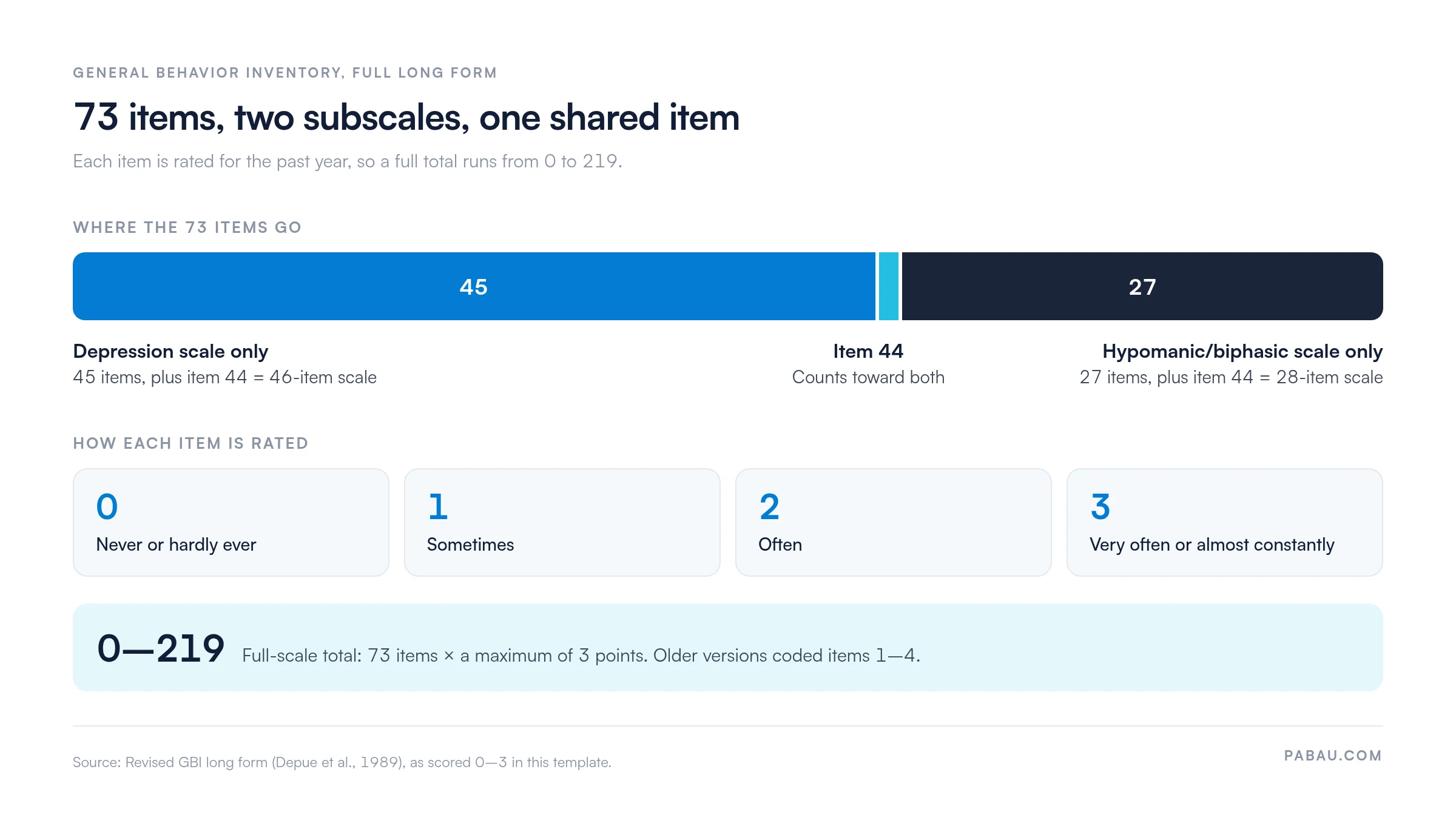
Older versions used 1–4 coding, so check which scoring your template uses before you compare totals. The template on this page uses 0–3.
Cutoff thresholds vary by study and version, so avoid treating any single number as universal. Use the threshold from the study that matches your version and population.
The GBI has been studied for its ability to tell bipolar spectrum patients apart from other groups. Published work reports discriminant validity for bipolar disorder. In the studies reviewed, it separates bipolar from non-bipolar presentations better than chance.
Reliability and criterion validity have been examined in several samples. Results differ by population and version, so read the primary papers for the specific coefficients.
Primary validation evidence is indexed on PubMed, and the instrument’s publication record is listed in the APA PsycNET database.
Clinicians typically use the GBI during intake or early in an assessment, when a patient’s mood history is still unclear. It works best in a quiet setting, with enough time for the patient to reflect on past episodes.
Keeping completed forms in a structured record lets you compare responses over time. Digital forms make that comparison easier than paper files, and they cut the risk of misplaced documents. In Pabau, the practice management platform we build, digital intake forms capture the same questions and attach each response to the patient’s record.
The GBI has been examined in adolescent offspring of parents with bipolar disorder, which is a high-risk group. Evidence in this group is separate from the adult evidence, so don’t assume results transfer directly.
When assessing a young person, consider the parent-report version alongside the self-report form, or the 10-item mania scale for a brief check. Interpret each result against evidence for that specific version and age group.
Clinicians often choose between the GBI and other screening instruments. The right choice depends on the clinical question, the population, and how much time you have. Shorter tools such as the bipolar spectrum diagnostic scale trade the GBI’s depth for speed.
The mood disorder questionnaire is another common bipolar screen, and some clinicians use the two together. Choose based on the question you need answered first.
Many practices still hand patients a printed GBI, then scan the pages and type the total into a note. The form, the score, and the version end up in different places. Comparing results months later then means digging through files.
Pabau’s therapy practice management software holds questionnaire responses alongside the rest of the clinical file. History, notes, and treatment plans sit in one place.
Clinicians apply the scoring guidance and clinical judgment themselves. Pabau keeps the score, version, and date together, so the next comparison starts from a complete record.

Pabau’s digital forms send each GBI response straight to the patient record. Scores, versions, and dates sit beside your clinical notes, ready to compare at every visit.

The GBI earns its place at intake when a patient’s mood history is unclear and a depression label may hide a bipolar course. Its value depends on how consistently you use it.
Match the version to the patient, score it with that version’s published key, and log the version and date with each result. A score with no version attached can’t be compared at the next visit, and that comparison is the point of screening.
Treat a high score as a reason for a structured interview, never as a diagnosis. Book a demo to see how Pabau keeps each GBI result in the patient record, ready to compare at the next visit.

Comparing bipolar screens before you choose one? Mood Disorders Questionnaire scoring explains how to score the MDQ, another common bipolar screen.
Want a narrative-style bipolar screen? Bipolar spectrum diagnostic scale (BSDS) template gives patients a short story to rate against their own mood history.
Tracking manic symptoms between visits? Altman Self-Rating Mania Scale (ASRM) offers a five-item check of current manic symptoms.
Screening a teenager for mood swings? Teenage bipolar test covers bipolar screening for adolescents.
Measuring depression severity after a positive screen? Hamilton Depression Rating Scale scoring explains how to score the clinician-rated HAM-D.
The general behavior inventory is a self-report screening questionnaire for bipolar spectrum symptoms. Clinicians use it to structure a patient’s mood history, and it is not a standalone diagnostic test.
Scoring totals item responses using the key from the published guidance for the version you use. Compare the total against the cutoffs from the validation study that matches your population.
Yes, a parent-report version exists for assessing children and adolescents. Its validation evidence differs from the adult form, so interpret results against that version’s own evidence.
Both screen for bipolar spectrum symptoms, but they differ in structure and focus. Choose the one whose items and validation match your patient and clinical question.
The full general behavior inventory has 73 items. A 46-item depression scale and a 28-item hypomanic/biphasic scale make up the total, and item 44 counts toward both.
Current scoring rates each item from 0 to 3. A 0 means never or hardly ever, and a 3 means very often or almost constantly. On that scale the full 73-item total can reach 219. Older versions used 1–4 coding, so check which scoring your template uses.
No. The GBI is a screening instrument, so a high score flags a patient for a structured clinical interview. A diagnosis rests on the clinician’s full assessment.
Store completed forms securely in the patient record, since they hold sensitive mental health information. Record the version, score, and date with each result so later scores can be compared.