Tanja Lepcheska
House rehab checklist
What a house rehab checklist covers and who completes it A house rehab checklist...

3
Last Updated: Oct 27, 2026
Free PDF 2 pages, print-ready Clinician-reviewed
A patient describes weeks of flat, heavy mood, then a stretch of unusual energy, irritability, and spending that causes trouble. That history does not fit bipolar I, and a depression checklist will not catch it. The Bipolar Spectrum Diagnostic Scale (BSDS) was written for exactly that presentation.
This page hands you the BSDS as a free PDF. You also get the scoring math, the four interpretation bands, and the total that should trigger a psychiatric referral. It sets the scale against the Mood Disorder Questionnaire too, so you can decide which instrument belongs in your intake.
A ready-to-use screening form with patient details, the 19-sentence mood narrative with a check box on every line, and the four-option story-fit question. It also carries the scoring box and the clinician interpretation table.
Start from scratch, or upload this PDF or any form you already use, and Pabau's AI Form rebuilds it with tick boxes, text fields and a signature. Attach it to the treatment once, and every patient gets it on time.
AI Form rebuilds the consent, history and aftercare forms you already use. You review each one, then publish.
Patients complete forms on their phone before they arrive, so the front desk stops retyping paper.
Every signed form is versioned and attached to the treatment record, ready when you need it.
Set how long a consent stays valid. Returning patients skip forms they have already signed.
Supports HIPAA and GDPR compliance AES-256 encryption 4.8 on G2 4.7 on Capterra Trusted by 4,000+ practices worldwide

The BSDS is a 19-sentence narrative about shifting mood and energy, written by Ronald Pies, MD, to catch bipolar II and cyclothymia.
The patient checks every sentence that describes them, then rates how well the whole story fits.
Each checked sentence scores 1 point, and the story-fit rating adds 6, 4, 2, or 0, for a total out of 25.
A total of 13 or above is a positive screen. It calls for a full psychiatric evaluation, not a diagnosis.
Pabau’s digital forms let you run the BSDS at intake, track scores across appointments, and keep them in the patient record.
The Bipolar Spectrum Diagnostic Scale is a validated screening instrument developed by Ronald Pies, MD. It opens with a story rather than a symptom list. The patient reads a passage of 19 sentences, written in the third person, describing how one person’s mood and energy shift over time.
The patient checks each sentence that describes them, then answers one question about how well the whole passage fits. That two-part design captures the rhythm of bipolar mood change instead of a tally of symptoms. The rhythm is what makes the scale useful for bipolar II disorder and cyclothymia, which present more softly than bipolar I.
A psychiatry practice or a mental health practice can use the BSDS to flag patients who need formal evaluation. The maximum score is 25 points, read across four probability bands.
The downloadable form keeps the instrument and its scoring on one document, so nobody transcribes the same answers twice. Each part maps to a step in administration.
File the completed form with the patient’s mood history rather than on its own. A screening score only helps at the next appointment if it sits beside the notes that explain it.
Administering the scale takes two steps, and the order matters. The patient reads and checks first, then rates the passage as a whole.
The two parts then add together. Total BSDS score = checked sentences (0 to 19) + story-fit rating (0, 2, 4, or 6). The sum runs from 0 to 25.
Four score bands turn a total into a probability of bipolar spectrum disorder. Before you read them, it helps to see how the 25 points split between the two parts.
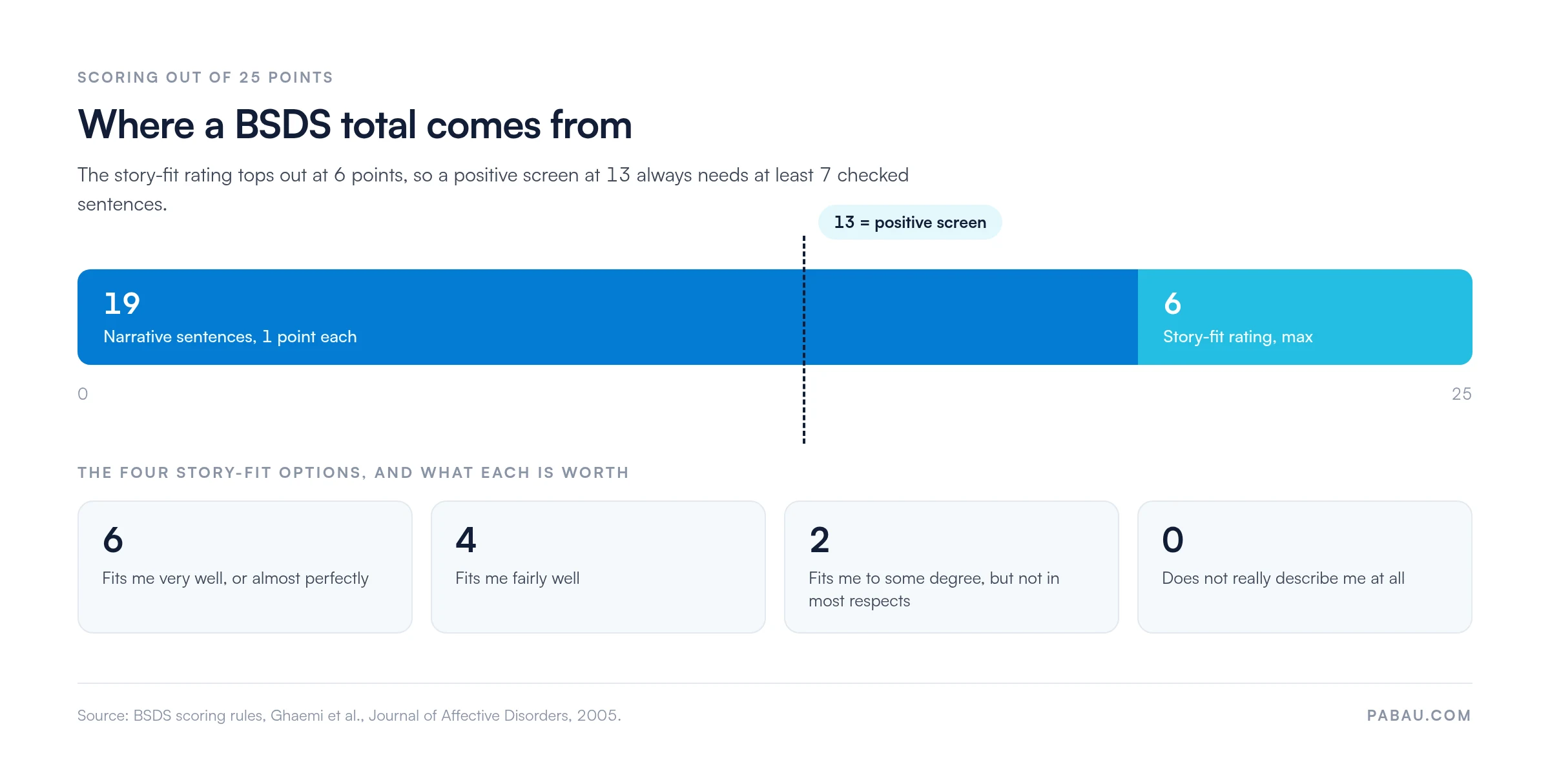
That split matters at the referral threshold. A patient who says the story fits perfectly still scores only 6 points. So a positive screen always rests on the sentences they checked, never on the rating alone.
A total of 13 or above is the threshold for a positive screen. The scale stays a screen rather than a diagnostic instrument. Confirming a bipolar spectrum diagnosis takes a formal psychiatric evaluation against DSM-5 criteria.
Clinicians often choose between the BSDS and the Mood Disorder Questionnaire (MDQ) for bipolar screening. Both are validated. They differ in format, in sensitivity, and in the presentations they catch.
The 2005 validation study appeared in the Journal of Affective Disorders. It put BSDS sensitivity near 75% for bipolar I and 79% for bipolar II. Those figures are why it sits alongside the MDQ rather than behind it.
Plenty of practices run both screens together. The BSDS catches softer presentations, while the MDQ gives a broader categorical read. A digital forms system can hold both instruments in one intake flow, so the patient completes them in a single sitting.
The BSDS suits mental health practices, psychology practices, and primary care as a first screening step. Patients who score 13 or above should be referred for a comprehensive psychiatric evaluation. For adolescent patients, a teenage bipolar test is built around teen presentations, which show faster mood shifts and more irritability than euphoria.
The limitations matter as much as the total. The passage assumes a reading level the patient may not have, and every answer is self-reported. Mood presentations also overlap.
Major depressive disorder with anxiety, seasonal affective disorder, and personality traits that resemble hypomanic energy can all push a total up. Treat the result as one data point inside a full psychiatric evaluation, never as a standalone diagnosis.
Where the history includes hallucinations or delusions, pair the BSDS with a psychosis spectrum test. That combination helps distinguish bipolar disorder with psychotic features from schizoaffective disorder.
Plenty of practices still print the BSDS, then type the total into the record hours later. That leaves two copies of the same assessment, and the score reaches the chart long after the appointment that produced it.
Therapy practice management software like Pabau puts the screen where the appointment already lives. The 19 sentences and the story-fit question run as a custom intake form, on the patient portal or an in-practice tablet. Answers save into the patient record, so nobody retypes a total.
Repeating the screen at follow-up appointments builds a score history you can read at a glance. That trend shows whether mood is stabilizing, which a one-off paper score cannot. Pabau Scribe, our AI scribe, can reference the total inside the clinical note, so the reasoning behind a referral stays on the record.

Pabau’s digital forms let you embed validated screening tools like the BSDS and capture responses automatically. Scores then sit in the patient record, tracked over time.

The BSDS earns its place in intake because it asks the patient to recognize a pattern instead of ticking isolated symptoms. That framing is what surfaces bipolar II and cyclothymia. It is also why a total of 13 should start a conversation rather than settle a label.
Download the form, fold it into intake, and let the total decide who gets referred. A more sensitive screen refers more patients who turn out not to have bipolar disorder. That is the right trade when the alternative is treating bipolar depression as unipolar.
Book a demo to see how Pabau keeps screening scores, referrals, and clinical notes in one patient record.

Need the full assessment behind the screen? Psychiatric evaluation template gives you a structured guide for a comprehensive mental health assessment.
Rating a manic episode rather than the spectrum? Young Mania Rating Scale (YMRS) template scores manic symptom severity during a clinician interview.
Want a screen the patient can finish in a minute? Altman Self-Rating Mania Scale is a five-item self-report tool with a single cut-off score.
Planning what happens after a positive screen? Bipolar treatment plan template sets out goals, interventions, and review dates for ongoing care.
Tracking mood between appointments? Daily mood chart gives the patient a simple log that turns into a trend you can read.
The BSDS is a two-part screening tool for bipolar spectrum disorder. The patient reads a 19-sentence narrative about shifting mood and energy, checking each line that describes them. They then rate how well the whole story fits. Totals run from 0 to 25, and the scale was built to catch softer presentations such as bipolar II and cyclothymia.
Each checked sentence is worth 1 point, for a maximum of 19. The story-fit rating then adds 6, 4, 2, or 0 points, depending on which of the four boxes the patient checks. The two parts combine into a total out of 25. Read 0 to 6 as highly unlikely, 7 to 12 as low probability, 13 to 19 as moderate, and 20 to 25 as high.
No. The BSDS is a screening tool, not a diagnostic instrument. A total of 13 or above indicates that a full psychiatric evaluation is warranted. Only a clinician assessment against DSM-5 criteria can confirm a bipolar spectrum diagnosis.
The BSDS asks the patient to recognize a narrative pattern, which makes it more sensitive to bipolar II and cyclothymia. The MDQ is a shorter yes/no checklist that suits broader bipolar screening. Many clinicians run both as complementary screens inside one intake.
The BSDS is copyrighted, so it is not freely licensable. It appeared in the Journal of Affective Disorders, copyright Elsevier 2005. Reproductions run by permission of its developers, Ronald Pies, MD, and Nassir Ghaemi, MD. Clinical screening use is widespread, but check the copyright holder’s terms before you reprint it or build it into your own materials.
Ronald Pies, MD, a psychiatrist specializing in mood disorders, wrote the BSDS. Nassir Ghaemi, MD, and colleagues published the validation study in 2005, reporting sensitivity near 75% for bipolar I and 79% for bipolar II. The design goal was better detection of soft bipolar presentations than existing tools managed.