Trauma response test: Free template for clinicians
A trauma response test is a structured screening questionnaire that helps clinic...

3
Last Updated: Oct 15, 2026
A mood tracker is a structured form patients use to record their daily mood, emotions, activities, and triggers. You then review the patterns together in session. Our free two-page printable gives each patient a daily page with 1–5 mood and overall ratings, plus a monthly summary page to review together.
Patients complete it between sessions, and you review the data at the start of the appointment. You then document the trends in the mental health practice management record. Vague self-reports like “I’ve been feeling down” become specific ratings you can act on.
This is a two-page printable tracker. The daily page covers mood and overall ratings on a 1-5 scale, emotions, activities, notes, gratitude, self-care, goals, and a short description of the day. A monthly summary page covers average mood, emotional patterns, self-care trends, achievements, and challenges.
Download template
Mood trackers turn a patient’s vague self-report into daily ratings you can compare from one session to the next.
Mood is what the patient reports, and affect is what you observe, so record the two separately in your notes.
Our free template covers daily mood and overall ratings, emotions, activities, notes, gratitude, self-care and goals, plus a monthly summary page.
The template has no sleep or medication fields, so ask patients to log those details in the Notes field.
Pabau’s digital forms let patients submit the same fields from their phone, straight into the patient record.
A mood tracker quantifies emotional state, while a journal narrates the experience. A patient logs “anxious, 4 out of 5” instead of a paragraph about their day. Clinicians use the ratings to spot patterns the patient can’t see alone, like dips on Sundays, spikes after coffee, or changes around a new medication.
Trackers solve three concrete problems in practice:
The National Institute of Mental Health (NIMH) and the American Psychological Association (APA) recommend mood monitoring as a standard intervention. It is used in cognitive-behavioral therapy, acceptance and commitment therapy, and dialectical behavior therapy (DBT).
Structured observation helps patients and clinicians recognize patterns sooner. Patients who track also tend to engage more intentionally with treatment, which is linked to better outcomes in depression and anxiety trials.
Mood and affect are different things, and your session notes need both. Mood is the patient’s sustained internal emotional state, usually what they report (“I’ve felt hopeless all week”). Affect is the observable expression of emotion: facial expression, tone, and energy during the session.
A patient might report stable mood (“I’m okay”) while showing blunted affect, with a flat expression and quiet tone. That mismatch can signal depression, medication side effects, or dissociation.
A mood tracker captures the patient’s self-reported mood, and you observe and document affect in session. When the tracker shows improved mood but affect stays flat, that’s clinical data you can act on. Either the internal shift hasn’t reached observable behavior yet, or medication is masking emotional recovery.
Mood tracking comes in four formats, each with its own clinical use:
Whichever format you choose, the data only helps if it reaches your system. AI-powered clinical documentation can then structure it for your records. Paper trackers handed out at intake need no app install, password, or technical setup. Apps are more flexible, but their data stays outside your clinical record unless your practice management system pulls it in.
Use a mood chart for patients who respond to visual patterns, since they can see their mood improve from session to session. A mood journal works for therapy focused on emotions and narrative processing.
Apps suit tech-comfortable patients or those who need reminders between sessions. Printable templates work best handed out at the first appointment, for patients to complete daily before they return.
An effective mood log captures five core data points:
Patients who only ever write “bad” usually need more words to choose from. A list of mood words for documentation gives both of you a shared vocabulary.
This structure keeps the log focused on information you can act on. Say a patient brings in a week of logs with a clear pattern: “Every Saturday my mood drops after I skip my morning run.” That gives you concrete evidence to guide treatment. Digital forms can standardize these fields, but paper trackers do the same job with less technology.
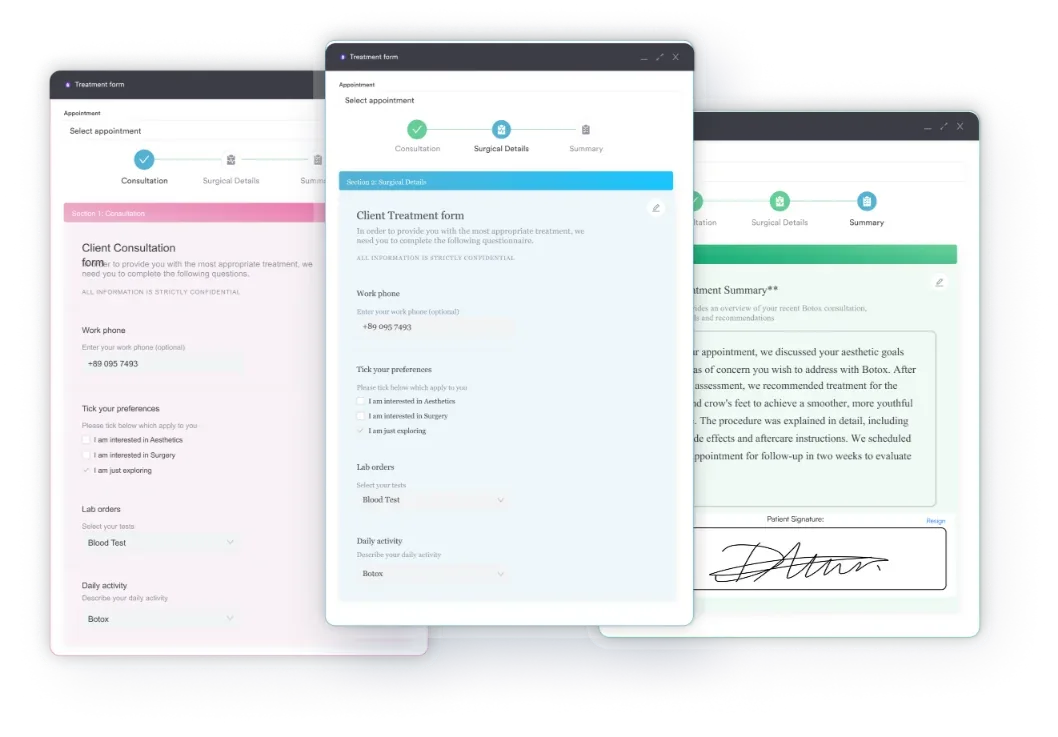
The template is a general-purpose mood tracker in a bullet journal layout, split across a daily page and a monthly summary page. It isn’t built for any one diagnosis, so you can hand it to most adult patients who are working on emotional awareness.
There are no dedicated fields for sleep hours, medication, or energy level. If those matter for a patient, ask them to record them in the Notes field so the details still reach your session.
The template works in three ways. First, the daily mood and overall ratings show how mood moves over the weeks between appointments. Second, the Activities and Notes fields help patients link a low day to what came before it, like a missed workout.
Third, the monthly summary page gives you both a structured review point, because the patient arrives having already reflected on patterns, achievements, and challenges.
The gratitude, self-care, and goals fields suit therapy homework that builds positive habits. Once a patient returns completed pages, treat them as part of the clinical record. Mood data is highly sensitive, so store the pages with the same care as the rest of the patient’s file.
At session start, spend two minutes reviewing the tracker and pick out one pattern. “I see you rated your mood higher on days you exercised. Want to try moving your workouts earlier in the week?” That one observation turns the data into a therapeutic tool.
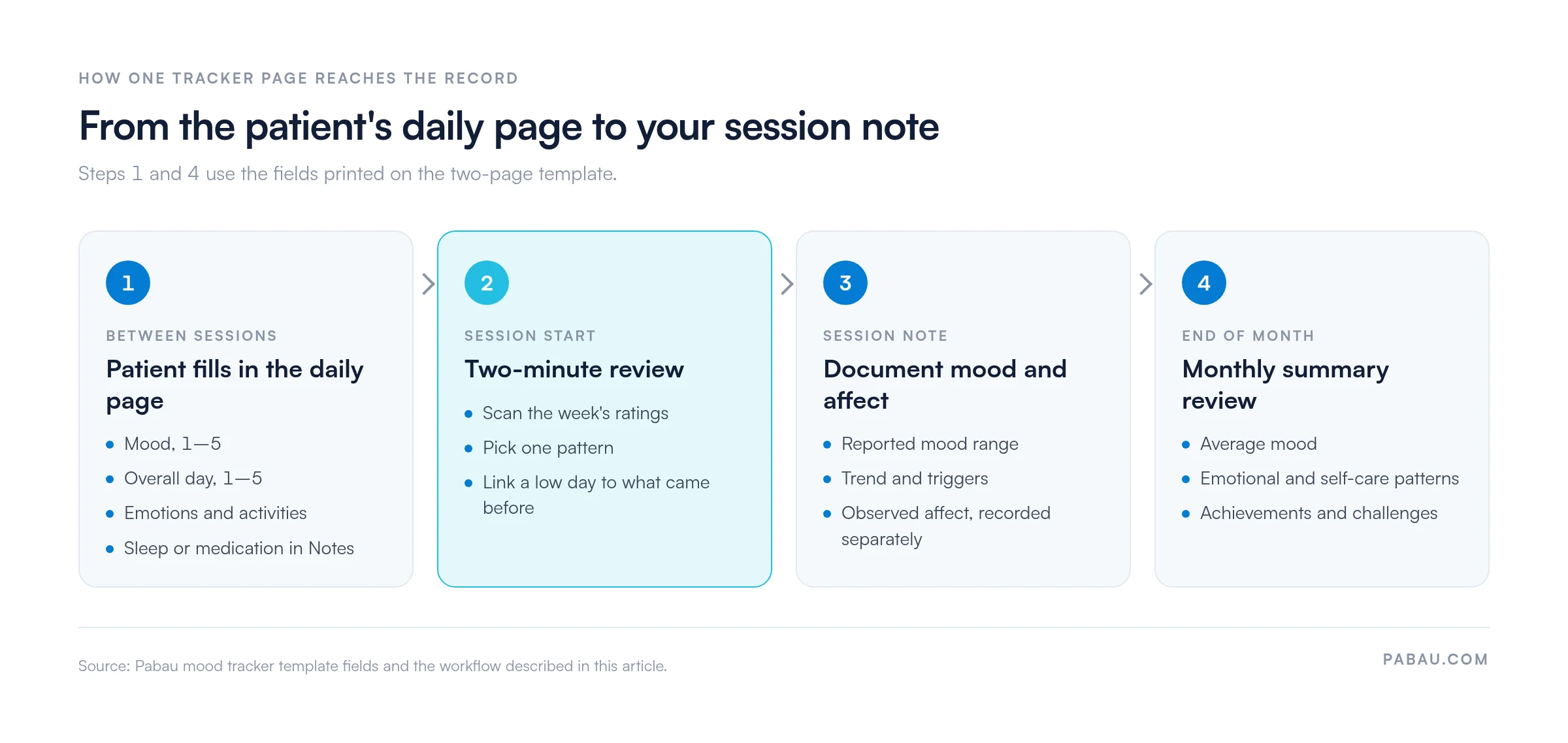
The flow below shows how a single daily page travels from the patient to your notes.
Mood trackers are especially useful for medication monitoring, and psychiatrists use them when deciding whether to adjust dosage or timing.
Say a patient on a new antidepressant shows stable mood for three weeks, then an unexplained dip. That dip might signal a timing issue or a life stressor, and the tracker helps you tell them apart. Store these detailed records in a HIPAA-compliant system.
A printable template is the better start when a patient begins tracking, and an app fits later, for long-term monitoring. Apps like Daylio or Moodnotes offer rich graphs and automated reminders. Printables offer simplicity and no setup at all. The right choice depends on your patients and clinical goals.
Choose an app if: your patients are tech-comfortable, you want data spanning months, and your practice management system pulls the app data in directly. Choose a printable if: you serve patients with limited smartphone access, or you want the data in your hands at the session.
A printable also suits practices that want a simple tool to hand out at the first appointment. A hybrid approach works too. Start patients on a printable tracker, then move engaged patients to an app for long-term monitoring.
The printable’s biggest advantage is low friction. A patient handed a paper form at intake can complete it that evening. A patient told to download an app faces four drop-off points: the app store search, the install, account creation, and first login. For baseline mood data, the printable wins. For long-term pattern analysis, you can move to digital later.
Frame the tracker as a clinical tool rather than homework. You might say: “I want to understand your mood patterns better. This tracker helps you notice what affects your mood, like sleep, activity, and stress. It also shows me what happens between sessions. Fill it in daily and bring it back next week.”
Tell the patient it takes about 90 seconds a day. Show them a completed example, so they can see it isn’t a diary.
Review the first week of data together in session and highlight one pattern. “You rated higher on days you called your friend, so connection seems to lift your mood.” This shows the tracker’s value straight away. It also builds the habit around an insight the patient found themselves.
Document tracker data in your clinical notes in plain, specific terms. For example: “Patient reports mood of 2–3 out of 5 this week, higher on exercise days. Notes mention poor sleep on two nights. No significant triggers identified.”
Then connect it to treatment: “Discussed more frequent morning exercise as a mood intervention. Patient agreed to aim for four sessions next week.”
Over time, the tracker becomes your objective measure. Week 1 might average 2 out of 5, and week 8 might average 4. That shift, backed by data the patient collected themselves, is strong evidence of progress. Comprehensive psychiatric assessment frameworks include mood tracking as standard, because the data is clinically useful and keeps patients engaged.
Paper trackers work, but the pages often stay in a folder. Someone has to scan them, file them, and remember to bring them up at the next appointment. When a patient forgets the page, a week of data goes missing.
Practice management software like Pabau lets you rebuild the tracker’s fields as a digital form. Patients can complete it on their phone before each appointment, and every response is saved to their patient record. Automated SMS and email reminders prompt them to fill it in, so fewer entries get skipped.
During the session, Pabau Scribe, our AI medical scribe, drafts your notes from the conversation while you review the ratings with the patient. The mood history, session notes, and treatment plan then sit in one record.
Every subscription includes every feature, so digital forms and email reminders cost nothing extra. SMS reminders draw on SMS credits, which you top up as needed.

Pabau’s digital forms, automated reminders, and Pabau Scribe help mental health practices capture mood data between sessions. It all sits alongside session notes and treatment plans.

Start with the printable. It costs nothing, needs no setup, and gets you baseline data by the second session. Hand it to your next patient at intake, track for three weeks, and review the pages together.
The trade-off comes later. Paper pages get lost and have to be scanned, so once a patient is tracking for months, a digital form saves you the filing. Therapy practice management software keeps that history in one record, from intake through discharge. Book a demo to see how Pabau collects mood tracker data for your practice between sessions.

Want a clinical vocabulary for the moods patients report? Types of moods walks through the clinical spectrum of moods and how to assess each one.
Need the right words for mood in your notes? Mood words for clinical documentation lists descriptors you can use when writing up tracker data.
Looking for a structured weekly check-in? Mental health check-in worksheet pairs a 0-10 mood check-in with reflection prompts and goals.
Working with patients who struggle to name emotions? Feelings face chart gives them illustrated faces to point to before they rate their mood.
Need a structured assessment framework for the first session? Psychiatric evaluation template gives you an intake structure that uses mood tracking as a baseline.
A mood tracker records emotional state as numbers and checkboxes, like 4 out of 5 anxious. A mood journal describes the experience in prose. Trackers are faster to complete and make patterns easier to spot. Journals support emotional processing, but they take more effort and are harder to analyze for trends.
Daily is ideal for capturing meaningful patterns. Many patients do a morning check-in that rates the day before, or an evening reflection on the same day. If daily feels overwhelming, a weekly summary works for less acute cases. The patient rates the week and notes what affected it.
Both work, for different reasons. Apps provide reminders and graphs, while printables need no setup at the point of care. For capturing baseline mood, a printable is the better start. For tracking patterns over months, apps with graphing features are easier to review.
Yes. Psychiatrists use mood tracker data to inform dosage and timing adjustments. For example, a patient’s mood might improve for three weeks on a new antidepressant, then dip unexpectedly. The tracker helps distinguish a medication plateau from a life stressor, which informs your next clinical decision.