Monika Lazarevska

DASES: Drug Avoidance Self-Efficacy Scale
DASES at a glance and what it measures DASES stands for Drug Avoidance Self-Effi...

2
Last Updated: Oct 29, 2026
Free PDF 4 pages, print-ready Clinician-reviewed
Relationship journaling prompts are short written questions that help individuals and couples reflect on communication, emotional intimacy, trust, and boundaries. The most useful ones are specific. "When did you last feel seen and heard by your partner?" draws a fuller answer than a broad question about love. Writing first gives people time to notice their own patterns before a hard conversation. Therapists can also assign the prompts as between-session homework.
Journaling supports reflection, but it doesn't treat any mental health or relationship condition. What follows covers a check-in routine, a clinician's assignment checklist, and every prompt in the free 30-question PDF, grouped by theme.
A printable set of 30 guided journaling questions on communication, emotional intimacy, trust, boundaries, and shared goals for individuals and couples.
Start from scratch, or upload this PDF or any form you already use, and Pabau's AI Form rebuilds it with tick boxes, text fields and a signature. Attach it to the treatment once, and every patient gets it on time.
AI Form rebuilds the consent, history and aftercare forms you already use. You review each one, then publish.
Patients complete forms on their phone before they arrive, so the front desk stops retyping paper.
Every signed form is versioned and attached to the treatment record, ready when you need it.
Set how long a consent stays valid. Returning patients skip forms they have already signed.
Supports HIPAA and GDPR compliance AES-256 encryption 4.8 on G2 4.7 on Capterra Trusted by 4,000+ practices worldwide

Relationship journaling prompts are short written questions about communication, intimacy, trust, and boundaries.
One or two prompts on a weekly or monthly schedule work better than one long writing session.
Clinicians can assign prompts as between-session homework, with clear rules on privacy and scope.
Journaling supports reflection, but it doesn’t treat or diagnose any relationship or mental health condition.
The free PDF holds 30 prompts for individuals and couples, with no scoring or exercises.
A relationship journaling prompt asks one question and invites a written answer. The best ones are specific enough to start writing and open enough for honest reflection. “When did you last feel seen and heard by your partner?” gets a fuller answer than “What does love mean to you?”
Couples can answer the same prompt separately, then compare notes. Individuals often use the same questions to spot patterns across past and current relationships. All 30 prompts from the free PDF appear later on this page, grouped by theme.
Expressive writing research, including work associated with psychologist James Pennebaker, suggests that putting experiences into words can help people process them. Direct evidence for couples is thinner. So it’s fairer to say journaling may support reflection than to claim it changes relationship outcomes.
Attachment-informed therapists treat writing as one tool among many. Prompts can help a patient notice how they respond to closeness and distance. That observation gives the next session something concrete to discuss. On its own, it never amounts to a diagnosis.
Clarity prompts help someone sort out what they want before a big decision or conversation. They suit people torn between staying and leaving, or unsure how to name a need. Two questions from the PDF work well here.
Keep each session to one or two prompts. Afterward, note what felt clear, what felt uncertain, and what you’d need to learn before deciding. If boundaries keep coming up, a healthy boundaries worksheet gives that theme more structure.
Prompts for avoidant attachment focus on how a person handles closeness, independence, and emotional expression. One might ask what happens in the body when a partner asks for more time together. These questions can surface strong feelings, so use them with clinical support. The free PDF doesn’t include them.
Trauma-related prompts should be trauma-informed. Let the writer choose how much to share, don’t press for detail, and signpost professional support clearly. Journaling is the wrong first step for someone in crisis or experiencing abuse. They should contact a qualified professional or local emergency service.
For patients at risk, put a mental health safety plan in place before you assign any writing homework.
A relationship check-in journal uses the same set of prompts on a fixed schedule, such as weekly or monthly. Consistency makes change easier to see over time. It also gives couples a low-pressure routine to come back to.
Couples who would rather talk than write can work through a relationship check-in template together instead.
Clinicians can assign relationship journaling prompts as between-session homework in couples therapy, an approach some therapists use alongside CBT-informed work. Set the purpose at the start of the session, agree on a timeframe, and review responses at the next appointment.
The cycle below shows where each step happens, and when to step off it.
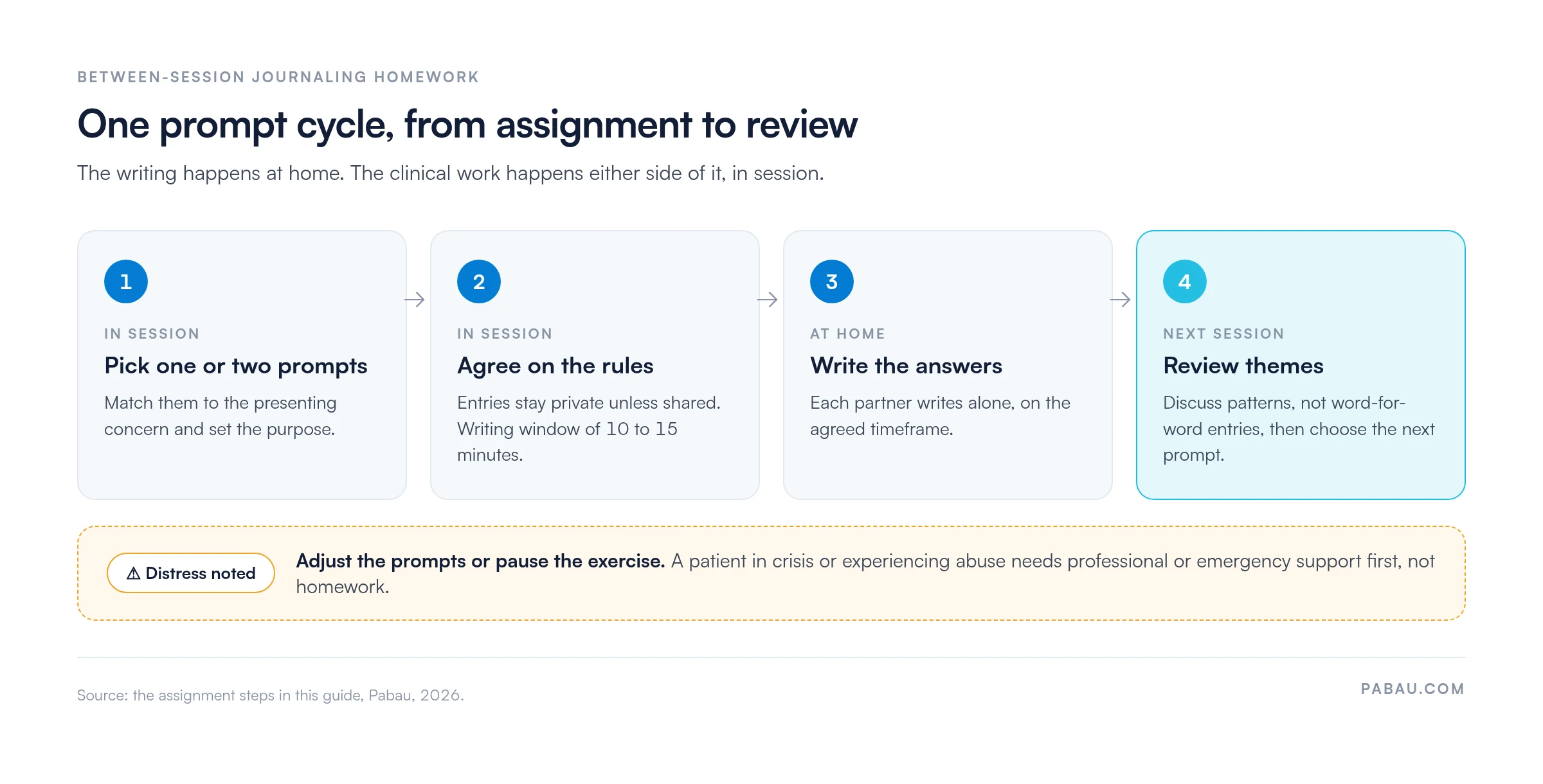
For structured work inside the session itself, pair the prompts with a couples therapy worksheet.
Journal content stays confidential. Where HIPAA applies in the US, or GDPR in the UK and EU, treat it as protected information. Record what you discussed in your psychotherapy progress notes, and store it under your practice’s data policies.
The PDF gathers guided questions on communication, emotional intimacy, trust, boundaries, and shared goals into one printable document. Individuals and couples can use it, and clinicians can hand it to patients as a starting point.
The PDF lists the prompts in one sequence. Here they are grouped by theme, so you can pick the ones that fit this week.
The prompt about your most meaningful romantic relationship may bring up a past partner, so keep it for individual reflection if partners share entries.
It opens with a short note on why journaling helps, then lists the questions with no scoring. Print a copy for each partner, or pick the one or two prompts that fit this week. Write the date beside each answer, so check-ins can be compared over time.
The answer boxes are short, so use a notebook for longer entries. Clinicians handing the PDF to patients should add a crisis contact to the printed copy, such as 988 in the US.
Many therapists still hand out prompts on paper or by email, then lose track of who received which set. The responses that come back sit in inboxes, far from the session notes.
Pabau, the practice platform we build for therapy and counseling practices, lets you send a prompt set as a form before the next appointment. Patients answer on their phone, and the responses land in their record.
The same digital forms handle intake and consent, so homework sits beside the rest of the patient file. You review themes from one screen, without hunting through email.

Pabau’s digital forms send relationship journaling prompts before the next session and file each response in the patient record. You review themes in session without chasing paper or email.

Start small. Pick one prompt that matches what a couple or patient is working on, and give it a week. A single honest answer, discussed in session, tells you more than a notebook of rushed ones.
The trade-off to remember is depth against safety. Clarity and check-in prompts work well on their own, while attachment and trauma prompts belong inside therapy. Hold that line and journaling stays a useful habit.
Book a demo to see how Pabau sends journaling prompts between sessions and files each response in the patient record.

Want prompts beyond relationships? Journal prompts for mental health covers mood, stress, and self-reflection questions for individual patients.
Working on repair after conflict? Gottman repair checklist gives couples a structured way to de-escalate and reconnect mid-argument.
Need a longer program for couples? Couples therapy workbook bundles exercises for communication, conflict, and shared goals across several sessions.
Assessing where a relationship stands? Relationship checklist helps partners rate the core areas of their relationship side by side.
Starting a general journaling habit? Journal entry prompts offers everyday prompts that make a daily writing routine easier to keep.
Write honest answers to one or two specific prompts, focusing on recent moments rather than general feelings. Note what happened, how you reacted, and what you needed. Short, frequent entries reveal patterns faster than long, occasional ones.
Only if both partners agree first. Many couples share themes or one chosen answer rather than full entries. Knowing an entry stays private usually makes the writing more honest.
Yes, it can support reflection after a breakup. Prompts about deal breakers, values, and what you’d want next time turn the experience into clearer priorities. If low mood persists, talk to a qualified professional.
No. A shared journal can make hard conversations easier, but it doesn’t assess or treat relationship problems. Partners facing ongoing conflict should consider couples therapy. Anyone experiencing abuse should contact a domestic abuse service or emergency help.
Journaling may support reflection and improve awareness, but direct evidence for changing couples outcomes is limited. It works best alongside open conversation or professional support.