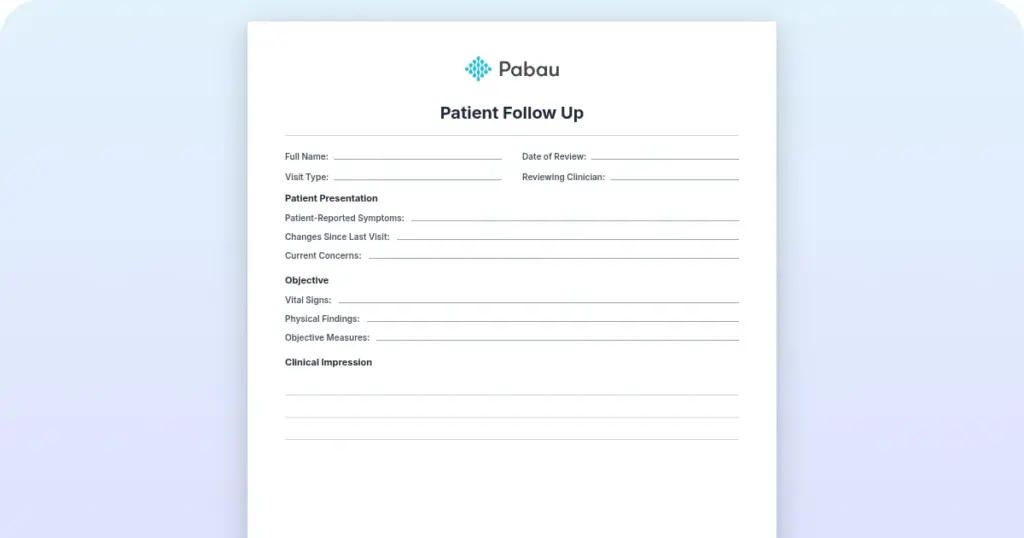
Patient follow up letter template
A patient follow up letter template lets your practice confirm a patient’s...

1
Last Updated: Oct 21, 2026

A HIPAA release form in Florida lets healthcare providers disclose protected health information (PHI) to third parties, as required under 45 CFR 164.508.
Florida Statute 456.057 (Medical Records Act) imposes additional state-level requirements beyond federal HIPAA for medical record release, including specific notification and timing provisions.
The form must include the patient’s name, a PHI description, recipient details, disclosure purpose, an expiration date or event, and the patient’s dated signature. Omitting any element invalidates the authorization.
Practice management software like Pabau lets Florida practices collect, store, and track HIPAA authorizations in one place, reducing compliance risk.
A comprehensive, state-compliant authorization form covering federal HIPAA Privacy Rule requirements, Florida Medical Records Act provisions, required form elements, signature blocks, and expiration options. Ready to customize for your Florida practice.
Download templateFlorida healthcare practitioners must navigate both federal HIPAA regulations and state-specific medical records laws when releasing patient information. A properly constructed Florida HIPAA release form ensures your practice stays compliant while protecting patient privacy and reducing liability during the disclosure process. Compliance tracking works when the evidence is captured as the work happens, not assembled before an audit.
A Florida HIPAA release form, also called an authorization for release of information form, is a legal document. It lets a healthcare provider disclose a patient’s protected health information (PHI) to a designated recipient.
Under the federal HIPAA Privacy Rule (45 CFR 164.508), covered entities cannot release PHI without a valid written authorization. Exceptions include treatment, payment, and healthcare operations.
Florida state law layers additional requirements on top of federal HIPAA. The Florida Medical Records Act (F.S. 456.057) governs how healthcare practitioners release medical records. It imposes stricter timelines, notification rules, and fee schedules than HIPAA alone.
While the federal HIPAA Privacy Rule sets the floor for authorization requirements, Florida practitioners must also comply with state law. The Florida Medical Records Act adds three requirements on top of HIPAA:
These requirements apply to every Florida practice that releases records, from a specialist’s office to a busy GP clinic.
Florida also imposes heightened protections for sensitive health information categories that go beyond standard HIPAA. This includes mental health records, substance abuse treatment records, and HIV-related information, and each needs a separate or more explicit authorization under state law.
The federal HIPAA Privacy Rule specifies exact elements a valid authorization must contain. Missing or unclear information invalidates the entire authorization and prevents you from disclosing the PHI. Here are the mandatory components:
Every field matters: a Florida HIPAA release form missing even one of these eight elements will be deemed invalid by regulators and courts.
Florida law recognizes sensitive health information categories that require enhanced protection beyond standard medical records releases. Three key categories demand special handling:
If your Florida practice treats mental health or substance abuse, or manages HIV-positive patients, you need specialized authorization forms. Use these in addition to, or instead of, the general HIPAA release form. A single, generic form will not satisfy these requirements. Practices that also handle dental records should keep a separate dental records release form for those requests.
Marketing use falls outside a records authorization altogether. Practices that publish patient reviews or before-and-after photos need a separate testimonial release signed before the content goes out.
Completing the form correctly is essential. Here are the five key steps to follow:
Common errors that invalidate authorizations include vague health information descriptions, missing signature dates, blank recipient fields, and no expiration date. Staff training is critical. One incomplete form triggers a compliance violation.
A Florida HIPAA release form is only valid until its expiration date or event. Once expired, you cannot use the old authorization to release records. The patient must sign a new form. Under 45 CFR 164.508, the authorization must specify either:
Florida Statute 456.057 requires practitioners to retain medical records for a minimum of five years (longer for minors). The authorization itself should be retained with the patient’s chart as proof of valid disclosure. Even after the authorization expires, keep the signed form as documentation that you acted lawfully.
A patient can revoke a Florida HIPAA release form at any time, even after signing. Under 45 CFR 164.508(b)(5), the patient simply submits a written request to revoke the authorization.
Once you receive revocation notice, you cannot make any further disclosures under that authorization, though disclosures already made before revocation remain valid.
Document all revocation requests in writing and file them with the original authorization. Notify the recipient, if you already disclosed records, that the authorization has been withdrawn. Make it easy for patients to revoke: never require an in-person visit or a fee to withdraw consent.
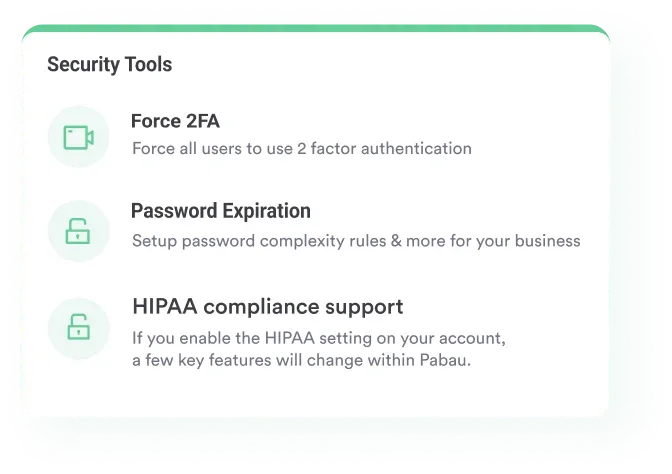
Manual, paper-based HIPAA release forms create compliance risk. Unsigned forms get lost, expiration dates get missed, and there’s no record of who accessed or sent protected health information.
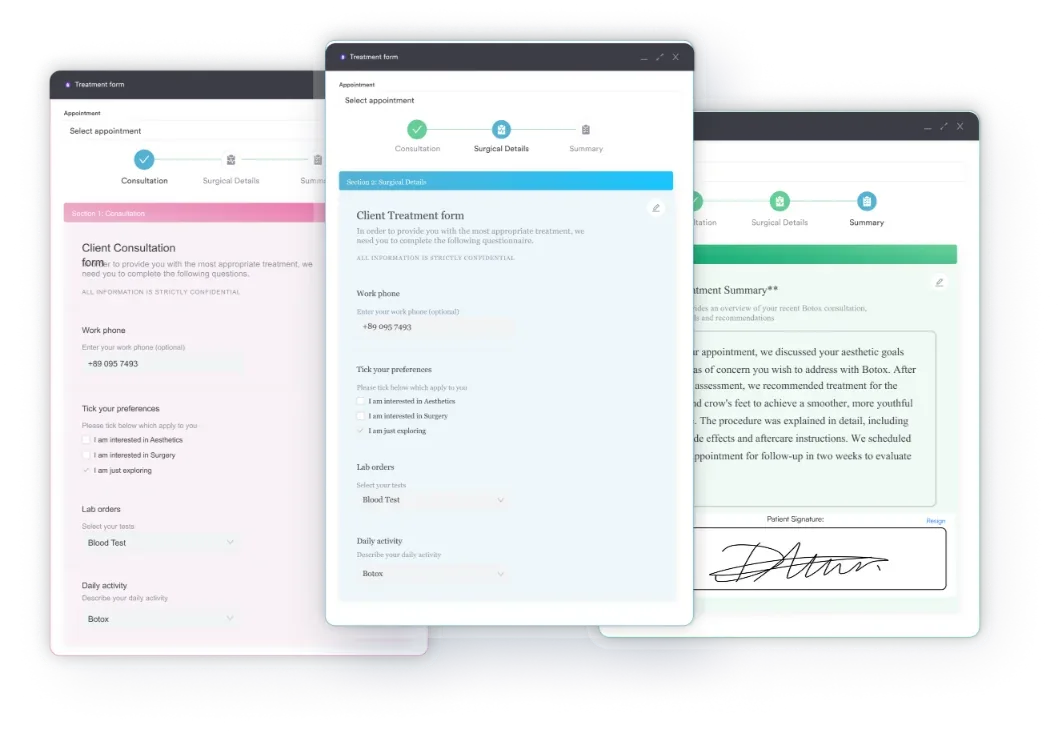
Pabau’s digital forms feature moves this process online. Florida practices can send a HIPAA release form for an electronic signature and store the signed copy directly in the patient’s chart. Staff can then check whether a valid, unexpired authorization exists before disclosing any records, without hunting through paper files.
This reduces the risk of releasing records under an expired or incomplete authorization. It also keeps a stored, time-stamped copy in the patient’s chart, ready to show a regulator or auditor on request.

Pabau’s digital forms let Florida practices collect, sign, and store HIPAA release forms directly in the patient’s chart. Staff can then confirm a valid authorization before disclosing records.

A Florida HIPAA release form has to satisfy two layers of law at once. The federal Privacy Rule sets eight required elements, while Florida law adds stricter timelines, fees, and sensitive-record rules. Skipping either layer invalidates the authorization and exposes the practice to a compliance complaint.
Build the form once, get every element right, and reuse it consistently rather than drafting a new version for each request. Track expiration dates and revocations just as carefully as the signature itself.
Digitizing this workflow removes most of the manual error that invalidates authorizations in the first place. Book a demo to see how Pabau keeps HIPAA release forms compliant and easy to track for your Florida practice.

Need a wider emergency compliance document? Emergency action plan template covers evacuation steps, staff roles, and posting requirements.
Documenting an adverse event at your practice? Incident report form guide explains what belongs in the record and how long to keep it.
Worried about a possible HIPAA violation? HIPAA violation investigation guide explains what happens during a federal investigation and how internal or external breaches trigger one.
Need a general medical release form? HIPAA medical release form lists the nine elements a valid authorization needs, plus state-specific rules and the free form.
A valid HIPAA release form in Florida must include the patient’s name and date of birth, plus a description of the health information. It must also name the recipient, state the purpose of disclosure, and set an expiration date or event. Finally, it needs the patient’s dated signature and a statement of the right to revoke the authorization. Missing any element invalidates the entire form.
The authorization remains valid until the expiration date or event specified on the form. Once expired, a new authorization is required for any further disclosures. Florida law requires medical records retention for at least five years, so retain signed authorizations with the patient’s chart as proof of lawful disclosure.
Yes. A patient may revoke the authorization in writing at any time, even after signing. Upon receipt of revocation notice, you must stop making disclosures under that authorization, though prior disclosures remain valid. Document all revocations and file them with the original authorization.
Mental health records (F.S. 394.4615) require a separate, explicit authorization beyond the standard HIPAA form. Substance abuse treatment records fall under federal 42 CFR Part 2, which has its own consent form separate from HIPAA. HIV-related records (F.S. 381.004) also require specific written consent. A single general authorization does not cover these sensitive categories.
Yes, if the patient signs a HIPAA release form authorizing the family member to receive the records. If the patient lacks capacity, for example if they are unconscious, deceased, or a minor, a legally authorized representative may request the records. This representative could be a parent, guardian, health care surrogate, or executor, acting under Florida law. The authorization process is the same: a signed form naming the family member as recipient.
Yes. The Florida Medical Records Act (F.S. 456.057) requires practitioners to release records within 30 days and limits copying fees to actual costs. It also mandates that patients receive a copy of the authorization, and it imposes stricter timelines and documentation requirements than HIPAA alone. Florida’s rules on mental health, substance abuse, and HIV records are also stricter than federal HIPAA.