HIPAA compliant texting: What you can send patients & how to communicate securely
HIPAA compliant texting is possible when a text holds no protected health inform...

Last Updated: Oct 16, 2026
A fridge temperature log is a daily record of the current, minimum and maximum temperatures inside a medication or vaccine fridge. Staff check it at set times, initial each entry, and note any corrective action.
Practices use it to prove stock stayed between 2°C and 8°C (36°F to 46°F) and to catch a failing fridge before vaccines are lost. This free template gives you a row for every check, plus space to record what you did when a reading went out of range.
It suits practices registered with the Care Quality Commission (CQC) in England and US practices enrolled in the Vaccines for Children (VFC) program.
A printable log with one row per check for the date, time and reading, plus a notes and action taken column. It also has fields for who recorded it, the period covered, and patterns you noticed.
Download template
A fridge temperature log records the current, minimum and maximum temperature of each medication or vaccine fridge, with initials and any corrective action.
Medication fridges must stay between 2°C and 8°C (36°F to 46°F), and freezers for freeze-stable vaccines between −15°C and −25°C (5°F to −13°F).
VFC providers and CQC-registered practices record temperatures twice daily with a min/max thermometer, then reset it after each reading.
Practice management software like Pabau holds the rest of your inspection file, including digital consent forms, audit trails and role-based staff permissions.
A fridge temperature log is a structured daily record of the minimum and maximum temperatures inside a medical fridge, and often a freezer. In a healthcare setting, it does three jobs:
Most practices check twice daily, in the morning and the evening, using a min/max thermometer. It holds the lowest and highest temperatures reached since its last reset.
Each entry notes the date, the time, the current temperature, and the minimum and maximum since the last check. Whoever took the reading adds their initials. If a reading drifts outside 2°C to 8°C, the entry also records what happened next.
CQC expects practices that store medicines to keep evidence of safe fridge storage, and inspectors ask for temperature records during a CQC inspection. The CDC Vaccine Storage and Handling Toolkit also requires VFC providers to keep daily temperature logs. A shared template means every team member records the same fields, so no half-finished or illegible entries turn up at inspection.
Each check takes five steps, and the template has a place for every one of them.
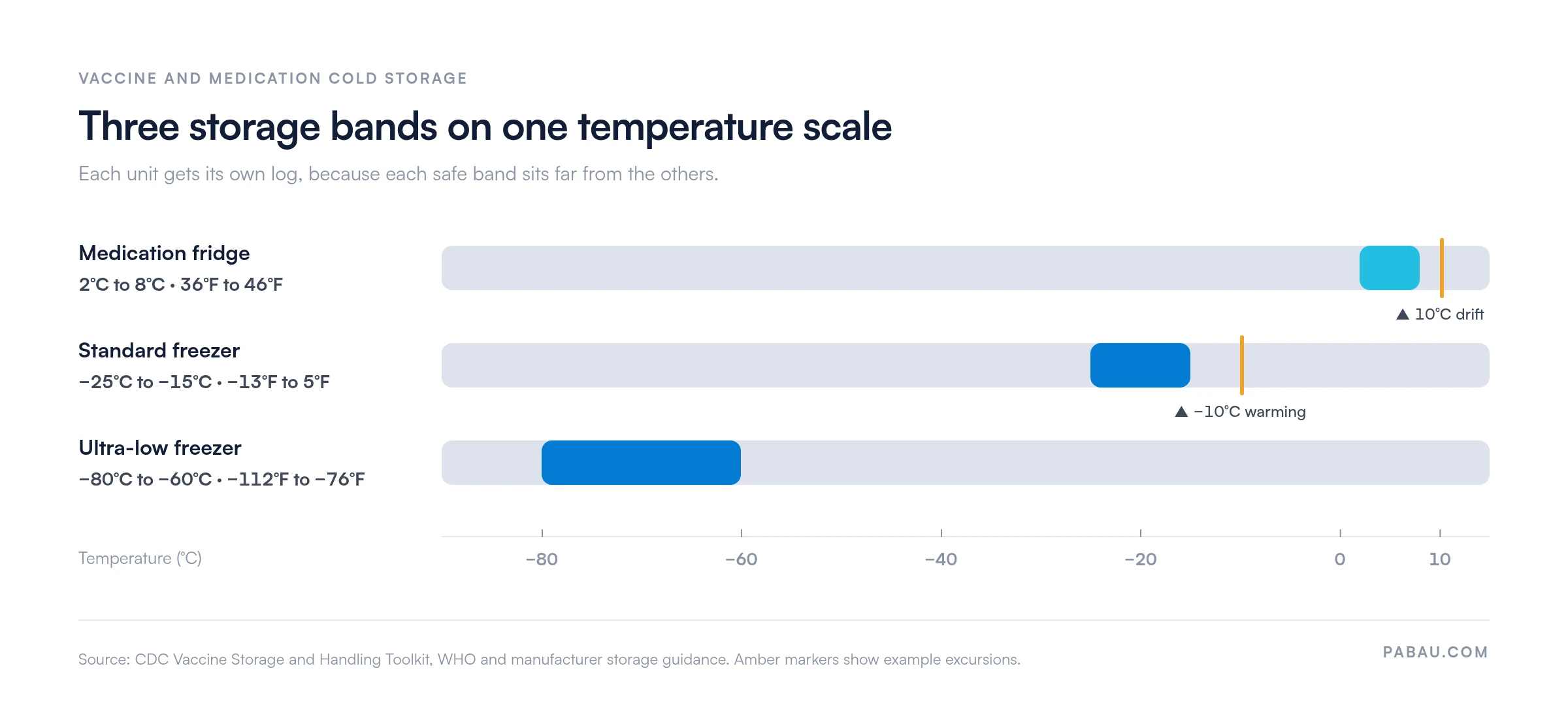
The safe range depends on the product. The table below shows the three storage bands clinical teams work with.
Some products carry their own freezer range, so the manufacturer’s label has the final word for each vaccine. Going outside these bands can reduce vaccine efficacy and medication potency. A fridge that drifts to 10°C, or a freezer that warms to −10°C, may leave vaccines unusable and needing replacement.
Plotted on one scale, the bands sit so far apart that no single unit can hold them all. That is why each fridge and freezer needs its own log.
A temperature excursion is any reading outside the safe band, which is 2°C to 8°C for a medication fridge. One reading isn’t automatically a crisis, but it needs an immediate, documented response. Work through these six steps.
Any practice that stores temperature-sensitive medications or vaccines needs one. That includes these settings.
Even a solo practitioner with a handful of vaccine vials needs a log to meet CQC or state expectations. Fertility practices storing hormone medications have an occupational safety list to check. Estradiol and testosterone both sit on the NIOSH hazardous drug list, which sets separate labeling and handling rules.
Regulatory compliance: CQC looks for evidence of safe medicines storage, and a completed log is the main document you’ll show. Without one, the inspector records a finding. With one, you show systematic governance.
Audit trail and incident response: When an excursion happens, the log shows when it started, what was done about it, and who authorized it. If a patient later receives a compromised vaccine, that record shows you caught the problem quickly and followed protocol.
Team accountability: A standard template removes guesswork about what to record and when. Initials show who last logged a normal reading, so the person who finds a problem knows where the timeline breaks.
Cost avoidance: Refrigerated vaccines and medications are expensive to replace. A fridge that drifts unnoticed for days can spoil a month of stock, while twice-daily checks catch drift within hours.
Paper logs
Digital data loggers
Most small and mid-sized practices start with a paper log and a min/max thermometer, which meets regulatory requirements at low cost. Once you run several fridges across more than one location, a digital data logger becomes worth the spend. A sensible middle route keeps the paper log as your main record. Add a wireless thermometer with app alerts to cover nights and weekends.
Fridge temperature logging is a regulatory requirement in several jurisdictions, and each regulator frames it slightly differently.
No regulation mandates one specific template. All of them ask for the same core data, though. That means the date, time, minimum and maximum temperatures, current temperature, initials, and any corrective action. This template has room for each field, so it’s audit-ready from the first day you use it.
**Pro tip: Post the log on or beside the fridge itself.** A log the team can see is far less likely to be skipped. Print a fresh sheet each week and file completed sheets in a dedicated compliance folder, so you can meet three-year retention.
A paper fridge log covers one part of your compliance file. Inspectors also look at digital consent forms, staff training records, incident logs, and records of patient interactions.
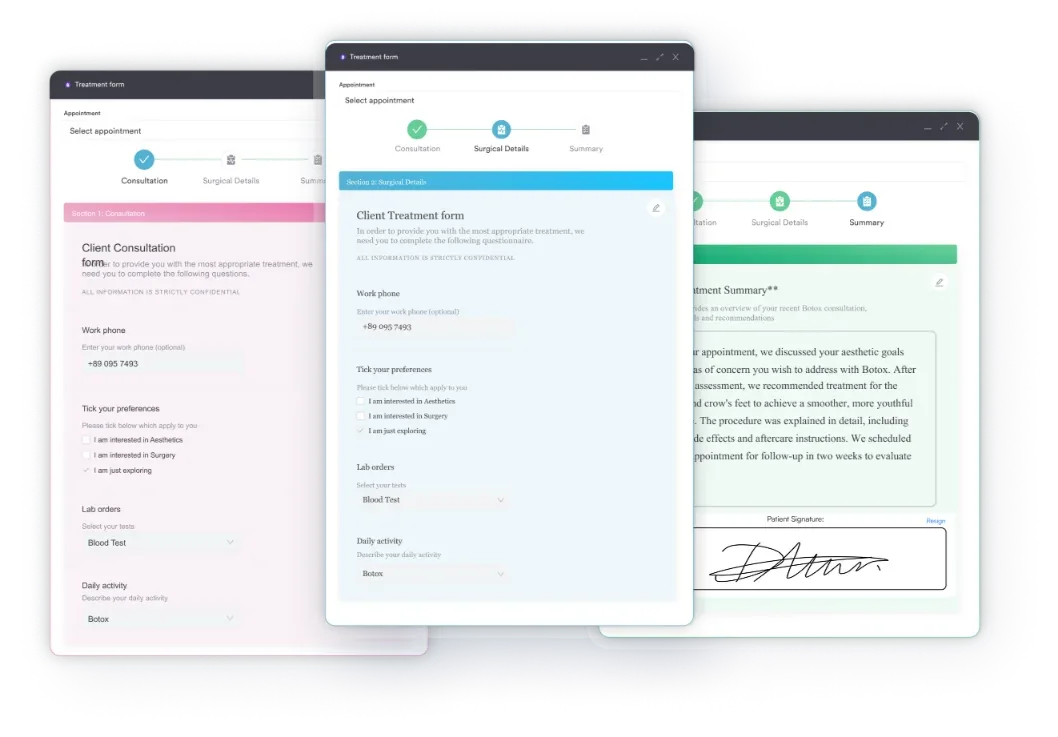
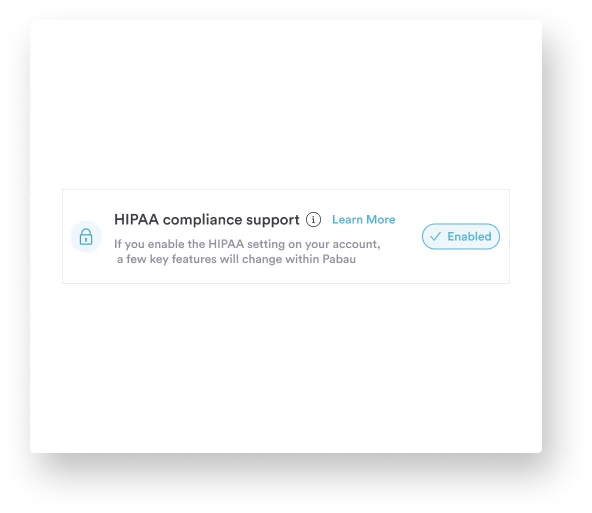
The paper log stays your cold-storage record. Practice management software like Pabau holds the rest of the file, with inspection-ready compliance management built in. Treatment notes are time-stamped, every action lands in a full audit trail, and role-based permissions control what each team member can see.
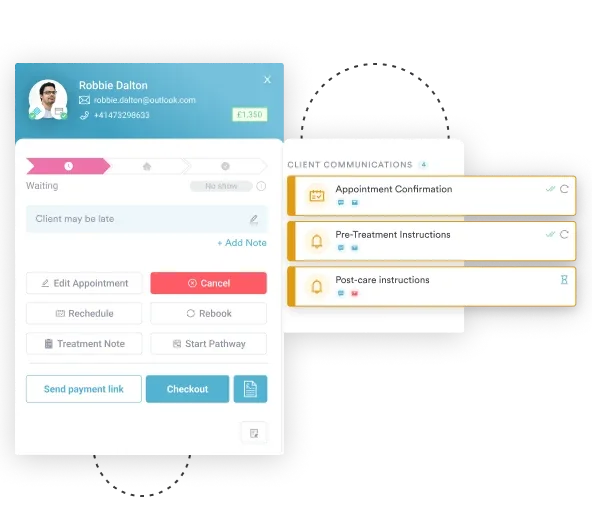
Aftercare instructions go out automatically, with a record that each one was sent and received. When the inspector arrives, you pull that evidence from one system instead of chasing paper around the practice.

See how Pabau’s digital forms, audit trails and staff permissions keep your compliance evidence organized and ready for inspection.

Start the log today, even if you only store a handful of vials. Each check takes a couple of minutes. When medicines are stored on site, the log is one of the first records an inspector asks to see.
Paper works well while you run one or two fridges. Once you add units or locations, pair the log with a digital data logger, so a weekend failure doesn’t wait until Monday to be found.
Book a demo to see how Pabau keeps your consent forms, treatment notes and audit trails ready for the same inspection.

Preparing for a visit from the regulator? CQC inspection: how to prepare covers what inspectors check and what happens on the day.
Not sure what CQC expects from your practice? CQC requirements every provider must prove sets out the evidence regulators ask for.
Still setting up your practice? How to get CQC registered walks through the registration process step by step.
How long should completed logs be kept? How long to keep medical records breaks down retention rules by state.
Want to audit your own documentation? Medical chart audit guide shows how to review records before an inspector does.
A medical fridge storing medications and vaccines should be kept at 2°C to 8°C (36°F to 46°F). This range maintains vaccine and medication potency. Most practices aim for the middle of the range, around 5°C. Freezers for freeze-stable vaccines should hold −15°C to −25°C (5°F to −13°F). Ultra-low freezers for the original Pfizer COVID-19 vaccine run at −80°C to −60°C.
VFC providers and CQC-registered practices should record fridge and freezer temperatures twice daily. That means once in the morning and once at the end of the working day. Some high-risk settings, such as vaccine clinics during busy immunization campaigns, log more often. Most practices keep the two checks roughly 12 hours apart.
A min/max thermometer records the lowest and highest temperatures reached since the last reset, covering the whole 12-hour window. A standard fridge log records only the temperature at the moment of the check. Most clinical fridge logs need both. The min/max range shows stability over time, while the current reading confirms the fridge is working right now.
If a fridge drifts outside 2°C to 8°C, stop using it and move affected medications and vaccines to a backup fridge. Ask your vaccine supplier or pharmacy wholesaler whether the stock can still be used or must be discarded. Record the incident, timeframe, suspected cause and corrective action in your fridge temperature log. VFC providers must also report the excursion to their state immunization program.
Yes. CQC expects practices to show they monitor and record temperatures for any refrigerated medications or vaccines. A completed fridge temperature log is the main evidence inspectors review. A practice without one can expect a finding at inspection.