Physician credentialing checklist
A physician credentialing checklist lists every license, certificate, verificati...

Last Updated: Oct 23, 2026

EMT patient assessment follows a standardized sequence: scene size-up, primary assessment (ABCs), secondary assessment, SAMPLE history, OPQRST pain assessment, and ongoing reassessment.
The AVPU scale (Alert, Verbal, Pain, Unresponsive) rapidly determines patient consciousness and guides treatment urgency in the field.
SAMPLE history (Signs/Symptoms, Allergies, Medications, Pertinent past history, Last oral intake, Events) and OPQRST pain assessment (Onset, Provocation, Quality, Radiation, Severity, Time) are critical for medical decision-making.
Structured documentation using digital intake forms ensures accurate field data and streamlined ePCR entry.
A comprehensive patient assessment template for emergency medical technicians covering scene size-up, primary and secondary assessment steps, vital signs documentation, and ongoing reassessment protocols aligned with NREMT standards.
Download templateEMT patient assessment is the systematic sequence every emergency medical technician runs on scene: size up the scene, find and treat immediate life threats, gather a focused history, examine the patient, and reassess en route to the hospital. Get the order right and a deteriorating patient is caught early. Miss a step and a treatable problem goes unnoticed.
This guide walks through all five patient assessment steps and the mnemonics that drive them (AVPU, SAMPLE, OPQRST, and DCAP-BTLS), separates the medical and trauma pathways, and shows how to carry field findings cleanly into your ePCR so nothing is lost at handoff.
An EMT patient assessment template is a structured form that guides emergency medical technicians through the systematic evaluation of a patient in the field. It captures clinical findings, vital signs, mechanism of injury or nature of illness, and patient history using standardized mnemonics and sequences aligned with NREMT skill sheet protocols.
The template ensures consistency across crews and shifts, reduces cognitive load during emergencies, and creates a documented record that supports handoff to hospital staff and ePCR entry. It serves dual purposes: training certification and field reference.
The template follows the five-step assessment sequence that NREMT practical exams evaluate:
Complete each section in order. Use the template as both a checklist during assessment and a field documentation aid before digital note entry with practice management software like Pabau at the station.
The template is designed for emergency medical technicians and AEMT students preparing for NREMT practical certification, field-based EMS crews. It also serves first-response teams at sporting events, correctional facilities.
Occupational therapists often score assessments like this directly inside occupational therapy software, keeping results attached to the treatment plan.
Certification alignment: NREMT examiners expect the exact sequence and verbalization the template models. Using it during training conditions students to pass practical exams.
Reduced decision fatigue: Structured protocols remove the “what do I check next?” burden, freeing cognitive capacity for clinical findings and communication.
Continuity of care: Consistent documentation means hospital staff receive a complete. Missing findings stand out immediately, so hospital ED teams know exactly what was assessed and when.
Legal protection: A documented assessment sequence protects providers. It shows standard of care was followed and findings were recorded contemporaneously, not guessed later.
Scene safety is non-negotiable. NREMT practical exams explicitly mark down providers who assess patients in unsafe scenes. Look for hazards: downed power lines, hazardous materials, violence indicators, unstable structures. If the scene is unsafe, do not enter — stage and request law enforcement or fire as needed.
Mechanism of injury (MOI) or nature of illness (NOI) guides the entire secondary assessment. A 45-year-old clutching the chest with shortness of breath signals medical assessment focus. A 45-year-old thrown from a motorcycle signals trauma assessment priority instead. The template flags MOI/NOI determination as the gate decision.
Primary assessment (ABCs) takes 60 seconds. Open the airway if needed, ensure breathing adequacy, check for severe bleeding. Only once immediate life threats are identified and treated does secondary assessment begin.
The MOI/NOI call you make during scene size-up forks the secondary assessment into two pathways. Getting the fork right decides what you examine first and which mnemonic leads.
EMT medical assessment is history-led. For a responsive medical patient, gather the SAMPLE history first, characterize the chief complaint with OPQRST, then run a focused exam of the affected body system. The patient’s story usually points to the problem before your hands do.
Trauma assessment is exam-led. A significant mechanism triggers a rapid head-to-toe survey using DCAP-BTLS at each region: deformities, contusions, abrasions, punctures or penetrations, burns, tenderness, lacerations, and swelling. Gather the SAMPLE history once life threats are controlled.
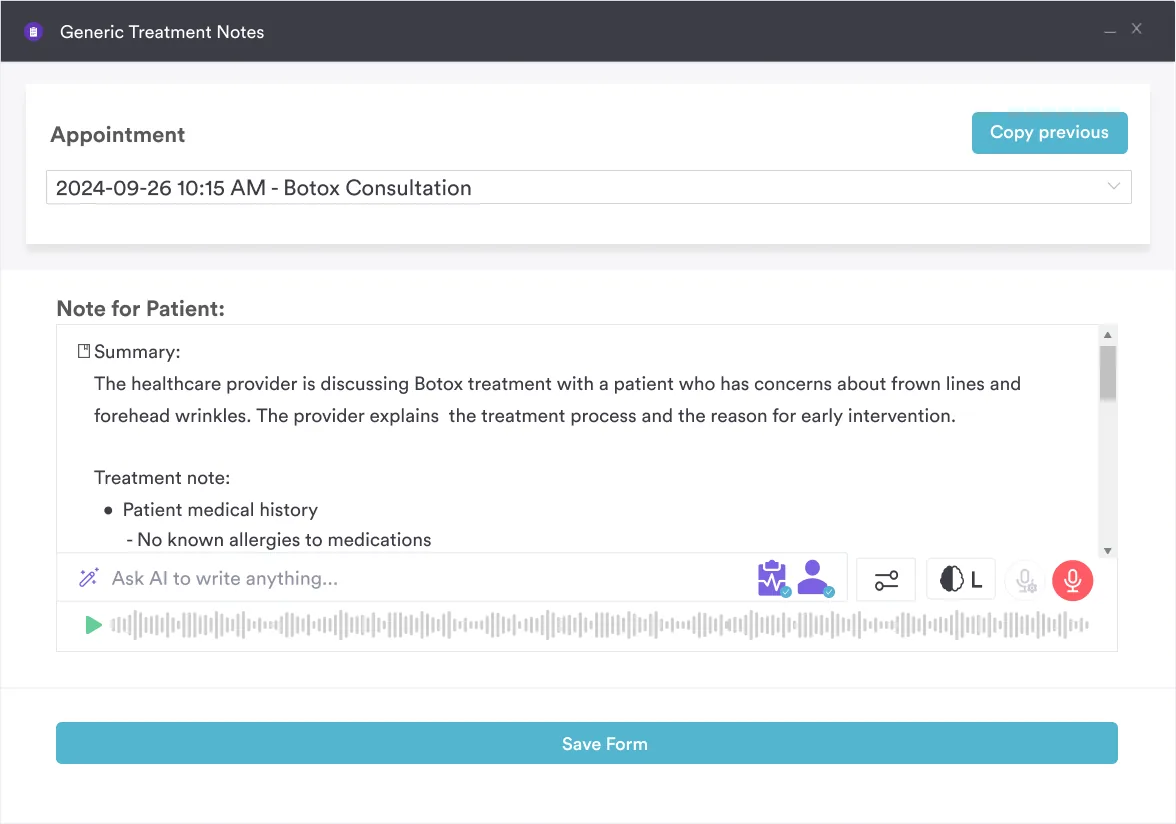
Paper templates are field-friendly but face transcription delays. Many EMS services now use tablet-based digital forms that auto-populate SAMPLE and OPQRST fields, reducing keystroke burden and improving data accuracy.
The template structure (scene size-up → primary → secondary → pain → reassessment) maps directly to ePCR sections. Field-captured data flows directly into the patient record, and some services also adopt a SOAP note format for narrative sections to keep pre-hospital and hospital documentation consistent.
Document vital signs every 5-15 minutes depending on acuity. Note any change in level of consciousness or respiratory effort. When you document a reassessment finding that differs from the primary assessment, hospital staff can see that disease progression occurred on your watch — invaluable for ED triage and treatment decisions.
Handoff continues inside the receiving unit on its own structured form. Nurses taking a neonatal patient, for example, carry findings forward on a NICU report sheet at each shift change.
Ensure HIPAA compliance in any digital documentation system. Patient assessment data is protected health information, so systems must enforce access controls and audit logs. Where a service shares records with a third party, keep a signed HIPAA authorization form on file.
Verbalize your assessment findings aloud to your partner as you perform each step. This habit, drilled during NREMT practicals, ensures nothing is overlooked and creates a second check on your findings. Partner communication also signals to the patient that a systematic, professional assessment is underway.
EMT patient assessment is the clinical foundation of pre-hospital care. Rush it and errors start to compound: a missed airway, an unrecognized shock state, or a misinterpreted vital sign can cascade into poor outcomes. Structured templates reduce error and ensure every patient receives the same systematic evaluation.
Book a demo with Pabau today to see how EMS teams can move from paper assessment sheets to integrated digital documentation that supports certification, improves continuity of care, and reduces handoff delays.

Need a note for work or school? urgent care doctors note template verifies medical treatment for employers and schools with customizable sections for diagnosis and restrictions.
Need to train crews on assessment mnemonics? Structured medical forms at your healthcare practice shows how templates enforce consistent data capture.
Need aftercare guidance for a procedure? wisdom teeth removal aftercare template covers wound care, diet, medication, and complication warning signs for dental practices.
EMT patient assessment follows five sequential steps: (1) Scene Size-Up (ensure safety, identify MOI/NOI, count patients, request resources), (2) Primary Assessment (check ABCs, determine level of consciousness with AVPU), (3) Secondary Assessment (focused exam and SAMPLE history), (4) Pain Assessment (OPQRST characterization), and (5) Ongoing Reassessment (repeat primary every few minutes and document changes).
SAMPLE stands for Signs/Symptoms (what you observe and patient reports), Allergies (medication and environmental), Medications (current use), Pertinent past history (relevant prior illnesses or injuries), Last oral intake (food, drink, timing), and Events leading to (circumstances of injury or illness onset).
OPQRST is a pain characterization tool: Onset (when pain started), Provocation (what triggers or worsens it), Quality (sharp, dull, burning, pressure), Radiation (where pain spreads), Severity (1-10 scale), and Time (duration, constant or intermittent). It systematically gathers pain details that guide treatment and communicate findings to receiving staff.
Reassessment should occur every 5-15 minutes depending on patient acuity. Unstable patients are reassessed frequently (every 5 minutes or sooner); stable patients can be reassessed less frequently. Document level of consciousness, breathing effort, circulation, and any change in condition with each reassessment.
AVPU is a rapid level of consciousness assessment: Alert (patient is awake and oriented), Verbal (patient responds to verbal stimuli), Pain (patient responds only to pain stimuli), and Unresponsive (patient does not respond to any stimulus). It is faster than the Glasgow Coma Scale and used during primary assessment to determine urgency and guide treatment.
Document all assessment findings in the patient care report (ePCR): scene information, vital signs, physical exam results, SAMPLE history, OPQRST pain details, treatments given, patient response, level of consciousness at each reassessment, and transport decision. Use a structured template to ensure nothing is omitted and findings are recorded contemporaneously.
The difference is which pathway the secondary assessment follows. A medical assessment is history-led: gather the SAMPLE history and characterize the complaint with OPQRST, then examine the affected system. A trauma assessment is exam-led: a significant mechanism of injury triggers a rapid head-to-toe survey using DCAP-BTLS, and SAMPLE is gathered once life threats are controlled. The MOI/NOI call at scene size-up decides which pathway you take.
DCAP-BTLS is the trauma exam mnemonic EMTs use to inspect and palpate each body region: Deformities, Contusions, Abrasions, Punctures/penetrations, Burns, Tenderness, Lacerations, and Swelling. It standardizes the rapid head-to-toe survey so no injury is overlooked.